Showing posts with label Ted Kennedy. Show all posts

Friday, August 16, 2019

Donovan – "Atlantis" (1969)


Way down below the ocean
Where I wanna be
She may be

After visiting Chappaquiddick Island and retracing the route taken by Ted Kennedy the night he drove off the Dike Bridge – killing Mary Jo Kopechne – I did quite a bit of reading about what happened that night.

I also watched the 2017 movie, Chappaquiddick, which purports to tell the true story of what happened that night:


Opinion about the Chappaquiddick movie is divided along political lines.  Those who believe Kennedy and his allies used their power and influence to preserve Kennedy’s political future by covering up what happened that night applauded the movie’s damning depiction of Teddy as callow, dishonest, and cowardly.  Defenders of Kennedy have criticized it as fake history.

As a work of art, Chappaquiddick is unimpressive – it suffers from a very weak script and unconvincing acting.  

And as a work of history, the movie relies too heavily on conjecture.  But it deserves credit for pointing out some key truths about what happened that night.

*     *     *     *     *

The movie puts great emphasis on the fact that Kennedy waited until the following morning to report the accident to police.  (By the time he went to the police, a fisherman and his son has discovered the submerged car and called authorities, who discovered Mary Jo Kopechne’s lifeless body.)

Kennedy said he failed to call the police immediately because he was in shock, having supposedly suffered a concussion in the accident.  


Many believe the real reason he put off calling the authorities was that he was trying to concoct a story absolving himself of blame for the accident – perhaps he thought about claiming that Kopechne or someone else had been driving the car.

But whatever the real reason for Kennedy’s delay in coming clean, did it ultimately matter?  After all, it would have taken him some time to make his way on foot from the bridge to a house with a phone.  And once he called the police, it would have taken more time for rescuers to get to the scene of the accident.  Surely Kopechne – trapped in the submerged car – would have died long before then.

*     *     *     *     *

But what if Mary Jo Kopechne didn’t drown?  

John Farrar, the captain of the Edgartown Fire Rescue unit and the diver who recovered Kopechne's body, believed that she suffocated instead.  


At the inquest into her death, Farrar testified that Kopechne's body was pressed up in the back seat of the car in the spot where an air bubble would have formed:

It looked as if she were holding herself up to get a last breath of air.  It was a consciously assumed position . . . . She didn't drown.  She died of suffocation in her own air void.  It took her at least three or four hours to die.  I could have had her out of that car twenty-five minutes after I got the call.  But [Kennedy] didn't call.

(In a 1989 interview, Farrar said that Kopechne “lived at least two hours down there.”  That’s less than his original estimate of three to four hours, but it’s still much longer than the time it would have taken him to get her out of the car if Kennedy had reportedly the accident sooner.)
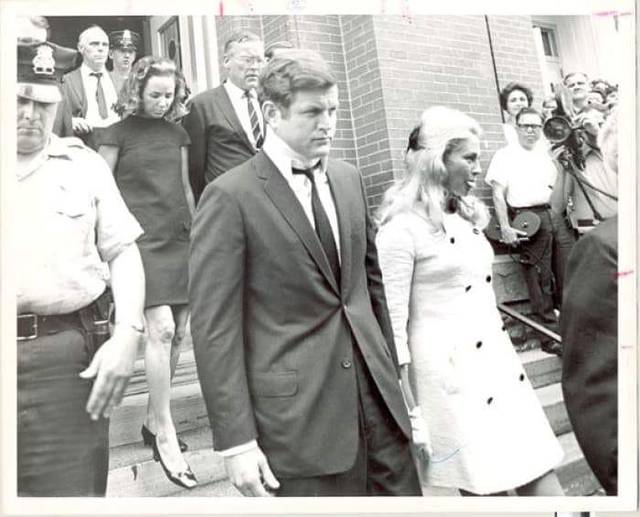
Ted Kennedy (in neck brace) and his wife Joan
leaving the funeral of Mary Jo Kopechne
The local medical examiner signed a death certificate that stated the cause of death was drowning and released Kopechne's body to her family without ordering an autopsy.  She was buried in Pennsylvania a few days later.

*     *     *     *     *

Ted Kennedy’s wife Joan was pregnant and confined to bed the night her husband drove Mary Jo Kopechne off the Dike Bridge.  (Joan had suffered two previous miscarriages and was trying – unsuccessfully, as it turned out – to avoid a third.)   

Joan Kennedy speaks only one line in the Chappaquiddick movie.  When Ted thanks her for agreeing to attend Mary Jo Kopechne’s funeral with him, she replies, “Go f*ck yourself, Teddy.” 

I don’t know if she really said that to her husband.   But if she did, the rat bast*rd richly deserved it. 

*     *     *     *     *

Donovan’s U.S. record company released “Atlantis” as a B-side.  After all, the song was five minutes long, and its first third features Donovan reading (not singing) a bunch of nonsense about the mythical lost continent.  


But it ended up becoming a top-ten hit.  (Go figure.) 

I’m featuring “Atlantis” today because it was used in one of the trailers for the Chappaquiddick movie.  That choice of musical accompaniment may be apt, but it’s of very questionable tastefulness.  After all, the song ends with Donovan singing “Glub glub, down down, my antediluvian baby.”

Click here to view that trailer.

Click here to listen to “Atlantis.”

And click below to buy the song from Amazon:

Tuesday, August 13, 2019

Poison Girls – "Underbitch" (1980)


Wonder which way up it goes?
Wonder which way water flows?
Wonder which way you must go?

In the previous 2 or 3 lines, I quoted the statement that Ted Kennedy gave to police the morning after he drove off a bridge on Chappaquiddick Island, MA, causing the death of Mary Jo Kopechne.

In case you missed it, here it is again:

On July 18, 1969, at approximately 11:15 PM in Chappaquiddick, Martha's Vineyard, Massachusetts, I was driving my car on [Chappaquiddick Road] on my way to get the ferry back to Edgartown.  

I was unfamiliar with the road and turned right onto Dike Road, instead of bearing hard left on Chappaquiddick Road].  After proceeding for approximately one-half mile on Dike Road I descended a hill and came upon a narrow bridge.  The car went off the side of the bridge.  

The Dike Bridge in 1969
There was one passenger with me, one Miss Mary [Jo Kopechne], a former secretary of my brother Sen. Robert Kennedy.  The car turned over and sank into the water and landed with the roof resting on the bottom.  I attempted to open the door and the window of the car but have no recollection of how I got out of the car.  I came to the surface and then repeatedly dove down to the car in an attempt to see if the passenger was still in the car.  I was unsuccessful in the attempt.  

The rebuilt Dike Bridge has guardrails
I was exhausted and in a state of shock.  I recall walking back to where my friends were eating.  There was a car parked in front of the cottage and I climbed into the backseat.  I then asked for someone to bring me back to Edgartown.  I remember walking around for a period and then going back to my hotel room.  When I fully realized what had happened this morning, I immediately contacted the police.   

Kennedy’s statement is so full of sh*t that its eyes are brown.  (I know, I know – police statements don’t have eyes.  I’m exercising a little poetic license.)

*     *     *     *     *

I went to Chappaquiddick for the first time last month.  I took the ferry that connects Edgartown and Chappaquiddick, rode my bike the length of Chappaquiddick and Dike Roads, and visited the Dike Bridge – which a group of boys were using as a diving platform:


Kennedy’s explanation of how he ended up driving off that bridge is really, really hard to swallow.  It’s possible that someone with a very poor sense of direction could have gotten confused and turned east toward Dike Bridge rather than turning west toward the Chappaquiddick ferry dock.  But the road that goes to the ferry is paved while the road that goes to Dike Bridge isn’t.  


Kennedy had driven from the ferry to the cottage where the party that he and Kopechne attended took place earlier that day – a trip that was entirely on paved roads – and you would think that he would have noticed that he was on an unpaved road and realized that something was wrong.  Dike Road is a very sandy road, and there’s no way someone driving an automobile wouldn’t realize he was on an unpaved road long before getting to the Dike Bridge.

Unless that driver was drunk.  Kennedy reportedly drank some beer during a sailing race earlier that day, toasted the winner of the race by downing three rum-and-Cokes, and had still more beer with friends at his Edgartown hotel before taking the ferry to Chappaquiddick for the party – where he had two or three more rum-and-Cokes – so he very well may have been impaired.  (Kennedy’s blood alcohol level was never tested.)

It’s also possible that he was simply lying about the wrong turn being a mistake that resulting from his unfamiliarity with the route to the ferry dock.  The Massachusetts judge who conducted the inquest into Kopechne’s death found that Kennedy did not intend to drive to the ferry, and that his turn on to Dike Road had been intentional.

*     *     *     *     *

It’s an understatement to say that Kennedy’s behavior after the accident was suspicious.

He testified at the inquest that after trying to rescue Kopechne, he rested for 15 minutes and then walked a mile and a half or so back to the cottage where the party took place.  He and two of his friends then went back to the bridge and tried once more to rescue Kopechne.  When they were unsuccessful, they drove Kennedy to the ferry dock.


The friends urged Kennedy to report the accident to the authorities, and he assured them he would.  But when they left to drive back to the cottage, Kennedy didn’t pick up the pay phone on the ferry dock and call the police.  He instead dove into the water and swam across the 527-foot channel that separates Chappaquiddick from Edgartown.  (The public ferry had stopped operating at midnight.)  

When Kennedy reached his hotel, he changed clothes and rested on his bed.  At about 3:00 AM, he went downstairs to complain to the hotel owner that he had been awakened by a noisy party in another room.  

When his two friends came to the hotel at 8:00 AM, they learned that he had not yet reported the accident to the police.  The three men took the ferry back to Chappaquiddick, and Kennedy used the pay phone on the ferry dock to call several friends and attorneys for advice.  

That’s when the fisherman and his son saw the submerged Oldsmobile and called the authorities, who extricated Kopechne’s body from the car and then towed it out of the pond.  


When Kennedy learned that his car and Kopechne’s body had been recovered, he hung up the phone, took the ferry back to Edgartown and walked to the police station – where he made a few more calls before giving a statement to the police.

*     *     *     *     *

Kennedy certainly should have called the police as soon as possible after the accident, but it doesn’t seem that his failure to do so could have made a difference.  After all, it would have taken him some time to make his way on foot from the bridge to a house with a phone.  And once he called the police, it would have taken some time for rescuers to get to the scene of the accident.  Surely Kopechne would have long since drowned by that time – right?

Wrong.  I’ll explain why in the next 2 or 3 lines.

*     *     *     *     *

Today’s featured song was released in 1980 on Chappaquiddick Bridge – the debut album of the UK anarcho-punk band, the Poison Girls.


The driving force behind the Poison Girls was the group’s singer and guitarist, the late Vi Subversa (née Frances Sokolov), who was 45 and the mother of two teenagers when Chappaquiddick Bridge – which has been described as “a phenomenally weird and surreal piece of work” – was released.  

Click here to listen to “Underbitch.”


And click on the link below to buy the song from Amazon:

Friday, August 9, 2019

Bill Anderson – "Ninety-Nine" (1959)


I had a nice little ride on a ferry boat
To the rock where the prison stands

I’ve been vacationing on Cape Cod since the seventies, but I only started taking day trips to Martha’s Vineyard – which is just a short ferry ride from the Cape Cod village of Woods Hole – a few years ago.  

The island has an extensive network of bike trails.  I make sure to ride the most scenic of those trails – the one that goes from Oak Bluffs (where most Martha’s Vineyard ferries dock) along the edge of Nantucket Sound to Edgartown – every year.

The Edgartown Harbor lighthouse
When I arrive in Edgartown, I first spend some time watching the boat traffic in Edgartown Harbor.  Then I have lunch, visit the Black Dog Kids store to buy some togs for my grandsons, and hit the island’s two breweries.

*     *     *     *     *

This year, I decided to take the shortest ferry ride in the United States and visit Chappaquiddick Island for the first time.

The two privately-owned ferries that carry cars, bikes, and people from the Martha’s Vineyard town of Edgartown to Chappaquiddick Island and back again traverse a distance of only 527 feet – one tenth of a mile less one foot.  The journey takes less than one minute to complete:


Chappaquiddick is small – it covers only about six square miles (that’s roughly 3800 acres) and has a population of fewer than 200 souls.

There’s not a lot for tourists to see or do on the island.  There is one store, a community center,  a fire station, and a snooty beach club.

The snooty young lady guarding the entrance to that snooty beach club snootily told me I couldn’t take this photo of that entrance:


And there’s the Dike Bridge across Poucha Pond – the site of perhaps the most famous one-car accident in history, which took place just over 50 years ago.

*     *     *     *     *

On July 18, 1969, Senator Ted Kennedy hosted a party at a friend’s summer cottage on Chappaquiddick Island for six women who had worked together in his brother Robert’s 1968 presidential campaign.  

The women were all single and in their twenties.  The six men who were at the party were all older, and five of them – including Kennedy, whose wife was pregnant and confined to bed at the time – were married.  (Just sayin’.)

Ted Kennedy
Kennedy decided to leave the party about 11:00 PM – supposedly to return to his hotel in Edgartown.   

One of the women at the party left with him – supposedly to return to her Edgartown hotel.  (Given that she left her purse and room key at the party, that seems doubtful.)

The next morning, a fisherman and his son saw Kennedy’s car submerged in a Chappaquiddick pond.  When the authorities arrived at the scene, they discovered the dead body of Kennedy’s passenger – Mary Jo Kopechne – trapped in it.

*     *     *     *     *

At that moment, Ted Kennedy was using a pay phone at the Chappaquiddick ferry dock to call various people for advice.  When he heard that Kopechne’s body had been recovered, he took the ferry back to Edgartown, went to the police station, and dictated this statement:

On July 18, 1969, at approximately 11:15 PM in Chappaquiddick, Martha's Vineyard, Massachusetts, I was driving my car on [Chappaquiddick Road] on my way to get the ferry back to Edgartown.  

I was unfamiliar with the road and turned right onto Dike Road, instead of bearing hard left on Chappaquiddick Road].  After proceeding for approximately one-half mile on Dike Road I descended a hill and came upon a narrow bridge.  The car went off the side of the bridge.  

The Dike Bridge in 1969
There was one passenger with me, one Miss Mary [Jo Kopechne], a former secretary of my brother Sen. Robert Kennedy.  The car turned over and sank into the water and landed with the roof resting on the bottom.  I attempted to open the door and the window of the car but have no recollection of how I got out of the car.  I came to the surface and then repeatedly dove down to the car in an attempt to see if the passenger was still in the car.  I was unsuccessful in the attempt.  

I was exhausted and in a state of shock.  I recall walking back to where my friends were eating.  There was a car parked in front of the cottage and I climbed into the backseat.  I then asked for someone to bring me back to Edgartown.  I remember walking around for a period and then going back to my hotel room.  When I fully realized what had happened this morning, I immediately contacted the police.   

On my recent trip to Chappaquiddick, I retraced the Kennedy’s route on my bicycle.  Since then, I’ve done quite a bit of reading about Chappaquiddick.  I’ll tell you what conclusions I drew about Kennedy’s story in the next 2 or 3 lines.

*     *     *     *     *

The title of today’s featured song – which was a 1959 hit for country singer “Whisperin’ Bill” Anderson – refers to the 99-year prison sentence that has been handed down to the song’s protagonist.


The song doesn’t mention Alcatraz by name, but it’s clear that he’s going to serve his time on “The Rock,” the forbidding island penitentiary in San Francisco Bay.

Seven days after Mary Jo Kopechne’s death, Ted Kennedy pled guilty to one count of leaving the scene of an accident that resulted in bodily injury.  He was sentenced to two months’ incarceration, which was the minimum sentence for that offense – but the sentence was suspended, and the rat bast*rd never spent a minute in jail.

Click here to listen to “Ninety-Nine.”

Click on the link below to buy the song from Amazon: