Showing posts with label Donovan. Show all posts

Saturday, April 22, 2023

Donovan – "Operating Manual for Spaceship Earth" (1973)


Don’t pour filth into the air

Air is the best thing that we can breathe


Today’s featured song was released in 1973 on Donovan’s 11th studio album, Essence to Essence, which was produced by Andrew Loog Oldham.  (Oldham is better known as the manager and producer of the Rolling Stones from 1963 until 1967.)


I wasn’t familiar with a single song on Essence to Essence until today, when I heard “Operating Manual for Spaceship Earth” for the very first time.


Essence to Essence failed to chart in the UK and peaked at #174 on the U.S. album charts.


*     *     *     *     *


The inspiration for “Operating Manual for Spaceship Earth” was a similarly-titled 1969 book by the famed architect and futurist, R. Buckminster Fuller:
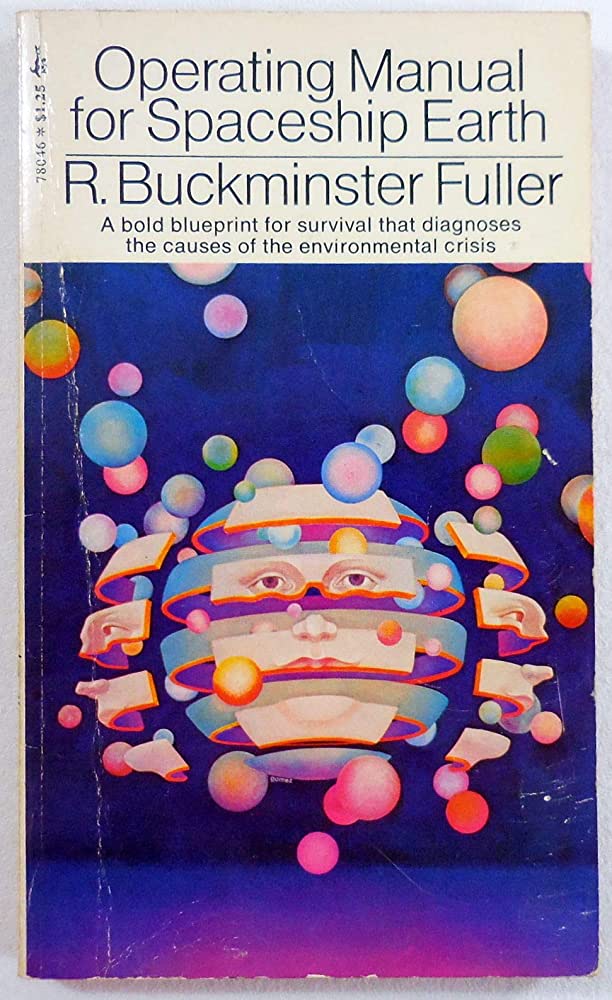

Fuller envisions Earth as a spaceship flying through space.  As such, it requires regular maintenance in order to keep functioning.


Engine oil needs to be filtered to do its job properly – if it gets dirty enough, the engine will stop working.  Likewise, the Earth’s atmosphere and oceans will be unable to sustain life if air and water pollution get out of control.


Fuller’s main concern about fossil fuels doesn’t appear to have been about global warming – he was more worried about us running out of energy.


So he encouraged specifically the Sun's radiation and Moon's gravity via wind, solar, and water tools. Fuller stated that humans must wean themselves from their dependence on fossil fuels, and instead rely on the energy generated by the Sun’s radiation and the Moon’s gravitational pull.


*     *     *     *     *


 Donovan’s song is kind of a dumbed-down version of Fuller’s book.  To wit:


Don't pour filth into rivers

Rivers are like the blood in our veins

Don't pour filth into the air

Air is the best thing that we can breathe


Here’s another verse:


Do be kind to your vegetable friends

You are the gardener of Earth garden

Do be kind to your animal friends

You are the keeper of Earth zoo


Let’s face it – these lyrics aren’t anything that the average high-school sophomore couldn’t have written.  


The Essence to Essence album cover

But let’s not be hypercritical.  Today’s featured record is a perfectly pleasant little ditty that is perfectly appropriate for Earth Day (which was first observed on this date in 1970).


*     *     *     *     *


Click here to listen to “Operating Manual for Spaceship Earth.”


Friday, July 15, 2022

Donovan – "Hurdy-Gurdy Man" (1968)


Here comes the roly-poly man

He’s singing songs of love


A hurdy-gurdy is a portable musical instrument that’s been played by itinerant musicians in Europe for centuries.  


In today’s featured song, a hurry-gurdy player “comes singing songs of love” – which is exactly what you might expect a street musician who’s hoping to get tips from passers-by to do.


There’s another character in today’s featured song – the “roly-poly man” (who’s mentioned only in passing).


“Roly-poly” is a term that’s used to describe a chubby, pudgy person.  But I don’t think Donovan is singing about some rotund guy who needs to lose weight.


A jam roly-poly

A jam roly-poly is a traditional British dessert, and I’m guessing that the “roly-poly man” in Donovan’s song is a vendor who’s walking the streets of London selling roly-polys.  He’s presumably singing songs in order to attract the attention of potential customers.


*     *     *     *     *


I was surprised to learn that “Hurdy Gurdy Man” made it all the way to #5 on the Billboard “Hot 100” in the summer of 1968 . . . which means that it meets the criteria for the 2 OR 3 LINES “GOLDEN DECADE” HIT SINGLES HALL OF FAME.


Donovan Leitch wrote the song when he was in India, studying transcendental meditation with the Beatles.  The four-string tambura that Donovan plays on “Hurdy Gurdy Man” was given to him by George Harrison, who also wrote this verse for the song:


When the truth gets buried deep

Beneath the thousand years asleep

Time demands a turnaround

And once again the truth is found


Donovan often sings that verse when he performs the song live, but it’s not on the studio recording of the song.  That’s because the producer told Donovan that he needed to cut either Harrison’s verse or the guitar solo to keep the record’s length reasonably close to three minutes.  


George Harrison, Donovan, and John Lennon

Donovan chose to keep the guitar solo and throw Harrison’s verse under the bus.


*     *     *     *     *


Speaking of that guitar solo, Donovan had hoped that Jimi Hendrix could play guitar on “Hurdy-Gurdy Man,” but Jimi wasn’t available when the song was being recorded.  (Donovan had originally wanted to give the song to Hendrix to record, but legendary British record producer Mickie Most – who produced “House of the Rising Sun” and many other great records – insisted that Donovan record it himself.)  


Jimmy Page, who was then in the Yardbirds, has said that he played guitar on “Hurdy Gurdy Man.”  Donovan has credited both Page and Allan Holdsworth – a very idiosyncratic guitar virtuoso – but John Paul Jones (who played bass and booked the studio musicians for the “Hurdy Gurdy Man’ recording session) said that well-known session guitarist Alan Parker was the guitarist on the record.  (Jeff Beck apparently played on one take of the song, but that take wasn’t ultimately used.)


The drummer was either John Bonham, or studio musician Clem Cattini, or both.


Donovan, George Harrison, Jimi Hendrix, Jeff Beck, and three of the four future members of Led Zeppelin – that’s a pretty amazing list of musicians for just one record.  


*     *     *     *     *


Here are a few random facts about “Hurdy Gurdy Man”:


– The Beastie Boys sampled the record on “Car Thief,” one of the tracks on their 1989 album, Paul’s Boutique.  Beastie Boy Adam Horovitz later married Donovan’s daughter, actress Ione Skye – who’s most famous role was as John Cusack’s love interest in Say Anything:


John Cusack and Ione Skye

– The soundtrack of the very creepy 2007 David Fincher mystery film, Zodiac, opens and closes with “Hurdy Gurdy Man.”  (Ione Skye had a small role in that movie.)


– The soundtrack of the very stupid 1994 “comedy” Dumb and Dumber includes a cover version of the song by the Butthole Surfers, whose frontman Gibby Haynes played college basketball at Trinity University in San Antonio at the same time my sister was playing for Trinity’s women’s team.  Click here to listen to that Butthole Surfers’ cover.


*     *     *     *     *


Click here to listen to “Hurdy Gurdy Man.”


Click below to buy the record from Amazon:


Friday, August 16, 2019

Donovan – "Atlantis" (1969)


Way down below the ocean
Where I wanna be
She may be

After visiting Chappaquiddick Island and retracing the route taken by Ted Kennedy the night he drove off the Dike Bridge – killing Mary Jo Kopechne – I did quite a bit of reading about what happened that night.

I also watched the 2017 movie, Chappaquiddick, which purports to tell the true story of what happened that night:


Opinion about the Chappaquiddick movie is divided along political lines.  Those who believe Kennedy and his allies used their power and influence to preserve Kennedy’s political future by covering up what happened that night applauded the movie’s damning depiction of Teddy as callow, dishonest, and cowardly.  Defenders of Kennedy have criticized it as fake history.

As a work of art, Chappaquiddick is unimpressive – it suffers from a very weak script and unconvincing acting.  

And as a work of history, the movie relies too heavily on conjecture.  But it deserves credit for pointing out some key truths about what happened that night.

*     *     *     *     *

The movie puts great emphasis on the fact that Kennedy waited until the following morning to report the accident to police.  (By the time he went to the police, a fisherman and his son has discovered the submerged car and called authorities, who discovered Mary Jo Kopechne’s lifeless body.)

Kennedy said he failed to call the police immediately because he was in shock, having supposedly suffered a concussion in the accident.  


Many believe the real reason he put off calling the authorities was that he was trying to concoct a story absolving himself of blame for the accident – perhaps he thought about claiming that Kopechne or someone else had been driving the car.

But whatever the real reason for Kennedy’s delay in coming clean, did it ultimately matter?  After all, it would have taken him some time to make his way on foot from the bridge to a house with a phone.  And once he called the police, it would have taken more time for rescuers to get to the scene of the accident.  Surely Kopechne – trapped in the submerged car – would have died long before then.

*     *     *     *     *

But what if Mary Jo Kopechne didn’t drown?  

John Farrar, the captain of the Edgartown Fire Rescue unit and the diver who recovered Kopechne's body, believed that she suffocated instead.  


At the inquest into her death, Farrar testified that Kopechne's body was pressed up in the back seat of the car in the spot where an air bubble would have formed:

It looked as if she were holding herself up to get a last breath of air.  It was a consciously assumed position . . . . She didn't drown.  She died of suffocation in her own air void.  It took her at least three or four hours to die.  I could have had her out of that car twenty-five minutes after I got the call.  But [Kennedy] didn't call.

(In a 1989 interview, Farrar said that Kopechne “lived at least two hours down there.”  That’s less than his original estimate of three to four hours, but it’s still much longer than the time it would have taken him to get her out of the car if Kennedy had reportedly the accident sooner.)

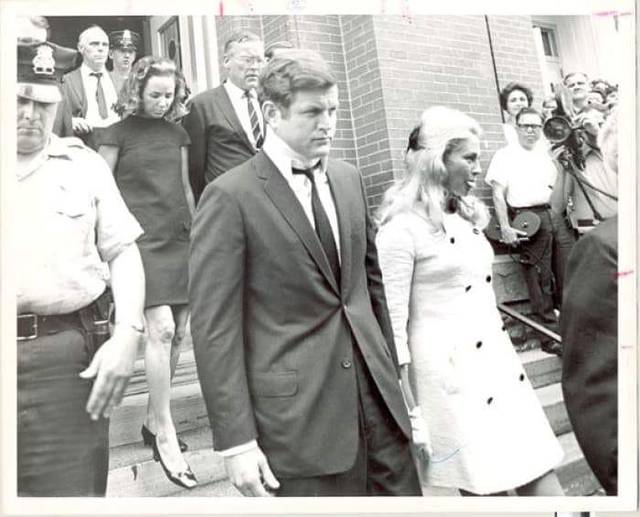
Ted Kennedy (in neck brace) and his wife Joan
leaving the funeral of Mary Jo Kopechne
The local medical examiner signed a death certificate that stated the cause of death was drowning and released Kopechne's body to her family without ordering an autopsy.  She was buried in Pennsylvania a few days later.

*     *     *     *     *

Ted Kennedy’s wife Joan was pregnant and confined to bed the night her husband drove Mary Jo Kopechne off the Dike Bridge.  (Joan had suffered two previous miscarriages and was trying – unsuccessfully, as it turned out – to avoid a third.)   

Joan Kennedy speaks only one line in the Chappaquiddick movie.  When Ted thanks her for agreeing to attend Mary Jo Kopechne’s funeral with him, she replies, “Go f*ck yourself, Teddy.” 

I don’t know if she really said that to her husband.   But if she did, the rat bast*rd richly deserved it. 

*     *     *     *     *

Donovan’s U.S. record company released “Atlantis” as a B-side.  After all, the song was five minutes long, and its first third features Donovan reading (not singing) a bunch of nonsense about the mythical lost continent.  


But it ended up becoming a top-ten hit.  (Go figure.) 

I’m featuring “Atlantis” today because it was used in one of the trailers for the Chappaquiddick movie.  That choice of musical accompaniment may be apt, but it’s of very questionable tastefulness.  After all, the song ends with Donovan singing “Glub glub, down down, my antediluvian baby.”

Click here to view that trailer.

Click here to listen to “Atlantis.”

And click below to buy the song from Amazon:

Thursday, February 23, 2017

Donovan – "Epistle to Dippy" (1967)


Look on yonder misty mountain
See the young monk m-e-d—
—itating rhododendron forest

“Epistle to Dippy” is a musical open letter to an old school friend of Donovan’s who was in the British Army in Malaysia at the time.  

One website says the song has “a strong pacifist message.”  (You could have fooled me.)  Another  website says that “Dippy” contacted Donovan when he heard the song, and Donovan bought his friend out of the army.  

I have no idea whether it was possible to buy someone out of UK military service in 1967.  (I am from Missouri, and you know what that means.)

Donovan
What I do know is that Donovan had to have been high when he wrote the lyrics to “Epistle to Dippy.”

There are a lot of sixties songs with lyrics that sound like the songwriter was high when he wrote them.  But Donovan stands out from the rest of the sixties crowd because EVERY Donovan songs sounds like he was high when he wrote it.  (And not just a little high.)

The song probably makes perfect sense to Dippy.  For the rest of the world, it's impenetrable.

The three verses of “Epistle to Dippy” share one odd little metrical trick: the second and third lines of all those verses break after the first syllable of a multisyllabic word.

In the lyrics quoted at the beginning of this post, Donovan holds the first syllable of “meditating” for several beats before completing that word.

The second line of the second verse ends with Donovan holding the first syllable of “suspicious”:

Doing us paperback reader
Made the teacher s-u-s—
—picious about insanity
Fingers always touching girl

And the second line of the third verse ends with the singer holding the first syllable of “speculating”:

Rebel against society
Such a tiny s-p-e-c—
—ulating whether to be hip or
Skip along quite merrily

The sleeve for the “Epistle to Dippy” 45
It’s a poetic technique I’ve never encountered before.  There’s probably a name for it, but I don’t know what that name is and I’m too busy to go looking for it.  (It’s February, which means I’m in the middle of “28 Songs in 28 Days,”which means I have no time to waste looking for needles in Internet rabbit holes.)

 I have no memory of hearing “Epistle to Dippy” on AM radio, and it doesn’t strike me as the kind of song that would get a lot of play on top-forty stations.

But “Epistle to Dippy” made it to #19 on the Billboard “Hot 100,” so I’m obviously full of sh*t.  (Like there was still any doubt about that.)

By the way . . . the lead guitarist on this record is Jimmy Page.  Before joining the Yardbirds, Page was an extremely busy session guitarist who played on Beatles, Rolling Stones, Kinks, and Who records, not to mention “As Tears Go By” (Marianne Faithful) and “Downtown” (Petula Clark).

Here’s “Epistle to Dippy”:


Click below to buy the song from Amazon:

Saturday, February 20, 2016

Donovan – "Atlantis" (1969)


Way down below the ocean 
Where I want to be 
She may be

I won’t lie to you, boys and girls.  I absolutely loved this song when it was released in 1969.

All of Donovan’s songs (with the possible exception of “Season of the Witch”) were hippy-dippy in the extreme, and “Atlantis” was the hippiest-dippiest of them all.  But I didn’t care – the song may have been a hot mess, but I loved it regardless.  

Donovan
“Atlantis” was released in the U.S. as the b-side of “To Susan on the West Coast, Waiting.”  It somehow became a top ten single.  

The first third of the five-minute-long song was a bunch of spoken-word nonsense about the lost continent of Atlantis.  (In case you've got a lot of time on your hands, you can click on this link to be taken to a website that discusses all the mistakes in "Atlantis.")

The last two-thirds of the song consisted of the lyrics quoted above being sung over and over – by my count, the chorus was repeated 14 times.


Like “Atlantis,” “Hey Jude” by the Beatles and “I’m Your Captain (Closer to Home)” by Grand Funk Railroad were very long songs that closed with choruses that were sung over and over.  I loved those songs, too.

“Atlantis” got a surprising amount of radio play back in the day.  When I was in high school, there were AM radio stations in Springfield, Missouri and Little Rock, Arkansas and other unlikely spots that I listened to that regularly played long songs like “Dazed and Confused” by Led Zeppelin, and “Midnight Rambler” by the Rolling Stones, and “Monster” by Steppenwolf.

“Atlantis” is featured in a scene in Goodfellas where Joe Pesci and Robert DeNiro beat the crap out of a gangster nicknamed Billy Batts, shoot him in the head, and then drive him way out into the country to bury him.  (I took my older son to see Goodfellas when he was barely seven years old, and I vividly remember the look of horror on his face during this scene.)


So have you figured out the theme of this year’s “29 Songs in 29 Days”?  No?  Geez Louise, it's as plain as the nose on your face.  (If it was a snake, it would have bit you.)

Here’s “Atlantis”:


Click below to buy the song from Amazon: 

Tuesday, October 27, 2015

Donovan – "There Is a Mountain" (1967)


First, there is a mountain
Then there is no mountain
Then there is

Do you think Donovan was confused when he wrote those lines?  Or maybe high?


Actually, he was neither.  He was simply paraphrasing something that the Buddhist scholar Qingyuan Weixin wrote in the 9th century:

Before I had studied Zen for thirty years, I saw mountains as mountains, and rivers as rivers.  When I arrived at a more intimate knowledge, I came to the point where I saw that mountains are not mountains, and rivers are not rivers.  But now that I have got [Zen's] very substance . . . I see mountains once again as mountains, and rivers once again as rivers.


So ask not whether Donovan was confused or high when he wrote "There Is a Mountain."  Ask instead whether Qingyuan Weixin was confused or high.

*     *     *     *     *

Speaking of getting high, Sugarloaf Mountain (which is a located in Frederick County, Maryland) has an elevation of 1282 feet.  It's a monadnock – an isolated hill or mountain that rises abruptly from the relatively flat land that surrounds it.

Sugarloaf Mountain
Chicago businessman Gordon Strong bought Sugarloaf Mountain and the surrounding land about a hundred years ago. 

In 1925, Strong commissioned Frank Lloyd Wright to design something called the "Gordon Strong Automobile Objective," a large circular structure built on the pinnacle of Sugarloaf that would have served as a sightseeing and entertainment destination for day-trippers from Washington and Baltimore.

The Gordon Strong Automobile Objective
The structure's most notable feature was a wrap-around exterior ramp that cars could use to ascend and descend the mountain.  (Wright later used a similar design for the Guggenheim Museum in New York City.)  

At one point, Wright's plans for the building also included a tall spire that was apparently intended to serve as a mooring post for dirigibles.  (Hmmm . . . maybe it was Frank Lloyd Wright that was confused or high.)

The dirigible mooring spire
Strong came to his senses when he saw Wright's plans, and cancelled the project because it would have violated the integrity of the mountaintop.  (You can say that again.)

This infuriated Wright, who promptly sent a nastygram to Strong:

I have given you a noble "archaic" sculptured summit for your mountain.  I should have diddled it away with platforms and seats and spittoons for expectorating businessmen and the flappers that beset them.

Click here to read more about the Gordon Strong Automobile Objective.

*     *     *     *     *

After Gordon Strong retired, he set up a nonprofit corporation (Stronghold, Inc.) to own Sugarloaf Mountain and maintain it in its natural state.

A Sugarloaf Mountain trail
Roughly a quarter of a million people come to Sugarloaf each year to hike or ride horses or mountain bikes on its miles of trails – absolutely free of charge.

I've probably visited Sugarloaf a dozen times since moving to the Washington area.  The trail to the summit of the mountain is fairly steep, but anybody in reasonably good physical condition can get to the top and enjoy the spectacular views of the Potomac River and the Blue Ridge.


On my last visit to Sugarloaf, I didn't take the trail to the summit.  Instead, I hiked on the Yellow Trail, which circles the base of the mountain.

A Yellow Trail marker
Eventually the Yellow Trail intersects with the Blue Trail, which climbs about halfway up the side of the mountain before descending and intersecting with the White Trail.

A Blue Trail/White Trail blaze
Here's the sign that's posted at the entrance to Sugarloaf Mountain:


In case the small size of that photo makes it hard for you to read the sign, here's what it says:

Sugarloaf Mountain is open to the public.  The mountain is privately owned and maintained by Stronghold Incorporated for the public enjoyment of nature.  Stronghold receives no local, state, or federal funding . . .

*     *     *     *     *

A few years ago, the Sugarloaf Mountain Winery opened a short distance away.  It's just what you need after a strenuous day of hiking on the mountain.

Sugarloaf Mountain Winery
If you're looking for a white wine, I recommend the viognier.  If you want a red, go with the cabernet franc.


Click here to listen to "There Is a Mountain," which Donovan released as a single in 1967.

Click below to buy the song from Amazon: