The day after Brian Wilson died, a group of Washington Post arts and entertainment writers put together a list of their 14 favorite Wilson songs.
That list includes “California Girls,” “Good Vibrations,” “God Only Knows,” and “Caroline, No”– which would probably be the four records I’d choose for the Beach Boys’ Mt. Rushmore if there were such a thing.(Kudos to the writer who picked “Caroline, No” – I think it’s very underappreciated.)
Brian Wilson in 1961
But some of their other selections are real head-scratchers.
Take “Barbara Ann.”(Please!)“Barbara Ann” is a lot of fun to sing along with after a night of binge drinking.But if you play it when you’re sober, it loses its appeal after about 30 seconds. Also, it’s not a Brian Wilson composition . . . which should have disqualified it from consideration.
“Sloop John B” should have been given the title “Sloop John B-Side.” It has a certain loosey-goosey charm, but there’s really no there there. Once again, it’s not a Brian Wilson composition . . . so why would you include it on a list titled “14 essential Brian Wilson songs”?
Finally, there’s “This Whole World,” which was released on the Sunflower album in 1970.Like a lot of Wilson’s post-Pet Sounds songs, it’s distinctive and interesting.But in the final analysis, it doesn’t really work – the whole is less than the sum of its parts.
* * * * *
What Brian Wilson songs that weren’t included on the Post’s list are on my MUCH BETTER favorites list?
The most puzzling omission from the Post list is “I Get Around,” which is the quintessential Beach Boys pre-Pet Sounds single.And it sounds just as fresh today as it did in 1964.
“Let Him Run Wild” – which was the B-side of “California Girls” – was almost as perfectly conceived and executed as “I Get Around,” but the moods of the two records couldn’t be more different.While “I Get Around” is about cool guys doing cool guy stuff, “Let Him Run Wild” is about uncool guys with hopeless crushes on girls who are waaaaay out of their league.(Guess which of those groups I was a member of when I was in high school?)
I’d fill out the rest of my list with additional Pet Sounds selections. (The Post’s list includes four tracks from Pet Sounds, but that’s not nearly enough.)
* * * * *
I talk a lot about Pet Sounds – which is far and away the greatest pop music album ever.
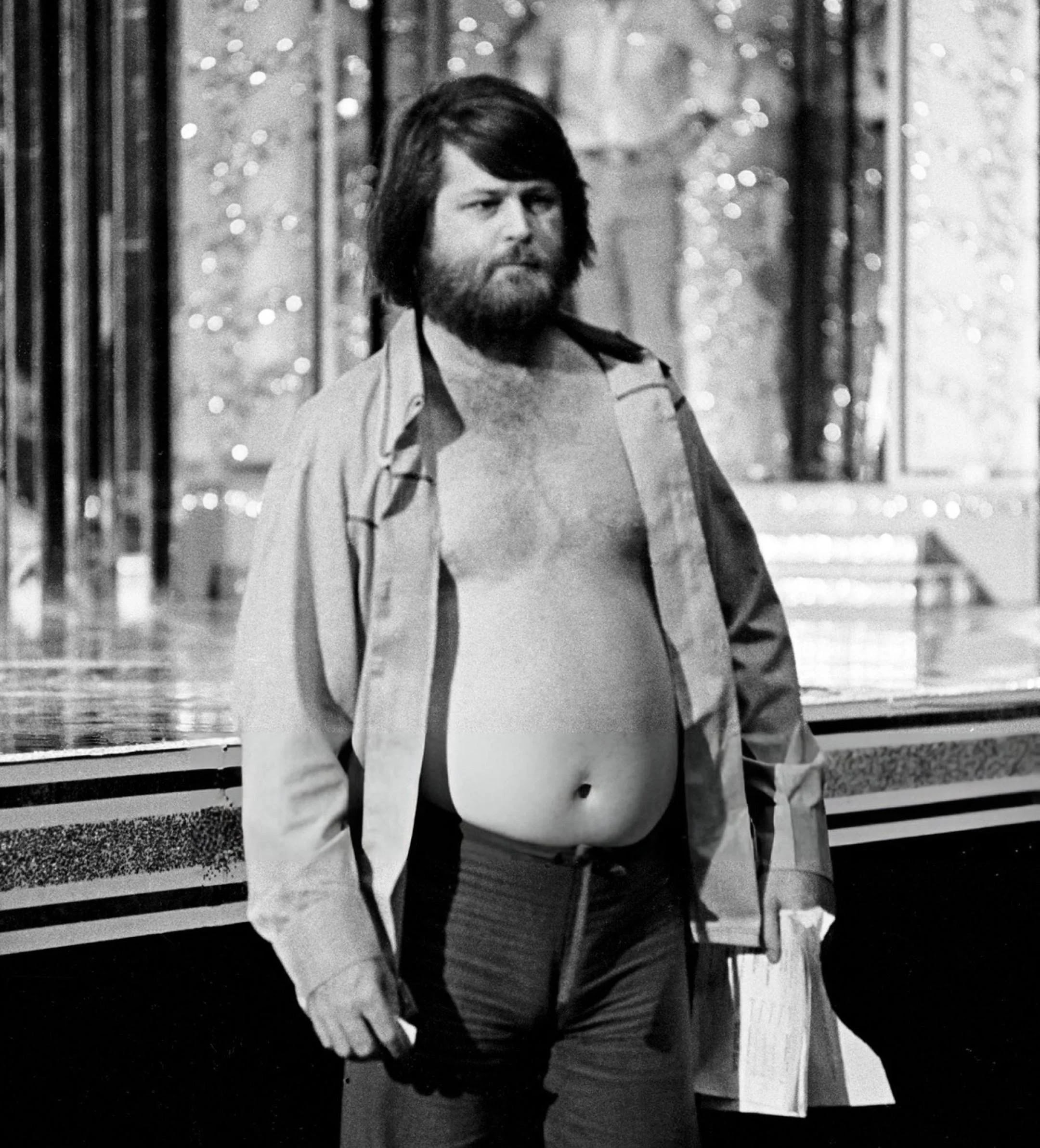
Brian Wilson in 1977
[Sgt. Pepper?Are you freakin’ kidding me?Sgt. Pepper has “A Day in the Life” – the best Beatles song ever – and a few other winners.But there are several very weak tracks on that album – especially “When I’m Sixty-Four” (Paul McCartney at his most annoying) and “Lucy in the Sky with Diamonds” (John Lennon at his most so-full-of-sh*t-that-his-eyes-are-brown).]
If I had to pick just one additional Pet Sounds track to add to the Post’s list, it would be “Here Today.”
But I don’t have to pick just one.So I’m also going to include “You Still Believe in Me,” “That’s Not Me,” “I’m Waiting for the Day,” and “I Know There’s an Answer.”
Don’t worry – I didn’t forget “I Just Wasn’t Made for These Times.”Like “In My Room” – which is included on the Post’s list – that song is a cri de coeur from deep within Brian Wilson’s troubled mind.But while the singer of “In My Room” will likely outgrow his teenage angst some day, the singer of “I Just Wasn’t Made for These Times” is a mature adult who has come to realize that his fear and anxiety will be with him for the rest of his life.
* * * * *
One final note.
I’m probably doing Wilson a disservice by not including any of his post-1966 songs on my favorites list.
Brian Wilson in 2017
But I never bought any of the Beach Boys post-Pet Sounds records.And while I’m sure there are some good songs on those albums, I can’t imagine that any of them are good enough to displace any of the songs on my list.
Feel free to try to make me change my mind – as anyone who knows me will tell you, I have no problem admitting it when I’m wrong about something.(The last time that happened was in 1982.)
* * * * *
I decided to feature “Heroes and Villains” today even though it didn’t make my favorites list.
It’s a real tour de force record – in some ways, it beats “Good Vibrations” at its own game.But in the final analysis, there’s a little too much sound and fury in “Heroes and Villains.”And while that sound and fury doesn’t signify nothing, it doesn’t signify as much as “Good Vibrations.”
To put it another way, “Heroes and Villains” is analogous to witnessing a dog delivering a sermon – the fact that it’s a dog speaking is so remarkable that you tend to overlook the fact that the points he makes aren’t all that persuasive.
Click here to listen to the version of “Heroes and Villains” that was released in 1967 on the Smiley Smile LP.(There are a number of longer versions, one of which was released on the 2004 Brian Wilson Presents Smile album.)
Click here to buy “Heroes and Villains” from Amazon.
Tom Sietsema is the restaurant critic for the Washington Post. Every Wednesday, he hosts an online Q&A session for his readers. A selected few of the online questions and answers appears in the print edition of the newspaper on Fridays.
Most of his questions are from people who want a restaurant recommendation for a birthday or anniversary celebration, a special meal with out-of-town visitors, or some other occasion. They state the time and day of the week they want to dine, note the type of cuisine they prefer, and almost always specify that they are looking for an eatery with outdoor seating. (Sietsema’s readers must be the most covid-fearful people in the country.)
Here’s one of the questions that Sietsema and his editors chose to include in his print-edition column last week:
My sons are coming to DC for Easter weekend and we are hoping to share brunch on Sunday morning in honor of my milestone birthday. They will be staying at the Watergate [Hotel] and would like to eat there. Do you know if their restaurants are open and, if so, are they offering a Sunday brunch?
Here is Sietsema’s answer:
It's been years since I visited Kingbird , the restaurant within the Watergate, but I see it’s open on Sunday afternoons. (Good luck finding a menu online, though!) Wish I could be of more help.
Here’s what Sietsema’s response should have been:
Lady, why the hell are you bothering me? Just call the f*cking restaurant and ask them!
* * * * *
I visited the Kingbird’s website to make sure it had the restaurant’s phone number. (It did.)
Like Sietsema, I was unable to find the restaurant’s menu online. (There’s a link to the menu, but it’s not functioning properly.)
But I did find this information about the restaurant’s hours:
Kingbird is open for breakfast weekdays from 6:30 am – 10:30 am and weekends 6:30 am – 11:00 am. Or join us for High Tea on Saturday and Sunday 2:00 pm – 4:00 pm.
In other words, the restaurant will be open for breakfast until 11:00 am on Easter Sunday. I don’t know if that’s late enough to qualify as “brunch” or not – maybe the woman who wrote Sietsema was hoping to eat at noon or even little later.
Sietsema didn’t bother telling her that Kingbird was open for breakfast until 11:00 pm on Sundays. Instead, he told his reader, “I see [that Kingbird is] open on Sunday afternoons.”
The woman explicitly stated that she and her sons were hoping to have brunch on Easter morning – not Easter afternoon. So I’m not sure why in the world Sietsema told her the restaurant was open for afternoon tea – after all, she wanted to have brunch, not tea – but didn’t tell her about the breakfast hours.
* * * * *
Let’s review the bidding.
In this corner, we have a Washington Post reader who wants to know if a particular restaurant will be open for brunch on Easter Sunday. Instead of simply calling up the restaurant and asking, she e-mails a restaurant critic.
And in this corner, we have a restaurant reviewer who not only is too lazy to call a restaurant to ask if they will be open for brunch on Easter Sunday but also can’t be bothered to read his reader’s inquiry carefully – she asks him if the restaurant will be open on Easter morning, and he responds by telling her that the restaurant’s website says it will be open (for afternoon tea only) on Easter afternoon.
The final line of his response – “Wish I could be more help” – couldn’t be more insincere. If Sietsema really meant that, he should have called the stupid restaurant himself.
* * * * *
Sietsema gets a lot of questions during his weekly online Q&A sessions. Why choose this one for the Washington Post print edition?
For one thing, it’s likely of very narrow interest. The reader is asking whether a particular restaurant offers brunch on one particular day of the year. (She’s not asking whether the restaurant is open for brunch on Sundays generally, but whether it’s open for brunch on Easter Sunday.) How many other readers are likely to be interested in the reply?
But if you do choose to run this question in the paper, why not take two minutes to call the frigging restaurant yourself so you can answer it? It’s like an advice columnist who prints a question from a woman who caught her husband wearing her underwear and wants to know what she should do, and then answers “Beats me!”
It reminds me of my eighth-grade civics teacher’s favorite pronouncement when he was asked why the government had done something: “When the blind lead the blind, we all go in the ditch together.”
* * * * *
When I was a student, I had a number of blue-collar summer jobs – like unloading trucks and rail cars at a grocery warehouse – where workers got a scheduled “coffee break” in the morning and another one in the afternoon.
These breaks lasted ten or fifteen minutes, and were paid – you didn’t have to clock out during coffee breaks. (They were written into union contracts.)
You didn’t have to drink coffee, of course – I usually ate half a sandwich and had a carton of milk or a can of Dr. Pepper on my coffee breaks.
I remember one job where a bunch of the guys on my shift would spend their coffee breaks playing liar’s poker – that’s a variant of regular poker that utilized the serial numbers of dollar bills instead of playing cards. The winner of each hand got a dollar bill from each player, and the liar’s-poker players I worked with didn’t waste any time – they managed to play several dozen hands before the whistle blew and we had to go back to work.
In addition to these scheduled coffee breaks, the guys I worked with who smoked felt entitled to take quick cigarette breaks every so often. (They smoked during coffee breaks as well, of course.)
“Smoko” is the Australian slang term for a cigarette break. It can also refer to a short coffee (or tea) break that doesn’t involve smoking.
I’ve never been to Australia, but I understand that hourly workers “Down Under” feel very entitled to their smokos. Heaven help you if you try to get a worker who’s on smoko to respond to your request for help.
“I’m on smoko,” he’ll probably tell you. “So leave me alone!”
Click here to watch the official music video for “Smoko,” which went viral after it was released in 2017 by the Chats, an Australian punk-rock band.
Click on the link below to buy that record from Amazon:
Google “angry people” and witness that more than 80 percent of the images are of men, mostly white men.
The Post is generally so full of sh*t that its eyes are brown, but that statement is right on the money.
I verified it by Googling “angry people,” and then clicking on “images.” I got a couple of pictures of angry African-Americans, a few pictures of angry women, and about a gazillion pictures of angry white guys.
Like this one:
The only thing about that Google search that surprised me is that it didn't return a bunch of pictures of me. Because I am pissed off all the time.
(What am I pissed off about? The better question is what am I NOT pissed off about.)
* * * * *
That thing about Googling “angry people” and getting a bunch of pictures of white guys came from a recent Post piece titled “Five Myths About Anger.”
Every Sunday, the Post runs an article by some self-proclaimed expert that lists five things about some random subject that most people believe, and then explains why those beliefs are all wrong.
In recent weeks, the Post has published articles titled “Five Myths About Texans” (e.g., it’s a myth that Texans love guns), “Five Myths About Infertility” (e.g., it’s a myth that stress causes infertility), “Five Myths About Volcanoes” (e.g., it’s a myth that volcanoes are more active today than they were in the past), “Five Myths About Marriage” (e.g., it’s a myth that extramarital affairs are responsible for most divorces), “Five Myths About Pizza” (e.g., it’s a myth that pizza became popular in the U.S. because so many American soldiers ate it in Italy during World War II), and – most recently – “Five Myths About Anger.”
According to the Post, it’s a myth that men are angrier than women:
[R]esearch consistently shows that men are no more likely than women to be angry. In fact, women report feeling anger more frequently and in more sustained ways. In early 2016, for example, a national survey conducted by Esquire and NBC found that women reported consistently higher rates of anger. Another, conducted by Elle magazine two years later, revealed the same pattern.
Have you ever heard the phrase, “Garbage in, garbage out”? Scientists use it to make the point that if you start with incomplete or incorrect data, you end up coming to the wrong conclusion.
The “research” cited in the “Five Myths About Anger” is a good example of garbage in, garbage out. That’s because I wasn’t surveyed by Esquire or NBC or Elle. If I had been, I have no doubt that I would have pulled the average male anger score up enough to beat out the ladies.
* * * * *
Of course, even if I wasn’t angry, people would say I that was. From the Post:
A 2016 study . . . found that most people are predisposed to associate negative and angry facial expressions with men and masculinity. Biases that lead most of us to “see” anger in men’s faces also lead us to commonly interpret women’s faces as fearful or sad. . . .
I don’t think I was angry when I was a preschooler, but a lot of people would have said that I was. That’s because people perceive little boys as being angrier than little girls:
Adults are more likely to describe infants they think are boys as agitated and disagreeable. Other studies show that both mothers and fathers are more likely, when reading to their children, to associate anger with male characters and use words making those connections.
One more cross for my three lovable little grandsons to bear.
* * * * *
Most of the angry people in rock songs are angry at a particular person – often a former spouse or lover. For example, Alanis Morissette’s “You Oughta Know” is directed at her ex-boyfriend, Dave Coulier.
But the singer of Todd Rundgren’s “Heavy Metal Kids” is just plain angry.
Click here to listen to “Heavy Metal Kids,” which was released in 1974 on the Todd double album.
Click on the link below to buy the song from Amazon:
A number of newspapers publish “blind date” columns that report on blind dates set up by newspaper staffers.
The Washington Post’s “Date Lab” is typical of these. Post staffers look over questionnaires that potential daters submit, then play matchmaker. They invite a young man and young woman to meet at a local restaurant for drinks and dinner on the newspaper. (On occasion, they pair up a more “mature” couple, or a same-sex couple.)
Where you can find “Date Lab” each Sunday
Then they debrief the daters and write up an account of the date that appears in the Post’s “Magazine” section, which is part of the Sunday paper.
* * * * *
Most “Date Lab” participants are wishy-washy and indecisive, and the upshot of most “Date Lab” pairings is . . . nothing.
The Post can usually be counted on to match couples who are reasonably compatible. (Rabid liberals aren’t matched up with rabid conservatives, and svelte triathletes aren’t paired up with pudgy couch potatoes.) So the dates are usually pleasant – the couples find each other physically attractive, and are able to sustain a pleasant conversation for as long as the date lasts.
The main problem with “Date Lab” dates is chemistry – or, to be more precise, lack of chemistry. The daters have very high expectations: perfection is acceptable, but just barely.
As a result, “Date Lab” dates usually one-offs. The couples may share digits, then exchange a text message or two – and occasionally they will meet for a second date. But most of the time they don’t.
“Date Lab” fine print
I can’t tell you how many “Date Lab” columns end with the couple engaging in some desultory follow-up that leads nowhere – e.g., “Jack texted Jill a week later and suggested they get together for a cup of coffee, but so far the couple have been unable to find a mutually convenient time to meet.”
If the millennials who make up the vast majority of “Date Lab” participants are representative of their generation, we’re not going to have to worry about overpopulation.
* * * * *
Sometimes there are other problems that derail any potential relationship.
In the most recent “Date Lab,” the participants were a 30-year-old male speechwriter for a mental health nonprofit (we’ll call him “M”) and a 25-year-old account manager for a health-care consulting firm (who we’ll refer to as “F”).
* * * * *
The date seemed to start off OK – both M and F had started drinking before they met at the restaurant where they were having dinner, so the evening “buzzed with a sense of mild inebriation.”
The two were able to converse throughout dinner “with nary an awkward silence.” According to the Post, “they were on the same page when discussing the Hollywood/media sexual assault allegations that seem to surface daily.” (Note to all you women: guys don’t necessarily tell the truth on dates.)
The bar where F and M met
Also, F concluded that M “wasn’t a total creep.” Things were really going well!
But the date jumped the shark when the waiter dropped off the check, which was $70 more than the allowance provided by “Date Lab.” F said M suggested that they split it down the middle, “which cooled her on him even further.”
“As much as women’s equality is a thing now, and whatever, I do think that chivalry is not dead and should not be,” F told the Post. “When a guy offers to pay, it [sends a message] of, ‘I’m interested in you and I want to keep this going.’”
In other words, F is all for gender equality except when it comes to pulling the old plastic out of her purse.
* * * * *
I’m old. But when I was young, it was de rigeur for the guy to pick up the tab for a date.
This made sense in part because men usually made more money than women back in the day – especially those men who were dating younger women, which was almost all men. So it seemed fairer for the man to pay. After all, as Karl Marx once said, “From each according to his ability, to each according to his need.”
But today women and men are pulling down comparable salaries.
It’s not clear from the “Date Lab” article whether F or M makes more money. F is younger, which might indicate that she makes less. But M works at a nonprofit organization, while F is employed by a for-profit company – and has a job description that sounds a little higher-powered to boot. So it’s probably 50-50 whether F or M makes more coin.
* * * * *
While considerations of gender equality and economics dictate that F and M should have split the bill even Steven, F wanted to have her cake and eat it, too – plus she wants M to pay for the cake.
Let’s face it – she’s a hypocrite. (She’s not alone, by the way.Click here to read a recent Boston Globe article reporting that almost two-thirds of women believe men should foot the entire bill for a first date, and that over 40% of women are “bothered” if men expect them to go Dutch.)
Which is too bad because she’s pretty hot. (Which may explain her attitude – good-looking women are used to getting their way with guys.)
* * * * *
“Danke Schoen” was recorded in 1963 by the 21-year-old Wayne Newton.
Many other singers recorded that song, but it was always identified with Newton – who was the quintessential schmaltzy lounge-singer.
Here’s Wayne Newton performing “Danke Schoen” live:
Leonard Downie, Jr., at the Washington Post for 44 years. He was the paper’s Executive Editor when he retired in 2008.
Downie was so concerned about avoiding bias or the appearance of bias in the Post’s political reporting that he refrained from voting while he was a Post editor.
Leonard Downie, Jr.
After he announced his retirement, a Post reader asked him if he planned to start voting. This was his response:
I’ll have to think about that since I didn’t just stop voting [when I was the Executive Editor], I stopped having even private opinions about politicians or issues so that I would have a completely open mind in supervising our coverage. It may be hard to change.
That may sound a little extreme, but you have to admire Downie’s integrity.
* * * * *
I wonder if there is anyone in the media today who follows Len Downie’s example.
Frankly, I’d be happy if everyone just followed George Orwell’s example.
In his new book, Churchill & Orwell: The Fight for Freedom, author Thomas Ricks said something about George Orwell that distinguishes him from most current-day journalists:
Instead of shaping facts to fit his opinions, [Orwell] was willing to let facts change his opinions.
Let’s face it. You can't say the same about most newspapers and television networks today.
George Orwell
Instead of weighing all the facts and coming to the appropriate conclusions based on those facts, “agenda journalists” start with a predetermined point of view and downplay any evidence that calls the validity of that point of view into question.
“The general modus operandi is simple,” according to one critic. “[J]ump to premature conclusions, accept orchestrated events as [coinciding with reality] and interpretation as fact, ignore confuting or problematic data, and suppress or damp down countervailing intel when the truth eventually emerges.”
* * * * *
The recently enacted “Tax Cuts and Jobs Act” will reduce federal income taxes for the vast majority of taxpayers. In fact, the left-leaning Tax Policy Center has estimated that only 5% of Americans will pay more in taxes in 2018 than they would have if the new law had not been passed.
But a number of polls show that most Americans believe that their taxes will go up – not down – as a result of the new legislation.
For example, a New York Times survey found that only 32% of respondents believed they would get a tax cut in 2018.
How are we to explain this discrepancy between what reality actually is and what Americans believe reality to be?
Could it be the result of the consistently negative reporting about the tax legislation in most of the mainstream media?
* * * * *
Earlier this year, Harvard University’s Shorenstein Center on Media, Politics, and Public Policy reported that 60% of the news coverage of President Clinton’s first 100 days in office were negative, while 40% were positive.
The numbers were almost identical for Clinton’s successor, President Bush – 57% negative, 43% positive.
The press was much nicer to President Obama – only 41% of the stories about his first 100 days in office were negative, while 59% were positive.
President Trump got slammed in 80% of the news stories about his first 100 days. Only 20% were positive.
But CNN, NBC, and CBS were negative more than 90% of the time.
Even the Wall Street Journal – which some people believe is a right-wing paper – was negative 70% of the time.
Only Fox News had balanced coverage. It was negative 52% of the time and positive 48% of the time.
* * * * *
Some of you will say that those numbers simply reflect reality – that Trump richly deserves every negative story that’s been published about him.
But consider this: according to the Center for Public Integrity, journalists contributed almost 25 times more money to Hillary Clinton’s campaign than Donald Trump’s campaign.
Journalists as a group clearly feel tremendous fear and loathing for President Trump. Most of the ones I know don’t apologize for feeling that way – they think he’s earned every bit of that fear and loathing.
* * * * *
In the 19th and early 20th centuries, most American newspapers were partisan publications.
Party newspapers didn’t apologize for what we call “fake news” today. “The power of the press,” in the words of one antebellum journalist, “consists not in its logic or eloquence, but in its ability to manufacture facts, or to give coloring to facts that have occurred.”
Political parties directly or indirectly subsidized newspapers. In some instances, the relationships between party and publisher were unknown to readers.
Professor James Baughman
As the revered University of Wisconsin journalism professor James Baughman told the Center for Journalism Ethics in 2011, “by the 1950s most newspapers, large and small, as well as the broadcast networks, tried to present the news objectively. . . . [O]ur national news culture, whether print or broadcast, preferred the middle ground.”
But that changed in the 1970s and 1980s. According to Baughman,
Reporters were encouraged to add analysis into their stories. Such analytical reporting more often than not, I think, had a liberal centrist slant. Not hard liberal. Not Rachel Maddow liberal. Maybe “neo-liberal.”
Look at the The New York Times in 1960 vs. 2010. The reportage is more interpretive. This is not a problem for me, but it is an issue for my more conservative friends (and I have them). The more analytical journalism could be off-putting for those on the fringes, left and especially on the right. One reader’s analysis is another reader’s opinion. Sixty percent of those surveyed by the Pew Research Center in 2009 believed reporting was politically biased.
There is a related problem that editors note and I encountered when I gave public service talks as director of the journalism school . . . a lot of people can’t distinguish the editorial page from the rest of the paper. Some assume the worst, that the editorial views of the newspaper inform the rest of the paper.
All too often, that assumption is justified.
* * * * *
Most of us are far from being experts when it comes to tax reform, immigration policy, and the other political issues of the day. We rely on newspapers and network news programs to present the facts relevant to those issues so we can make an informed decision concerning which side is right and which side is wrong.
At least that’s the way it used to work. Nowadays, it’s more likely that we turn to a news source that tells us what we want to hear.
Occasionally, I’ll come across a story in the Washington Post or another news source that’s on a topic that I actually know quite a bit about. Almost without exception, those stories are a disappointment. At best, they are naive or simplistic. At worst, they are poorly-disguised advocacy pieces that reflect the author’s biases.
That makes me wonder whether the articles on topics that I don’t know anything about are equally flawed.
* * * * *
In many cases, you don’t have to know anything about the subject of a newspaper story to know that its conclusions aren’t worthy of being taken seriously.
For example, the author of the article may base his or her conclusions on anecdotal evidence that is inherently unreliable. You have to wonder whether that author is too lazy to dig deeper into the facts, or is simply unaware that his or her arguments are illogical, inconsistent, or otherwise flawed.
A good example of this kind of “reporting” is a recent story about a large Utah family that ran on the Washington Post’s front page. That article clearly implied that the new tax reform legislation would hurt that family, even though it is almost certain that the new law will help them.
The Post article pays lip service to objectivity by acknowledging that “[i]ndependent analysts say most families should get a tax cut” as a result of the new law, but undercuts that statement with quotes from the husband and wife who are the subject of the article.
“We just don’t want to have less money than we had before,” says the wife. In fact, her family won’t have less money – unless there is something very atypical about them. And if her family is that atypical, why is the Post focusing on them rather than on families that are more representative of all American families?
“It doesn’t feel like it’s for the middle class,” the husband says. “It doesn’t feel genuine to me,” the wife chimes in. Why should what the legislation “feels like” to one apparently ill-informed couple matter?
“It seems like it might be worse for us,” the husband says. What are we to make of this statement? We are reading this article in hopes of learning something about the effects the new tax law will have on Americans generally – and on our family in particular. Instead, we’re told that one man has concluded that it “seems like” the new law “might” make his family’s situation worse. SO WHAT???
Imagine if that Post reporter was assigned to write a story about a new cancer treatment. Would he feature one cancer patient who said “It doesn’t feel like this treatment is for me,” or “It seems like I might be worse off” by undergoing that treatment? Hopefully not.
I’m guessing that it’s news coverage like this story – which should embarrass the powers-that-be at the Post – that is responsible for the divergence between the very large number of Americans who will benefit from the new tax-reform law, and the relatively small number who believe they will benefit from that law.
* * * * *
I think every Post story about the new tax bill has stated – usually in the headline, subhead, or initial paragraph – that it will primarily help the wealthy.
The implication is that this is a bad thing – few of us see ourselves as wealthy, after all.
The new tax law cuts tax rates across the board – almost all taxpayers will benefit. But the wealthy will benefit more than the poor or middle-class for one simple reason: THE WEALTHY PAY A LOT MORE IN TAXES.
The top-earning 1% of Americans paid roughly 46% of all individual federal income taxes in 2014. (They earned only 17% of all the income earned by individuals that year.)
Roughly 45% of Americans pay NO federal income tax. (That percentage will go up as a result of the new tax law.) By definition, people who pay zero income tax will not be directly benefitted by a reduction in federal income tax rates.
Saying that the tax-reform bill primarily benefits the wealthy is about as meaningful as saying that a law-enforcement initiative against car-theft rings primarily benefit the wealthy.
But given that the wealthy own more cars, and more expensive cars, any police efforts aimed at car thieves do benefit the wealthy more.
But would the Washington Post lead off a story about such a law-enforcement effort with a statement that it will primarily benefit the wealthy? Of course not.
* * * * *
I don’t agree with the Washington Post when it comes to the tax-reform law. I happen to think that the new tax legislation is a good thing for the country as a whole.
But maybe the Post is right. I’m willing to admit that’s a possibility.
What I’m not willing to admit is that the Post ever truly had an open mind on the subject. I would say that nine of out ten stories about the new tax law that have appeared in the Post over the past several weeks represent agenda journalism – not impartial, George Orwell-style reporting.
I’m not a conspiracy-theory kind of guy, and I’m usually very skeptical of those who make broad generalizations – including those who assert that the mainstream media has a liberal agenda.
But after reading what the Post has had to say about the new tax law, I have no choice but to conclude that the newspaper has its thumb on the scale. Rather than keeping an open mind and considering all the relevant facts before coming to a conclusion about that law, the Post let its political point of view drive its “reporting.”
* * * * *
John Lennon wrote a lot of terrible songs, but “Gimme Some Truth” is not one of them. In fact, it may be the best song ever released by Lennon as a solo artist.
“Gimme Some Truth” has some things in common with rap songs – Lennon speaks the lyrics more than he sings them, and he hangs a lot of words on a very simple musical framework. There’s a lot of repetition – “Gimme Some Truth” would be very short if the repetition was eliminated. (Of course, that’s the case with a lot of Beatles songs.)



 Posts
Posts

