Showing posts with label Tru Fax and the Insaniacs. Show all posts

Tuesday, November 5, 2019

Tru Fax and the Insaniacs – "The Problem Is Me" (1982)


I’ve got friends, status, money, health
I’m popular, good-looking
There must be something else

[NOTE:  Today's 2 or 3 lines features the second part of our groundbreaking interview with . . . 2 or 3 lines!  Just click here if you missed part one.]

*     *     *     *     *

2 or 3 lines:  You’ve reached an important milestone.  Ten years is a long time to keep a blog going.

2 or 3 lines:  Truer words were never spoken.

Q:  Do you plan to keep going?  Will 2 or 3 lines be around for another ten years?

A:  If I live that long.

Q:  [Knocks on wood.]  So no thoughts of pulling the plug?

A:  I might have done that after the first year.  But the longer I go with 2 or 3 lines, the less likely I am to pull the plug.

Q:  But isn’t it tempting?  Think of all the additional time you would have to fiddle about – not in the Uncle Ernie sense, of course – if you weren’t committed to producing new material for 2 or 3 lines every week.

A:  Pulling the plug would take a lot of pressure off me – which may sound silly, because that pressure is 100% self-imposed.  

Q:  So why not do it?

A:  I’m still hoping that 2 or 3 lines will become something better than what is currently is.  Did you take Latin in high school?

Q:  I did – but that was a long time ago.


 A:  There’s a Latin saying “Dum spiro, spero” – which can be translated as, “While I breathe, I hope.”    As long as you’re alive, there’s a possibility that things will get better.  A baseball team can be down to its final out – even its final strike – but as long as the game isn’t over, it still has a chance to win.  Maybe that chance is very small, but it exists.  And as long as I keep 2 or 3 lines going, there’s a possibility that it will grow into something much greater than what it currently is.  But as soon as I pull the plug on it, that possibility disappears.    

 *     *     *     *     *

2 or 3 lines:  It’s clear that 2 or 3 lines is very important to you.  Can you articulate why that is?  

2 or 3 lines:  One reason that I write 2 or 3 lines is that I feel a need to explain myself to the world – to communicate who and what I am.  I recently came across a quote from a Swedish academic named Jenny Sunden that may explain the motivation for 2 or 3 lines as well as anything: “In order to exist online, we must write ourselves into being.”  That’s what I’m trying to do with 2 or 3 lines – I’m writing myself into being, and sharing that being with my readers . . . especially my children and my grandchildren (when they’re old enough to read).  

Q:  Do you see 2 or 3 lines as a kind of legacy?

A:  I suppose 2 or 3 lines is a legacy in the sense that it’s something tangible I’m leaving behind, but it’s of more than casual interest to only a very small number of people.  The fact that people worry about their legacy proves how vain we are.  

Q:  Speaking of being vain, do you think it’s at all vain to have yourself conduct a lengthy interview with yourself about yourself?

A:  I’ll ignore your interruption and continue with my response to your question about whether I see 2 or 3 lines as my legacy.  I’ve come to terms with the fact that no one will remember what I accomplished as a lawyer, and that I haven’t written a great novel or created some other memorable work of art – but the vast majority of lawyers and novelists and artists will be forgotten relatively quickly after they die.  The most meaningful legacy I will be leaving behind isn't 2 or 3 lines.  It's my children, and my grandchildren, and so on.   A lot of what I write is intended to enable them to know me better. 

Q:  You once paraphrased the famous Louis XIV quote, “L’état, c’est moi” – which can be translated as “The nation is me” – as “Le 2 or 3 lines, c’est moi.”  That statement can be read in two different ways.  Maybe you’re simply saying that 2 or 3 lines is wholly your creation – that you’re the chicken and that 2 or 3 lines is your egg.  Or maybe you’re saying that you are what 2 or 3 lines says you are.  Which is it?  


A:  Both, I think.  Most people would say that someone is what he is rather than  what he says he is.  Of course, no one knows a person as well as that person knows himself.  An honest autobiography is always going to be more revealing and comprehensive than a biography.  While autobiographies aren't always honest, everything I write about myself in 2 or 3 lines is the truth.  Not necessarily in an objective sense, but everyone knows that there’s really no such thing as “objective” truth. 

Q:  Was what you wrote about your hot (age-adjusted) French girlfriend the truth?  Did she really exist?  

A:  Absolutely!  

Q:  We haven’t heard anything about her in a long time – just sayin’.

A:  That’s because she’s now my hot (age-adjusted) French ex-girlfriend.

Q:  I’m sorry to hear that.

A:  Not half as sorry as I am. 

*     *     *     *     *

2 or 3 lines:  Let’s shift gears and discuss today’s featured song.  It is well-known that you love irony, and I’m smelling more than a whiff of irony in the lines from today’s featured song that are quoted at the beginning of this post.  

2 or 3 lines:  I can’t deny it – I am one ironic son of a b*tch.

Q:  Is the singer of “The Problem Is Me” being ironic?

A:  You bet your *ss she is.  She doesn’t really believe the problem is her – she believes someone else is at fault.  After all, she’s popular and good-looking, she  has money, status, etc. – how can she possibly be the problem? 

Q.  Good question.

A:  But the real irony here is that the singer really is the problem.  Theres a type of irony called dramatic irony, which is when a character in a play or a movie says something that he or she believes is true, but which the audience knows is false.  Here we have an ironic variation on dramatic irony: the singer intends her words to be ironic, but we know that what she is saying is actually true.  

[NOTE:  Here endeth part two of the 2 or 3 lines interview of 2 or 3 lines.  Click here to read part three of the interview.]

*     *     *     *     *

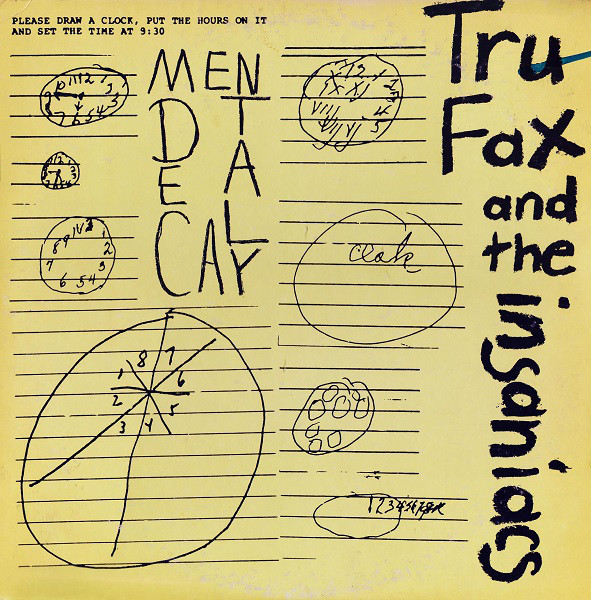
Click here to listen to “The Problem Is Me,” which was released in 1982 on Tru Fax and the Insaniacs’ first and only (to date) album, Mental Decay:


Unfortunately, “The Problem Is Me” is not currently available for purchase from Amazon or iTunes. 


Saturday, October 31, 2015

Tru Fax and the Insaniacs – "Perfect Day" (2015)


It was a perfect day
You were alive and so was I

Michael Mariotte, who's been the drummer for Tru Fax and the Insaniacs since the band formed in 1978, wrote "Perfect Day" just last year.  It’s one of the four songs on TFI's brand-new EP, 4Shadows.  


Michael wrote both the music and lyrics for “Perfect Day,” and he plays guitar on the recording of the song – the first time he’s done that as a member of TFI.

Michael, who is battling cancer, wrote “Perfect Day” for his kids – especially his four-year-old and five-year-old daughters, who are both named in the song.  “My cancer may leave them without a father at a too-young age,” Michael told me, “and I wanted them to know, when they are old enough to understand it, that these days we have together – even the crappy ones – are precious for me, and I hope for them.”

Here's part two of my interview with Michael about the history of Tru Fax and the Insaniacs.  Click here if you missed part one of that interview and would like to read it now. 


2 or 3 lines:  I understand that Washingtonian magazine named you the worst band in Washington without ever hearing you perform.  How good was Tru Fax when you first started playing in public?

Michael: We weren't great at the beginning, but we weren't bad either.  Alex Eldridge didn't last long as our first bass player – he was a student and he went back to Harvard after our first few gigs.  Libby Hatch replaced him, and while she wasn't technically that good, she had a presence and a style that people liked.  

TFI, circa 1982: Diana Quinn, Michael
Mariotte, Tim Carter, and David Wells
As a band, we started getting very good when Tim Carter replaced Libby as bass player in 1981, and reached our peak when Bob Young replaced Tim in late 1982 – Bob was quite good.  Here's a little-known fact: David Arnson of Insect Surfers filled in on bass for TFI for a couple months after Tim left and before we brought Bob on.

2 or 3 lines:  Did Tru Fax play mostly original songs?

Michael:  We've always done a mix of originals and covers, but always more originals than covers. A typical 15-song set might contain three or four covers.  The mix hasn't changed much over the years, though the songs themselves have.

2 or 3 lines: How did TFI create original songs?  Who contributed what?  Was there a lot of collaboration, or was each song essentially written by one person?

Michael:  David Wells was the main songwriter.  In the early days we'd sit in the living room and write some lyrics and he would put them to music.  Sometimes David would bring in a whole song, or most of one.  Most often, the song would get rearranged some and messed with during practices, and eventually would show up in live shows.

2 or 3 lines: Who were the best bands you played with? Who were the bands from that era you admired the most? 

Michael:  We played with a bunch of good bands.  My favorites were The Fleshtones – we always had a good time with them wherever we were.  Also the Slickee Boys, since they were all good friends of mine.

The Fleshtones' 1981 album, "Roman Gods"
The Insect Surfers were good friends as well.  We were on same label (WASP Records) and played together pretty often.  Beex were very fun – they were a punk band from Richmond.  The Embarrassment, from Kansas or Nebraska or something, were a band I had never heard of but still remember; they were really good.  [Note: The Embarrassment was from Wichita.  Famed music critic Robert Christgau called them a "great lost American band."] 

The bands from that period that I liked best – Dream Syndicate, Green on Red, Translator – we never actually played with.  But at least I did get to hang out with all of them when they'd come through town.  Back then the 9:30 Club gave me full house privileges.  I could get in free whenever I wanted and could go down to almost anyone's dressing room anytime . . . so I'd just go and introduce myself to bands I liked and hang out.

2 or 3 lines:  Did you ever have to perform with other bands whose music you didn't really like?  

Michael:  I really liked The Bongos on record, but they weren't that good live and they were pretty annoying people – especially when they learned they were opening for us instead of the other way around.  The Revillos were also quite annoying and I didn't really like them as a band.  Orchestral Maneuvers in the Dark, Magazine, and Bauhaus were three bands we opened up for in bigger venues whose music just didn't work well with our music.


2 or 3 lines:  What was the highlight of your years with TFI?  Was there a particular live appearance where you felt the band reached its peak?

Michael:  My favorite show ever was at the Wax Museum with the Slickees.  That was in January 1983.  They had predicted an actual blizzard that night, but it didn't snow at all.  The place was packed – 1500 people, which I was told was the largest crowd Wax Museum ever had.  We were amazingly good and the crowd was really with us.  That was probably the only time I can say we blew the Slickees off the stage.  That was when I decided we had become a really good band and could play with anyone.

Our show with Stiff Little Fingers at the Bayou was another particularly good one, as was a July 4 show at the Bayou with the Slickees.  Almost any show with Fleshtones was great – there were a bunch of them.  


Another very memorable show was the one for the last week of the old 9:30 Club in December 1995, part of which was released as a live CD.  We sounded good, and there were lots of old friends there.
  
2 or 3 lines: What do you think TFI's best song was?

Michael:  I should probably say "Washingtron," since it's the only one I have co-writing credits on. But my real favorite is "King of Machines," which David actually wrote with a poet friend named Harrison Fisher before I ever came on the scene.  "Mars Needs Women" is another one that has held up well – it was also co-written by David and Harrison before I met them.

The "Washingtron" 45
2 or 3 lines: What did you want TFI to be?  Were you happy with what the group accomplished, or did you think you should have been bigger stars?

Michael:  David and Diana both had good jobs and never planned to leave them – so the idea of becoming a big touring band on a big label was never in the picture for TFI.  I had a good job as manager of the Washington City Paper, but it didn't pay that well, so I would have gone for more, as would have Bob Young.  But we knew that would never happen so it didn't especially bother us.  And we did get to do some touring: New York City, Philadelphia, Richmond, Charlottesville, Ohio, North Carolina, etc., etc.

Still, it's hard to know what would have happened had David not moved to California for 1984, when we were absolutely at our peak both musically and in popularity.  Record labels had already showed some interest.  There was a Bayou show in early 1983 where an agent for Chrysalis Records shoved their business card under the door – Diana who shoved it back.
[Note: Chrysalis Records was a major British record label whose acts included Blondie, Billy Idol, Jethro Tull, Joan Jett, Huey Lewis and the News, and Procol Harum.]  

TFI's 1982 album, "Mental Decay"
From my work at City Paper, I had good contacts with the then very new MTV, where Peter Zaremba of the Fleshtones hosted a show called "120 Minutes" dedicated to promoting bands like us, and with IRS Records, which was a major new wave/punk label.  [Note: IRS Records was an independent label with acts like R.E.M., the Buzzcocks, the Go-Go's, Squeeze, the English Beat, and Fine Young Cannibals.]  So we might have had opportunities to do more – make videos maybe, tour more . . . I don't know.  Certainly our first album, which was released in late 1982, did well in some markets and was played on some college radio stations.  An album with better distribution and promotion, maybe backed up by a video, conceivably could have done very well. 

But we never resumed the same kind of concert schedule when David returned from California, and while we had a few good shows in 1985 and 1986, we sort of faded away for a while there.

2 or 3 lines:  Looking back, what was the best thing about being in TFI?    

Michael:  Best thing was it was always a blast.  It enabled me to misspend my youth for an entire extra decade! It was nearly always fun – now and then not so much, but most of the time.  I got to meet a lot of great people from all over the place, hang out with great musicians.  What more can you ask for? And while the extras aren't there anymore – meeting new bands, having privileges at the 9:30 Club, and girls – although I'm married now, so that's not needed anymore – there is still nothing more fun than getting on stage and playing as loud and hard as I can.


David Wells, Diana Quinn, and
Michael Mariotte in 2013
Here’s some big news for fans of Tru Fax and the Insaniacs: the band is planning to release a double album that includes old and new songs before the end of the year.  

2 or 3 lines will mark that occasion by featuring several songs from the forthcoming album as soon as it’s released, as well as interviews with TFI’s two other original members, David Wells and Diana Quinn. 

Click below to listen to “Perfect Day”:


Click below to buy "Perfect Day" or the entire 4Shadows EP.

Thursday, October 29, 2015

Tru Fax and the Insaniacs – "Nuclear Waste" (2015)


They thought it was safe
But now something's gone wrong

"Nuclear Waste" – which is one of the four songs on the 4Shadows EP that was released last month by Tru Fax and Insaniacs – was inspired by the partial nuclear meltdown at the Three Mile Island nuclear power plant near Harrisburg, Pennsylvania, in 1979.

Anti-nuke protestors at Three Mile Island
"Nuclear Waste" and "Melt Down," another anti-nuke song that's on 4Shadows, are among the first songs that TFI wrote and performed, but the band had never recorded those songs until now.

It's no surprise that "Nuclear Waste" and "Melt Down" are particular favorites of Michael Mariotte, the only drummer that TFI has ever had.

Michael speaking out against nuclear power
That's because Michael is the President and former Executive Director of the Nuclear Information and Resource Service ("NIRS"), an organization that was founded in 1978 to be a national information and networking center for those concerned about the safety of nuclear power.  Click here to learn more about NIRS. 

Last year, Michael was honored by more than a dozen environmental organizations with a "Lifetime Achievement Award" in recognition of his three decades of leadership at NIRS.  That award was presented to Michael by none other than Ralph Nader.

Michael with his daughter
Zoryana and Ralph Nader
But when 2 or 3 lines recently interviewed Michael, the focus was the long and illustrious history of Tru Fax and Insaniacs ("TFI").  Here's part one of that interview.

2 or 3 lines: Michael, where did you grow up?

Michael Mariotte:  I'm an army brat.  I was born near Chicago, then lived in Paris for four years until the French kicked the U.S. military out, then moved to to northern Virginia – I lived in "Arlingtron," then Reston.

2 or 3 lines:  I understand you were the only member of Tru Fax and the Insaniacs who had been in a performing band prior to the formation of Tru Fax.

Michael:  That's right.  I started playing guitar in high school in Reston.  My first band was The Underground Cable – I was the rhythm guitarist.  Our claim to fame was beating our rock-band competition at a Reston talent show.  That was mostly because I had learned how to do a liquid light show and taught our lead guitarist's little sister how to do it while we played.  That was the first time anyone in Reston had seen such a light show.

Then I switched to organ and played in a band called the Prickly Heat, which had a few live shows.  The nucleus of that band eventually became a real band: Artful Dodger.  Ask anyone my age who grew up in Cleveland: they were huge there. 
[Note: Artful Dodger was a very good power pop band that released several albums in the late seventies.  Click here to read what 2 or 3 lines had to say about them in 2011.]

The first Artful Dodger album
I left that band to start a new band called The Street – which later became The New Street when we learned there was already a band called Street.  We played around the Reston/Herndon/Vienna area for a couple years.

I switched back from keyboards to guitar during college – I went to Antioch College in Ohio – but I wasn't in an actual band . . . just did occasional jamming.

2 or 3 lines: What kind of music did you like as a teenager? Who were your favorite groups, and which groups did you think were awful?

Michael: I liked psychedelic music then and still do.  One of my favorites was Jefferson Airplane.  I got to meet them and hang out with them backstage in San Antonio in 1971.  I also liked the Doors, Quicksilver Messenger Service, Country Joe and the Fish, etc. 


Country Joe McDonald
I got to meet Country Joe in 1972, during an FTA tour – we hung out together for several hours. [Note: FTA – which stood for "Free the Army" – was a group of performers organized by Jane Fonda that presented anti-war programs at Army bases.  Country Joe eventually pulled out of FTA because he thought Fonda patronized soldiers.]  I ran into Country Joe again 25 years later and he remembered our conversation.  In a very odd coincidence, he had become very good friends with former Tru Fax bass player Libby Hatch, who had been killed in a motorcycle accident by that time. 

I also liked early garage and punk rock, like the music on Lenny Kaye's first "Nuggets" compilation: the 13th Floor Elevators, Count Five, etc.  It was like the "Nuggets" album had been made for me.  

Locally, I loved Fallen Angels (still do), Sageworth & Drums, Grin, and The Hangmen, which was the first live band I ever saw.  It was a great pleasure to become acquainted with Bob Berberich many, many years later.  [Note: Berberich, who was the Hangmen's drummer, joined with Nils Lofgren and others to form Grin.]

I hated top 40. Still do.

Michael Mariotte back in the day
2 or 3 lines: How did Tru Fax and the Insaniacs – which I'm going to abbreviate as "TFI" – get started?  How did you come to be a member of TFI?

Michael:  I returned to DC area a few months after graduating from Antioch College and was looking for a place to live.  I saw a classified ad seeking a roommate who was "Devo, not disco," so I had to check it out.  It turned out that Diana Quinn, one of the people who lived in the house, also had also gone to Antioch.  We didn't know each other there, but knew a couple of people in common.  When I saw all these musical instruments in the house – which was on Jenifer Street in northwest DC – I said OK, I'm ready to move in.  So I did.

A day or two after I moved in, the other three who lived in the house – Diane, David Wells, and Alex Eldridge – said they were going downstairs to play music and asked if I wanted to join them.  I said yep, what should I play?  I had had to sell my guitar a couple months earlier, so I didn't have an instrument.  They said they needed someone to play drums, so I became the drummer. 

Michael Mariotte, Diana Quinn, and David Wells
We practiced nearly every night for six months – lots of Ramones and Devo covers.  David had already written "King of Machines" and a few others, and we wrote a bunch more that became part of our early repertoire – "Ambassador X," "Heat Inversion," "Melt Down," "Nuclear Waste," "Mystery Date," and, of course, "Washingtron."  I wrote the verses to "Washingtron" while sitting at the nearby Booeymonger's restaurant drinking a beer one afternoon.

After six months, we invited a bunch of people over for a party and played for them.  They seemed to like it, so we were ready to go public.


2 or 3 lines:  Tell me about TFI's first year.  Where did you play?

Michael:  Our first gig was at Hard Art Gallery on 15th Street, with Rhoda and the Bad Seeds in the summer of 1979.  We then played every weekend for months (and at least once a week for about three or four years).  We sometimes produced early shows ourselves at downtown galleries – we'd buy a bunch of beer and sell it for a dollar a bottle.  We played for a lot of people at Fort Reno Park, then we got into D.C. Space.    

By that fall, we were playing at clubs like Childe Harold and Columbia Station.  We also played at the University of Maryland – I remember a big, early, beer-drenched show at the student union ballroom there.  We even played at CBGB's in New York. 


2 or 3 lines:  You eventually became regulars at the original 9:30 Club on F Street.

Michael:  We headlined their first sold-out show – the first time where they kicked out everyone after the first set because there was a long line waiting to get into the second set.  We hid a lot of people in our dressing room and got in a little trouble with the club's manager, Dody Bowers, over that.  After that, the 9:30 Club did a better job warning people in advance that when a band was booked for two shows that you might have to leave after the first one.

Dody had her idiosyncrasies, but she really cared about her audience and really cared about DC bands.  For example, we were opening for the Revillos one night.  They had a huge drum set that took up about half of the stage.  They did their sound check and when we went up for ours, they refused to move their drums.  They said I should put my drum set in front of theirs and the rest of Tru Fax should stand on milk crates in front of the stage to do our set.  Dody came up and told them to get the drums off the stage immediately, or Tru Fax would be the only band playing that night.  Needless to say, the Revillos’ drums got moved.  I can't think of many club owners who would have put a local band ahead of a big-time touring bands the way Dody did.


Desperado's was another club where we played regularly.  Since we lived close by in Arlington by 1981, they would call on us whenever someone cancelled.  I remember filling in for Koko Taylor one night, and we didn't leave the crowd disappointed.  We also played regularly in Baltimore – at the Marble Bar, and Oddfellows Hall in Towson.


Part two of Michael's interview – which will feature a song that he wrote for 4Shadows – will appear in the next 2 or 3 lines

Click below to listen to "Nuclear Waste":


Click below to buy "Nuclear Waste" or the entire 4Shadows EP.

Sunday, January 5, 2014

Flamin' Groovies -- "Teenage Head" (1971)


When you see me
Better turn your tail and run
'Cause I'm angry
And I'll mess you up for fun

In the last 2 or 3 lines of 2013, I told you about winning free tickets to the Flamin' Groovies' first-ever live performance in Washington, DC, and giving one of those tickets to Diana Quinn (the lead singer for  Tru Fax and the Insaniacs, which was one of the great DC punk/garage bands of the 1980s).  

Diana returned the favor by introducing me to several other luminaries of the DC music scene who were in attendance at the show.  The evening was capped off when we met Flamin' Groovies lead singer Chris Wilson and the group's guitarist and co-founder, Cyril Jordan, after the show.
This 2 or 3 lines features my interview of Diana Quinn, who may be the hardest-working musician in your nation's capital.  Diana is not only still a member of Tru Fax and the Insaniacs, but also performs with Honky Tonk Confidential (a retro country-western band), the Fabulettes (a classic sixties "girl group") and Diana & Mike (a country/rock/rockabilly acoustic duo).

Diana Quinn and David Wells of
Tru Fax and the Insaniacs (circa 1980)
Diana also has a day job: she's a producer/writer for CBS News.

And if that's not enough, she's also a serious collector of vintage clothing.  (Another term for such a person is "hoarder.")
One of the younger lawyers at my firm met Diana after a recent performance, and offered this one-sentence description:  "She was super cute and energetic and I dug her rockabilly shirt."  (I couldn't have put it better myself.)
Here's are the highlights of the interview:
2 or 3 lines:  Diana, you must have been terribly excited when I asked you to be interviewed for 2 or 3 lines.  How are you doing?  Not too nervous, I hope?
Diana Quinn:  Oh, no -- not at all.
2 or 3 lines:  I understand you’ve played at some pretty amazing venues – like the legendary New York City punk club, CBGB’s, as well as Nashville’s Ryman Auditorium, which was the home of the Grand Ole Opry for many years.  
Diana:  The best thing about Tru Fax and the Insaniacs playing CBGB’s was the photo we got taken of ourselves outside the club. The show was OK – it was a showcase with some other DC bands, including the Nurses and I can’t remember who else.  I do remember that our drummer, Michael Mariotte, broke some ribs a few days before the show, but he insisted on playing, all bandaged up.  That was Tru Fax and the Insaniacs.


)
Diana & Mike
(Diana Quinn, Mike Woods)
2 or 3 lines:  You say you can’t remember who else was on the bill when you played at CBGB’s.  Could it have been the Ramones?  The Talking Heads?  Blondie?  Joan Jett?  All those groups played at CBGB’s, didn’t they?
Diana:  Well, yes – they did.  But not the night we played there.
2 or 3 lines:  But you said that you didn’t remember who else played that night.  So you can’t be sure it wasn’t one of those groups.
Diana:  I’m pretty sure I’d remember if we played with one of those groups.
2 or 3 lines:  There’s one other possibility.  Maybe you played with the Ramones or Joan Jett but you don’t remember because of all the drugs you took that night.  
Diana:  Oh, no.  We never – 
2 or 3 lines:  I withdraw the question, Diana – there's no need to air a lot of dirty laundry from the ancient past.  Let’s move on to your Grand Ole Opry appearance, shall we?    I assume it was your country band, Honky Tonk Confidential, that played there -- am I correct?
Diana:  That’s right.  Honky Tonk Confidential performed at the Ryman Auditorium with Bob Schieffer of CBS News – he’s the moderator of “Face the Nation” and anchored the “CBS Evening News.”  Bob is a great lyricist, and he and I have collaborated on many songs.


Bob Schieffer with Diana Quinn

2 or 3 lines:  Ryman Auditorium is one of the most famous live-music venues in the country.  What was it like to perform there?
Diana:  Walking on the Ryman stage the first time -- for our sound check -- was truly magical.  And playing was a blast.  After the previous act finished playing, we had maybe a minute to get onstage, plug in our guitars, and get to the microphones before we were announced, and we had to be on time because the show was being broadcast on the radio.  [Click here to read more about the Ryman Auditorium appearance.]
2 or 3 lines:  Now let's move on to . . . 
Diana:  Could I mention one other thing before you ask the next question?  We also appeared once at the Waldorf Astoria in New York City.  It was quite an honor to meet Tony Bennett, who performed a song before Honky Tonk Confidential took the stage.  We like to flatter ourselves by saying that Tony Bennett opened for us at the Waldorf Astoria that night.
2 or 3 lines:  I'm confused.  You’re not saying Tony Bennett actually opened for Honky Tonk Confidential, are you?  Because it doesn’t sound like that is what happened.
Diana:  No, no.  It was just a little joke.


Honky Tonk Confidential
2 or 3 lines:  As I understand it, you were not familiar with 2 or 3 lines before we met at the recent Flamin’ Groovies show in Washington, DC.  Frankly, I find that a little hard to believe given that 2 or 3 lines is kind of a big deal – so are you, of course.  
Diana:  First off, I am definitely not a big deal, but it’s very nice of you to say so.  As for your blog, someone sent me a link to your piece about Tru Fax and the Insaniacs several years ago.  [NOTE: Click here to read that post.]  I was pleased to read it – it was very nice.

2 or 3 lines:  2 or 3 lines has featured over 600 songs, and I’m sure you’ll want to read each and every one.  I’ve sent you links to some of the posts that I’m sure will be of great interest to you – about how many have you read so far?
Diana:  Uh, I'm not sure.  But I’ve read a number of them.
G:  I see.  Exactly how many is “a number of them”?
Diana:  Mmmm . . . I would say several.  Definitely more than just a few.
2 or 3 lines:  Which one would you say is your favorite so far, and why?  It's probably very hard to choose just one.
Diana:  They are all interesting, but I especially liked your Matthew Sweet post -- the one about girlfriends.  I thought that was a very nice one.  I liked that you included a quote by Jane Austen.  [NOTE: Click here to read that post.]


The Fabulettes

2 or 3 lines:  That’s high praise indeed, coming from a big star such as yourself -- thank you, Diana!  As for the Jane Austen quote, I’ve found that chicks usually dig that kind of thing.  But let’s get to the Flamin’ Groovies.  As I understand it, you had also sent an entry to “DC Rocks,” hoping to win the drawing for the two free tickets that I ended up winning.  It’s kind of ironic, isn’t it – I’m the big winner, and you’re just another loser, but you still got to go to the concert for free thanks to my generosity.  Any comment on that?
Diana:  No . . . I can’t really think of anything.
2 or 3 lines:  Are you sure?  You can think about it for a minute or two before you answer if you need to – there’s no hurry to respond.  And you really haven’t said that much so far.
Diana:  . . . .
2 or 3 lines:  I have to admit, I was a little surprised when you accepted my offer of one of the two free tickets I won.  I mean, it wasn’t like we were going on a date or anything, but you obviously didn’t know me – I think a lot of women would have been a little suspicious of some unknown guy who popped up out of nowhere and offered them a free ticket to a concert.  I assume you Googled me before you responded?
Diana: Of course. You appeared to be harmless enough.
2 or 3 lines:  I did, huh?  Thank you -- I think.  So what was your impression of me when we met in person – what did you think of me in the flesh?  Besides being “harmless enough,” that is.
Diana:  You seemed very nice. [NOTE:  Diana uses “very nice” a lot, doesn't she?]  You were solicitous. Extremely polite.  Even charming.  And you were dressed somewhat appropriately, although you didn’t dress like most of the Washington law firm partners I know.


One of Honky Tonk
Confidential's albums
2 or 3 lines:   Anything else you wanted to say about me before we move on?  Anything particularly impressive that you noticed?  
Diana:  Mmmm, let me think . . . well, you’re very tall – I noticed that right away.  And you’re trim.  It’s obvious that you keep in shape.
2 or 3 lines:  Thank you!  Hey, I figure that if I don’t watch my figure, no one else will – right?  Hahahaha.
Diana:  Ah, you’re a fan of Ziegfield Girl, I see – that’s a great movie with a great cast.  Jimmy Stewart, Judy Garland, Hedy Lamarr . . . and one of my personal favorites, Dan Dailey.


Dan Dailey
2 or 3 lines:  I'm afraid you've lost me.  What in the hell are you talking about, Diana?
Diana:  Ziegfield Girl – it’s a classic Busby Berkeley movie.  You just paraphrased a line from it -- the line about watching your figure.
2 or 3 lines:  Did I hear you correctly?  Did you say Dan Dailey is one of your favorite actors?  The guy from “The Governor and J.J.”?
Diana:  Yes, although I like him more because of his movies.
2 or 3 lines:  Diana, no one reading this interview has a clue who Dan Dailey is -- maybe their grandparents knew who Dan Dailey was, but those grandparents are either dead or don't have a computer or both.  So let’s move on.  By the way, how’s the interview going so far?  Having a good time so far?
Diana:  It’s been . . . uh . . . different.  Not exactly what I was expecting.
2 or 3 lines:  Thank you!  I appreciate the compliment, and I'm glad you're enjoying yourself.  Speaking of the Flamin’ Groovies . . . would you describe yourself as a big fan?

Diana performing with Tru
Fax and the Insaniacs
Diana: Not as big a fan as I am of the Stooges or the New York Dolls or the Ramones, which were other huge influences on Tru Fax and the Insaniacs.  But Teenage Head was on one of the first albums that David Wells, who was the co-founder of Tru Fax, ever played for me.  We hadn’t formed our band yet, but we were talking about it, and I think that what we wanted to do was similar to what the Flamin’ Groovies did in that we wanted to have hooks and a kind of raw power and play songs crafted like “Teenage Head.”  Also, the Groovies had the same kind of tongue-in-cheek attitude that we had.  
2 or 3 lines:  What songs by the Groovies were the best in your opinion? 
Diana:  Of all the Flamin’ Groovies’ songs, I think “Teenage Head” and “Shake Some Action”  were the two most influential on  punk/new wave bands and musicians.  Most of the songs on the Teenage Head album were pretty straightforward rock/blues tunes.  What set it apart was the rawness and the sloppiness of the recordings and performances.  From my point of view, that is a good thing, because the overriding factor that makes the album so good was the pure energy of those performances.  
2 or 3 lines:  What about "Teenage Head" in particular -- I'm referring to the song, not the album.


Diana:  While I like the album Teenage Head, it wouldn’t be on my list of influential albums without that seminal title track.  I found “Teenage Head” absolutely mind-blowing.  It transfixed me.  When I hear it, my head starts nodding to the beat.  The beat then invades your body and takes over.  “Teenage Head” is the perfect protopunk song.  It has thumping power, it has feigned malevolence, it even has a sense of humor.  It’s full of teenage angst, but it’s tongue-in-cheek.  We know that we’re searching for meaning, floundering through life, but it’s not the end of the world, for crying out loud.  
2 or 3 lines:  The Groovies' original lead singer, Roy Loney, left the band after it released Teenage Head in 1971.  Chris Wilson eventually replaced him, and the band went to England several years to record their next album, Shake Some Action, which was one of three albums they did for Sire Records in the late 1970s.
Diana:  I really loved that first Sire album, Shake Some Action -- especially the title track.  The band made a continental shift when Roy Loney left, moving into pure pop territory -- not that there’s anything wrong with that.  The Groovies sort of threw themselves back into England at the time of the "British Invasion," and some of the resulting songs are beautiful, little pop gems.   
2 or 3 lines:  Speaking as an accomplished musician in your own right, what do you think made the Flamin' Groovies so special as a band?  What were their greatest strengths?
Diana:  The hooks and the inimitable guitar sound.  You hear some Groovies songs and you know right away who that guitar player is -- it’s Cyril Jordan.  I love that jangly, Byrds-ish guitar sound.  Also, the group’s unpretentious and friendly attitude and their willingness to make fun of themselves.  That may not seem like a strength, but it is.

2 or 3 lines:  What did other musicians of your acquaintance think about them?  They never achieved a great degree of popularity with the public at large – were they a favorite of other musicians?

Diana Quinn, Mark Noone (the Slickee Boys) 
and Lynda Cokinos ("DC Rocks" blog)
Diana:  Yes, definitely – and you noticed that at the U Street Music Hall show we went to.  There were a lot of musicians and fans there from back in the day, all there to pay their respects to the Groovies:  Mark Noone and Kim Kane of the Slickee Boys . . . Bob Boilen, who played with Tiny Desk Unit and who hosts NPR’s All Songs Considered show . . . and many others.  Even Steve Lorber, who introduced so many punk and new wave songs to us on his "Mystic Eyes" radio show, was there.  So was Skip Groff, who owned "Yesterday and Today Records" in Rockville, Maryland.  [NOTE: Groff also owned Limp Records, which released 20-odd punk records by local artists between 1978 and 1982.]
2 or 3 lines:  I think the Groovies' “Shake Some Action” is one of the very best rock songs of all time. 
Diana:  “Shake Some Action” was very influential in the early punk/new wave scene.  It’s just about perfect -- a guitar-driven, power-pop  masterpiece.  Compared to the growling, bass-driven “Teenage Head,” “Shake Some Action” is light and jangly, with that syncopated chorus that just makes you want to pogo up and down.  The producer, Dave Edmunds, had a big fat sound on his own records, and you can clearly see his influence with all the layering, especially of guitar tracks, on “Shake Some Action.”  It was a great song and it should have made the Flamin’ Groovies famous. 
2 or 3 lines:  Any other Groovies’ songs you particularly like?
Diana:  Of their other poppy songs, I’d have to say that  I love “You Tore Me Down” the most.  It’s a beautifully sad song about breakup and romantic sorrow and it’s perfectly crafted with lush, jangly guitars and sweet and simple harmonies.
2 or 3 lines:  “Shake Some Action” was the 500th song to be featured on 2 or 3 lines, and I interviewed the band’s lead singer, Chris Wilson, for that post.  [NOTE: You can click here if you missed it.]  Tell me how great it was for you when I introduced you to Chris after the concert and got him to agree to pose for a picture with you.

Two legends meet: Diana 
Quinn with Chris Wilson
Diana:  Oh yes, I did read the interview you did with Chris Wilson.  He mentioned how odd David Bowie was when the Groovies toured with him, but you didn’t follow up, so I’ve been wondering exactly what he meant.  [NOTE:  As for not following up with Chris Wilson concerning why he thought David Bowie was odd, I guess I didn’t feel the need to ask why Chris felt that way because David Bowie is just about the weirdest effing guy who ever recorded an album.]  What was the question again?  Oh yeah, you asked me about meeting Chris Wilson.  I do have to say that he was a truly nice, gracious guy, and it was fun talking to him.  But I wonder how much of our conversation he remembered the next morning, though.   
2 or 3 lines:  Diana, it’s been fun talking with you.  I want to feature songs from all of your groups on 2 or 3 lines  in the future.  So let’s keep in touch -- OK?
Diana:  Sure, Gary.
"Teenage Head" is a great song, but it really shouldn't have been featured in this 2 or 3 lines.  You see, I asked Diana to pick a song that met two simple criteria.  First, it had to be a song that the Groovies played at the concert we attended.  Second, it had to be a song that was recorded when Chris Wilson -- he's my BFF! -- was the lead singer (not Roy Loney, the original Flamin' Groovies lead singer).  

But Diana said she wanted to talk about "Teenage Head" -- which was recorded long before Chris Wilson replaced Roy Loney, and which the Groovies did not play the night we saw them.


Cyril Jordan and Chris Wilson
of the Flamin' Groovies
What could I do in the face of Diana's seeming inability to follow simple directions?  Nothing, really.  I just let it go.  Because this is the business that I have chosen.  Capisce?
One final note about "Teenage Head."  In a 2011 interview that appeared in the Los Angeles music magazine, L.A. Record, Cyril Jordan was asked where the song's name came from:

Interviewer:  Didn’t you get the phrase "Teenage Head" from some time you were on acid with [the colorful musician and record producer] Kim Fowley at a folk festival?

Cyril Jordan:  That’s true!  I dropped two tabs that were 1500 mg each.  [Kim] was getting a contact high off me!  He had me in hysterics!  Every time some little chippie would walk by, he’d immediately come on to her.  "We’re available . . . we’re looking for teenage head!"  I laughed so hard that when I woke up the next morning, my mouth was wide open and stuck that way for an hour.  We even said it to Linda Ronstadt!  Let me tell you, she was not pleased!


Here's "Teenage Head":


Click below to buy the song from Amazon: