Canadian Mounted, baby, police force that works
Red and black, it's their color scheme
Get their man in the end,
It's all right . . .
Frontenac Chateau, baby,
I cross the frontier at ten
Got a whip in my hand, baby,
And a girl or a husky at leather's end,
It's all right . . .
I discovered Blue Öyster Cult 37 or 38 years ago when I picked up a Columbia Records 3-record sampler album titled "Music People" at a record store in Houston, Texas.
Record companies issued sampler albums like this one to publicize new bands or give a bit of a goose to more well-known musicians whose forthcoming albums weren't expected to do very well. The most famous of these sampler albums were
the "Loss Leaders" series of mostly double albums produced by Warner Brothers/Reprise records and sold by mail order for $2. The musicians represented on "The Big Ball," "Schlagers," and others of that ilk included some very mainstream artists (like Petula Clark and Peter, Paul and Mary), but were dominated by crazies like the Fugs, Captain Beefheart, and Frank Zappa and the Mothers of Invention.
Columbia Records also issued several samplers, and "Music People" included cuts by superstars (Bob Dylan, the Byrds), cult favorites (Spirit, It's a Beautiful Day, Mahavishnu Orchestra), and some utterly forgotten never-wases (Sweathog, Compost, Grootna, and Mylon with Holy Smoke).
The fourth cut on side one of "Music People" was "I'm On The Lamb But I Ain't No Sheep" by Blue Öyster Cult (or "BOC," as I will hereinafter abbreviate it) -- and it impressed me sufficiently that I immediately ran out and bought BOC's eponymous first album, which led off with this song. (That's right, Columbia Records sucked me right in – I did EXACTLY what they hoped I would do.)
BOC's first album cover – the artist was a guy named Bill Gawlik – got your attention. It looked like it definitely meant something serious and important, but who the hell knew what?
The cover featured the band's logo – that funny thingie right in the middle – like a cross with an upside-down question mark. Here's the flag featuring the logo that was displayed at some BOC concerts:
Blue Öyster Cult is generally credited with being the first band to use the so-called heavy metal umlaut – that's the two dots over the "O" in "Oyster" – which was later copied by Mötley Crüe, Motörhead, Queensrÿche, and others. Since umlauts are used in Germanic languages but not in English, its usage by such bands is presumably intended to add an element of menace and general nastiness.
The titles of the songs on the first BOC album were attention-getting, to put it mildly: "Transmaniacon MC," "Before the Kiss, A Redcap," "She's as Beautiful as a Foot," etc.
Click here to listen to our featured song.
* * * * *
I'm featuring "I'm On The Lamb" because it was the first BOC song I ever heard, but I also have to talk about the last song on side one of that LP – "Before the Kiss, A Redcap." Here are a few lines from that song, the lyrics are which are obscure even by BOC standards:
And underneath the black light
Underneath it all
4 and 40 redheads meet
Come to doom, doom the dawn
With threats of gas and rose motifs
Their lips apart like swollen rose
Their tongues extend and then retract
A Red Cap, a Red Cap
Before the kiss
Before the kiss
I guess you're asking yourself "What's a 'Red Cap'?" (If you're letting that stuff about tongues extending and retracting distract you, SNAP OUT OF IT AND PAY ATTENTION!)
According to Wikipedia, a "Red Cap" is "a type of malevolent murderous dwarf, goblin, elf, or fairy. . . said to inhabit ruined castles found along the border between England and Scotland [who] are said to murder travelers who stray into their homes and dye their hats with their victims' blood (from which they get their name). Redcaps must kill regularly, for if the blood staining their hats dries out, they die. Redcaps are very fast in spite of the heavy iron pikes they wield and the iron-shod boots they wear. Outrunning a redcap is supposedly impossible." (As
Count Floyd would have said, that's some scary stuff, boys and girls.)
But that was not the meaning BOC intended here. So put those nasty little goblins out of your mind and think beer instead. That's right, beer -- or at least ale.
Given that this song is takes place in a bar, I think it's safe to assume that "Red Cap" ale what BOC is talking about here. "Red Cap" ale was a product of Carling Breweries, a Canadian brewer that expanded to the United States after the end of Prohibition, and which was best-known for its "Black Label" lager. With snappy ads like the one below, it's hard to believe that Carling's U.S. sales went down the toilet in the 1970's. [NOTE: see the comments at the end of this post for other explanations of the meaning of "redcap."]
Moving on . . .
The second BOC album, which was released a year or so later, featured an equally portentous (I didn't say pretentious) Bill Gawlik cover.
It was titled "Tyranny and Mutation" (the cover actually said "Tyranny and Mvtation" by "Blve Öyster Cvlt" – not sure it was supposed to make you think of ancient Rome or something else entirely) – and the song titles were equally odd: "7 Screaming Diz-Busters," "Mistress of the Salmon Salt (Quicklime Girl)," etc. (For an explanation of what a "diz-buster" is,
read this unintentionally hilarious interview with lead vocalist Eric Bloom from about 10 years ago, as BOC was slouching into Pensacola, Florida.)
The first cut on this album is titled "The Red & the Black." It's a live version of "I'm On The Lamb But I Ain't No Sheep." (No, little boy, I don't know why they changed the title.)
The inner sleeve of the second album said you could write in and get a copy of the lyrics, which I promptly did. I received printouts of the lyrics for the songs in both albums on old-fashioned 11" x 14 7/8" continuous-feed computer paper.
I already knew that BOC lyrics were generally enigmatic and just plain odd, and these printouts certainly confirmed that. Adding to the general bewilderment concerning what the songs meant is the fact that whoever transcribed the lyrics was careless, or high, or dyslexic, or had a very curious sense of humor – the lines were often out of order, and there were a number of other discrepancies.
For example, the lyrics for "Before the Kiss, A Redcap" took "4 and 40 redheads meet/Come to doom, doom the dawn" and rendered it as "4 and 40 redheads meet/
Bold with soup and then the corn/Meet to doom, to doom the dawn."
(Bold with soup and then the corn?)
* * * * *
The third BOC album was released a year after the second one – I was a senior in college by then – and it was a worthy successor to the first two. Instead of the brooding, geometric Gawlik covers, "Secret Treaties" featured a drawing of the band's members posed around a German World War II-vintage fighter plane – except it had the BOC insignia instead of a swastika on its tail.
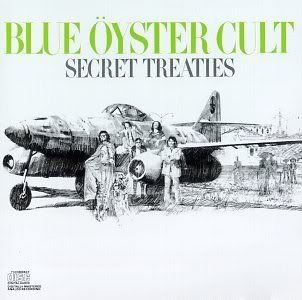
The album's song titles included "Cagey Cretins," "Harvester of Eyes," "Flaming Telepaths," and "ME 262" – a reference to the Nazi jet fighter (the first jet fighter to fly in combat) depicted on the cover. Here are a few representative examples of this album's lyrics:
From "Career of Evil" (co-written by Patti Smith):
I'd like your blue eyed horseshoe,
I'd like your emerald horny toad,
I'd like to do it to your daughter on a dirt road
And then I'd spend your ransom money,
But still I'd keep your sheep
I'd peel the mask your wearing,
And then rob you of your sleep
Rob you of your sleep
I choose to steal what you chose to show
And you know I will not apologize
Your mine for the taking
I'm making a career of evil . . .
From "Astronomy" (later covered by Metallica):
The clock strikes twelve and moondrops burst
Out at you from their hiding place
Miss Carrie Nurse and Susie dear
Would find themselves at Four Winds Bar
It’s the nexus of the crisis
And the origin of storms
Just the place to hopelessly
Encounter time and then came me
Call me Desdenova, eternal light
These gravely digs of mine, will surely prove a sight
And don’t forget my dog, fixed and consequent
Astronomy . . . a star
From "ME 262":
Get me through these radars, no I cannot fail
When my great silver slugs are eager to feed
I can't fail -- no, not now
When twenty-five bombers wait ripe
ME 262, prince of turbojet
Junkers Jumo 004
Blasts from clustered R4M quartets in my snout
And see these English planes go burn
Now you be my witness how red were the skies
When the Fortresses flew for the very last time
It was dark over Westphalia
In April of '45
As a special treat for all of you who experience a strange yet exciting tingling when you see Nazi stuff,
click here to watch a YouTube video that features "ME 262" as the soundtrack to a lot of German WWII film footage.
But first you should know the following:
1. The "Junkers Jumo 004" was the turbojet engine used in the ME 262.
2. The "R4M" was an unguided air-to-air missile that was added to the ME 262 late in the war.
3. "Fortresses" refers to the B-17 "Flying Fortress," which was the primary Allied heavy bomber in the European theatre.
4. "Westphalia" is a region in west-central Germany.
* * * * *
I think I took BOC's lyrics pretty seriously at the time – it appeared that they were intended to be taken seriously, and God knows I was being assigned readings in some of my classes in those days that I know my professors took seriously, although they often made less sense to me than BOC lyrics. Later I heard that the band members were a bunch of nerdy Jewish guys from Long Island who did the whole thing as a big joke, but I don't think that's really true. (I've skipped over the band's origins, personnel, etc., but you can get into all that by visiting
the BOC official website, which has a fairly detailed historical section, as well as
Wikipedia, etc.
I saw BOC on August 7, 1974 in Little Rock, Arkansas (along with the Guess Who). That was the summer before I went to law school, and after quitting my summer job (which was driving a water truck for a company that was widening US Highway 71 south of my hometown of Joplin, Missouri), I decided to go visit a high-school friend who had moved to Alexandria, Louisiana, and then say good-bye to my college girlfriend, who was spending the summer in Houston before heading off to Stanford Business School.
On the way, I stopped to visit a cousin of mine who lived in Little Rock, where her boyfriend (now husband) played baseball for the Arkansas Travelers, who were the Double-A minor-league affiliate of the St. Louis Cardinals.
The reason I know I saw that concert took place on August 7 is that Richard Nixon went on television to resign from office at 9:01 pm on August 8, and I was at the Travelers game with my cousin that night. I had no idea he had resigned until the next morning, when I was driving through the wilds of southern Arkansas on my way to Alexandria.
Today, BOC is best remembered for several relatively formulaic radio hits – like "Don't Fear the Reaper" and "Burnin' for You" – which came later. ("Don't Fear the Reaper" was the song featured in
the famous Christopher Walken-Will Ferrell "More Cowbell" bit on Saturday Night Live.
"Godzilla" wasn't too bad – or maybe it's just because I loved singing it whenever Hideki Matsui had a big hit for the Yankees. I have a couple of their later records, but the first three stand head and shoulders above anything else they did.
I must admit that BOC did not always bring out my nobler side. I left my copy of the first album on the back deck of my
1970 Olds Cutlass Supreme (the smallest engine this two-door coupe came with was a 350 V-8) and the hot Houston sun warped it a bit. I went to the local record and bought a new copy of the album.
I then returned a few hours later with my warped album and my receipt, claiming that the store had sold me a defective record and demanding a refund. The store manager wouldn't give me a refund, but did allow me to exchange it for a fresh copy of the record. Curses – foiled again. I still have both copies.
The summer after my first year of law school, I worked at a large Houston law firm. I got chummy with one of the secretaries in the department I was assigned to and socialized with her a bit outside of the office. ("Dating," unfortunately, would not be an accurate description of our relationship – much to my chagrin.) Sherry told me that M&Ms went very well with beer – I was skeptical at first, but she turned out to be right – and I responded to that kind gesture with a lie, hoping to impress this fair lady. To be exact, I showed her the computer printouts of the Blue Öyster Cult lyrics, and claimed I had written them.
She probably saw through this pathetic falsehood, but even if she had believed me, did I really think that lines like "Lecherous, invisible/Beware the limping cat" or "Didn't believe it when he bit into her face/It tasted just like a fallen arch" would win her heart? I guess I must have. And that, kind reader, goes a long way to explaining my limited success those days with the fairer sex – even though I was super cute (and have pictures to prove it).
Actually, Sherry did take a liking to "oyster boys," a term used in "Subhuman" – "Oyster boys are swimming now/Hear 'em chatter on the tide/We understand, we understand/But fear is real and so do I." (Say what?)
For some reason, I never bought CD versions of the BOC albums, so I hadn't listened to these songs for years until I got on YouTube in preparation for writing this entry. Whether the band was being serious or just having some fun with the teenaged heavy-metal fans who were too dumb or drug-addled to know it, I think that most of these songs hold up very well.
One final BOC story and then adieu. (I know you wish this post would never end, but my well of BOC material is about to run dry, I fear.)
My favorite author, George Pelecanos, often mentions the names of song titles in his books. "Then Came the Last Days of May," a song from the first BOC album (it's about three friends who are murdered by the confederate who is driving them to the Mexican border to consummate a drug transaction) is mentioned a couple of times in his 2008 novel,
The Turnaround.
The key event in
The Turnaround (which takes place in 1972) is an ugly confrontation that takes place when three white teenagers insult three black teenagers who are standing on a street corner in a working-class black neighborhood in the Maryland suburbs of Washington, DC. The driver of the car (a Ford Gran Torino) is the one who precipitates the fight, and he is shot and killed. One of his friends – who tries to prevent the trouble – is badly beaten.
Prior to the incident, there's a scene where the character who is later beaten was listening to the first BOC album in his bedroom, waiting for his girlfriend to call:
He was looking at the Blue Öyster Cult art now, while "Then Came the Last Days of May" played in the room. The song was about the end of something, its tone both ominous and mysterious, and it troubled Alex and excited him. The cover of the record was a black-and-white drawing of a building that stretched out to infinity, stars and a sliver of moon in a black sky above it, and, hovering over the building, a symbol that looked like a hooked cross. The images were unsettling, in keeping with the music, which was heavy, dark, dangerous, and beautiful. This was Alex's favorite new group.
After the incident, Alex goes home to recuperate after a long hospitalization and several reconstructive surgeries.
[H]e listened to his Blue Oyster Cult album incessantly, returning to the song "Then Came the Last Days of May" over and over again. "Three good buddies were laughin' and smokin'/In the back of a rented Ford./They couldn't know they weren't going far." It seemed to have been written for him and his friends.
A couple of years ago, Pelecanos edited an anthology of noir stories set in Washington titled DC Noir 2, and he a couple of the other authors featured in that anthology did a reading at a local bookstore/restaurant.
I bought a copy of the anthology for my older son, who is also a Pelecanos fan, and got all three authors to autograph it after the reading was over. But I also got Pelecanos to autograph the jacket of one of my two copies of the first BOC album, which includes "Then Came the Last Days of May." I'm not sure if it was the one I paid for or the one I exchanged the old warped record for.
To wrap this up, let's go back to the "I'm On The Lamb, But I Ain't No Sheep" lyrics quoted at the very beginning of this hot mess. What is the "Frontenac Chateau" mentioned in that song?
I assume that it's a reference to the
Chateau Frontenac, a famous old hotel that dominates the skyline of Quebec City, Canada, and is listed in The Guinness Book of Records as being the most photographed hotel in the world. What this hotel has to do with the song – other than the fact that it is located in Canada – is anybody's guess.
 |
| The Chateau Frontenac hotel |
Click on the link below to buy "I'm On The Lamb But I Ain't No Sheep":


 Posts
Posts

