Showing posts with label Pagliacci. Show all posts

Friday, August 5, 2022

Smokey Robinson & the Miracles – "Tears of a Clown" (1970)


Just like Pagliacci did

I try to keep my sadness hid


I’m aware of three well-known popular songs that make reference to the famous Leoncavallo opera, Pagliacci


The first is “The Masquerade is Over,” an Allie Wrubel-Herb Magidson collaboration that was first recorded in 1939:


I guess I’ll have to play Pagliacci

And get myself a clown’s disguise

And learn to laugh like Pagliacci

With tears in my eyes


The song was covered by everyone from Sarah Vaughan to Patti Page to Marvin Gaye to Stevie Wonder to Peggy Lee to José Feliciano to Aretha Franklin to . . . well, you get the picture.  Click here to listen to Sarah Vaughan’s 1956 recording.


Enrico Caruso in Pagliacci

“Mister Sandman” – a #1 hit for the Chordettes in 1954 – includes these lines:


Mister Sandman, bring us a dream

Give him a pair of eyes with a come-hither gleam

Give him a lonely heart like Pagliacci

And lots of wavy hair like Liberace


Click here to listen to the Chordettes’ version of “Mister Sandman.”


Today’s featured song – “Tears of a Clown” – also makes reference to “Pagliacci” in the lines quoted at the beginning of this post.  


*     *     *     *     *


Pagliacci – which was a big hit when it was first performed 1892, and remains very popular among contemporary opera fans – has a “play within a play” structure (like Shakespeare’s A Midsummer Night’s Dream and Chekhov’s The Seagull).


The opera is about a troupe of traveling actors who are putting on a play in which a character named Pagliaccio learns the identity of his adulterous wife’s lover and stabs both of them.  We have a case of life imitating art here: the actor who portrays Pagliaccio is actually married to the actress playing his wife, who is having a real-life affair with the actor who has the role of her lover in the play.  


When Pagliaccio stabs his wife and her lover in the play, he’s not just acting – he really stabs his wife and her lover, killing both of them.


That must have come as quite a surprise to the audience.


*     *     *     *     *


Did you notice that the character’s name is “Pagliaccio” – not “Pagliacci”?  All three of the songs discussed above mistakenly use “Pagliacci” when they really meant “Pagliaccio.” 


“Pagliacci” – which is the title of the opera – is the plural form of the Italian word for “clown.”  “Pagliaccio” – the name of the character who murders his wife and her lover – is the singular form of that word.  


It’s not unusual for even a major character in a play not to be identified by his given name.  For example, Our Town has the “Stage Manager,” and Cabaret has “The Master of Ceremonies” – famously portrayed by Joel Grey in the 1972 movie.  


There’s good reason to identify the main character in Pagliacci simply as “The Clown” because that is his role in the play with the play (or the play within the opera.)


*     *     *     *     *


“Tears of a Clown” – the final member of this year’s group of inductees into the 2 OR 3 LINES “GOLDEN DECADE” HIT SINGLES HALL OF FAME – was originally released on the 1967 Smokey Robinson and the Miracles album, Make It Happen.  
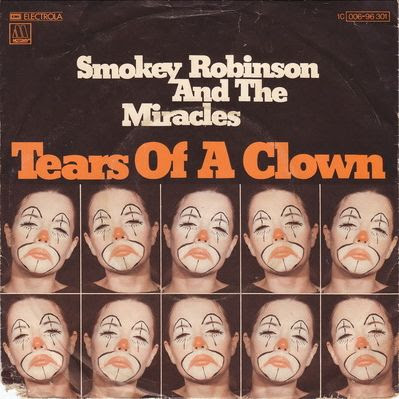

Three years later, some genius decided to release it as single in the UK, where it promptly went to #1.


When it was subsequently released as a single in the U.S., it went to #1 just as promptly.  (Better late than never.)


Click here to listen to “Tears of a Clown,” which is yet another note-perfect Motown production. 


Click on the link below to buy the record from Amazon:


Tuesday, April 30, 2013

Pomplamoose -- "Mister Sandman" (2009)


Give him a lonely heart like Pagliacci
And lots of wavy hair like Liberace

The Chordettes, a female vocal quartet that was formed in Sheboygan, Wisconsin, in 1954, had their biggest hit with "Mr. Sandman" in 1954.  Obviously, there was a lot that they didn't know about Liberace.

The Chordettes
"Mr. Sandman" was subsequently recorded by Chet Atkins, Marvin Gaye, The Chipmunks, the Supremes, the Andrews Sisters, and Linda McCartney.  Perhaps the most famous cover version of the song was the one recorded by Emmylou Harris, Dolly Parton, and Linda Ronstadt in 1980.

Pomplamoose recorded "Mister Sandman" (not "Mr. Sandman") in 2009, and their version was a perfect choice for the soundtrack of this 2010 Toyota Avalon TV commercial:


I don't know quite what to make of Pomplamoose.  Their music is foamy and frothy and lighter than air.  It's twee squared.  Twee with a capital "T"!  Twee on steroids!  But the 337,000 subscribers to the duo's YouTube channel don't seem to mind.

Even their name is twee.  Pomplamoose is a play on the French word for grapefruit, pamplemousse, which sounds even more ridiculous than the typical French word.

The band's two members -- they're a couple in real life -- are Jack Conte and Nataly Dawn (née Natalie Dawn Knutsen).  If you don't believe they're as twee as twee can be, check out Pomplamoose performing "Jingle Bells" on this Hyundai TV commercial from a couple of Christmases ago:


Nataly, who does most of the singing, is probably a perfectly nice young woman.  But Nataly's style of singing -- affected and cutesy and almost childlike -- has become all too prevalent among young female indie singers.  This kind of singing needs to stop!  (As does Jack's insufferably goofy on-camera behavior.  No juggling -- please!)

I think the main problem with Pomplamoose is that Jack and Nataly both went to Stanford University.  (Jack majored in music, while Nataly studied art and French literature.)

Jack and Nataly: twee and tweer
Jack and Nataly are typical of pop musicians who went to Ivy League schools or quasi-Ivy League schools like Stanford.  Bands like Pomplamoose and Vampire Weekend (whose members went to Columbia) and others of that ilk are generally (1) too smart, (2) too affluent, (3) too self-aware, and (4) too well-adjusted to be rock stars.

Rock stars are generally angry -- perhaps because they grew up poor, had rotten parents, or were social misfits in high school.  From all outward appearances, Pomplamoose's members have absolutely nothing to be angry about -- so you end up with songs like "Mister Sandman."  

Ex-Harvard student Tom Morello of Rage Against the Machine -- whose music is an angry as its name indicates -- may appear to be an exception to my rule, but RATM's anger is mostly just political correctness.  It's intellectual anger, not the kind of deep personalized anger that drives you to do great things just to show all the assh*les who dissed you when you were in high school how stupid they were.

These two graduated from Stanford?
It's not surprising that Pomplamoose picked "Mister Sandman" to cover, given that its lyrics feature a reference to the famous opera, Pagliacci.  That's about as intellectual as pop music gets.  (I don't recall any operatic references in "Hound Dog" or "Summertime Blues.")

Speaking of Stanford, I visited the Stanford campus recently.  As I've explained elsewhere, I stayed in San Francisco when my family flew back from our recent vacation there -- I was flying to San Diego on business the next night.  Before heading to the airport, I drove to Palo Alto and rented a very nice KHS hybrid bike from the Campus Bike Shop, a large, well-stocked, and privately owned bike store that's located smack dab in the middle of the Stanford campus.

Here is a picture of some of the bikes in the Stanford rental fleet:


Stanford has a very attractive campus.  I didn't think it had a lot of personality -- it was too tidy and uniform-looking to be all that interesting -- but it seemed like a very pleasant environment for its students.  And it is a very bike-friendly place -- a lot of students ride bikes to class:


Here's a view of one of the classroom buildings at Stanford.  You can see the Hoover Tower (named after Stanford grad Herbert Hoover) in the background:


Unfortunately, there were no good bike trails nearby.  I rode through Palo Alto's residential neighborhoods for several miles, crossing over into Mountain View before finally coming to the paved Stevens Creek Trail.  I took it until it ended in Shoreline Park, where I had a view of the marshy southern parts of San Francisco Bay.

Here's a shot of Stevens Creek and the trail:


 The trail runs along the western edge of Moffett Federal Airfield, a former naval air station that is now part of NASA's Ames Research Center.  

Hangar One at Moffett was built to house the USS Macon, which was launched in 1933 and was one of two largest helium-filled airships ever built.  (It was just a few feet shorter than the hydrogen-filled Hindenburg.)  Hangar One's floor covered eight acres and could have accommodated six football fields.    It's almost 200 feet high.  Hangar One is not only a big-ass hangar, it's one of the biggest-ass structures in the world.

Here's the Macon moored outside of Hangar One:


The Discovery Channel show, MythBusters, used another big-ass hangar at Moffett to disprove the old myth that it is impossible to fold a sheet of paper in half more than seven times.  (They started with a piece of paper that was as big as a football field.)


Moffitt Airfield is also home to a Boeing 767 owned by Google founders Larry Page and Sergey Brin.  (Google is headquartered in Mountain View.)


Here's Pomplamoose's "Sandman" video.  It's a good example of Pomplamoose's "VideoSongs," which are completely transparent.  Pomplamoose doesn't do any lip-synching -- for voice or for instruments.  If you hear a sound, you will see it -- and vice versa.  So when Nataly's voice is overdubbed to make it sound like she is singing three-part harmony, you will see three Natalys singing.  (There's a short interview with Jack and Nataly after the song, which I found unbelievably annoying.  How did these two get into Stanford?  They act like twelve-year-olds with room-temperature IQs.)


Click here to buy "Sandman" from Amazon: