Showing posts with label James Williamson. Show all posts

Sunday, November 6, 2016

Iggy and the Stooges – "Raw Power" (1973)


Don't you try to tell me what to do
Everybody always tryin' to tell me what to do

I don’t know if anyone ever tried to tell Iggy Pop and the other Stooges what to do.  If so, I’m pretty sure they didn’t listen.  

I learned a lot about the Stooges from Gimme Danger, Jim Jarmusch’s new documentary about the group.  (You can click here to read my review of that movie.)


For example, I learned that Stooges guitarist James Williamson said good-bye to rock ’n’ roll and went to college to study electrical engineering when the group broke up in 1974.  Williamson moved to Silicon Valley after graduating from Cal Poly Pomona, and eventually became vice president for technical standards at Sony Electronics.  (Among other things, he worked with other industry members to codify the technical specification for Blu-ray video discs.)  

Williamson and Ron Asheton – one of the original members of the Stooges – first met when both were in high school.  Williamson had formed a cover band called The Chosen Few, and Asheton eventually became the group’s bass player.  But shortly after Asheton joined The Chosen Few, Williamson left the band.  (Williamson’s departure wasn’t voluntary.  His high school suspended him because his hair was too long.  When he refused to get it cut, he was sent to reform school for several months.)

Ron Asheton, James Williamson, and Iggy Pop
Williamson joined the Stooges in December 1970, just in time to see the group dissolve.  (The breakup was the result of drug and alcohol problems and the fact that the two albums the Stooges recorded before Williamson came on board were commercial flops.)

Stooges frontman Iggy Pop (whose real name is James Osterberg) had been blown away the first time he heard Williamson play the guitar:

The first time I heard him play, which was in a basement in Ann Arbor, he did something that later became known as punk or speed metal – a great number of chords, almost all at once – but which at that time came from no known musical vocabulary.  His playing had dirt, but it did not lack authority.  You could hear the intelligence in it.

So when Iggy hooked up with David Bowie and went to London to record a new album in 1972, it was Williamson he invited to join him – not Ron Asheton nor his brother Scott (the original Stooges drummer).

Iggy Pop and David Bowie
Asheton couldn’t believe it:

I saw [Iggy Pop] at a party and he offhandedly said “I’m going to England.  Oh, by the way, I got a [record] deal and I'm taking James [Williamson].”  I’m thinking, “Thanks a lot, pal.  You shit on your two fucking buddies who started the band.”  I was shattered. 

Eventually Iggy did invite the Ashetons to come to London and play on the new Stooges album.  But Ron was told he would have to play bass instead of guitar.

“[Williamson] was supposed to be a helper for me,” Asheton told an interviewer many years later, “but he totally usurped my position.”

Iggy and Williamson handled all the songwriting for the Raw Power album, and Asheton wasn’t happy about that either:  

So [Williamson] and Iggy were the songwriters.  They wouldn't let me do nothing even though I would come up with pieces.  Jim [Osterberg] would actually almost go for something.  Little suggestions I made for the tunes, little twists.  Not that I did any major structural changes.  But I did do pieces to enhance and I was never recognized for it or [given] even a fuckin' “thank you.”
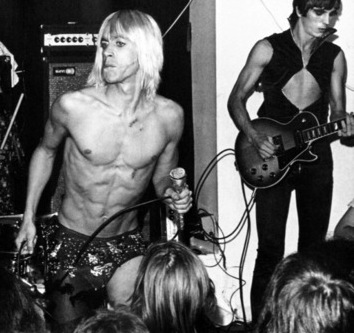
Iggy Pop and James Williamson
Today, many critics and musicians tout Raw Power as one of the greatest rock albums of all time.  But it didn’t sell much better than the first two Stooges albums, and their record company dumped them shortly after it was released.

The group’s manager, Tony DeFries (who also managed David Bowie), severed ties with them about the same time – reportedly because he believed that much of the money he had advanced to the Stooges had been squandered on drugs

With no record deal and no management, the Stooges threw in the towel for a second time in 1974.  Iggy Pop and James Williamson recorded an album together in 1975, but couldn’t find a record company willing to release it until two years later, after Iggy had released two successful solo albums (The Idiot and Lust for Life).  

Williamson did some producing after that, but devoted most of his time and energy to learning about computers.  “I gave up being a Stooge to study calculus,” Williamson told The Guardian in 2010.  “I designed computer chips, working with geeks who had no idea about my past and who wouldn't have heard of the Stooges.”  

In 2003, Iggy Pop and the Asheton brothers reformed the Stooges.  The band toured successfully and even released a new album.  

When Ron Asheton died of a heart attack in 2009, Iggy tracked down Williamson and asked him if he would take over as the Stooges’ guitarist.

Sony Electronics executive James Williamson
“I told him I had a full-time job and couldn’t do it,” Williamson told The Guardian.  But the aftershocks of the 2008 recession forced Sony to tighten its corporate belt.  Williamson was one of the Sony executives who was offered early retirement.  

He accepted the buyout offer and picked up his guitar, which had been gathering dust for 30-odd years.  After spending a few months getting reacquainted with his signature riffs, the 60-year-old Williamson made his second Stooges debut before 30,000 fans in São Paulo, Brazil.  It was the biggest audience he had ever played for. 

Iggy Pop and James Williamson in 2011
One of Williamson’s biggest admirers was Johnny Marr, who played guitar for the Smiths and Modest Mouse:

I'm his biggest fan.  He has the technical ability of Jimmy Page without being as studious, and the swagger of Keith Richards without being sloppy.  He's both demonic and intellectual, almost how you would imagine Darth Vader to sound if he was in a band.

(Darth Vader?  Really?)

*     *     *     *     *

“Raw Power” is the first track on the second side of the Stooges’ 1973 album of the same name.  


Iggy Pop initially mixed the album, but the Stooges’ record company wasn’t happy with the result.  So David Bowie was asked to remix it.

Twenty years later, Iggy’s original mixes were released as Rough Power.  

Several years after the release of Rough Power, Columbia Records invited Iggy to re-mix the album.  Iggy purposely pushed the recording levels into the red – causing considerable audible distortion – and the resulting album may be the loudest one ever released.

Both James Williamson and Ron Asheton said they preferred David Bowie’s mix of Raw Power.to Iggy’s 1997 version, although neither had liked the Bowie-produced album when it was originally released.

Here’s David Bowie’s mix of “Raw Power”:


Click below to buy the song from Amazon:

Friday, November 4, 2016

Iggy and the Stooges – "Gimme Danger" (1973)


Gimme danger
Little stranger

If you’re a fan of Iggy Pop and the Stooges, you’re going to love Gimme Danger, director Jim Jarmusch’s new documentary about the group.  (Gimme Danger was released in New York and Detroit last week, but is hitting theaters in the rest of the country today.)

Here's the Gimme Danger trailer:


Jarmusch has been described as an idiosyncratic filmmaker – which is a polite way of saying he is a really weird dude.

His feature films – Stranger Than Paradise, Down by Law, and Broken Flowers are three of his better-known movies – often move v-e-r-y slowly.  

Jarmusch once said that his goal as a filmmaker was “to approximate real time for the audience”:

Instead of embellishing the pace with quick editing, and moving things along simply because the audience is accustomed to being moved along at a certain “film” pace, I wanted to remove all that.  Minimalize it so that you watch people in almost real time. 

Jim Jarmusch and Iggy Pop
at the Cannes Film Festival
By contrast, Gimme Danger moves right along.  In addition to the usual talking-head interviews and footage of live performances by the Stooges, Jarmusch mixes in all kinds of old movie clips, kinescopes of old black-and-white TV shows, even animation – there’s never a dull moment in Gimme Danger.

One of the many strengths of Gimme Danger is that it’s not just about the group’s infamous lead singer, Iggy Pop – whose real name is James Osterberg.  Gimme Danger also pays attention to the other original Stooges – bassist Dave Alexander, guitarist Ron Asheton, and drummer Scott Asheton – as well as guitarist James Williamson, who joined the group after the first two of the three Stooges albums were recorded.  

Gimme Danger introduces us to Osterberg when he was an Ann Arbor high school student and aspiring blues drummer in the mid-1960s.  

James Osterberg as a high school senior
Osterberg got tired of staring at his bandmates’ butts, so he gave up the drums and became the frontman for a new band he formed – which was initially called the Psychedelic Stooges, and then renamed the Stooges.  (After the Stooges signed a record deal, Osterberg called Moe Howard on the phone to see if he had any objection to the band’s name.  Howard told him that as long as the band wasn’t called the Three Stooges, he couldn’t care less what name they used.)

The group’s eponymous first album was recorded in New York in 1969 – its producer was Velvet Underground member John Cale.  It didn’t sell.  

Neither did their second album, Fun House, which was recorded in Los Angeles the next year.  

Ron Asheton, Williamson,
and Osterberg in 1973
Iggy met David Bowie at Max’s Kansas City in 1971.  Bowie persuaded Iggy to come to London to record a new album, which he produced.  But Raw Power didn’t sell any better than the group’s first two albums.   

The Stooges’ record company cut them loose shortly thereafter, and the group was reduced to playing at some really sketchy venues.  Here's how Iggy described the band's final tour:

We bumbled around America, playing raggedly [and] upsetting people wherever we went.  Some gigs, I could get it together to sing – some I couldn't.

The Stooges performing live
During a 1974 gig at a biker bar, a thrown bottle narrowly missed Iggy Pop’s cabeza, but Iggy was such a degenerate heroin addict by that time that he might not have felt anything if the throw had been more accurate.  (We’re talking the Blues Brothers at Bob’s Country Bunker, boys and girls.)

The Stooges threw in the towel after that biker bar gig.  Iggy – who had moved to West Berlin with his friend and fellow drug addict Bowie – eventually kicked his habit and released several acclaimed solo albums.  Ron Asheton and later his brother Scott joined forces with frontwoman extraordinaire Niagara in Destroy All Monsters and then Dark Carnival.  (Unfortunately, Jarmusch didn't interview Niagara for the Gimme Danger.)  James Williamson said good-bye to rock ’n’ roll and enrolled at Cal Poly Pomona as an electrical engineering major.  

Ron Asheton with Niagara
After a hiatus of almost 30 years, Iggy got back together with the Ashetons and ex-Minutemen bass player Mike Watt in 2003 and reformed the Stooges.  When Ron Asheton died of an apparent heart attack several years later, he was replaced by Williamson.

Gimme Danger closes with the Stooges’ 2010 Rock and Roll Hall of Fame induction ceremony.  Iggy flipped the bird to the black-tie-attired crowd with both hands before delivering his acceptance speech, which included a heartfelt tribute to Asheton.  The 63-year-old then stripped off his shirt and led the Stooges in a rousing performance of “Search and Destroy.”  


Don’t you just love a movie with a happy ending?

*     *     *     *     *

The significance of the Stooges is much greater than you might expect given that the group only released three albums, none of which sold worth a damn.  

The band’s best songs were and are almost unbearably intense.  “I Wanna Be Your Dog” and “Search and Destroy” in particular stagger you like a body blow from a heavyweight boxer. 

Bob Dylan recently won the 2016 Nobel Prize for Literature for his song lyrics.  No one will ever mistake the lyrics of a Stooges song for those of the songs of 2016 Nobel Prize for Literature winner Bob Dylan.  (“Blah blah blah blah blah blah” is how Iggy characterizes Dylan’s lyrics.)  

Williamson, Osterberg, and
Scott Asheton in 2010
Dylan’s influences included Woody Guthrie, William Burroughs, William Blake, Arthur Rimbaud, Jack Kerouac, Bertolt Brecht, and many others.  The Stooges lyrics were inspired by  . . . Soupy Sales? 

In Gimme Danger, Osterberg reminisces about watching the children’s TV show, Lunch with Soupy Sales, when he was a kid growing up in Ann Arbor, MI.  The comedian would invite his young viewers to write letters to him, but asked them to keep those letters brief – 25 words or less.

Osterberg says that Soupy’s 25-words-or-less rule inspired him when he began to write songs for the Stooges.  

*     *     *     *     *

“Gimme Danger” was the second track on the Stooges’ third and last studio album, Raw Power, which was released in 1973.


The Stooges recorded Raw Power – which also included “Search and Destroy” – in London.  Iggy Pop produced and mixed the album, but the group’s record company insisted on having David Bowie remix it.

Raw Power was Kurt Cobain’s favorite album – he said it influenced Nirvana’s sound more than any other album.

Here’s “Gimme Danger”:


Click below to buy the song from Amazon: