Showing posts with label Devo. Show all posts

Tuesday, December 3, 2019

Hotfoot Quartet – "Mongoloid" (1979)


Mongoloid, he was a mongoloid
One chromosome too many

Bob Frank, who was born in Cleveland in 1953, heard blues music for the first time when he was 14 years old.  

“My mother had bought me an FM radio for my birthday, and I used to listen to it late at night, hunting for different kinds of music when I was supposed to be sleeping,” Bob told me recently.  “One Friday night, I discovered a blues program on a local college radio station, and I had what I guess I would describe as an epiphany.  That night was the beginning of my lifelong obsession with the blues.”

A week later, that program featured blues harmonica records.  So Bob took a train into downtown Cleveland the next day and purchased a Hohner “Marine Band” harmonica (in C):


When he moved to Boston to attend Boston University a few years later, he bought a Fender Telecaster and taught himself to play blues guitar.  His sophomore year, he put together a band – they called themselves the Nathaniel Graves Band – that played at many of the colleges in the Boston area and eventually got a regular gig at Charlie’s Place, a Harvard Square bar where they played seven nights a week.

When the Nathaniel Graves Band broke up, the bar owner asked Bob if he could put together a new group to play there.  “I told him I really needed to go back to school and focus on graduating,” Bob told me.  “So he went out and got this guy from New Jersey – Bruce Springsteen.”

*     *     *     *     *

Music journalist Jon Landau met Springsteen at Charlie’s Place in April 1974 – shortly after Bob Frank’s band had given up their regular gigs there.  


A few weeks later, Springsteen opened for Bonnie Raitt at the Harvard Square Theatre.  That was the night Springsteen played “Born to Run” in concert for the first time. 

Landau reviewed Springsteen’s performance for Boston’s The Real Paper:

I saw my rock 'n' roll past flash before my eyes.  And I saw something else: I saw rock and roll future and its name is Bruce Springsteen.  And on a night when I needed to feel young, he made me feel like I was hearing music for the very first time.

Landau and Springsteen in 1974
Landau later became Springsteen’s manager and produced many of his most famous albums.

*     *     *     *     *

A couple of years after he graduated from BU and moved back to Cleveland, a friend of Bob Frank’s hired him as the music director for a local production of Diamond Studs: The Life of Jesse James, a musical that featured a bluegrass score.  When the play’s run was over, Bob and several of the musicians who had performed in the show decided to start a bluegrass band, which they called the Hotfoot Quartet.  

I interviewed Bob a couple of weeks ago about the Hotfoot Quartet and their famous – infamous? – cover of Devo’s “Mongoloid.”  (Bob handled the lead vocal and played the guitar on that record.)

2 or 3 lines:  Maybe I’m wrong, but I don’t think of Cleveland as a big bluegrass town.  Was the Hotfoot Quartet able to get jobs performing bluegrass live?

Bob Frank:  Our first regular gig was at a bar called the Coach House, which was right by the Case Western Reserve University campus.  We played there every Friday night.  They had a jukebox in the bar, and whenever we took a break, someone would play Devo’s “Mongoloid.”  Sometimes they would put it on when our break was almost over, so when we were back up on the bandstand ready to start our next set, we would  kind of play along with the record until it ended.  Eventually people started asking us to play it, so we would play the whole song a couple of times a night.

Q: How did it happen that you put out a record of “Mongoloid”?

A:  There was this high-school kid named Russell Potter who used to hang out at the bar, and he came up and said, “Do you guys want to make a record?”  Back then if someone asked you to make a record, it was a big thing, so of course we said yes.  

Q:  Where did you record “Mongoloid”?

A:  Russell took us to this cool studio called Boddie Recording, which was in the basement of a house owned by an African-American couple.  Besides the recording studio, Boddie had a record pressing machine.  He had rigged up a TV so that his wife could watch her soap operas while she pressed records one at a time.  We had to throw out the first batch of records she pressed for us because she didn’t let them cool off enough before she picked them up, so she left fingerprints on each record.


[NOTE: The Boddie Recording Co., which was owned by Thomas and Louise Boddie, was Cleveland's first African-American owned and operated recording studio, serving a clientele that included not only gospel, soul, and R & B groups but also rock, bluegrass, and country musicians from as far away as Detroit and West Virginia.]

Q:  So it was kind of like someone walking on a cement sidewalk before the cement dried and leaving foot prints?

A:  Exactly.  We had to go back and ask Mr. Boddie to make us new records to replace the ones his wife had ruined.  I think we ended up with a thousand copies of it.  

Q:  What was the flip side to “Mongoloid”?

A:  Our fiddle player suggested a waltz called “LaZinda Waltz” that he had heard on a Johnny Gimble album.  It was an instrumental – no lyrics – and was totally different from “Mongoloid.”  At one point I wanted to cover “Ramshackle Shack,” a classic old Stanley Brothers song, but we ended up going with “LaZinda Waltz.”

Q:  On the cover on the “Mongoloid” record, you guys are wearing suits that look like the weird yellow one-piece suits that Devo wore in their concerts.

A:  After we recorded “Mongoloid,” I asked this guy who called himself Johnny Dromette – his real name was John Thompson – to do our record cover.  Thompson owned a record store and released some records by Cleveland punk bands on his own label, and did a really good job on the sleeves for those records. 

Q: How did you know Dromette – or Thompson?

A:  I met him before we formed Hotfoot Quartet.  I used to hang out at his record store, and one day he asked me if I wanted to help him put on some concerts.  I was about two years out of college, and I had just gotten fired from my first job – which was selling advertising for a radio station – so I had absolutely nothing else to do.  When Johnny asked me to find a place to hold these concerts, I remembered that my father had a friend – Kellman was his name – who owned an old auditorium downtown.  So I went to Mr. Kellman and rented the auditorium for Johnny’s first show for $150.  

Q: Who were the bands who played in that show?

A:  Johnny hired three bands.  One of them was Devo.  The second band was this act out of Ann Arbor called Destroy All Monsters.  I forget who the third band was.

A poster for the WHK Auditorium show
[NOTE: Click here to hear a bootleg recording of Devo’s performance that night.]

Q:  Was the show a success?

A:  Oh yeah – we had a lot of people come to the thing.  Johnny wanted to do another show after the first one, so I called up Mr. Kellman again and rented his building – which was called the WHK Auditorium – for a concert that Pere Ubu headlined.  It was about a year later that we recorded “Mongoloid.”  Johnny not only designed the cover, he distributed the record, too.  He got it played all over.

Q:  What did people think of ”Mongoloid”?

A:   The Hotfoot Quartet was trying to get really serious about playing bluegrass at that time, and the record kind of held us back with a lot of local bluegrass purists – they thought we were just a novelty act.  Bluegrass was a tough nut to crack back then.  I think we eventually lived it down – we recorded three albums, and we were together almost 20 years.    

Q: Do you have any idea what Devo thought of your cover of “Mongoloid” – assuming they knew about it?

A:  I don’t know if they ever heard this record.  I’ve got to be honest with you – to this day, I’ve never spoken to anyone from the band.  I helped put their Cleveland concert on in 1977, I ran the sound that night – but I never spoke to them.  

Q: A lot has changed since you recorded “Mongoloid,” and a lot of people today probably consider the song inappropriate and offensive.  Did you ever hear from people who said they were offended by the record?

A:  Nobody reacted to it negatively back in 1979.  I always wondered why no one ever came up and said, “How dare you!”  But that never happened – no one ever complained.  But we only played it live for about a year after the record was released.  I’m sure the reaction would be very different if the Hotfoot Quartet was still together and playing it today. 

*     *     *     *     *

Hotfoot Quartet stayed together for almost two decades, recording two albums and touring extensively.  After they broke up, Bob went back to his first musical love and formed a blues band called Blue Lunch.  

In 2018, Bob released his first solo album, True Stories and Outrageous Lies, which features a number of original songs:


We’ll feature a song from Bob’s solo album sometime in the feature.  But for the next few months, 2 or 3 lines is featuring only records that he heard on legendary DJ Steven Lorber’s “Mystic Eyes” radio program in 1980.  The Hotfoot Quartet’s cover of “Mongoloid” is certainly one of the most distinctive of those records.

*     *     *     *     *

Click here to listen to the Hotfoot Quartet’s cover of Devo’s “Mongoloid.”

[NOTE: In addition to Bob Frank, the other musicians who played on that recording were Paul Kovac (banjo and vocal), Bob Yocum (fiddle), Jim Blum (bass and vocal), and Bobby “Bobby Smack” Smakula (mandolin).]


Sunday, June 3, 2018

Devo – "Through Being Cool" (1981)


We're through being cool
Eliminate the ninnies and the twits

Your Nation’s Capital is now a cool city, according to a recent Washington Post opinion piece by law professor David Fontana.  He thinks that is “terrible news for American democracy”:

Like all hip cities, contemporary Washington combines cool with a distinctive local flavor.  New York is where cool meets money, Los Angeles is where cool meets beauty, San Francisco is where cool meets technology — and Washington is where cool meets government.  

That combination has created a class of people unique in American history.  If the late 1990s and 2000s produced the hipster as a new type of cool in some of America’s more stylish cities, the more recent past has produced Washington’s version of it: the “govster” — a person who is able to enjoy the benefits of living in a cool city while also working for the federal government or somehow exercising influence over the direction of national politics.

David Fontana is anti-cool
Fontana says that one of the things that makes Washington cool is its chi-chi restaurant scene:

[T]he new Washington was rated by Zagat as the nation’s hottest dining city in 2016.  The capital received its first stars from Michelin that same year.  José Andrés, one of the world’s most prominent chefs, started in Washington before branching out elsewhere.

This represented a major change, according to Fontana:

For a long time, Washington was more like Atlanta or Buffalo or Kansas City.  It had . . . restaurant scenes just like these cities did, but [DC-area] restaurants couldn’t be compared to those in Los Angeles, New York or San Francisco.  Today, that’s no longer true.  

Why does Fontana think that’s “terrible news for American democracy”?

The fear is not just that cool Washington will increasingly struggle to relate to America, but also that America will struggle to relate to it.  Can people who live in Atlanta or Buffalo or Kansas City fully connect with a metropolitan area where the median home value is half a million dollars? 

*     *     *     *     *

Observer writer Davis Richardson says Washington isn’t a cool city, and never will be one (world without end, amen): 

The Washington Post ran an uninformed piece on Monday claiming that Washington, D.C. is cool.

Although the town is rapidly gentrifying . . . it is a mistake to conflate unaffordable housing with trendiness. 

(True dat.)

Pundit Davis Richardson
While the author of the Post‘s suspicious report recognizes the city’s elitism and disconnect from everyday Americans . . . he fails to recognize how miserable of a place D.C. actually is to live, even for those who can afford to gallivant from pastel Georgetown townhouses to sprawling Maryland country clubs.

Having grown up in the city’s surrounding suburbs, I will be the first to tell you that D.C. is a beautiful town filled with hideous people, all slogging their resentments across grueling beltway commutes.

That doesn’t really have anything to do with the city’s foodie culture, but no matter – I love snotty rants like Richardson’s piece.

*     *     *     *     *

To go back to Fontana’s thesis, I’ve spent a fair amount of time in his triumvirate of American cool, Los Angeles, New York City, and San Francisco.

As for the three burgs he chooses to represent uncool America, I know Kansas City well, but am generally ignorant of Atlanta and Buffalo.

I’m guessing that Washington is more like Atlanta than any of the other cities named by Fontana, although it does have some things in common with New York City.  Of course, you could say a minor-league baseball player has some things in common with Aaron Judge.

Aaron Judge and Jose Altuve
Washington may have a thriving restaurant scene, but that hardly makes it cool.  If you ask me, musicians and artists and writers and other creative types do much more to determine how cool a place is than its restaurants.  

That’s not to say that you have to be a musician or an artist or a writer or other creative type to be cool.  Not all creative types are cool, and not all cool people are creative types.  But I think cool creative types and cool non-creative types are both in relatively short supply here.

What qualifies me to say that?  God knows I’m not cool at all, but I do think I know cool when I see it.  Of course, I could be sadly mistaken about that. 

In the next 2 or 3 lines, I’ll tell you about one of the restaurants that makes Washington so cool.

*     *     *     *     *

“Through Being Cool’ was the first track on Dev’s fourth studio album, New Traditionalists, which was released in 1981.  


Click here to watch the music video for “Through Being Cool.”

And click below to buy the song from Amazon:

Monday, February 8, 2016

Devo – "Uncontrollable Urge" (1978)


I got an uncontrollable urge
I wanna tell you all about it

Impulse control disorder (ICD) is a class of psychiatric disorders characterized by an inability to resist an urge or impulse.  (E.g., pyromania and kleptomania.)

In many Anglo-American jurisdictions, the inability to exercise self-control is at least a partial defense to a criminal charge.  So someone who kills another person as the result of an uncontrollable urge could be convicted of manslaughter, but couldn’t be convicted of murder.

After Lorena Bobbitt cut off the penis of her husband, John Wayne Bobbitt, she was found not guilty of the crime of malicious wounding because she had yielded to an irresistible impulse to do so.  (Many other women have experienced that same impulse at one time or another.  Fortunately, it has proven to be irresistible in only a small number of instances.)  

Lorena and John Wayne Bobbitt
Lorena testified that her husband had raped and beaten her repeatedly, and that the constant abuse caused her to finally snap.  

But the Ecuadorean native gave police a slightly different explanation for her action the night of her arrest: "He always have orgasm, and he doesn't wait for me ever to have orgasm.  He's selfish." 

“Uncontrollable Urge” is the first track on Devo’s debut album, Q: Are We Not Men?  A: We Are Devo!


I bought the album shortly after it was released in 1978, but forgot about it for a long, long time.  A couple of years ago, I discovered that it was available from my public library through Freegal.

It’s an absolutely unique album, full of compelling music by a group of very talented but very weird guys from Akron, Ohio.  If 7 Up was the uncola, Devo is the unrock ’n’ roll band.

Here’s a video of Devo performing “Uncontrollable Urge” in 2014.  Lead singer Mark Mothersbaugh – who went on to become a very successful movie and television soundtrack composer – was 64 years old at the time, and his performance gives hope to all of us hommes et femmes d'une certain âge :


Here’s “Uncontrollable Urge”:


Click below to buy the song from Amazon:

Friday, August 24, 2012

Devo -- "Come Back Jonee" (1978)


Jonee went to the pawnshop
Bought himself a guitar
Now he's gonna go far

A couple of weeks ago, 2 or 3 lines featured Devo's "Gut Feeling/(Slap Your Mammy)."

I had a hard time choosing between that song and "Come Back Jonee," the track that follows it on Devo's debut album, Are We Not Men? We Are Devo!, but I eventually chose "Gut Feeling."

Then it hit me: I'm in charge here . . . I can feature both songs if I want to!  (If you don't like it, go find a different wildly popular blog to read.)


"Come Back Jonee" (pronounced "Johnny") was clearly inspired by Chuck Berry's classic 1958 hit, "Johnny B. Goode."  (Just listen to the very Berry-esque lead guitar licks.)

With the possible exception of a few Elvis Presley songs, is there a more iconic fifties rock 'n' roll song than "Johnny B. Goode"?

Berry's hit is perhaps the most covered song in pop music history.  (Wikipedia lists almost a hundred artists who covered it, including the Beach Boys, the Beatles, Elvis, the Grateful Dead, Jimi Hendrix, Led Zeppelin, Prince, the Rolling Stones, the Who, and Marty McFly and the Starlighters -- that's the band that played at the high school dance in Back to the Future.)

Michael J. Fox as Marty McFly
The line about "a country boy named Johnny B. Goode" was originally written as "a colored boy named Johnny B. Goode," but Berry changed the lyric to increase his chances of getting on the radio.  

The Devo song begins with a nod to Berry's hit:

Come back Jonee
Jonee be good
Treat her like you should

While Johnny B. Goode lived in a log cabin in the Louisiana backwoods, Devo's Jonee seems to have been a city boy -- after all, he bought his guitar in a pawnshop and drove his Datsun on an expressway.

Like many guitar heroes, Jonee wasn't very nice to his girl:

You gotta love 'em and leave 'em
Sometimes you deceive 'em
You made her cry
Jonee, you're bad

But karma's a bitch, and Jonee eventually paid the price for making his girl sad:

Jonee jumped in his Datsun
Drove out on the expressway
Went head-on into a semi
His guitar is all that's left now

If you're too young to know what a Datsun is, let me explain.  Datsun was a brand name used by an old Japanese automobile company, DAT Motorcars, which was taken over by Nissan Motor Co. in 1933.

Datsun B210 (circa 1975)
When Nissan entered the American market in 1958, they called their cars Datsuns.  But the company decided to phase out the Datsun brand and replace it with the Nissan name.

The rebranding strategy was announced in the U.S. in 1981, and the company took several years to fully implement the name change (at a cost of about $500 million).  By 1986, the transition was complete.

At the time, I remember a lot of business experts saying Nissan was crazy to abandon the well-known Datsun brand name in favor of Nissan.  I guess it worked out OK in the long run, but I remember that I was not entirely accustomed to the new name in 1990, when I bought a black Nissan Maxima.  (Best car I ever owned, with the possible exception of my first one -- a 1970 Olds Cutlass two-door with the 350 V8.)

1990 Nissan Maxima (not mine)
By the way, Nissan just announced that it is going to revive the Datsun name for the inexpensive models it sells in India, Indonesia, and Russia.

Here's the truly demented music video for "Come Back Jonee."  (Note the one-octave synthesizer Mark Mothersbaugh plays.)


Click here to buy this song from Amazon:

Wednesday, August 8, 2012

Devo -- "Gut Feeling/(Slap Your Mammy)" (1978)


Something about the way you taste
Makes me want to clear my throat

Herewith begins a new series of 2 or 3 lines posts.  (The old series rarely if ever truly end -- they just fade away when I forget about them.)

This series will feature the music I liked in the time period that began when I left law school and ended when I had children -- mid-1977 through mid-1983.  I'm going to serve you up some new wave, some punk, some art rock, and who knows what else.  (I usually have no particular plan when I start a new series, and this one is no exception.)

(I read it in translation)
Here's a quote from Michel Houellebecq's novel, La carte et le territoire (The Map and the Territory):  

Jed would be asked numerous times what it meant, in his eyes, to be an artist.  He would find nothing very interesting or original to say, except one thing, which he would consequently repeat in each interview: to be an artist, in his view, was above all to be someone submissive.  Someone who submitted himself to mysterious, unpredictable messages . . . messages which nonetheless commanded you in an imperious and categorical manner . . . to set off in a radically new direction, or even occasionally no direction at all.

Exactly.  Which explains why I am writing about a group that I haven't thought about for three decades or more -- a group that I would have remembered as recently as last week as being the object of a short-lived and rather shallow enthusiasm of mine, which was based almost entirely on their novelty and eccentricity rather than any real musical merit or significance -- a group whose music I have suddenly realized is brilliant and absolutely original.

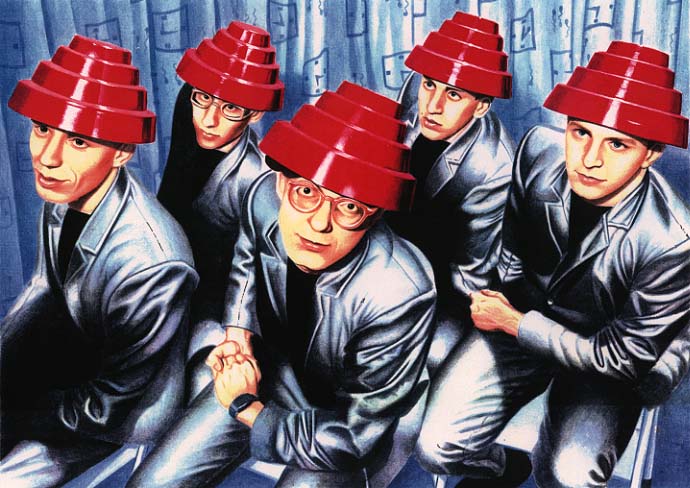
Devo (wearing energy domes)
Ladies and gentlemen, boys and girls, I speak of . . . Devo.  (Of course!)    

A funny thing happened to me recently while I was on the road to Damascus.  (Actually, I was taking a walk in my neighborhood with my dog and my iPod.)

The long instrumental introduction to "Gut Feeling/(Slap Your Mammy)" -- you'll find it on side two of Devo's debut album, Q: Are We Not Men?  A: We Are Devo! -- was playing, and suddenly a light from Akron, Ohio, flashed all around me, and I fell to the ground and was blind.


As I lay on the ground, I listened to the song three times, and something like scales fell from my eyes and I could see again.  A neighbor who closely resembled Brian Eno (the producer of We Are Devo!) placed his hands on me.  A mom driving her kids to the local pool stopped her minivan and asked if everything was alright, and the neighbor who looked like Brian Eno told her, "This man is my chosen instrument to proclaim Devo's name to the residents of Flower Valley, and the people of the Parkwood High School class of 1970, and those all around the world who randomly stumble upon the wildly popular 2 or 3 lines."

Hearing his words, the mom in the minivan rolled up the window, locked her doors, and got the hell out of there -- no doubt calling 911 as she drove away.  As for me, I got up and returned to my home, where I took some food (a slice of leftover pepperoni and mushroom pizza).

(I had a similar experience)
Now that I have regained my strength, I am ready to preach to the unbelievers that Devo's music is unexcelled.  I will talk to and debate with the followers of of Supertramp, and John Cougar Mellencamp, and Bon Jovi, and Bruce Springsteen, and they will try to kill me.

But I will speak boldly in the name of Devo, and 2 or 3 lines will enjoy a time of peace and be strengthened, and those who click on its ads will increase in numbers.  

(Apologies to Acts 9:1-31.  You don't think you-know-who is going to find this blasphemous, do you?  I'm just funnin' a little.)

"Gut Feeling" is worthy of comment in part because it has an unusual structure, consisting of phrases that are five measures long.  Each measure features a different chord -- E, G, C, A, and D (in that order).

This five-chord progression is repeated relentlessly throughout the lengthy instrumental introduction to the song, and the same pattern continues through the verses and chorus, which are sung by Mark Mothersbaugh.  It is as compelling as it is simple, and I wouldn't mind it a bit if the song kept going for an hour or so.

Devo lead singer Mark Mothersbaugh at age 60
The "(Slap Your Mammy)" part of the title comes from the last minute or so of the track, when the five-measure phrase are abandoned and Mark Mothersbaugh (who wrote the music for the Nickelodeon Rugrats series, among other things) sings "Slap your mammy down, slap your pappy down again" over and over.

Here's a clip featuring the instrumental introduction to "Gut Feeling" from the 2004 movie, The Life Aquatic with Steve Zissou.  The whole movie (like all Wes Anderson movies) is just as nonsensical as this clip is, so don't feel bad if you don't get it -- the only thing to get is that there's really nothing to get.  


Believe it or not, the Weather Channel has used "Gut Feeling" as background music for its local forecasts.


Here's a fascinating old video of Devo performing "Gut Feeling" live at the late, great Max's Kansas City club in New York City in 1977.


Here's Devo performing the song at an outdoor concert in California in 1996.


The drummer is fan-f*cking-tas-tic, n'est-ce pas?  And note Bob Mothersbaugh's LaBaye 2x4 guitar (so named because the body resembles a 2x4):


Here's "Gut Feeling/(Slap Your Mammy)":


Here's a link you can use to order the song from Amazon: