[Cream is more of an album tracks band than a hit singles band. Their albums are chock full of great songs, but “Sunshine of Your Love” and “White Room” were their only real hit singles. Both are worthy of being in the 2 OR 3 LINES “GOLDEN DECADE” HIT SINGLES HALL OF FAME, but I think “White Room” is a much better song. What follows is an edited version of the February 1, 2015 2 or 3 lines post that featured “White Room.”]
* * * * *
I know, I know – the lyrics quoted above aren't the actual lyrics to "White Room." Those are the made-up lyrics my really cool friends and I sang when "White Room" came on the tape that played during lunch period in my high-school cafeteria.
I'm not sure which is more amazing – that our student government was able to persuade the administration at good ol' Parkwood High School to install a soda dispenser in our cafeteria, or that our student government persuaded the administration at good ol' Parkwood High School to allow us to use the proceeds from the sales of Coca-Cola and Sprite and Dr. Pepper to buy a big-ass reel-to-reel tape recorder and make a tape with songs of our own choosing to play on it.
Parkwood High School (Joplin, Missouri)
Like "Touch Me," by the Doors . . . "Venus," by the Shocking Blue . . . Led Zeppelin's "Communication Breakdown" . . . "You Can't Always Get What You Want," by the Rolling Stones . . . and Cream's "White Room."
Anyway . . . here are the actual opening lyrics to our featured song:
In the white room
With black curtains
Near the station
* * * * *
Holy moly, "White Room" is a MONSTER song. Everything about it is fabulous – especially Ginger Baker's relentless drumming and Jack Bruce's surreal lyrics.
Ginger Baker
You'll probably find this hard to believe, but "White Room" was covered by Joel Grey of Cabaret fame. Click here to listen to Grey's cover (which is terrible).
It was also covered by Waylon Jennings, of all people. Click here to listen to Waylon's cover (which is terrible, but in an entirely different way).
* * * * *
I can't explain why power trios started coming out of the woodwork in the late sixties, but there's no denying the greatness of three-man aggregations like Cream, the Jimi Hendrix Experience, the James Gang, and Grand Funk Railroad.
"White Room" was released on Cream's Wheels of Fire album
Click here to listen to the album version of "White Room," which includes a third verse that was omitted from the single version of the song (which was all I ever heard played on the radio):
Tomorrow is April Fools’ Day. (“April Fool’s Day” is also acceptable.)
April Fools’ Day is observed in many countries, but it’s only an official government holiday in one city – Odessa, Ukraine.
* * * * *
The term for April Fools’ Day in France and the French-speaking parts of Belgium, Switzerland, and Canada is Poisson D’Avril – “April Fish Day.”
From a French website:
The French name for April Fools’, Poisson d’Avril, dates back to one of the first pranks played on this day. A man was sent to the market to retrieve fish on April 1. Fish season ended in March, so when the runner returned tired and empty handed, he earned the title of the “April fish.”
The tradition in France continues today with children spending the day trying to stick paper fish to their friends’, parents’, and even teachers’ backs unnoticed. When they succeed with the prank, they shout “Poisson d’Avril!”
(Those French are somethin’ else!)
* * * * *
I thought Good Housekeeping was a pretty fuddy-duddy publication, but their website has a bunch of great April Fools’ pranks you can play on your friends and family.
Here’s one that’s perfect for this year’s April 1:
Swap the clear disinfectant within a container of sanitizer for clear school glue instead. They’ll pump out a sticky surprise right into their hands . . . and wonder why it’s not evaporating as they rub.
I like this one, too:
What’s more frustrating than spinning the toilet paper roll endlessly in search of the end? Make that exercise even harder by spraying down the loose edge of the toilet paper roll with a bit of hairspray — they can roll and roll, but won’t get the loose edge free before they lose their cool.
But this is the best of the Good Housekeeping pranks:
If you have a baby in the home, smear a diaper with chocolate candy or peanut butter; then call in a spouse or child to observe with horror as you taste the mess.
* * * * *
“Politician” was released on Cream’s third album, Wheels of Fire, in 1968:
The song was co-written by Jack Bruce – the group’s bass player and lead vocalist – and a poet and performance artist named Peter Brown (who once formed a group called “The First Real Poetry Band”).
Bruce and Brown also collaborated on “Sunshine of Your Love,” “White Room,” “I Feel Free,” and “SWLABR.”
How his naked ears were tortured By the sirens sweetly singing
In June, 2 or 3 lines announced the second group of inductees into the 2 OR 3 LINES “GOLDEN DECADE” HIT SINGLES HALL OF FAME – each and every one of them an all-time great.
This month, my wildly popular little blog will present the members of the second group of inductees into the 2 OR 3 LINES “GOLDEN DECADE” ALBUM TRACKS HALL OF FAME.
You remember the rules for the 2 OR 3 LINES “GOLDEN DECADE” ALBUM TRACKS HALL OF FAME, don’t you?
First, the song must have been released between 1964 and 1973 – which was the golden decade of rock music.
Second, the song must have NOT been a top 40 single – possibly because it was too long for AM radio.
Last and certainly not least, the song must have been A STICK OF DYNAMITE!
This year’s group of inductees is being presented in chronological order – today’s featured song was the first of them to be released.
[NOTE: 2 or 3 lines originally featured “Tales of Brave Ulysses” in February 2018. What follows is a lightly edited version of that post.]
* * * * *
The story goes that the late Martin Sharp, an Australian artist and cartoonist who was visiting London in 1967, told a musician that he met at a nightclub about a poem that he had just written. The musician told Sharp that he was looking for lyrics for a new song he had just written, so Sharp wrote his poem down on a paper napkin and gave it to him.
Martin Sharp
The musician turned out to be Eric Clapton, and the song turned out to be “Tales Of Brave Ulysses” – which I think is Cream’s best song.
Sharp later invited Clapton to move into the building where he was living. (Other residents of that building included Robert Whitaker – the photographer who took the infamous “butcher” photo originally used for the cover of the Beatles’ Yesterday and Today album – and Germaine Greer, who wrote The Female Eunuch while living there.)
At Clapton’s request, Sharp did the cover art for Cream’s Disraeli Gears and Wheels of Fire albums.
* * * * *
There were a lot of great “power trios” in the sixties and seventies – among the best were the Jimi Hendrix Experience, James Gang, and Grand Funk Railroad.
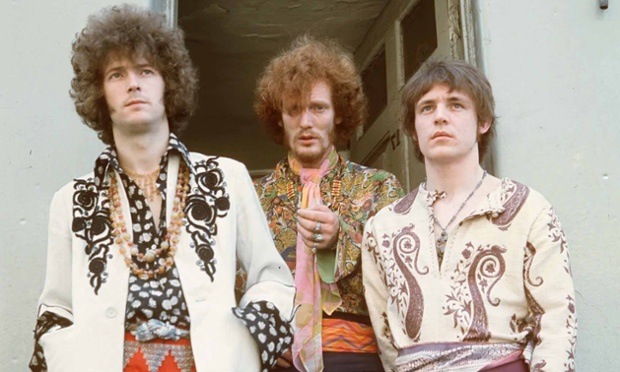
Cream: Baker, Bruce, and Clapton
But the ne plus ultra of power trios was Cream, which consisted of drummer Ginger Baker, bassist Jack Bruce, and guitarist Eric Clapton – each of whom is usually ranked as one of the ten best of all time on his respective instrument.
The group’s second (and best) album, Disraeli Gears, included “Sunshine of Your Love.” “Strange Brew,” “SWLABR,” and the mesmerizing “We’re Going Wrong” in addition to “Tales of Brave Ulysses.”
The “Disraeli Gears” cover
Here’s famed rock critic Robert Christgau’s take on Disraeli Gears:
Cream's best album distilled their prodigious chops and rhythmic interplay into psychedelic pop that never strayed far from their blues roots. Except for the electricity, “Outside Woman Blues” is nearly identical to Arthur Reynolds’ 1930s original. And the riff to “Sunshine of Your Love,” written by bassist Jack Bruce, is Delta blues in jab and drive. But Disraeli Gears decisively broke with British blues purism in the ecstatic jangle of “Dance the Night Away,” the climbing dismay of “We're Going Wrong” (driven by Ginger Baker’s circular drumming) and the wah-wah grandeur of “Tales of Brave Ulysses.”
Click here to listen to “Tales of Brave Ulysses.” (PLEASE pay attention to Martin Sharp’s lyrics, which are nothing like those of any other rock song I’ve ever heard.)
The opening lines of “Tales of Brave Ulysses” are très à propos for the first week of February, n’est-ce pas?
* * * * *
The story goes that the late Martin Sharp, an Australian artist and cartoonist who was visiting London in 1967, told a musician that he met at a nightclub about a poem that he had just written. The musician told Sharp that he was looking for lyrics for a new song he had just written, so Sharp wrote his poem down on a paper napkin and gave it to him.
Martin Sharp
The musician turned out to be Eric Clapton, and the song turned out to be “Tales Of Brave Ulysses” – which I think is Cream’s best song.
Sharp later invited Clapton to move into the building where he was living. (Other residents of that building included Robert Whitaker – the photographer who took the infamous “butcher” photo originally used for the cover of the Beatles’ Yesterday and Today album – and Germaine Greer, who wrote The Female Eunuch while living there.)
At Clapton’s request, Sharp did the cover art for Cream’s Disraeli Gears and Wheels of Fire albums.
* * * * *
There were a lot of great “power trios” in the sixties and seventies – among the best were the Jimi Hendrix Experience, James Gang, and Grand Funk Railroad.
Cream: Baker, Bruce, and Clapton
But the ne plus ultra of power trios was Cream, which consisted of drummer Ginger Baker, bassist Jack Bruce, and guitarist Eric Clapton – each of whom is usually ranked as one of the ten best of all time on his respective instrument.
The group’s second (and best) album, Disraeli Gears, included “Sunshine of Your Love.” “Strange Brew,” “SWLABR,” and the mesmerizing “We’re Going Wrong” in addition to “Tales of Brave Ulysses.”
The “Disraeli Gears” cover
Here’s famed rock critic Robert Christgau’s take on Disraeli Gears:
Cream's best album distilled their prodigious chops and rhythmic interplay into psychedelic pop that never strayed far from their blues roots. Except for the electricity, “Outside Woman Blues” is nearly identical to Arthur Reynolds’ 1930s original. And the riff to “Sunshine of Your Love,” written by bassist Jack Bruce, is Delta blues in jab and drive. But Disraeli Gears decisively broke with British blues purism in the ecstatic jangle of “Dance the Night Away,” the climbing dismay of “We're Going Wrong” (driven by Ginger Baker’s circular drumming) and the wah-wah grandeur of “Tales of Brave Ulysses.”
For all my fellow lovers of wah-wah grandeur, here’s “Tales of Brave Ulysses”:
I’ve read that “our kid” is Cockney slang for “little brother.” That would make the “Badge” lyrics quoted above slightly less puzzling.
* * * * *
The story goes that each of the members of Cream were supposed to write a song for the group’s aptly-named final studio album, Goodbye, but that Eric Clapton wasn’t able to come up with anything by himself. So he sat down with his friend, George Harrison, and wrote “Badge.”
This was in 1968, years before Harrison’s wife, Pattie Boyd, divorced him and moved in with Clapton – but perhaps not long before Clapton first got the hots for Boyd.
The story goes that Harrison had written “bridge” next to the lyrics for the song’s bridge, which Clapton misread as “badge” – hence the song’s title.
While Harrison and Clapton were laughing about the “bridge”/“badge” misunderstanding, Ringo Starr walked in three sheets to the wind and suggested the line about the swans that live in the park.
Harrison and Clapton (1969)
(By the way, Pattie Boyd said the reason she left Harrison was the fact that he had a number of affairs while they were married – including one with Ringo Starr’s wife, Maureen. I’m not sure if that was before or after Boyd had an affair with Faces guitarist Ronnie Wood, who later replaced Mick Taylor in the Rolling Stones.)
* * * * *
The last 2 or 3 lines discussed the Civil War-era High Bridge near Farmville, Virginia, which has been converted from a railroad bridge to one suitable for use by hikers and bikers.
It also discussed a different kind of bridge – the musical bridge, which is a section of a song that is usually inserted between the verses of a song, and which contrasts musically with those verses. The particular musical bridge that was the subject of that discussion was the bridge (or “middle eight”) of “Ticket to Ride” by the Beatles.
Cream
The bridge in “Badge” – which begins at 1:07 of the song – is the most interesting part of that song. It really steals the show from the verses. (“Badge” doesn’t have choruses.)
Like all great bridges, the bridge in “Badge” contrasts with the verses, but also complements them. It’s not one of those bridges that sounds like it should have been the foundation of a whole different song.
* * * * *
Shortly before “Badge” was recorded, Eric Clapton joined the Beatles at Abbey Road Studios to play the lead guitar part on Harrison’s song, “While My Guitar Gently Weeps.”
George Harrison returned the favor and played rhythm guitar when Cream recorded “Badge.”
For legal reasons, neither Clapton’s nor Harrison’s name could appear on those records. (The rhythm guitar part on “Badge” was credited to “L’Angelo Misterioso” – or “Mysterious Angel.”)
George and Ringo at Abbey Road Studios
Some people think Harrison played the lead guitar part that accompanies the bridge in “Badge.” The guitar arpeggios that introduce the bridge do sound very Abbey Road-ish, but most sources say that Clapton – not Harrison – is the one playing there.
* * * * *
“Badge” is a very economical song. It clocks in at less than three minutes long.
The song featured in the previous 2 or 3 lines, “Ticket to Ride,” is about 30 seconds longer . . . although there is less there there.
The Beatles stretched “Ticket to Ride” by repeating everything – both verses are repeated, and the bridge is repeated as well. (If you eliminated all the repeated lines from “Ticket to Ride” it would be about half as long as “Badge.”)
* * * * *
Cream was a fabulous band. Like the Jimi Hendrix Experience, Cream had only three members – such groups were known as “power trios” back in the day – but all three were extremely talented. It’s amazing that such near-perfect music could be produced by only three musicians.
While Eric Clapton is the household name among Cream’s members, it’s possible that he wasn’t as good a guitarist as Jack Bruce was a bassist or Ginger Baker was a drummer.
So far, no one has even hazarded a guess as to what the songs of “29 Songs in 29 Days” have in common.
Even if you don’t have a clue what this year’s “29 Songs in 29 Days” theme is, surely you can figure out where the singer of “Sunshine of Your Love” has been waiting so long to be going.
I’ve been a big fan of this song since it was orignally released in 1968. But I have to admit I never really thought about the lyrics – which are ham-handed enough that they could pass for the lyrics to a Spinal Tap song.
For example, there are these lines:
I'll soon be with you, my love
To give you my dawn surprise
(Three guesses what that "dawn surprise" refers to.)
And then there are these lines:
I'll stay with you darling now
I'll stay with you till my seas are dried up
Genius.com has a wonderfully wrongheaded annotation for those lines. It interprets them as meaning that the singer will stay with the object of his affection “until his ‘seas dry up,’ possibly referring to andropause [emphasis added] and how he will reserve his sexual existence for only her.”
I seriously doubt that the singer is referring to andropause, which is also known as “male menopause.” For one thing, there’s really no such thing as male menopause.
I think the lyrics are referring to what scientists call the “refractory period,” during which time the sexually-sated male is too pooped to pop.
“Sunshine of Your Love” has two very distinctive musical elements.
First, there’s Jack Bruce’s unforgettable opening guitar riff, which is repeated incessantly throughout the song and which sounds just as compelling today as it did when the record was new. (Eric Clapton told Rolling Stone that Bruce came up with this riff after attending a Jimi Hendrix concert, but it doesn’t sound at all Hendrix-like to me.)
Second, there’s Ginger Baker’s drumming, which mostly eschews the snare and cymbals in favor of the tom-toms. Baker’s drum part broke with tradition in one other way – instead of emphasizing the “off” beats (two and four), he accents the “on” beats (especially the first beat of each measure). Baker sounds like a Native American drummer calling his tribe’s braves to do battle against John Wayne, Ward Bond, Victor McLaglen, Ben Johnson, and their fellow cavalrymen.
Eric Clapton, Ginger Baker, and Jack Bruce
Eric Clapton’s solo is acknowledged to be the best example of his “woman tone,” a “smooth, dark, singing, sustaining sound” (to quote author Mitch Gallagher) that Clapton produced by playing his solid-body, humbucker-pickup-equipped Gibson SG Standard (Gibson’s best-selling guitar of all time) through a Marshall tube amplifier.
“Sunshine of Your Love” was Cream’s biggest hit single. Cream didn’t stay together long, but they released some unforgettable songs. “Sunshine of Your Love,” “White Room,” “Badge,” “SWLABR,” “I Feel Free,” “Tales of Brave Ulysses” – those are some truly great songs, boys and girls.
Here’s a live performance of “Sunshine of Your Love." (Ginger Baker absolutely kills it.)
I know, I know – those aren't the actual lyrics to "White Room." Those are the made-up lyrics my really cool friends and I sang when "White Room" came on the tape that played during lunch period in my high-school cafeteria.
I'm not sure which is more amazing – that our student government was able to persuade the administration at good ol' Parkwood High School to install a soda dispenser in our cafeteria, or that our student government persuaded the administration at good ol' Parkwood High School to allow us to use the proceeds from the sales of Coca-Cola and Sprite and Dr. Pepper to buy a big-ass reel-to-reel tape recorder and make a tape with songs of our own choosing to play on it.
Parkwood High School (Joplin, Missouri)
Like "Touch Me," by the Doors . . . "Venus," by the Shocking Blue . . . Led Zeppelin's "Communication Breakdown" . . . "You Can't Always Get What You Want," by the Rolling Stones . . . and Cream's "White Room."
Anyway . . . here are the actual opening lyrics to our featured song:
In the white room
With black curtains
Near the station
* * * * *
Holy moly, "White Room" is a MONSTER song. Everything about it is fabulous – especially Ginger Baker's relentless drumming and Jack Bruce's surreal lyrics.
Ginger Baker
You'll probably find this hard to believe, but "White Room" was covered by Joel Grey of Cabaret fame. Click here to listen to Grey's cover (which is terrible).
It was also covered by Waylon Jennings, of all people. Click here to listen to Waylon's cover (which is terrible, but in an entirely different way).
* * * * *
I can't explain why power trios started coming out of the woodwork in the late sixties, but there's no denying the greatness of three-man aggregations like Cream, the Jimi Hendrix Experience, the James Gang, and Grand Funk Railroad.
You know, songs by power trios wouldn't have been a bad theme for this year's edition of "29 Songs in 28 Days."
"White Room" was released on Cream's Wheels of Fire album
But I have a better theme. In fact, I have two better themes. And since I couldn't decide which one I liked better, I decided to use both of them, alternately.
Except for "White Room," which incorporates both themes. (Sort of.)
So put on your thinking cap, Tom Terrific, and be the first one to figure out exactly what those two themes are!
Click here to listen to the album version of "White Room," which includes a third verse that was omitted from the single version of the song (which was all I ever heard played on the radio):
"We're Going Wrong" is a stunning song -- absolutely chilling.
It doesn't sound like any other song I've ever heard. That's mostly due to the unique and unearthly quality of Jack Bruce's singing and the drumming of Ginger Baker, who used timpani sticks (which have heads wrapped in felt or chamois) instead of traditional drum sticks. The 6/8 time signature is somewhat unusual as well.
Clapton, Baker, Bruce
There's not a lot in the way of lyrics here -- two very short verses, and "We're going wrong" repeated over and over. I don't think there's any great mystery as to what the song is about -- it seems to be about a love affair that has gone so wrong that it probably can't be resuscitated.
But given the way that Ginger Baker and Jack Bruce came to absolutely loathe each other -- their bitter arguing during a car ride in early 1968 reduced Eric Clapton to tears -- one is tempted to see the song as describing their venomous relationship.
Cream formed in July 1966 and broke up in November 1968, the victim not only of Bruce's and Baker's mutual antipathy, but also of Clapton's dissatisfaction with the musical direction Cream had taken. The group got its start as a blues trio -- half the songs on its first album were covers of blues standards -- but is remembered now for psychedelic songs like "White Room," "Tales of Brave Ulysses," and "SWLABR."
"We're Going Wrong" appeared on Cream's second album, Disraeli Gears, which was recorded in New York City in May 1967 and released that November. The album was produced by Felix Pappalardi, who was almost a fourth Cream member. He not only produced Disraeli Gears, but also co-wrote (along with his wife) two of its songs.
Pappalardi was also the bass player for Mountain, best known for its classic single, "Mississippi Queen," which also was produced by Pappalardi. He retired from performing because he had suffered significant hearing loss while touring with Mountain.