Showing posts with label Johnny Bond. Show all posts

Wednesday, February 21, 2018

Johnny Bond – "Three Sheets in the Wind" (1963)


I bought me a boat
Nine cases of gin
Now I’m sailin’ high
Three sheets in the wind

Enville is a small unincorporated community in located just north of Lake Texoma (which divides Oklahoma from Texas).

The story goes that Enville’s name is a contraction of the phrase, “End-of-the-road-ville.”  I don’t know if that’s true, but I hope it is.

*     *     *     *     *

The most famous native of Enville was Cyrus Whitfield “Johnny” Bond (1915-1978), a country-western singer and movie star who was elected to the Country Music Hall of Fame 1999.

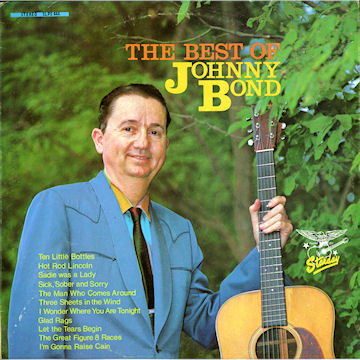
When I was in college in the early seventies, I won a copy of The Best of Johnny Bond by calling into the college radio station and answering a trivia question.

(The price was right!)
I had never heard of the guy – I was not at all into country music in my college days – but I really enjoyed his album, which consisted mostly of songs about cars (like “Hot Rod Lincoln” and “The Great Figure Eight Race”) and songs about drinking (including “Sick, Sober and Sorry,” “Ten Little Bottles,” and today’s featured song, “Three Sheets in the Wind”).

Sadly, the album did not include his #5 hit single from 1947, “So Round, So Firm, So Fully Packed.”

*     *     *     *     *

How did “Three Sheets in the Wind” come to be used to describe someone who is very inebriated??  

From The Word Detective:

The first example of “three sheets to the wind” found in print so far is from 1821 (in the form “three sheets in the wind”), but the expression is almost certainly much older. . . .

Nine out of ten urban legends about the origins of words or phrases erroneously trace them to seafaring traditions and the age of tall ships.  There’s even an acronym for the folks who propagate this nonsense: CANOE (Committee to Assign a Nautical Origin to Everything).  But “three sheets to the wind” really does have a nautical origin.  The “sheets” in the phrase are the lines (ropes) that hold a sail in place.  If one of the “sheets” . . . comes loose, the sail flaps in the wind and causes the ship to lose power.  If two sheets are loose and fluttering in the wind (or “to the wind”), you’re in major trouble, and “three sheets in the wind” means the ship is uncontrollable, reeling like a drunken sailor. . . .


But there’s an alternate explanation as well, as this excerpt from a 1994 letter to the editor of the New York Times explains:

An inebriated person is often said to be a certain number of sheets to the wind.  Uncertain whether this is three or four, you still suggest that the expression comes from sailing.  Many have drawn this connection, because the line, or rope, controlling the trim of a sail on a sailboat is called a sheet.

The true origin of "three sheets to the wind" was disclosed to me by a Nantucket sailor. . . .

The old Dutch-style windmill on Nantucket Island in Massachusetts, which is still grinding cornmeal for the tourists, has four wooden vanes to which are attached four sails -- or more properly, sheets.  If the miller leaves one off, only three are presented to the wind.

The mechanism is then severely out of balance, and in a fresh breeze the entire structure of the mill goes into a violent and potentially destructive shudder, evoking the image of a staggering drunk.

Letting go a sailboat's sheet to flap in the wind usually gets the skipper out of trouble by causing the boat to come up into the wind on an even keel -- the opposite of the metaphor intended.

That certainly clears things up, doesn’t it?

*     *     *     *     *

Here’s Johnny Bond’s recording of “Three Sheets in the Wind” which has a 3/4 time signature:


Click below to buy the song from Amazon:


Tuesday, November 15, 2011

Johnny Bond -- "Hot Rod Lincoln" (1960)


I wound it up to a hundred and ten
Twisted the speedometer cable off the end
Had my foot feed clear to the floor
That's all there is -- there ain't no more

When I was a freshman at Rice University in 1970-71, I thought the campus radio station was amazing.  

After all, I was used to listening to AM radio in my hometown of Joplin, Missouri -- where the coolest top 40 station refused to play Beatles records after John Lennon had observed that they were "more popular than Jesus."

The Rice station -- the call letters were KTRU -- was programmed entirely by students, and they played some pretty crazy stuff.  (I'm guessing a number of the student DJs were serious drug users, which was nothing very remarkable in those days.)  I remember being shocked five years later to hear one of the KTRU DJs doing a very professional job as the morning drive-time DJ on a popular St. Louis FM station.

KTRU's programming was disseminated using a technology called "carrier current," which uses electrical wiring to propagate AM radio transmissions.  Carrier current transmitters are low-powered and relatively cheap, so the technology was commonly used by college and other noncommercial stations.

Your radio didn't have to be plugged up to pick up the station, but you had to be fairly close to the campus electricity grid -- once you left the Rice campus, you left KTRU as well.

One night I was listening to KTRU when the DJ was giving away promotional copies of records that the station didn't want to people who called in with the correct answers to trivia questions.  I have no idea what question I answered, but I won a copy of "The Best of Johnny Bond."


I had never heard of Bond, but I loved his multicolored shirt, which really emphasized his turkey neck.  Johnny was a pretty handsome guy when he was young, but this photograph was taken when he was a few years past his prime.

Bond's real name was Cyrus Whitfield Bond.  He was born in 1915 in the tiny Oklahoma community of Enville (which is supposedly a contraction of "End of the Road Ville"), headed west where he performed in a few movies with singing cowboys like Gene Autry, and became a country music star in 1947, when he released "Divorce Me C.O.D." and two other top 10 singles.  

Most of Johnny's best-known songs are either about cars or about getting drunk.  Actually nearly all of them are about getting drunk.  There was "Sick, Sober, and Sorry," "Three Sheets in the Wind," "Here Come the Elephants," and his biggest hit, "Ten Little Bottles."


His album titles included "Bottles Up," "Ten Nights in a Barroom," and "Drink Up and Go Home."  The guy had kind of a one-track mind.

"Hot Rod Lincoln" was actually a hit on the pop charts, not the country charts.  It was first recorded in 1955 by one of its authors, Charlie Ryan, and was an answer song to a 1951 hit, "Hot Rod Race."  The guy who recorded "Hot Rod Race" also recorded several sequels to that song himself, and a bunch of other guys put out hot rod songs that were more or less inspired by it.  Here's a link to a history of the whole phenomenon from the Rockabilly Hall of Fame website.  

I actually owned another record with "Hot Rod Lincoln" on it -- Commander Cody and His Lost Planet Airmen recorded the song in 1972.  

Like most songs about street racing -- "Maybelline" and "Dead Man's Curve" are other examples -- "Hot Rod Lincoln" was probably looked down on by true aficiondos of automobiles and automobile racing.  Even I knew that these songs weren't terribly authentic and I wasn't a car expert by any means, although I did read quite a few hot rod magazines before I discovered other magazines of a somewhat more interactive nature.   

One final note: "foot feed" is an archaic term for the accelerator pedal (which feeds gas to the engine when you push your foot down on it).  That's what my mother used to call the accelerator when I was learning to drive.

Here's Johnny Bond's version of "Hot Rod Lincoln":


Here's Commander Cody's version:


Click here to buy the song from Amazon: