Wednesday, November 1, 2023

Kinks – "20th Century Man" (1971)


I'm a paranoid, schizoid product

Of the 20th century


2 or 3 lines – which made its first appearance on November 1, 2009 – is mos’ definitely a product of the 21st century. 


Today we’re celebrating the 14th birthday of 2 or 3 lines the blog by interviewing 2 or 3 lines the blogger – who is more a 20th century man than a 21st century man.


Hence our featured song.


*     *     *     *     *


Q:  It’s become an annual tradition for me to interview you on each  anniversary of your wildly popular little blog, 2 or 3 lines.  Do you remember how long ago it was when I first interviewed you?


2 or 3 lines:  Actually, I do.  You first interviewed me on the blog’s 10th anniversary, which was November 1, 2019.


Q:  For the better part of the last year, you’ve been dropping hints about a rather dramatic change in your life.  I understand you’re prepared to quit beating around the bush and come out with the truth, the whole truth, and nothing but the truth.


A:  That’s correct.  It’s something I really should have gotten off my chest months ago.


Q:  Better late than never, as they say.  But I want to start off this year’s anniversary interview by asking you a question about the newest members of the 2 OR 3 LINES “GOLDEN DECADE” HIT SINGLES HALL OF FAME and the 2 OR 3 LINES “GOLDEN DECADE” ALBUM TRACKS HALL OF FAME – which were announced in September and October, respectively.


A:  Before you ask that question, let me say how proud I am of the new 2023 inductees.  The hit singles hall-of-famers really run the gamut – we’ve got something from the Beach Boys, a couple of Brill Building pop classics, some standout Motown hits, a great folk-influenced record, and a beautiful blue-eyed soul ballad.  And each of the artists who had an album track inducted into that hall of fame this year is responsible for several HOF-worthy records – there’s nary a one-hit wonder in the group.


Q:  I did notice that a number of the new hall of fame selections had been featured on 2 or 3 lines previously.  Instead of having to come up with new material about those records, you were able to simply cut-and-paste your original posts about them.  Was that your strategy?  In other words, did you choose those records on the merits, or because picking records you had previously written about saved you a lot of time and effort?


A:  You’re such an d*ck.  You ask that same question every year – why don’t you give it a rest and ask something new?


Q:  I’ll give it a rest as soon as you answer the question – this isn’t the first time you’ve ducked it rather than giving me a straight answer.


A:  [Silence.]


Q:  So that’s a “yes”?


*     *     *     *     *


Q:  Let’s talk a little about today’s featured record.  The Kinks released “20th Century Man” in 1971, but it’s lyrics are just as relevant to the 21st century.  For example:


I was born in a welfare state

Ruled by bureaucracy

Controlled by civil servants

And people dressed in grey

Got no privacy, got no liberty    


A:  Plus ça change, plus c'est la même chose.


The Muswell Hillbillies album

Q:  Indeed.  I believe you were born in 1952 – just a couple of years after the midpoint of the 20th century.


A:  Your math is a little off, sport.


Q:  How so?


A:  I was delivered in 1952, but I was conceived in 1951 – and conception is what really counts, isn’t it?


Q:  I’m not sure we want to get into that issue right now.  But even if you’re correct, we’re still talking about 1951, not 1950.


A:  I’m guessing you’re one of those people who thinks the 21st century began on January 1, 2000.


Q:  Well, it did – didn’t it?


A:  Think about it.  Back in the day, the calendar went directly from 1 BC to 1 AD?  There was no year zero.  Correct?


Q:  Yes.


A:  So what was the first year of the first century?


Q:  The year 1 AD, I guess.  


A:  So what was the first year of the 21st century?


Q:  2001.


A:  Exactly!  And the first year of the 20th century was 1901 . . . which means that 1951 is smack dab in the middle of the 20th century because it’s midway between 1901 and 2001!


Q:  Hmmm . . . something about that doesn’t seem right, but I’m exactly not sure what it is.  Anyway, it’s time to turn our attention to the dramatic change in your life that took place not quite one year ago.


A:  I’ll tell you all about that in the very next 2 or 3 lines. 


*     *     *     *     *


“20th Century Man” was released on the Muswell Hillbillies album – which I believe was the first Kinks album I ever owned.  (I’ve since purchased several Kinks albums that were released before Muswell Hillbillies was.)


Muswell Hillbillies was a commercial failure.  Most of the critics loved it, but I didn’t – I don’t remember a single song from that album other than “20th Century Man.”


Click here to listen to today’s featured record.


Click here to buy the album version of that record from Amazon.  


Tuesday, October 31, 2023

David Bowie – "Rebel Rebel" (1974)

Got your mother in a whirl
She's not sure if you're a boy or a girl

[NOTE: I originally posted about the last of this year's group of inductees into the 2 OR 3 LINES "GOLDEN DECADE" ALBUM TRACKS HALL OF FAME on November 25, 2011.]

To call David Bowie a musical chameleon is an understatement.  A chameleon may be able to change its colors, but it remains a chameleon.  It can't turn itself into a fish or a bird or a monkey.

(Love the eyepatch!)
It seemed that Bowie changed musical identities almost as often as I change my underwear.  (Once a week, whether I need to or not.)  When I was in college, he was a glam-rocker from outer space (Ziggy Stardust).  During my law-school years, he was a funk/soul/disco dude (the "Thin White Duke").  Later he transformed into the cooly post-modern minimalist of the "Berlin Trilogy" albums.  So confusing!

His 1974 album, Diamond Dogs, was his last glam-rock album and his first "plastic soul" album.  (One + one = one in this case.)

"Rebel Rebel" – his last glam-rock single – was originally written for a planned Ziggy Stardust musical that never got off the ground.  It's a gender-bender like the Kinks' "Lola," but sounds more like an old Rolling Stones song.  

Dozens of other artists have covered it – everyone from the Bay City Rollers to Def Leppard to Duran Duran to Joan Jett to Iggy Pop to the Smashing Pumpkins.

*     *     *     *     *

Manchester United soccer fans sang this tribute to Gary and Phil Neville – two brothers who once played on the team – to the tune of "Rebel Rebel":

Neville Neville, they're in defence
Neville Neville, their future's immense
Neville Neville, they ain't half bad
Neville Neville, the name of their dad

And yes, Neville Neville is the actual name of Gary's and Phil's dad, a former cricketer.

Netballer Tracey Neville
By the way, Neville Neville's other child, daughter Tracey – Phil's fraternal twin – is a professional netball player (whatever netball is).

*     *     *     *     *

Click here to watch a fabulous old video of Bowie lip-synching "Rebel Rebel."

Click here to order the record from Amazon.

Friday, October 27, 2023

Mott the Hoople – "All the Way From Memphis" (1973)


And you look like a star 
But you're still on the dole
All the way from Memphis!

[NOTE: I originally wrote about the penultimate record in this year’s class of inductees into the 2 OR 3 LINES “GOLDEN DECADE” ALBUM TRACKS HALL OF FAME in 2013.  What follows is a somewhat edited version of that post.] 


Mott the Hoople were a great band, and this is a great song with a great piano part.

Record producer Guy Stevens gave the band its name, which is the title of a 1966 novel about a sleazy guy who works in a carnival.  Stevens had read the novel when he was in prison.  (Stevens, who produced the Clash's London Calling album, named the band Procol Harum after a friend's cat.)


*     *     *     *     *

Mott's most famous song is "All the Young Dudes," which David Bowie wrote for them when he heard they were about to split up.  (Bowie was a big fan of the group.)

"All the Way from Memphis" tells the story of a rock guitarist whose instrument is mistakenly shipped to Oriole, Kentucky.  By the time he catches up with it a month later, it's just junk.  The song was inspired by an airline's losing a guitar belonging to lead guitarist Mick Ralphs when Mott was touring the U.S.  

If there's a message here, it's that life on the road can be a drag for rock 'n' rollers.  (The same is true for authors of wildly popular blogs, boys and girls.)

*     *     *     *     *

"All the Way from Memphis" is featured in the opening scene of Martin Scorsese's 1974 movie, Alice Doesn't Live Here Anymore, a chick flick which is nothing like Scorsese's previous movie (Mean Streets) or his next movie (Taxi Driver).

Alice had a remarkable cast.  In addition to Ellen Burstyn – who portrayed the title character – it featured Diane Ladd (who was nominated for the "Best Supporting Actress" Oscar), Kris Kristofferson, Harvey Keitel, and Jodie Foster (who was 12 going on 21 when the movie was filmed).  Vic Tayback reprised his movie role as a diner owner who hires Alice as a waitress in the CBS sitcom based on the movie than aired from 1976 to 1985.

Click here to listen to "All the Way From Memphis."

Click here to buy this song from Amazon.

Tuesday, October 24, 2023

Roxy Music – "In Every Dream Home a Heartache" (1973)


Inflatable doll
My role is to serve you
Immortal and life-sized
My breath is inside you 

[NOTE: It’s about time that there’s a Roxy Music record in the 2 OR 3 LINES “GOLDEN DECADE” ALBUM TRACKS HALL OF FAME.  “In Every Dream Home a Heartache” is perhaps the most outré of all Roxy tracks – which is really saying something.  The following was originally published on February 18, 2020.]


*     *     *     *     *

Take a look at the following list of recording artists and tell me what they all had in common:

David Bowie, Chic, Kraftwerk, Siouxsie and the Banshees, Magazine, Devo, Talking Heads, Spandau Ballet, Human League, Ultravox, Duran Duran, Morrissey, U2, Nirvana, Garbage, Blur, Pulp, Radiohead, Franz Ferdinand, and . . . Bill Murray?

According to Tim de Lisle of the influential British newspaper The Guardian (formerly the Manchester Guardian), all of those artists were either fans of Roxy Music, influenced by Roxy Music’s records, or both.

Roxy Music
“The most influential of all British groups is clearly the Beatles,” de Lisle wrote in 2005.  “Who comes second is more debatable: the Stones, the Who, the [Sex] Pistols, the Clash . . . but have any of them had wider repercussions than Roxy?”

*     *     *     *     *

A couple of the names on the list above deserve further comment.

Let’s start with Devo and the Talking Heads – two of the most interesting American bands of the seventies and eighties.  Both were devotees of Brian Eno, the musical genius who was one of the founding members of Roxy Music but who left the group after the release of its second album to pursue a solo career and to produce records for others (including Devo and the Talking Heads). 

U2 also collaborated with Eno and Chris Thomas (who produced some of the early Roxy albums).  When they were inducted into the Rock and Roll Hall of Fame, U2 drummer Larry Mullen said in his acceptance speech that “The Sex Pistols, Television, Roxy Music, Patti Smith – these people are in our rock and roll hall of fame.”  (Three out of four ain’t bad.)

Garbage drummer Bruce Vig – who produced Nirvana’s Nevermind album – was a huge Roxy fan.  “I was president of the Roxy Music fan club at the University of Wisconsin,” Vig told de Lisle.  “We used to hold ‘Roxythons’ once a month where we would play their albums non-stop.”  How many people turned up for those events?  “Seven or eight,” Vig said.  “A small but loyal following.”

*     *     *     *     *

What is Bill Murray’s connection to Roxy Music?

Do you remember the scene in the movie Lost in Translation where Murray goes to a karaoke bar with Scarlett Johansson?  The original plan was to have him sing Elvis Costello’s “What’s So Funny ‘Bout Peace, Love, and Understanding.”

Murray and Johansson
But when Murray and director Sofia Coppola realized that they both loved Roxy’s music, they decided to have Murray sing “More Than This,” which was released in 1982 on Roxy’s eighth and final studio album, Avalon.

Click here to watch the Lost in Translation scene of Johansson and Murray singing karaoke.  (She sings a song by the Pretenders – another underrated group.)

*     *     *     *     *

“Love Is the Drug” was Roxy’s only top-40 hit single in the U.S.  While Avalon went platinum here, it took 10 years.

But while the rest of you boobs underrated them, I didn’t.  I bought their first five albums while I was in law school, and played them loudly and incessantly (to the dismay of some of my dormitory neighbors).

“Liking them was an act of rebellion,” according to Tim de Lisle.  Rebel’s my middle name, boys and girls – no surprise that I was a big Roxy fan.   

*     *     *     *     *

Bruce Vig's University of Wisconsin band used to cover today’s featured song, “In Every Dream Home a Heartache,” which was released on Roxy’s 1973 album, For Your Pleasure:


“It’s guaranteed to freak out an audience when you’re playing a midwestern bar,” Vig said.  Given the subject matter of the song’s lyrics, that’s a fact, Jack! 

In Genesis, God formed man out of dust and “breathed into his nostrils the breath of life; and man became a living being.”

In the lyrics of today’s featured song, the singer orders a life-sized inflatable sex doll and creates the perfect companion by blowing her up.  “My breath is inside you,” he sings.

Click here to watch a mesmerizing live performance of “In Every Dream Home a Heartache” on British TV. 

Click here to buy the record from Amazon.

Friday, October 20, 2023

Traffic – "The Low Spark of High-Heeled Boys" (1971)


If I gave you everything that I owned 
And asked for nothing in return
Would you do the same for me?

[NOTE: I published the following post about the longest of this year’s class of inductees into 2 OR 3 LINES “GOLDEN DECADE” ALBUM TRACKS HALL OF FAME on June 1, 2018.  Actor Michael J. Pollard, who coined the song’s title, died the next year.]


*     *     *     *     *

The two most notable things about Traffic’s fifth studio album, The Low Spark of High Heeled Boys, are its title track – which is eleven minutes and 35 seconds long – and its cover, which is a two-dimensional hexagon that looks like a three-dimensional cube:


There are very few rock songs that are more than ten minutes long.  Iron Butterfly’s “In-A-Gadda-Da-Vida” (17:05) is probably the most famous.  The Doors’ “The End” (11:41), Elton John’s “Funeral for a Friend/Love Lies Bleeding” (11:07), and Creedence Clearwater Revival’s cover of “I Heard It Through the Grapevine” (11:05) are three other well-known ten-minute-plus songs that got a fair amount of play on album-oriented rock stations back in the seventies.

“The Low Spark of High Heeled Boys” doesn’t feel eleven minutes long.  It has long instrumental passages, but they aren’t pointless or repetitive.  The song’s tempo is leisurely, and the verses are longer than the verses of most rock songs.  It’s naturally long, not artificially long – like ultra-long rock tracks that feature unimaginative instrumental solos or jams that drag on forever and ever.

The Low Spark of High Heeled Boys was released late in 1971, when I was a sophomore in college.  I probably bought it the next year, after hearing the title track on the radio a few times.  


John Barleycorn Must Die, the previous Traffic album, was better – but “The Low Spark of High Heeled Boys” holds up very well.

In case you’re wondering, the song’s title is taken from a phrase that actor Michael J. Pollard coined when he and Traffic’s co-founder and drummer, Jim Capaldi, were in Morocco working on a proposed movie that was never filmed.  

Pollard was nominated for the Academy Award for Best Supporting Actor for his work in Bonnie and Clyde, but lost out to Cool Hand Luke’s George Kennedy.  (All five of the featured actors in Bonnie and Clyde – Warren Beatty, Faye Dunaway, Gene Hackman, Estelle Parsons, and Pollard – were nominated for Oscars.  Only Parsons went home with a statuette.)

Pollard, Dunaway, Beatty, Parsons, and Hackman
Click here to hear “The Low Spark of High Heeled Boys.”

Click on the link below to buy the album from Amazon.  (Amazon doesn’t sell just the song.  Apparently they think $1.29 isn’t enough for an 11:35 song, so they make you buy the whole album if you want it.)

Tuesday, October 17, 2023

Leon Russell – "Delta Lady" (1970)

Woman of the country, now I've found you
Longing in your soft and fertile delta


The night before Thanksgiving, an old friend and I went to see Leon Russell – who was born Claude Russell Bridges on April 2, 1942 – perform at a small concert venue in suburban Virginia.  

I have mixed feelings about the experience.  

On the one hand, I'm really glad I finally saw him play live.  (Neither of us is getting any younger, after all.)  I've always had a particular interest in him because he was primarily a piano player, he was from Tulsa (very near where I grew up), and a lot of friends of mine were (and are) big fans of his.  

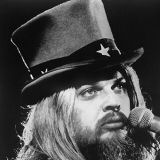
Leon Russell then (circa 1970)
On the other hand, Leon is 68 and I'm afraid he looks every day of that.  He does not get around very well.  (One of those electric mobility scooters was parked next to his tour bus when we left the concert.)  His hair is as white as white can be.  

Leon Russell now (November 2010)

*     *     *     *     *

It usually depresses me to see old rock bands flogging the same "classic" songs, 40 years after they were relevant.  I love and respect the Who, but I thought their performance at the last SuperBowl halftime was pathetic.  (Maybe Keith Moon was lucky to die before he got old.)  

Can you imagine Jimi Hendrix, age 65, doing "Purple Haze" at a SuperBowl halftime show?  No?  Wouldn't you have thought the same thing about Pete Townsend or Keith Richards?

I recently read a New Yorker review of Keith's new autobiography.  Here's a quote from it:

Keith Richards is 66.  He's a grandfather . . . Where he used to have a wolfhound named Syphilis, he now has a golden Lab named Pumpkin.  He and his wife pack Pumpkin onto a private jet and go to relax at their spread in Turks and Caicos. . . . "People think I'm still a goddamn junkie.  It's 30 years since I gave up the dope!  Image is like a long shadow.  Even when the sun goes down, you can see it."

*     *     *     *     *

The Leon Russell performance my friend and I saw had its moments, but I can't say that the show really ever caught fire.  There wasn't a lot of imagination or passion on display.  

Leon Russell and his current band
When I went to YouTube to look for videos to embed in this post, I found some that seemed to indicate that Leon was basically doing the same songs in his live appearances three years ago.  

For example, the show I saw opened with a medley of "Jumpin' Jack Flash," "Papa Was a Rolling Stone," "Paint It Black," and "Kansas City."  Click here to see a video from a 2007 concert showing Leon performing the exact same medley in exactly the same manner.

*     *     *     *     *

What can you realistically expect from a performance by a 68-year-old at a converted suburban movie theatre holding maybe 700 baby boomers?  The Beatles at Shea Stadium?  Woodstock?  Of course not.  After all, when you go to a baseball game, you rarely see your favorite player win the game with a walk-off home run – but that  doesn't keep you from hoping for it.

Perhaps I should look at things from a more positive angle.  George Orwell once said that if you can choose the manner of your own death, let it be in hot blood – not in bed.  

Russell isn't going gently into that good night.  He's out on the road, criss-crossing the country in a tour bus, playing some really great songs . . .and a lot of them are his songs.  Good for you, Leon – even if you do need an electric mobility scooter to get around with.

*     *     *     *     *

The song featured in this post – "Delta Lady" – is one of Russell's most well-known compositions.  The inspiration for the song was Rita Coolidge, a backup singer who became a solo star.  

Rita was a bit of a femme fatale.  She was romantically involved with both Stephen Stills and Graham Nash, and her leaving Stills for Nash may have contributed to CSN&Y's initial breakup.  (David Crosby's song "Cowboy Song" and Stephen Stills's song "Sit Yourself Down" both refer to her by her nickname, Raven.)

Rita and Kris
She met Kris Kristofferson during the filming of the Sam Peckinpah movie, Pat Garrett and Billy the Kid (which also featured Bob Dylan).  The two later married.

*     *     *     *     *

Click here to see a very interesting video of Leon performing "Delta Lady" in 1970. – 

I'm not sure what the context of this video was – there are some things going on in the background that make no sense to me, and the ending is very strange, too.  (Anyone out there have a clue what this performance was for?)  

It begins with a couple of false starts, but then Leon and the other musicians hit their stride.

I've never seen Russell put more into a live performance.  He absolutely chews the song up and spits it out. 

Legendary backup singers Claudia
Lennear and Kathi McDonald
But the real revelation here is Kathi McDonald, a white female backup singer who is seen several times.  You first hear her making her presence known at 0:44 of the video (just as Leon is calling a stop to the first take).  You hear her again at about 1:25, 1:38, 2:16, and 3:24 -- each time she echoes the line that Leon has just sung.  Actually, "echo" is not a very good description of what she does.

She more or less turns herself inside out when she sings.  It sounds like she is experiencing childbirth au naturel each time she tears into a line.

*     *     *     *     

I had never heard of Kathi McDonald until I read the comments to this video, but she is sort of a big deal.  She started her career as a backup singer for Ike and Tina Turner – and no one ever topped Tina and the "Ikettes" as live performers.  

She replaced Janis Joplin when Janis left Big Brother and the Holding Company – when people told her she sounded like Janis, she used to respond by saying, "No, she sounds like me" –  and later was part of the Joe Cocker "Mad Dogs and Englishmen" tour.  (Here's a recent interview with Kathi.)

Kathi McDonald now
She also appeared on albums by Leon Russell, Delaney and Bonnie, Rita Coolidge, Nils Lofgren, Dave Mason, Quicksilver Messenger Service, and Long John Baldry, and she was a backup singer on the Rolling Stones' Exile on Main Street.  

Click here to see Joe Cocker performing "Delta Lady" (with a little help from Leon and Kathi).     
Click here to listen the version of "Delta Lady" that appears on Leon's eponymous (there's my favorite word again!) solo album.  I'm pretty sure I hear Kathi McDonald at about 0:29 of the song.

Click here to buy that record from Amazon.

Monday, October 16, 2023

Steppenwolf – "Monster/Suicide/America" (1969)


'Cause the people grew fat and got lazy

Now their vote is a meaningless joke


[NOTE: Today, we’re reprinting a post from 2012.  At the time it was originally published, American troops had been stationed in Afghanistan for a very long time – over a decade, in fact.  Back then, no one would have predicted that U.S. forces would remain in Afghanistan for almost another decade, finally departing in 2021.  (I’m sure you remember what a debacle that was.)  In any event, today we’re inducting the record featured in that 2012 post – Steppenwolf’s “Monster/Suicide/America” – into the 2 OR 3 LINES “GOLDEN DECADE” ALBUM TRACKS HALL OF FAME.]


*     *     *     *     *

Only two weeks left in the 2012 campaign – we're getting down to the short strokes, boys and girls!

"Monster/Suicide/America" is from Steppenwolf's 1969 album of the same name.    The group's first three albums all made it into the top ten in the U.S., but Monster peaked at #17 and was the first Steppenwolf not to feature a top ten single.


The three-part title of the song reflects the fact that it consists of three somewhat disparate segments joined together.  But let's just refer to it as "Monster" – OK?

"Monster" is nine minutes, fifteen seconds long, and I remember hearing it on the radio a number of times the year it was released.  I'm pretty sure the station I heard it on was KWTO-560, an AM station in Springfield, Missouri, that played a lot of rock album tracks before that format had become popular.  (The other l-o-n-g song I remember hearing on KWTO was "Midnight Rambler" by the Rolling Stones.  KWTO was a great station.)

Songs with political themes were fairly common in 1969, and "Monster" is certainly a political song.  It  summarizes the entire history of the United States, warts and all – it decries witch-burning, slavery, the displacement of native Americans, the Civil War, and so on.  

But the song saves most of its bile for contemporary American society:

The cities have turned into jungles
And corruption is strangling the land
The police force is watching the people
And the people just can't understand

Not surprisingly, the song alludes to the Vietnam War:

We don't know how to mind our own business
'Cause the whole world's got to be just like us
Now we are fighting a war over there
No matter who's the winner we can't pay the cost

In 1969, we had no idea that American involvement in Vietnam would drag on for several more years.  It officially ended in May 1975 – not quite eleven years after the Gulf of Tonkin incident.

*     *     *     *     *

The war in Afghanistan began on October 7, 2001 – so it has lasted longer than the war in Vietnam.  

The number of American troops in Afghanistan grew gradually under the Bush Administration.  There were roughly 34,000 soldiers in Afghanistan when President Obama was inaugurated.  Obama ordered 17,000 more troops to Afghanistan as part of a planned "surge" in troop levels within weeks of his swearing-in.  

There were 71,000 American soldiers there at the beginning of 2010, and almost 100,000 there at the beginning of 2011.  The gradual withdrawal of those troops began late in 2011.

American troops in Afghanistan
Joe Biden got a little confused a few weeks ago, telling a New Hampshire audience that there were 650,000 troops left in Afghanistan.  There are actually about 68,000 soldiers left in Afghanistan.  

President Obama has said that the drawdown of American forces will continue through 2014, but about 20,000 troops will stay in Afghanistan – perhaps for years to come.  (The week before the Democratic convention, Obama mistakenly said that "[w]e will have them all out of there by 2014," but his press secretary later said that "[h]e never said that all the troops would be out.")

When he originally announced the withdrawal plans in June 2011, the President declared that the U.S. had largely achieved its goals in Afghanistan.  But everything that I've read indicates that the Afghan government will likely lose control over more and more of the country to local warlords as the Americans leave.

Here's what Michael Cohen, a former Democratic speechwriter, had to say about how Obama would likely handle the Afghanistan issue during the rest of the campaign:

He will take credit for winding down the war, he will claim that the surge blunted the Taliban's momentum – which is partially true – and he'll argue that Afghanistan is on its way to security and stability – which is not really true, but isn't quite a lie either.  That things are falling apart and that the administration is making no effort to ensure that there is a viable political process after we withdraw combat troops – I'm guessing that won't come up.
I'm guessing that's a pretty good guess.

There's been almost no substantive discussion of Afghanistan in the campaign to date.  It's an unpopular war, and both candidates seem to prefer just to pretend that it doesn't exist.  

The third and final presidential debate – which took place last night – was supposed to focus on foreign policy, so perhaps there was some discussion of Afghanistan during it.


I have no idea, because I didn't watch a minute of that debate.  I'm a big baseball fan, and I was watching the World Series.

*     *     *     *     *

You say the World Series doesn't begin until tomorrow night?  OK, OK – I told a little white lie.  To tell the truth, I wouldn't have been watching the World Series even if it had been on last night. 

I was hoping for a St. Louis win so I could rant about a World Series matching the 5th-best team in the National League and the 7th-best team in the American League.

The Cardinals lost their division to the Reds by nine games – their regular-season record was much worse than any of the other NL playoff teams.  If they hadn't added a second wild-card team this year, the Cardinals would have been on the golf course a couple of weeks ago.

And the Tigers were even worse.  If the Tigers had been in either the AL East or the AL West, they wouldn't have finished first – or second – or even third.  They would have finished FOURTH.  Their only hope of sneaking into the playoffs this year was to win the AL Central.  That shouldn't have been much of a test, considering that the other teams in that division are the White Sox, the Twins, the Royals, and the Indians – whose cumulative won-loss record was 66 games below .500.

I vividly remember the 1968 Tigers-Cardinals World Series.  The Cardinals were led that year by their unhittable pitcher, Bob Gibson (who had 28 complete games, 13 shutouts, and a 1.12 regular-season ERA – all of which were truly mind-boggling accomplishments).  They had a 3-1 lead in the Series after Gibson shut out the Tigers (and hit a home run) in game four.

Bob Gibson and Lou Brock
But the Redbirds proceeded to lose three games in a row, including Gibson's start in game seven.  It was the third-most shocking baseball game I've ever seen.

*     *     *     *     *

Click here to listen to "Monster/Suicide/America."

Click here to buy the record from Amazon.