Sunday, January 3, 2010

Tubes – "What Do You Want From Life?" (1975)


What do you want from life?
A meaningless love affair
With that girl that you met tonight?

I was in law school when The Tubes' first album (The Tubes) came out in 1975.  That fall, as part of their "Ad Hoc Rock" tour, they came to Cambridge to play two nights at the small Harvard Square theatre (seating capacity: 383) that was home to the famous Hasty Pudding Theatricals.


The Tubes' eponymous debut album cover
I'm not sure how I heard about the Tubes – maybe I read about them in the local free alternative newspaper, the Boston Phoenix, or maybe Charles Laquidara played their music on WBCN. In any event, I bought a ticket to the first show.

It was the second-best rock concert I ever attended. The best concert I ever attended was the following night, when I went back and saw the show again – but this time, from backstage.

How did I pull that off? Glad you asked. Pull up a chair and I'll tell you all about it.


*     *     *     *     *

The day after seeing the Tubes for the first time, I was wandering through the record department of the Harvard Cooperative Society (a/k/a/ "the Coop") and saw a backstage pass for the previous night's concert stuck to a Tubes album cover. As I recall, it was blue and there was a date handwritten in a blank space on the pass – the date of the previous night's show (October 3, 1975, to be precise). 


The Tubes (circa 1975)
I figured I had nothing to lose, so I peeled the pass off the record's cover, stuck it on my shirt, and presented myself at the theatre that night. Apparently no one on duty knew what day it was, so I was politely escorted to the backstage area and left alone. (Apparently, they were all color-blind as well, because the passes for October 4 show that everyone else backstage was wearing were yellow.)

So I watched the show from backstage. That is, when I wasn't gawping at the female dancers who performed with the Tubes as they changed costumes, which was most of time.


*     *     *     *     *

I was online a couple of nights ago, trying to track down any details about the concert I could find. Lo and behold, I hit the mother lode – a site called
"The Tubes Project", which includes large chunks of video from the Tubes' early concert tours, as well as copies of reviews and news stories about the band. The site even had information about a planned documentary movie about the Tubes – here's a link to the trailer for that documentary.

[NOTE: as of 2019, "The Tubes Project" website had disappeared.  I'm guessing the planned documentary is kaput, which is a real shame.]

Amazingly, the site had three reviews of the band's performances in Cambridge that I attended – one from the Boston Globe, one from Newsweek, and one from Rolling Stone.

From
the Boston Globe review:

[F]rom the moment lead singer Fee Waybill strutted on stage in a white tux for a put-down [of] overconsumption entitled "What Do You Want From Life," the Tubes were manic surgeons cutting on the flesh of pop America's soul. Part theater and part music, they unleashed a witty and satiric 90-minute barrage of 15 tunes that were impressively tight but seldom crossed the line into slickness.


From the Newsweek piece:

If
Mad Magazine's Alfred E. Neuman became a rock star he would probably slip into a silver-lame jumpsuit, put on a pair of 18-inch platform shoes and swish on to the stage like a stoned-out lead singer named Quay Lewd. Quay is actually a refreshingly perverse character created by the Tubes, a rock theater spectacle currently on its first national tour . . . .

"What do you want from life?" the band sang recently from the stage of Harvard's venerable Hasty Pudding Club as TV monitors flashed shots of washer-driers and microwave ovens and two hideously smiling boob-tube hostesses buried a "contestant" in boxes of Tide. The 23-member group . . . also whipped through "Mondo Bondage," a vamp of black leather, skin and silver studs, and brought down the house when Quay sang "White Punks on Dope." 

"It's not Jonathan Swift," one Harvard spectator punned, "but it's not slow."

A Tubes concert poster
Finally, an excerpt from the Rolling Stone review that took (and still takes) the words right out of my mouth:

The Tubes' antic amorality is not only very funny but so intimately attractive that we end up wishing the party would never end. The circus atmosphere naturally extends to the audience, because the Tubes' fantasies are our fantasies as well. . . . [I]t is impossible for the observer not to revel, to some extent, in such gloriously insane nihilism. When I grow up I want to run away and join the Tubes.

And that reviewer had a sweet gig at Rolling Stone. By contrast, I was just a poor second-year law student -- sentenced to live in a tiny room in one of the concrete-block Gropius dorms at Harvard Law School and suffer through a nasty Massachusetts winter. If he wanted to run away and join the Tubes, just imagine how much more badly I wanted to run away and join the Tubes. (Plus I had an additional reason for wanting to do so – I had seen the Tubes' dancers in a charmingly dishabille condition while observing from backstage.)


*     *     *     *     *

"White Punks on Dope" may have been the band's signature song – they closed their shows on this tour with it – but "What Do You Want From Life?" (which was the band's opening song) was their real tour de force.

The first half of that song was a series of possible answers to the question asked in the song's title, which ranged from bizarre to pathetic:

What do you want from life?
To kidnap an heiress and threaten her with a knife?
What do you want from life?
To get cable TV and watch it every night?

Some were more short-term in nature:

What do you want from life?
A meaningless love affair with that girl that you met tonight?

The last stanza suddenly turns serious, and perhaps comes a little too close to the truth for comfort:

What do want from life
Someone to love and somebody you can trust?
What do you want from life?
To try and be happy while you do the nasty things you must?

The second half of the song shifts gears suddenly. Lead singer Fee Waybill informs you that you can't have any of those things, but as an American citizen you are entitled to a number of other items. 
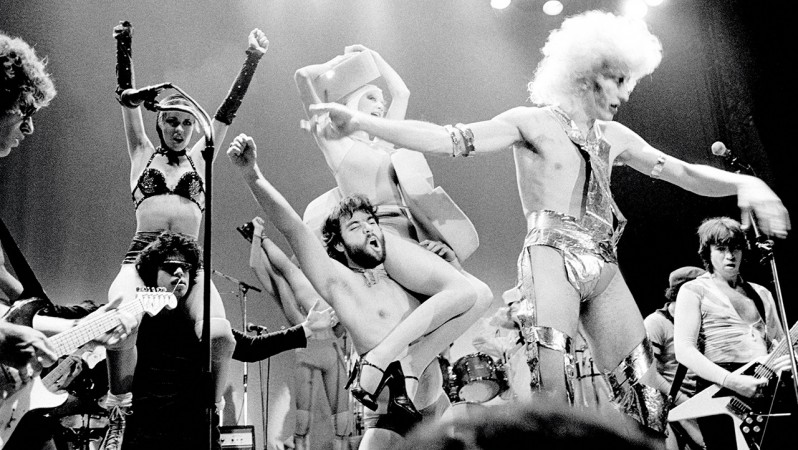
The Tubes performing "What
Do You Want From Life?"
He declaims a list of said items in the manner of Johnny Olson or some other TV game-show announcer racing through the list of prizes that the lucky winner will be taking home that day. His reading becomes more and more frantic as he pours on the crescendo and the accelerando -- so much accelerando, in fact, that you miss about half the jokes. (Of course, since about half the jokes miss being funny, it's no big loss.)

The items on the list include:

A foolproof plan and an airtight alibi

(Think about it.)

A year's supply of antibiotics.

(This was 1975, remember, and people weren't quite as hygienic in those days.)
A personally autographed picture of Randy Mantooth

(Mantooth played a paramedic on the long-running NBC television series, "Emergency!" I suppose you could say the show was the 1975 equivalent of "E.R." -- but Mantooth never enjoyed the success of George Clooney.)

A Las Vegas wedding, a Mexican divorce

(Might as well be prepared.)

A baby's arm holding an apple

(I already have one of those, of course.)

The highlight of this part of the song for me is when the announcer reads a long series of names of cars -- most real, a couple made up (like "Mort Moriarty," which isn't a car at all but the name of the Tubes' manager):

A new Matador, a new Mastodon, a Maverick, a Mustang, a Montego, a Merc Montclair, a Mark IV, a Meteor, a Mercedes, an MG, or a Malibu, a Mort Moriarty, a Maserati, a Mack truck, a Mazda, a new Monza!

Click here to see a video of the Tubes performing the song in San Francisco just a few weeks before I saw them. 

The second side of The Tubes features three other Tubes classics that were highlights of the live show. First, there's "Mondo Bondage" – the live performance featured Fee Waybill and lead dancer Re Styles doing a leather-clad pas de deux – which includes one of the great rhyming couplets in rock history:

I could run off the Jamaica
If this bondage I could breaka

Next comes "What Do You Want From Life?" – which is followed by "Boy Crazy," a song about a girl who grew up just a little too fast:

Petting heavy didn't bother you
Your eighth grade teacher showed you what to do
Failed your English and Biology
But you learned the facts of life from A to Z


But the final song of the album is the song the Tubes are best remembered for today – the band's signature and most tongue-in-cheek song, "White Punks on Dope."

Other dudes are living in the ghetto
But born in Pacific Heights don't seem much betto
We're white punks on dope
Mom and dad moved to Hollywood
Hang myself when I get enough rope
Can't clean up, though I know I should


My life intersected these songs unexpectedly in the summer of 1978, after I had graduated from law school and had started working for the federal government in Washington, DC. That summer, a group of my friends and I went to half a dozen or show midnight showings of the Rocky Horror Picture Show at the long-gone Key Theatre in Georgetown. (That's a story for another post.)


Fee Waybill performing
"White Punks on Dope"
People showed up early to get good seats, and the theatre was usually filled at least half an hour before the movie started. To entertain the crowd, the Key's management would play the second side of The Tubes – with "White Punks on Dope" leading right into the movie. nbsp;

Click here to view a high-quality video of a live London performance of "White Punks on Dope" (with "born in Beverly Hills" substituted for "born in Pacific Heights").

Finally, click here to watch a video of German singer Nina Hagen performing her version, the lyrics of which are entirely different – "White Punks on Dope" has become "I Gawk at the TV."

*     *     *     *     *

Click here to listen to today's featured song, "What Do You Want From Life?"

And click on the link below if you want to buy "What Do You Want From Life" from Amazon:


Friday, January 1, 2010

Ted Nugent -- "Stranglehold" (1975)


Here I come again now, baby
Like a dog in heat . . .

Like 2 or 3 lines, Ted Nugent (a/k/a/ the "Motor City Madman") is a real man.

Ted Nugent – proud right-winger, expert bowhunter, "straight edge" role model (he disavows alcohol and drug abuse), and heavy-metal guitar god – saved the best for first when he left the Amboy Dukes.  The first cut on his first solo album is "Stranglehold," perhaps the ne plus ultra example of guitar-solo-heavy 1970s arena rock. 

Not only that, he led off the song with its best two lines (quoted above).

*     *     *     *     *

I don't remember when I first heard this song. But I do remember an evening many years ago when for some reason I went to a local Kentucky Fried Chicken restaurant with my youngest son, who was then small enough to require a car seat.

"Stranglehold" came on just as I was parking, and it is a song that simply does not allow you to turn the radio off until it is over, some eight-plus minutes later. 

 My son didn't actually burst into tears as a result of me singing along at the top of my lungs, using the steering wheel and my thighs as drums, and generally making a spectacle of myself – but you could tell he was terrified of the goings-on from the front seat.

*     *     *     *     *

"Stranglehold" is featured on a number of movie soundtracks, including the original
Bad News Bears (I can't believe that movie was rated PG when it came out) and the ultimate teenage movie, Dazed and Confused.

Click here to listen to "Stranglehold."  

Click on the link below to buy the record from Amazon:

Saturday, December 26, 2009

The Doors -- "The Crystal Ship" (1967)


The crystal ship is being filled
A thousand girls, a thousand thrills
A million ways to spend your time


The Doors' debut album (The Doors) was released the first week of 1967 – that's 42 years ago. If I were to really think about that, my whole day would be ruined.

One reason I always liked the Doors was because Jim Morrison had a relatively low voice, and so did I. When I was singing along with the radio, I couldn't reach the high notes in a lot of my favorite songs – but that was never a problem with a Doors song because Morrison and I had similar vocal ranges. (Speaking of my singing along with the radio . . . I remember one long drive when my father suddenly turned the car radio off. When I protested, he said "We can either listen to the radio, or listen to you.  But not both.")

Jim Morrison
"Light My Fire" wasn't the first song released as a single from The Doors – "Break on Through (To the Other Side)" was.  I assume that was because "Light My Fire" was over seven minutes long.

Six months after the album was released, a more radio-friendly 2:52 version of "Light My Fire" was created, and became one of the most unforgettable hit singles of the AM radio era. It is #7 on VH1's "100 Greatest Songs of All Time"and was one of the few rock songs included in NPR's ranking of the 100 most important American musical works of the 20th century (which included, among other things, "West Side Story" and "Rhapsody in Blue"). When you come across The Godfather Part II on television, you have to watch it, and when you hear "Light My Fire" on the radio, you have to listen to it.  

"Light My Fire" was #1 on the Billboard "Hot 100" for three weeks. Jose Feliciano's cover version reached #3 only a year later, and an astonishing variety of others have covered the song since then – including Patricia Barber, Nancy Sinatra, Shirley Bassey, Stevie Wonder, Al Green, B. J. Thomas, Type O Negative, and Massive Attack. (Massive Attack's version samples the "Light My Fire" covers by Jackie Wilson and Young-Holt Unlimited.)

(I need a pair of leather pants just
like those Jim Morrison wore)
*     *     *     *     *

The B-side of "Light My Fire" was another song from The Doors – "The Crystal Ship." 

 I didn't own the album until many years later, and I'm not sure when I first heard "The Crystal Ship." I must have heard the entire album played by friends during college, but I don't remember hearing "The Crystal Ship" until the early 1980's, when I was living in San Francisco and it was played regularly on a local classic rock station.  

It's a classic Jim Morrison song – which can be good news and bad news. Morrison, who considered himself first and foremost a poet, was influenced by William Blake, Baudelaire and Rimbaud, Joseph Campbell, and the "Beat Generation" writers. (The name "The Doors" came from a line in the Blake poem, "The Marriage of Heaven and Hell": "If the doors of perception were cleansed, every thing would appear to man as it is: infinite.") 

Morrison took himself just a tad too seriously, and he wrote a lot of crap. But his lyrics are like no one else's, and the Doors' best songs are unique and really get under your skin. If you're in the right mood – nostalgic, or longing for something that you can't quite get a grip on – a song like "The Crystal Ship" is just what the doctor ordered.

*     *     *     *     *

Some people interpret "The Crystal Ship" as a drug-trip song – of course, that's the default interpretation for any 60's or 70's song that you can't make sense of. (What is a "crystal ship" anyway? I have no clue, but it sounds awfully fragile.) 

The other explanation you'll find is that the song is Morrison's good-bye to a former girlfriend. (I suppose it's a bummer when a rock star dumps you, but having him write a song or two about you before the breakup is pretty cool.)


I don't really care what the song means. It's a gorgeous two and a half minutes of dreamy, loopy music and dreamy, loopy words. The studio recording is perfectly arranged and executed – especially the way Morrison's voice crescendos into the last stanza, peaking on the word "crystal."

Click here to listen to "The Crystal Ship."

Click here to buy that recording from Amazon.

Click here for a video that combines a pretty good live performance of the song with some very interesting photos of Morrison and the other Doors.


Wednesday, December 23, 2009

System of a Down -- "Lost in Hollywood" (2005)


They take you, and make you
They look at you in disgusting ways
You should have never trusted Hollywood

Life can be pretty random. 

If you don't think so, just look at your husband/wife or boyfriend/girlfriend. (That's assuming you have one, of course).  How did you meet him/her?  

The odds are that the meeting was such a fluke, seemingly mere happenstance – perhaps the result of the flap of a butterfly's wings in Brazil – that a slight alteration in any one of about a million events would have caused enough of a divergence in your paths that you would never have encountered one another. 

Of course, some would say that fact that there were incredible odds against that particular outcome actually taking place is the best proof that it was not the result of chance, but destiny.

That explains how I became aware of today's featured song.


*     *     *     *     *

Like much of the music I have on my computer, I got System of a Down's Mesmerize CD through my local public library. 

I don't recall ever hearing the band's music on the radio or seeing anything about them on TV.  I can only assume that I searched for and requested Mesmerize because I came across the name of the band or the CD on some music review site – maybe on a "Top 100 CDs of 2005" list or something like that.

After downloading the CD, I don't recall ever listening any of the songs on it until last Saturday, when we were buried by the Mother of All Snowstorms.  Somehow five songs from Mesmerize had ended up on my iPod shuffle, and came up while I was shoveling the driveway.  (Four of them were great, and the fifth wasn't bad.)

This is the final song on the CD, and it's about an archetypal "young man from the provinces" who goes to the big city to seek his fame and fortune. 

 Unfortunately, we know what happens to all those strays who end up in Los Angeles: they end up working as waiters in vegetarian restaurants, playing in bands that never get any real gigs, and checking out each other's hairstyles.

I'm a sucker for songs about Los Angeles. Forget the traffic and the tacky, temporary-looking buildings, and the generally ugly, dried-out landscape – it's the center of the popular culture world, and popular culture is so much more important than serious culture.  (Sorry, New York City!)

Click here to listen to "Lost in Hollywood."  It's a stick of dynamite from beginning to end.

Click here to see System of a Down performing the song live in Rio de Janeiro in 2015.

And click on the link below to buy "Lost in Hollywood" from Amazon:

Sunday, December 20, 2009

Spirit -- "Prelude/Nothin' to Hide" (1970)


We got nothin' to hide
Married to the same bride
She eats away from inside

This song is the first track on Twelve Dreams of Dr. Sardonicus, Spirit's fourth (and last) album with its original lineup – a truly great record.  

You'd best believe it wasn't easy picking just one song from that album to feature today.  I originally was going to feature "Morning Will Come," but it has fairly uninteresting lyrics, and this blog's format does require that each entry begin with two or three lines from the featured songs.  


But even though I decided to feature a different song, here's a link to "Morning Will Come" – a little bonus for my fans.

*     *     *     *     *

I used to listen to "Morning Will Come" every morning before going to my summer job.  I was in college when Dr. Sardonicus was released, living at home and unloading rail cars at a grocery warehouse for $5 an hour.  My shift started at 7 AM, and I was usually a little banged up when my mother woke me up to get ready for work in the mornings because I spent my evenings at Nina's Green Parrot, Buck's Recreation Parlor, and other establishments of that ilk in Galena, Kansas, drinking 3.2% beer and playing spades.  So I needed some musical inspiration to get myself going in the mornings.

Galena is a very sad little mining town just over the Missouri-Kansas line.  I grew up in Joplin, Missouri, only about 10 miles from Galena via old Route 66 ("It goes from St. Louie/Joplin, Missouri/Oklahoma City/Looks oh so pretty"). Missouri had relatively normal liquor laws – bars could serve liquor by the drink. Kansas did not have liquor by the drink, but allowed 18-year-olds to drink 3.2% beer, legally classified as non-intoxicating.  (Ha!) 

So on weekend nights, there was a steady stream of Kansas adults going eastward to Joplin's tonier nightclubs to sip martinis and manhattans, while Missouri teenagers were heading the other way to drink 35-cent quarts of Falstaff, Schlitz, and Coors – which had a particular cachet in those days because it was not sold east of Kansas.

Fortunately, the Kansas beer joints closed at midnight, so I did get 6 or so hours of sleep each night.  But I was a growing boy, and that didn't really get the job done.  Hence the need for some musical stimulation to help clear out the cobwebs each weekday morning.

There to help me out was "Morning Will Come," which I would play on my family's Magnavox console stereo.

Magnavox console stereo (circa 1970)
Our Magnavox had legs that were long enough that I could lie on the floor on my back and slide my head underneath it, much in the manner of a mechanic sliding under a car to change the oil. I  did that so I could block out the rest of the world and really focus on the music – plus stereo sound was fairly new, and positioning myself in this fashion allowed me to maximize the separation between the channels -- one channel for the left ear, the other for the right.

A couple of times through "Morning Will Come" and I was ready to do battle with the 50-foot rail cars from General Mills, Scott Paper, Ralson-Purina, Del Monte, Clorox, etc., that I unloaded every day at the warehouse.

*     *     *     *     *

I remember two of those freight cars with particular displeasure.  One time, a Clorox car had been banged around a little too much en route.  Because the car wasn't fully loaded, some of the cases of one-gallon bleach bottles had tipped over and crashed to the floor, and there were a few dozen gallons of undiluted bleach sloshing around when I opened the car's doors.  My black high-top tennis shoes and the bottom six inches or so of my Levi's were bleached almost entirely white by the time I finished cleaning up the mess.  (Today, that much exposure to concentrated chlorine fumes would have been more than enough to attract dozens of sleazy personal-injury lawyers smelling major contingency fees as well as chlorine.)

Even worse was the Ralston-Purina car that had been bumped around sufficiently to break open a number of cans of cat and dog food.  The car then sat on various Midwestern railroad sidings in the hot August sun for a few days, plenty of time for a few gazillion maggots to hatch and grow before we opened the car to unload it.  You should have seen the look on my face when I picked up an undamaged case and exposed those little creepy-crawlies feasting on some cans of Alpo-brand "Prime Cuts in Gravy" dog food.  Quelle surprise!  

But I digress . . . . (By the way, if digressions aren't your cup of tea, you are on the wrong blog.)

*     *     *     *     *

Spirit is somewhat forgotten today, but they were a remarkably talented collection of musicians with a unique style (or mixture of styles).  

If you had to choose one adjective to characterize their music, you might pick "psychedelic" – but their music has elements of pop, jazz, art rock, and quite a few other genres. 

Spirit was not a great commercial success. The band's most successful single – the irresistible "I've Got a Line on You" – peaked at #25.  The group's biggest mistake was probably turning down an invitation to appear at Woodstock in order to tour in support of their third album.  Spirit would have appeared just before Jimi Hendrix.

The band's most recognizable member was drummer Ed Cassidy – a sort of Mr. Clean look-alike who had a shaved head (very unusual in an era where long hair was de rigeur) and always dressed in black.

Spirit drummer Ed Cassidy
Cassidy was 37 when Dr. Sardonicus was released.  He had started working as a musician before World War II, and played with a long list of jazz greats in the 1950's –  including Cannonball Adderely, Art Pepper, Lee Konitz, and Rahsaan Roland Kirk.

(Kirk was notorious for playing two or even three saxophones at the same time.  Click here to see him do that.)

Cassidy was the stepfather of Spirit guitarist and singer Randy California. (He was given that name in 1966 by Jimi Hendrix to distinguish him from another Randy in Hendrix's 1966-era band – "Jimmy James and the Blue Flames"  who was called "Randy Texas." Randy California met Hendrix when he was living in Queens.) California was not quite 17 when Spirit's first album was released. He wrote "I Got a Line on You" and a number of Spirit's other signature songs.

*     *     *     *     *

Jay Ferguson (songwriter/vocalist) and Mark Andes (bass) left the band after Dr. Sardonicus and founded Jo Jo Gunne, which was moderately successful. Ferguson later released several solo albums. His "Thunder Island" is a wonderfully innocent, appealing little song that doesn't make a lot of sense, but who's counting?  Click here to listen to it.

After Ferguson and Andes left, California pursued a solo career, joined by stepfather Ed Cassidy and former Hendrix bassist Noel Redding (who called himself "Clit McTorius" when the group performed live).  His first album, Kapt. Kopter and the (Fabulous) Twirly Birds, was an odd conglomeration of original songs and covers that critic Robert Christgau said was characterized by "sheer dense weirdness."

After Dr. Sardonicus, the band's original lineup never recorded together again, but there have been a number of subsequent Spirit albums – Cassidy was part of all of them, and California contributed to most of them. 

California drowned in 1997 while helping his twelve-year-old escape from a rip current while both were swimming off the coast of Molokai, Hawaii.

Click here to listen to "Prelude – Nothin' to Hide."

Click on the link below to order the song from Amazon: