Showing posts with label Joplin. Show all posts

Friday, June 11, 2021

Talking Heads – "Memories Can't Wait" (1979)


Everyone has gone to sleep

I’m wide awake on memories

These memories can’t wait


As I noted in the previous 2 or 3 lines, the biggest pop music superstars – e.g., the Beatles,  the Stones, Led Zeppelin, Elton John, Michael Jackson, Bruce Springsteen, Madonna, Taylor Swift – never performed live in my hometown of Joplin, Missouri.


You can’t blame them.  When I graduated from high school in Joplin in 1970, the city’s population was only 39,526 – making it only the 527th-largest burg in the U. S. of A.  (Joplin’s current population is just over 50,000, which might or might not be enough to make it one of the 500 most populous American cities.) 


*     *     *     *     *


A little over a year ago, the Joplinite website began to count down the 100 greatest concerts in the history of Memorial Hall, the city’s 4000-seat convention center and concert hall, which opened in 1925:


I was astonished to see how many prominent recording artists had performed there over the years.


The first few decades featured concerts by a number of first-rate jazz musicians – including Duke Ellington, Count Basie, Nat King Cole, and Bob Wills and the Texas Playboys.


A number of classic rock performers played at Memorial Hall in the sixties and seventies – among them Paul Revere & the Raiders, Chicago, Badfinger, the Guess Who, and Steely Dan.


The eighties and nineties featured visits by hair/metal bands like Nazareth, Ratt, Great White, Megadeath, and Sammy Hagar.


Not surprisingly, Memorial Hall attracted the crème de la crème of country music – including both older artists (like Roy Acuff, Ernest Tubb, Bill Monroe, Hank Thompson, Ray Price, and Johnny Cash) and more contemporary stars  (including Garth Brooks, Kenny Chesney, Alan Jackson, Willie Nelson, Brad Paisley, and Hank Williams, Jr.).


Last but not least, there were a number of performers that don’t fit into any of those genres – like John Philip Sousa (who came to Joplin in 1929), Weird Al Yankovic, and Snoop Dogg.


*     *     *     *     *


Of course, Memorial Hall isn’t the only concert venue in Joplin.


As I noted in a previous post, Junge Stadium – where Joplin High School plays its football games – has hosted a few outdoor concerts (including a 1973 Rare Earth/Sugarloaf/Dr. Hook & the Medicine Show extravaganza that I heard from afar).


And while Missouri Southern State University’s 2000-seat Taylor Performing Arts Center is utilized mostly for theatrical productions, it has hosted concerts by some well-known recording artists – including the Talking Heads.


*     *     *     *     *


I learned only recently that the Talking Heads performed in Joplin in 1979.  I still can’t quite wrap my head around the idea of that cutting-edge art-rock group – who in their heyday were the darlings of the New York City punk/new wave scene – playing songs like “Psycho Killer” and “Life During Wartime” in my little ol’ hometown.


The Talking Heads

After appearing on Saturday Night Live on February 10, 1979, the Talking Heads spent the next few months recording their third studio album, Fear of Music.  


The band spent June touring Australia and New Zealand.  In July, they visited London, Berlin, Paris and several other European cities before flying to Japan for five shows in five nights.


Between August 8 and November 17, the Talking Heads travelled the United States from pillar to post to promote Fear of Music.  Their tour stops were divided roughly 50-50 between big cities (e.g., New York City, Los Angeles, Chicago, Houston, Philadelphia) and college campuses (including the University of Massachusetts, Penn State, the University of Illinois, the University of Arizona, and San Diego State).  Why the tour promoters decided to include Joplin and Missouri Southern on their itinerary is a mystery to me.


The night before the Talking Heads played at Missouri Southern, they performed in St. Louis and reportedly drew a crowd of only about 100.  If that figure is accurate, I shudder to think what the attendance at the Joplin show was.


*     *     *     *     *


I bought Fear of Music shortly after it was released, but I never listened to it as much as I listened to the Talking Heads’ first two albums, Talking Heads:77 and More Songs About Buildings and Food – which were two of my favorites from that era.


The most familiar song from Fear of Music is “Life During Wartime”:


This ain’t no party, this ain’t no disco

This ain’t no fooling around

No time for dancing, or lovey-dovey

I ain’t got time for that now


But the track that follows – “Memories Can’t Wait” – may be the best song on the album.


Click here to listen to “Memories Can’t Wait,” which was the penultimate song on the setlist of the Talking Heads’ concert in Joplin.


Click on the link below to buy that recording from Amazon:


Friday, January 11, 2019

Katie Ellen – "Lucy Stone" (2017)


I don’t believe in getting married
It’s a socioeconomic prison

(That’s what he said.)

*     *     *     *     *

Many of the notable people that Wikipedia says are natives of my hometown – Joplin, Missouri – were born in a hospital in Joplin but grew up in a nearby town.

One such person was Jane Grant, who was born in Joplin in 1892, but went to school in Girard, Kansas – a town with fewer than 3000 residents that’s about 45 minutes northwest of Joplin.   

Jane Grant
I don’t recall ever passing through Girard, much less stopping there.  I got as far as Pittsburg – a much larger college town that had a number of bars where 18-year-olds could legally drink 3.2% beer – but no farther.

It turns out that Girard was a hotbed of socialism in the early 1900s.  Appeal to Reason, the largest-circulation socialist newspaper in the United States, was printed in Girard.  Its editor commissioned novelist Upton Sinclair to write The Jungle, which was serialized in Appeal to Reason.

Eugene Debs, who was the Socialist Party’s candidate for president in 1904, 1908, 1912, and 1920, lived in Girard for a number of years.

But I digress.

*     *     *     *     *

I don’t know if Jane Grant’s parents were socialists, but her father was a miner – so it wouldn’t be surprising if he was.

Grant moved to New York City when she was just 16.  She told her parents that she wanted to learn to be a music teacher and then move back to Girard, which she later admitted was a big fib:

Although teaching voice was considered a cut above school teaching, I wanted no part of it.  At an early age, I had decided against both teaching and marriage.  In my secret heart I meant to remain in the East once I got there.  I would be a singer – perhaps go on stage.  But my secret must be carefully guarded, I knew, for no such idea would be tolerated by my mother’s religious family.

She was hired as a stenographer by the New York Times, but eventually became a reporter – the first female to be a full-time reporter for the Times

When the famed Times theatre critic Alexander Woollcott went to France to report on World War I, he arranged for Grant to became a singer with a USO-type organization.  He introduced her to Harold Ross, who wrote for Stars and Stripes, a weekly newspaper written by American soldiers for American soldiers.

*     *     *     *     *

When she returned to New York City after the war, Grant became one of the group of writers who dined regularly at the Algonquin Hotel and later became famous as the “Algonquin Round Table.”

Jane Grant and Harold Ross
Grant married Harold Ross in 1920.  The next year, she and journalist Ruth Hale founded the Lucy Stone League, which was named after the first married American woman to retain her birth name after marriage.

Hale wrote a pamphlet that explained why the Lucy Stone League was founded:

We are repeatedly asked why we resent taking one man’s name instead of another’s – why, in other words, we object to taking a husband’s name, when all we have anyhow is a father’s name.  Perhaps the shortest answer to that is that in the time since it was our father’s name it has become our own –  that between birth and marriage a human being has grown up, with all the emotions, thoughts, activities, etc., of any new person. . . . Even aside from the fact that I am more truly described by the name of my father, whose flesh and blood I am, than I would be by that of my husband, who is merely a co-worker with me (however loving) in a certain social enterprise, am I myself not to be counted for anything?

Ross did not share his wife’s beliefs:

I never had one damn meal at home at which the discussion wasn’t of women’s rights and the ruthlessness of men in trampling women.  Grant and Ruth Hale had maiden-name phobias, and that was all they talked about, or damn near all.

*     *     *     *     *

For several years, the couple lived on Grant’s paycheck and saved Ross’s salary until they had enough to get their new magazine off the ground.

The cover of the first
issue of the
New Yorker
The New Yorker was not a big hit initially – a wealthy friend came through with a well-timed offer to invest in the magazine just when Grant and Ross thought they would have to suspend publication – but eventually became a financial and artistic success.  Its contributors included the many of the best journalists, critics, short-story writers, poets, and cartoonists in the world.

Grant and Ross divorced in 1929.  She visited Nazi Germany and the Soviet Union several times in the thirties in her capacity as a foreign correspondent for the New York Times

*     *     *     *     *

Grant married William Harris, a Fortune magazine editor, in 1939.  The couple moved to Litchfield, Connecticut, and founded White Flower Farm, which became one of the largest and most successful mail-order gardening businesses in the United States.

I’ve given amaryllis bulbs from White Flower Farms as gifts for years.  (If you've received one from me, you must be a very special person.)  They produce spectacular flowers:


*     *     *     *     *

Grant rebooted the Lucy Stone League in 1950.  The League pushed the Census Bureau to allow married women to use their maiden names as their official names in census records.

In 1968, Grant published a memoir titled Ross, The New Yorker, and Me.  It was dedicated to her second husband, who had encouraged her to write it.

Jane Grant's memoir
Jane Grant died in 1972.  Her widower funded the Center for the Study of Women in Society at the University of Oregon, and donated his wife’s papers to the university.

*     *     *     *     *

When pop-punk band Chumped broke up in 2016, front woman Anika Pyle and drummer Dan Frelly formed Katie Ellen, which took its name from a moniker used by Pyle’s great-grandmother, who – like Jane Grant – was a feminist who pursued a career in journalism.


“Lucy Stone” was the lead single from Katie Ellen’s debut LP, Cowgirl Blues, which was released in 2017.

Click here to listen to “Lucy Stone.”

Click on the link below to buy the song from Amazon:

Monday, December 31, 2018

Miss Toni Fisher – "The Big Hurt" (1959)


Now it begins, now that you've gone
Needles and pins, twilight till dawn
Watching that clock till you return

2 or 3 lines is ending the year on a serendipitous note.

While I was researching the song featured in the previous 2 or 3 lines – “Friends,” by Feather – I saw a photo of the 45 of that song, which credited J. R. Shanklin as the producer.

I Googled Shanklin and discovered that his father – Wayne Shanklin, Sr. – was born in 1916 in Joplin, Missouri, which is where I was born.


*     *     *     *     *

Fewer than 40 people from Joplin have Wikipedia pages.  (I’m not one of them.  There’s still hope, I suppose, but I need to get busy.)

Several of them – NASCAR driver Jamie McMurray, golfer Hale Irwin, NFL lineman Grant Wistrom, soccer midfielder Jack Jewsbury, and baseball players Darrell Porter and Tito Landrum – were professional athletes.  (Wistrom grew up in Webb City, MO, and Irwin’s family lived in nearby Baxter Springs, KS, but both were born in Joplin hospitals.)

A couple of major television stars – Bob Cummings (who had his own network sitcom, The Bob Cummings Show, in the late 1950s) and Dennis Weaver (who starred in Gunsmoke and McCloud) – also hailed from Joplin.


Other notable Joplin natives include poet and Harlem Renaissance figure Langston Hughes, romance novelist Norma Lee Clark (who was Woody Allen’s personal assistant for over 30 years), model railroader extraordinaire John Whitby Allen, and silent-film actress Pauline Starke – not to mention Blondie and Dagwood Bumstead of Blondie comic strip fame.

The next three 2 or 3 lines posts will feature three other notable people that I never knew were Joplin natives.  

*     *     *     *     *

It turns out that “Friends” producer J. R. Shanklin was actually Wayne Shanklin, Jr. – the records he produced usually credited him as “Jr.” or “J. R.”

Wayne Jr. was one of five children born to Wayne Sr. and his first wife, who divorced after eight years of marriage.

Wayne Sr. quickly remarried and had four more children by his second wife.

Later he married his longtime secretary.  They had one child.

Wayne Sr. released an album and several singles in the 1950s, none of which sold very well.  (His first single was titled “Up to My Pockets in Tomahawks.”  Hard to believe that it wasn’t a hit.)


He had better luck as a songwriter.  His most famous song was “The Big Hurt,” which was a #3 hit for Miss Toni Fisher in 1959.  

Some sources claim that Shanklin and Toni Fisher were married at some point, but there seems to be no official record of that marriage.  (Her daughter did marry one of Shanklin’s sons.)

“The Big Hurt” is considered by most to be the first record to use a phasing sound effect called “flanging.”  You can click here to learn more about flanging, or you can just click here to listen to the song.

Click on the link below to buy the song from Amazon:

Friday, December 16, 2016

Bobby Lewis – "Tossin' and Turnin'" (1961)


I couldn’t sleep at all last night
Just a-thinkin’ of you

A couple of weeks ago, I put the house where my parents lived for the last 20-odd years of their married life up for sale.

My sister and I didn’t grow up in that house, which is located at 2327 Alabama in Joplin, MO.  (If you have any interest in buying a 3-bedroom, 2 1/2-bath brick house with two separate garages on a corner lot, let me know and I’ll give your name to our realtor.)

2327 Alabama (Joplin, MO)
The house where we did grow up had only one bathroom – which made things very difficult when I brought my family back to see my parents and grandmother.  (I have four children.)

My parents didn’t buy the 2327 Alabama house for themselves – they bought it because they wanted to have a nicer place for their grandchildren to stay when we visited during the summer, or for Christmas.

When my 90-year-old father died in January, we tried to persuade my mother to an independent-living place in the Washington suburbs that's near where my kids – who are all adults now – and I live.

She resisted moving, and was getting by in her house – although just barely – until she fell and broke her neck in April.  

We moved her here in May, and there’s no chance that she will ever move back to Joplin.  So it’s time to sell the house and its contents.

*     *     *     *     *

My sister and I both went back to Joplin this fall and went through the house, putting aside everything we wanted to keep.

Most of what I’m keeping are family photos – like this photo of my parents all dolled up for a formal dinner-dance at one of the Teamsters’ conventions they attended when my father was a business agent for the Teamsters local in Joplin.  (He had driven a delivery truck for a local dairy for 20 years before getting that job.)  

My parents (circa 1972)
(You can't tell me that's not a damn good-looking couple.)

Of course, I wouldn't dream of letting these bronzed baby shoes fall into the hands of strangers:


*     *     *     *     *

It's one thing to want to hang on to your bronzed baby shoes.  But you might find it odd that I’m sentimental about an unremarkable kitchen table and the chairs that go with it.

I had graduated from law school in 1977, and moved to Washington, DC, to work for the Federal Trade Commission.  I still remember what my starting salary was – $17,051 per year.  

When I was growing up, my parents had an old and very dated formica-topped kitchen table with chromed legs.  (I can only imagine how much it would be worth today to a collector of vintage furniture.)  I knew my mother really wanted a new one, and I also knew that it wasn’t very likely that my father would give her the OK to buy one in the foreseeable future.

So I bought one for her, motivated in equal parts by gratitude for the sacrifices she and my father had made for me, and by pride that I was now an adult with a real job who could afford to buy a nice gift.

The table and chairs were nothing special – they came from a middle-of-the-road furniture store in Joplin and were affordably priced – but my parents kept them for almost 40 years:  


That table was where we sat down to eat meals whenever I visited them . . . once we moved the piles of bills and other mail so there was room for our plates and glasses.  (As is the case in many American homes, my parents’ kitchen table doubled as their desk.)

That table and chairs will be sold tomorrow – probably to a stranger, and probably for very little money.  C’est la vie.  

It would have been crazy to keep a kitchen table and six chairs as a souvenir, although I was tempted.  

But I can’t keep everything in my parents’ house that reminds me of my childhood, or my children’s childhood.  Keeping all that crap won’t turn the clock back and allow me to do things differently.  (As the Spanish novelist Carlos Ruiz Zafón has written, “There are no second chances in life, except to feel remorse.”)

So what’s the use of holding on to all that stuff?  It’s time to get rid of it.  If you’re interested, drop by 2327 Alabama tomorrow morning – almost everything must go, and no reasonable offer will be refused.

*     *     *     *     *

Not everything in the house is for sale. 

For example, check out this cowboy hat.  I bought in one summer when I was home from college at a pawnshop owned by the father of a high-school friend.  The story was that a truck driver who had been drinking at a bar across the street from the pawnshop bought it in and sold it so he could keep drinking.


This hat is a 10X – which means that it’s a high-quality cowboy hat made of 100% beaver fur.  (Note the American flag pin, and the hand-tooled leather hatband.)  

I rarely wore it because it wasn’t quite big hand for my big egg-shaped head.  (I’m at least a size 8 – an 8 1/8 or 8 1/4 is more comfortable – and it’s damn hard to find a hat that big.  This one was a 7 7/8, which is about as big a hat as you’ll find.)

*     *     *     *     *

My father served on the USS Hancock – an Essex-class aircraft carrier – in World War II.  He didn’t talk about his service much, but I was intensely interested in that aspect of his life when I was a teenager.  I read everything I could find about the Hancock, which was hit twice by Japanese kamikazes.

I assembled a kit of an Essex-class carrier and gave it to my father for his birthday 20 or so years ago.  I had built a lot of model cars and airplanes when I was a kid, but that had been two or three decades before I sat down to put together that model aircraft carrier.   Not surprisingly, my model-building skills were a little rusty – but the finished product didn’t turn out too badly:

USS Hancock (CV-19)
*     *     *     *     *

I knew there were a lot of old LPs in a closet at my parents’ house.  But I didn’t realize until my last visit to Joplin that there was a box of 45s there as well.

Here’s a photo of a Beatles four-song 45 rpm EP, plus a copy of Bobby Lewis’s “Tossin’ and Turnin’,” which was one of the first two records I ever bought and is today’s featured song:


I treated myself to “Tossin’ and Turnin’” and Sam Cooke’s “Twisting’ the Night Away” after winning two dollars in a preliminary round of the Joplin spelling bee when I was in 4th grade – which was 1961.  (Good thing I won a portable record player in the next round.)

“Tossing’ and Turnin’” spent seven consecutive weeks in the #1 position on the Billboard “Hot 100.”  It was Bobby Lewis’s biggest hit record by far.

Here’s “Tossin’ and Turnin’”:


Click below to buy the song from Amazon:

Thursday, May 26, 2016

Alice Cooper – "Under My Wheels" (1971)


I'm driving in my car now
Anticipating fun

Earlier this week, I drove my mother’s car (a 2012 Chevrolet Equinox SUV with only 4000 miles on the odometer) from Joplin, Missouri – where she’s lived for virtually all of her 90 years – to Rockville, Maryland, the Washington suburb where the assisted-living facility she is moving to is located.

As I was driving, my sister flew with my mother to Reagan Airport in Washington, DC.  My son met them at the airport and drove them to her new home.

I crammed my mother’s car full of all kinds of stuff.  


For example, I transported a flat-screen television, which I’m hoping will be easy to hook up to cable at my mother’s new building.  Whether she will actually watch the TV or just stare at the wall – which is what she’s spent most of her time doing since my father died – remains to be seen.

I’ve packed up a couple of boxes with framed family pictures.  The walls of my parents’ home were covered with dozens and dozens of pictures of my sister, me, and my four children.  Some were taken over 50 years ago, when my sister and I were very small.  Others are from the recent weddings of my three older children.

I also brought back about a dozen plastic storage containers filled with unframed photos:


Most of those photos feature one or more of my four kids.  But there are quite a few of me as well.

Here's one of the oldest ones of me:


*     *     *     *     *

Don’t tell anyone, but I also brought back about $19,000 in cash – for some reason, my parents had squirreled away all that money in their safe-deposit box at the bank.

Part of that cash was hidden in a small toy savings bank that resembled an old Sinclair Oil gas-station pump.

Mucho Benjamins
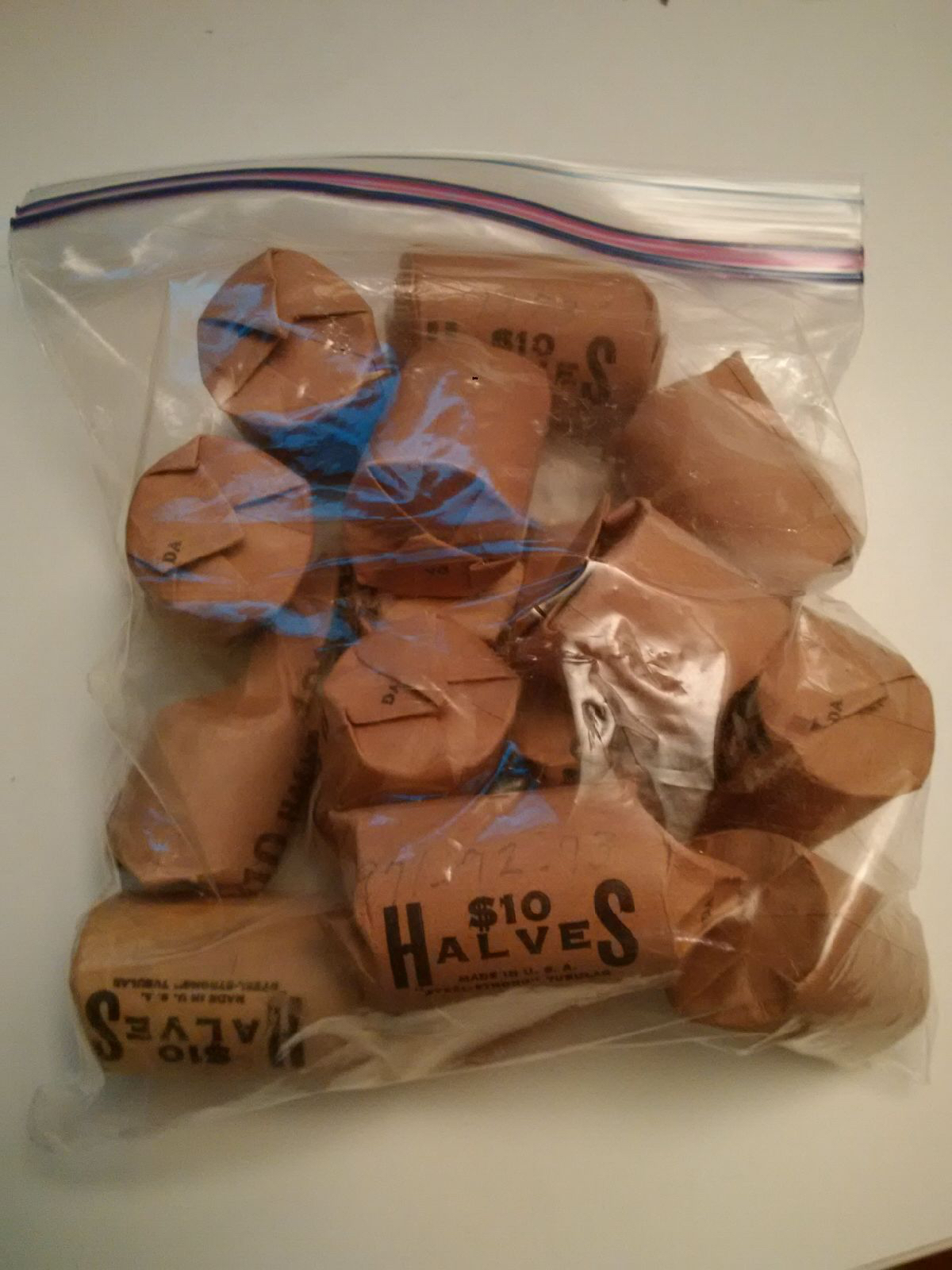
I also had what must have been a couple of hundred pounds of silver dollars and half dollars, which we accumulated before the price of silver shot up dramatically in the mid-sixties and people like us began to hoard such coins.  (I don’t know what I’ll do with those coins, but this may be the only time I’ll ever drive back from Joplin rather than fly.  There’s no way I could fly back with those coins in my baggage.)

Three or four hundred Walking
Liberty silver half dollars
Last but certainly not least, I brought back a lot of my old stuff that I never got around to schlepping back from my parents' home to my home.  I'm talking LPs, high school and college yearbooks, copies of student newspapers, sheet music, and much, much more.  (Some of you are wondering why I don't toss all this flotsam and jetsam, but some of you don't know me – I would rather cut off a body part of two than throw away these precious artifacts.)

*     *     *     *     *

I covered some 875 miles on the second day of my drive – I averaged 65 mph, which means I was on the road about thirteen and a half hours.  That's not counting stops for gas, food, and so on.

I got home at 1:30 am.  Ugh.

If you ask me, driving a car isn't any fun.  Stop-and-go traffic brings out the worst in me, and sitting behind the wheel for an extended period of time is very hard on my 63-year-old body.

Flying is a pain in the ass, too.  There’s nothing enjoyable about waiting in the security screening lines at the airport, dealing with flight delays and cancellations, and folding my six-foot-two, 200-pound self into a middle seat. 

But the condition of being on a trip – far away from my home and my office – is a wonderful (albeit temporary) escape from everyday realities.

My favorite New Yorker cartoon of all time depicts a businessman/lawyer type standing behind a large desk and talking on the telephone.  “No, Thursday’s out,” he says to the person on the other end of the phone.  “How about never – does never work for you?”


I can’t tell you how many times I’ve fantasized about responding to a client’s or colleague’s request by saying “How about never – does never work for you?”

(It turns out that this 1993 cartoon – which was the creation of New Yorker cartoon editor Bob Mankoff – is hugely popular.  In fact, Mankoff titled his autobiography How About Never – Is Never Good for You?  Click here to read a 2014 New Yorker piece Mankoff wrote about his cartoon.)


When you’re in an airplane or driving across the country, it’s very easy deflect people who want you to do something you don’t really want to do.

“I’m sorry,” you say.  “My flight is about to take off."

Or “I really can’t help you right now.  I’m driving from X to Y – I’ll be in the car all day.” 

That’s why I look forward to airline flights and all-day drives.  Not because they are pleasant experiences (which they aren’t) but because you have carte blanche to ignore the rest of world for as long as you  are in the air or on the road.

Once upon a time, you were free once you left your office for the day – anyone who called you after 5:00 pm didn’t really expect to hear back until the next day.  

If you got a call from someone who had waited until the last minute to ask you to do something, it was OK to say, “My schedule’s pretty full today and tomorrow – I won’t be able to turn to your project for a couple of days.”

But today, people expect you to read and respond to e-mail on nights and weekends.  And they don’t understand why you can’t drop everything else and solve their problem immediately – after all, doesn’t every client believe he or she is the most important client you have?

*     * * * *

“Under My Wheels” is the first track on Alice Cooper’s 1971 album, Killer.


John Lydon (a/k/a Johnny Rotten) of the Sex Pistols once said Killer was the greatest rock album of all time.  I don’t know if I would go quite that far, but I do know that “Under My Wheels” is a silly-bazilly song.

Click here to listen to “Under My Wheels.”

Click here to buy it from Amazon.


Sunday, May 22, 2016

Alice Cooper – "Long Way to Go" (1971)


We’ve still got a long way to go
Yes, we’ve still got a long way to go 

Exactly five years ago today, an EF-5 tornado devastated Joplin, Missouri – the city where I grew up, and where my mother still lives.

The tornado touched down first on the western edge of Joplin, then cut a swath that was six miles long and 3/4 mile wide through the heart of Joplin.  Its winds are believed to have exceeded 200 miles per hour.


The tornado killed 161 people, and destroyed or seriously damaged some 7500 homes, plus many small and large commercial buildings, schools, and churches.  

*     *     *     *     *

The city recently released a nine-page fact sheet about the destruction caused by the tornado and the status of Joplin’s recovery from the aftereffects of the storm.  Here are a few of the facts from that document that caught my attention:

– An astonishing 182,000 volunteers (more than triple the population of Joplin) assisted in the cleanup and rebuilding of the city.  Officially, volunteers donated over 1.5 millions hours of service.


– The tornado generated some three million cubic yards of debris, which took the US Army Corps of Engineers, the Missouri National Guard, dozens of contractors, and thousands of volunteers about eleven weeks to remove.

– Insurance companies paid over $1.6 billion in claims: almost a billion dollars for commercial property losses, over half a billion dollars in residential property losses, and over $50 million for damage to automobiles.

– The city has issued over 7000 residential and commercial building permits since the storm, representing over $1.4 billion in total construction value.


– Joplin builders have built 1657 brand-new houses since the tornado hit, which is just short of one new house per day.

– The largest and most significant nonresidential structures destroyed by the tornado (including Joplin High School, St. John’s Hospital, St. Mary’s Church and Elementary School, and Irving Elementary School) have all been replaced.

– Over 9000 people were displaced by the tornado, and some 4500 employees lost their jobs or had their hours cut.  Many of those people had to move to neighboring cities and towns to find jobs and housing.  But Joplin’s current population (51,000-plus) is slightly higher than it was at the time of the tornado.


– Over 500 businesses were destroyed or severely damaged by the storm.  About 90% of those businesses have reopened or are in the process of reopening.  In addition, more than 300 new businesses with over 1600 full-time or part-time employees have opened in the last five years.

– Over 1300 pets displaced by the storm were taken to an emergency pet shelter.  Over 500 were eventually reunited with their owners, while most of the rest were adopted by new owners.


*     *     *     *     *

Of course, statistics like these don’t begin to tell the whole story.  And while I’ve visited Joplin a dozen times or more since May 2011, I can’t tell you the whole story either – for that, you need to talk to those residents who lived through the tornado and its aftermath. 


I do think the people of Joplin are much closer to realizing the much-to-be-desired vision of the future that is described in the following lines from the Book of Job than they were when I first quoted those lines in a September 2011 2 or 3 lines post:

You will surely forget your trouble
Recalling it only as waters gone by 
Life will be brighter than noonday 
And darkness will become like morning 
You will be secure, because there is hope 
You will look about you and take your rest in safety 
You will lie down, with no one to make you afraid

But I don’t think that most of Joplin’s residents are there yet.  They will get there sooner or later . . . but I feel like they still have a long way to go.


*     *     *     *     *

Click here to listen to “Long Way to Go,” which was released in 1971 on Alice Cooper’s Love It to Death album.

Click here to buy that recording from Amazon.