Tuesday, July 19, 2011

Sean Paul -- "Get Busy" (2002)


Woman, get busy, 
Just shake that booty nonstop
When the beat drops
Just keep swinging it
Get jiggy
Get crunked up, percolate 
Anything you wanna to call it
Oscillate your hip 
And don’t take pity

Sean Paul is a Jamaican dancehall "toaster" (click here for an explanation).  He's had a number of international hits, but this song -- which was a #1 hit in the United States in 2003 -- was probably his biggest. 

Sean Paul
"Get Busy" was one of several hits that featured the "Diwali riddim."  A "riddim" (which is the Jamaican patois pronunciation of "rhythm") refers to the instrumental accompaniment to a Jamaican dancehall or reggae song.  A particular riddim may be used as the basis for dozens of different songs, and the songs you hear in a Jamaican dancehall at any given time may all utilize only two or three riddims.


Greensleeves Records & Publishing, a London label that owns the copyrights to 20,000 dancehall and reggae songs, issues albums that are built around a single riddim.  The Greensleeves Rhythm Album #27: Diwali, which was issued in 2002, featured 20 Diwali riddim songs.  ("Get Busy" was not on the original album, but was  one of two songs added to the "Gold Edition" version that was released in 2010.)


The Diwali riddim is a syncopated handclapping rhythm based on Indian dance music.  Diwali (which can be spelled "Devali") is a contraction of "Deepavali," which an important Hindu festival.

During Diwali, celebrants light small clay lamps filled with oil to signify the triumph of good over evil, wear new clothes, and share sweets with family members and friends.  Diwali is an official holiday in India and a number of other countries.   

Here's "Get Busy":


Here's a link you can use to buy the song from Amazon:

Saturday, July 16, 2011

Grass Roots -- "Feelings" (1968)


I have known you all my life
Girl, it seems to me
That you will always be
Very close to me -- close to me

Rob Grill, the lead singer of the Grass Roots, sustained a serious head injury last month when he fell after suffering a stroke.  He was in a coma for several weeks before he died earlier this week.  Grill was 67.

You don't hear much about the Grass Roots these days, but they were one of the most successful top 40 groups of the late 1960s and early 1970s.

Rob Grill
The Grass Roots set a record that is likely to never be broken.  There was a Grass Roots single on the Billboard Hot 100 chart for 307 consecutive weeks -- beginning with "Let's Live for Today" (which was released in 1967 and made it to #8) and ending in 1972.  (That statistic is from the Grass Roots' official website.  I can't quite make the math work, but it's not nice to nitpick rock 'n' roll legends.)  In between came great AM radio hits like "Midnight Confessions" and "The River Is Wide" and "I'd Wait A Million Years" and "Temptation Eyes."

The story of the Grass Roots begins in 1965, when P.F. Sloan and Steve Barri recorded a demo of their song "Where Were You When I Needed You?" as the Grass Roots.  (Sloan and Barri recorded some of their own songs, but are better remembered for the songs they wrote for other performers -- including "Eve of Destruction" and "Secret Agent Man.") 

The demo made a somewhat favorable impression so Sloan and Barri found a San Francisco band called the Bedouins and had them re-record the song under the Grass Roots moniker.  It reached #28 on the Billboard chart.  But the partnership between the Sloan/Barri duo and the Bedouins didn't last long -- they had "artistic differences."

Sloan and Barri recruited a Los Angeles band called the 13th Floor (not to be confused with the great Texas psychedelic band, the 13th Floor Elevators) to be the new Grass Roots.

One of the members of the 13th Floor was Creed Bratton, who is one of the regular cast members of the NBC television series, "The Office."


The 13th Floor's original lead singer got drafted, which is how Rob Grill (a graduate of Hollywood High whose back-in-the-day musician friends included Cory Wells of Three Dog Night and John Kay of Steppenwolf) became a member of the Grass Roots.  

Grill and the new Grass Roots hit it big right out of the starting gate with "Let's Live for Today," and the rest is history.  

The Grass Roots didn't get a lot of respect despite their popularity.  I suppose you could compare them to the Monkees -- they were a singles band (not an album band), and they didn't write their biggest hits themselves.  

But at the beginning, they were an honest-to-God San Francisco "Summer of Love" band.  Their first big hit, "Let's Live for Today," was very different from some of their later and more lightweight hits -- it's lyrics struck a chord with the Vietnam generation. 

The Grass Roots appeared at the "Fantasy Fair and Magic Mountain Music Festival" in Marin County, California, on June 11, 1967 -- at the height of the popularity of "Let's Live for Today."  That festival was arguably the first great outdoor rock festival.  It preceded the "Monterey International Pop Festival' by one week -- but no one made a movie about it.

Here's a partial list of the performers who also appeared at the Marin County festival:  the Doors, Canned Heat, Spanky and Our Gang, Every Mother's Son (don't sleep on "Come On Down To My Boat, Baby"!), Jefferson Airplane, the Byrds, Captain Beefheart, the Seeds, Tim Buckley, Steve Miller, Country Joe and the Fish, and the 5th Dimension.  That's a quality lineup, boys and girls.  


Part of the charm of 2 or 3 lines is its unpredictability.  So to pay tribute to Rob Grill, we are featuring a 1968 Grass Roots single that didn't break into the top 100 -- even though it is probably the best Grass Roots song of all time!  ("Midnight Confessions," a serious contender for that title, was the next Grass Roots single to be released, and made it all the way to #5 -- no Grass Roots song ever did better.)

I don't remember ever hearing "Feelings" until a couple of months ago, when I was listening to the music from the great "Mystic Eyes" radio show I had recorded in 1980.  (I recently found someone who transferred all that music from the ancient audiocassettes on which I recorded it to CDs.)  I had no idea it was a Grass Roots song until I googled the lyrics.  

"Feelings" features a marimba riff, and will likely remind you of "Under My Thumb" by the Rolling Stones.  It is a pastiche of all sorts of rock/pop bits and pieces, but the whole is greater than the sum of the parts.

If you don't like it, you are banned from 2 or 3 lines FOR LIFE!

Here's "Feelings" -- featuring the late Rob Grill.


And here's a snippet of the band lip-synching the song in Doris Day's last movie, "With Six You Get Eggroll":


Tuesday, July 12, 2011

EPMD -- "Strictly Business" (1988)

So when I say jump, you reply, "How high?"
Because I'm takin' no prisoners, so don't play hero and die
'Cause you're a soldier -- and I'm a Green Beret
I do not think twice about the MCs I slay

MCs Erick Sermon and Parrish Smith -- who, like Eric B. and Rakim, were Long Island boys -- formed EPMD and released their first album (Strictly Business) in 1988, when Erick was barely 20 and Parrish was 19.  

EPMD was an acronym for "Erick and Parrish Making Dollars."  The duo released 7 albums together, each of which had the word "business" in the title.  Each of those albums also has a song with "Jane" in the title.


Erick and Parrish split up in 1993.  According to Smith, armed burglars invaded his house in late 1991.  When the culprits were apprehended, one of them allegedly implicated Sermon, who was brought in for questioning but never charged with a crime.  Sermon later accused Smith of financial shenanigans.  The two went their separate ways for several years, but they reunited in 1997 and are still performing and recording together.

"Strictly Business" -- the first track on their eponymous (haven't used that word in a long time!) debut album -- is built around a sample of Eric Clapton's "I Shot the Sheriff."  

The lyrics of this song and others on the album are quite innocent compared to the gangsta raps that came later -- when Parrish asks Erick if he sniffs blow, Erick's answer would warm the heart of any parent with a teenager:

Hell no!
I got my whole life ahead of me
No time to be sniffin'
And if my parents find out, 
Then they start riffin'

There's a lot of talk in this and other EPMD raps about guns and killing, but the only weapon EPMD uses is a microphone.  Their battles are strictly verbal, and the rival MCs they "slay" may be embarrassed when their inferior rhymes are exposed, but only their pride is hurt.

Erick B. and Rakim and EPMD represent something new but also are somewhat old-fashioned.  Their rhymes are innovative and subtle, but the subject matter goes back to the days of live, head-to-head rapping competitions, when cleverly dissing your opponent was essential to winning over the audience.

And the production style is refreshingly low-tech -- no Auto-Tune for EPMD.  (Erick mumbles his lines to the point where you wonder why his parents didn't send him to a speech therapist, but there's no attempt to electronically clean things up.) 

So if contemporary hip-hop's misogyny and all the talk about Benzes, bling, guns and drugs isn't your cup of tea, return now with 2 or 3 lines to the days of yesteryear and enjoy some "Golden Age" rap courtesy of the E and the PMD.  

If you're around my age (God help you if you are, you poor bastard), you'll especially enjoy the references to old TV shows like Star Trek and Twilight Zone, and to the obscure Hanna-Barbera cartoon character, Muttley (and his inimitable laugh).


Here's a charmingly primitive and dated music video for "Strictly Business":


And here's a link you can use to buy the song from Amazon:


Sunday, July 10, 2011

Jay-Z and Alicia Keys (ft. Derek Jeter) -- "Empire State of Mind" (2009)


I'm the new Sinatra, 
And since I made it here
I can make it anywhere, 
Yeah, they love me everywhere

When the Yankees win at Yankee Stadium, they play Sinatra's "New York, New York" over the public-address system.

Jay-Z, Beyoncé
Everyone knows the lines from that song that Jay-Z is referring to above:  "If I can make it there, I'll make it anywhere."  And while Jay-Z has made it big in New York -- sitting courtside at Knicks' games with Spike Lee, cruising the Manhattan streets in his off-white Lexus with his hot superstar wife, BeyoncĂ© Knowles -- there's at least one guy who's a bigger star.

That's Derek Jeter, of course -- the Yankee captain -- the man who once said, "In a perfect world, we'd all be Yankees."    

They play "Empire State of Mind" every time Jeter comes to bat at Yankee Stadium.  They played it five times yesterday, and every they played it, Derek Jeter got a hit.

Derek Jeter got his first major-league hit on May 30, 1995 -- my birthday.  He got his 3000th hit yesterday -- also his 2999th, 3001st, 3002nd, and 3003rd hits.

That's right, he went 5-for-5 yesterday -- for only the second time in the 2361 regular-season games and 147 postseason games he's played for the New York Yankees.  Only one of the other 27 players who has 3000 hits got his 3000th in a 5-for-5 game.

Jeter's 3000th hit was a 420-foot home run.  Only one of the other 27 players who has 3000 hits got his 3000th hit on a home run.

Jeter watches number 3000 leave Yankee Stadium
Of course, no other player has ever done both.  But nothing is less surprising than Derek Jeter doing something on a baseball field that has never been done before.

17 seasons
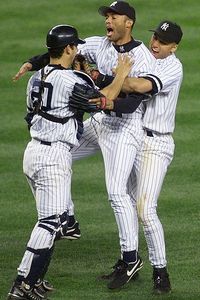
It was fitting that the first two Yankee players who greeted Jeter at the plate after his historic home run were Jorge Posada and Mariano Rivera.  This is the 17th season that the trio -- each of whom will end up in the Hall of Fame -- has played together as Yankee teammates.  That has never happened in any other major-league sport.

The Yankees have overpaid the three to keep them together and to ensure that they will never play a game in any other uniform, which is one more reason that everyone should love the Yankees -- they understand that tradition and loyalty can be just as important to fans as hits and wins.

And did I mention that Jeter's last hit yesterday drove in the game-winning run in the 8th inning?  (Actually, that was Jeter's 3188th hit if you count postseason games.  Derek Jeter has more postseason hits than any other player in history.)

After the game, Jeter said that he was grateful that the team had won the game because "it would have been really, really awkward to be out there giving interviews and waving to the crowd after the game if we had lost."

That's a very characteristic comment.  Jeter will probably be remembered by the casual fan as a player who came through in a lot of clutch situations.  But he should be remembered first and foremost as the ultimate team player -- the guy who was never happy with his season unless his team won it all.  

It's interesting that Jeter's father's first comment when he was interviewed after the game was "First of all, we needed a victory."  Jeter's father -- who's a substance-abuse counselor -- played shortstop in college, and Jeter once said he always wanted to be a shortstop because "when you're a kid, you want to be just like your dad."

Derek Jeter with his mother, sister, and father

If you had asked me about Derek Jeter ten years ago, I would have said that he was a very good player, but probably a bit overrated.  When you went to Yankees games ten years ago, you would see a lot of guys wearing Yankees jerseys or T-shirts -- many bearing the numbers of iconic Yankee old-timers (Mantle, Berra, DiMaggio, Don Mattingly), while others wore the numbers of contemporary players (Riviera, O'Neill, Bernie Williams).

Virtually all the women who came in Yankee shirts wore #2 -- Derek Jeter's number.

I was something of a purist -- I knew a lot about Yankee history, and I considered myself to know a lot about baseball statistics.  Jeter's stats were good, but didn't match up to the all-time Yankee greats.  So I refused to allow myself to get caught up in the virtual beatification of the Yankee shortstop for several years.

Eventually, I saw the light.  Derek Jeter transcends his numbers (although his numbers are very, very good).  His charisma, his performance in pressure situations -- most of all, his character and his decency -- are unsurpassed. 

I was wrong about Derek Jeter -- he's not overrated.  It's IMPOSSIBLE to overrate Derek Jeter.

In the famous 1978 one-game playoff between the Yankees and Red Sox, Hall of Famer Carl Yastrzemski popped out to Yankee 3B Graig Nettles for the game's final out.  Nettles was a very accomplished player -- he played major-league baseball for 22 seasons, was chosen for the All-Star Game six times, and played in five World Series.  

Yet how did he answer when a reporter asked him what he was thinking just before Yastrzemski hit that game-ending pop-up to him?  

"I was praying, 'Please don't let him hit it to me,'" Nettles answered -- an answer whose honesty endeared him to all the ex-Little Leaguers like me who spent most of their time on the field saying the same thing to themselves.

Yankees celebrate Nettles' pennant-clinching catch
What makes Derek Jeter different from even most good major-league players is that he's never thought "Please don't let him hit it to me."  As one of his former teammates said about him, "The thing that says Derek apart is that he's not afraid to fail."

Baseball is a game where even the best hitters fail most of the time -- as the old cliche goes, a .300 hitter makes out 70% of the time.  But there's a difference between understanding that you will fail 70% of the times you bat over the course of a season, and being afraid of failing in your next at-bat.   

Jeter once said this about his former manager, Joe Torre:

The last thing you need when you're not going well is to look over and see panic on your manager's face.  With Joe, he always looks like he's in control. . . . [P]anic, that's something you'll never see from him.

The Yankee captain could have been speaking about himself.   

And speaking of Joe Torre, he was at the game yesterday.  "Derek Jeter shows up to work," he said later.  "His ability is only a portion of what he brings to the game and his teammates on an everyday basis."  

Torre's the manager who decided the 21-year-old Jeter was ready to be the Yankees' everyday shortstop -- he saw something special in the young player, and he was right.  Jeter homered and made a couple of outstanding defensive on Opening Day of his rookie season, and the team went on to win the World Series that year, upsetting the heavily favored Atlanta Braves.  Jeter was named Rookie of the Year:


One thing that has to strike you about Jeter's accomplishment yesterday is how his opponents reacted.  The Tampa Bay first baseman, Casey Kotchman, tipped his cap to Jeter as he rounded first after hitting his home run.  The Rays' brilliant young pitcher, David Price, left the mound and sat in the dugout during the post-3000th celebration -- he wasn't mad or upset, he just didn't want to intrude on Jeter's moment.  

A tip of the cap
Terry Francona, manager of the Boston Red Sox -- don't get me started -- said that Jeter was still the same person he was as a 19-year-old playing in the minors when Francona first met him.  "Always plays the game right, he always treats people right, and he tries to beat your brains out."

Francona went on to say how disappointed he was that he didn't get to manage Jeter in the 2005 All-Star Game.  (Jeter was on the team in 2004 and has been on the team every year after 2005, but somehow missed that game.)  "I told him, 'I've been wanting to do this for a long time, and the fact that you're not on the team is upsetting to me,'" Francona said.  "He respects the game.  He plays the game right.  He makes me proud for the way he goes about his business."

Click here to see what some of the Yankee players, former teammate Johnny Damon, Jeter's father and Jay-Z himself had to say about The Captain's performance.

The tributes from sportswriters are rolling in, of course -- and they transcend the fact that he has 3000 hits.  Here's what Jon Paul Morosi of Fox Sports had to say just before Jeter reached that milestone, when the haters were saying Jeter had lost it -- was showing his age -- that the end of his career might be within sight:

There remains some mystery about Jeter, in part because he hasn’t stumbled in a manner that exposed personal flaws.  He isn’t Tiger Woods.  He isn’t Brett Favre.  He isn’t Kobe Bryant.  He is an anomaly.  Such is the state of our society that the more you mess up — see Charlie Sheen — the more interesting you become.  Compared with those who blur the line between fame and infamy, Jeter is kind of boring.  But his reward for solid citizenship has been steady speculation about his impending professional demise, because he’s left us with no other avenue for criticism.

Derek Jeter has always made it look easy.  But he admitted in his post-game press conference that the pressure to get number 3000 in front of Yankee Stadium fans this weekend had begun to wear on him.  "I've been lying to you guys for a couple of weeks" about not feeling any pressure, he told reporters.

Jeter at his postgame press conference yesterday
Jeter's 3000th hit was caught by a 23-year-old fan whose girlfriend had bought him a ticket to the game.  (Every guy should be so lucky as to have a girlfriend like that.)  I can only imagine how much money that ball would have brought at auction, but the fan didn't ask for anything -- he just wanted to be able to present it to Jeter in person.  Click here to see what this fan had to say about his experience.

Mel Brooks (playing King Louis XVI) said, "It's good to be the king."  Well, it's good to be The Captain, too.

I'll close with a little quiz for you baseball trivia fans: what does Derek Jeter have in common with Barry Bonds, Roger Clemens, Rafael Palmeiro, Manny Ramirez, Mark McGwire, and Pedro Martinez?


Here's perhaps the most mind-blogging play in baseball history -- it saved a crucial 1-0 victory in the playoffs:


Click here to view the live performance of "Empire State of Mind" before game 2 of the 2009 World Series at Yankee Stadium, which the Yankees won, beating the Philadelphia Phillies (and their starting pitcher, the truly despicable Pedro Martinez).
Here's the official music video for "Empire State of Mind."  It's a great song, and a great video -- even if you're not a fan of New York City.  And Jay-Z is a great rapper.  But to claim, "I made the Yankee hat more famous that a Yankee can"?  Spare me, Jay-Z.


Wednesday, July 6, 2011

Kid Creole and the Coconuts -- "Annie, I'm Not Your Daddy" (1982)


Oh Annie, I'm not your daddy
See if I was in your blood
Then you wouldn't be so ugly

Serendipity is the defining quality of 2 or 3 lines.  As the hot (age-adjusted) French girlfriend might say (riffing on the Sun King's famous line, which is probably apocryphal), "La sĂ©rendipitĂ©, c'est deux ou trois lignes." 

To wit . . .

While working on my post about Eric B. and Rakim's "Eric B Is President," I learned that one of the records they sampled in that track was Fonda Rae's 1982 disco hit, "Over Like a Fat Rat."

It turns out that Fonda Rae was one of the original members of Kid Creole and the Coconuts, a tongue-in-cheek retro act that actually could sing, play and dance.  I had a cassette of one Kid Creole album back in the day, and the reference to the band immediately brought "Annie, I'm Not Your Daddy" back to me.

*     *     *     *     *

Kid Creole – who has been described as "the larger-than-life central figure in a multi-racial, multi-cultural music carnival" – was Thomas August Darnell Browder (he went by August Darnell), a multi-racial, multi-cultural singer and guitarist.  I can't think of another musician who looked snazzier in a zoot suit:


The term "creole" was originally used to distinguish New World residents of French or Spanish heritage (in particular, residents of Louisiana) who were born in the Western Hemisphere from colonists who had migrated from Europe.  Eventually, the term came to apply to mixed-race Louisianans – especially the offspring of white Creole fathers and black or mixed-race mothers.

Louisiana developed a three-tiered social structure, with whites on top, blacks on the bottom, and mixed-race Creoles somewhere in the middle.  But the Creoles didn't have it too bad – they were gens de couleur libres ("free people of color") and had most of the legal privileges of whites.  

The Coconuts were Kid Creole's female dancers and backup singers, who usually wore grass hula skirts and (of course) coconut-shell bras:


This article captures the essence of the group and the essence of the time (1980's) and place (New York City) when they were most popular.

Click here for an article from Slant magazine that discusses the sociological significance of Darnell's songs.

*     *     *     *     *

This song was the first track on the third Kid Creole and the Coconuts album, Wise Guy.  That album reached #3 on the UK charts (under the title Tropical Gangsters), and this song and two others from the album were top 10 singles across the pond.

The singer denies his paternity of the hapless Annie on two grounds.  First, Annie's mother got around – so the odds of the singer being her father are pretty slim.  Second, basic genetics precludes any possibility that the two are related – the singer is a very handsome man, but Annie is heinous-looking.  Quod erat demonstrandum!

Click here to view the music video for "Annie, I'm Not Your Daddy."

(Boy, does that video not make any sense or what?)

Click here to view a video of a 1982 "Top of the Pops" performance of the song.

(Have you ever seen a band that was working harder and having a better time while performing?)

You can use this link to buy the song from Amazon:


And you can use this link to buy a coconut-shell bra:


Monday, July 4, 2011

Eric B. and Rakim -- "Eric B. Is President" (1986)


I came in the door, I said it before
I never let the mike magnetize me no more
But it's biting me, fighting me, inviting me to rhyme
I can't hold it back, I'm looking for the line,
Taking off my coat, clearing my throat
My rhyme will be kicking it until I hit my last note

After our brief detour to Los Angeles to learn about early-day gangsta rap, we're returning to New York City for the next few "Hip-Hop 101" posts.

Eric B. and Rakim formed one of the great DJ/MC duos of old-school rap's so-called "Golden Age," which lasted from 1986 to 1992 (when gangsta rap became the dominant style).

Eric B. (Eric Barrier) was an up-and-coming 20-year-old DJ living on Long Island when he met 17-year-old MC William Michael Griffin, Jr., also a Long Island resident.  

Clarence 13X
Griffin had taken the name Rakim when he converted to The Nation of Gods and Earth, an offshoot of the Nation of Islam that was founded in Harlem in 1964 by Clarence Smith, who called himself Clarence 13X.

Followers of Clarence 13X are often called "Five Percenters."  That's because The Nation of Gods and Earth teaches that 85% of humanity is mentally dead, 10% know the truth but oppress the 85% by convincing them to believe in a "mystery God" who cannot be seen in this lifetime, while the remaining 5% constitute the "poor righteous teachers" who possess the truth.

(I don't about all this, but it's hard to argue with their theory that 85% of humanity is mentally dead and 10% are liars.)

A number of other hip-hop artists -- including Big Daddy Kane, Common, Brand Nubian, and Busta Rhymes -- are Five Percenters.  Click here to read more about The Nation of Gods and Earth.

The Paid In Full album cover
Eric B. and Rakim's debut album, Paid in Full -- which was ranked as the greatest hip-hop album of all time by MTV -- was released in July 1987, but "Eric B. Is President" came out as a single in 1986.  It's a hip-hop track about hip-hop -- Rakim's subject is MC'ing, not drugs, or guns, or sex, or expensive cars. 

Rakim took MC'ing to a whole new place.  Early-day rap lyrics were simple and sing-songy, heavy on end rhymes.  Rakim's style was jazz-influenced -- his rhythms were less predictable than the "flat-footed" rhythms used by older rappers, and his more complex raps were characterized by internal rhymes as much as by end rhymes.  (In the lines quoted above, "biting me, fighting me, inviting me" is an example of internal rhyming -- three rhymes within one line.) 

And Rakim's quiet, low-key delivery was the polar opposite of the high-energy, scream-into-the-microphone vocal technique that most rappers of the day utilized. 

James Brown
Eric B. was equally innovative as a DJ.  He was a master of live turntable mixing and scratching, and was the first DJ -- but far from the last -- to use James Brown samples.  (In fact, the "Godfather of Soul" sued to prevent the use of a sample of his music on this cut.)

"Eric B. Is President" also samples the bass line from Fonda Rae's 1982 disco hit, "Over Like a Fat Rat."  When Eric B. told Rakim that he planned to use that bass line, Rakim laughed so hard that he spit beer all over the wall.  "Just like you laughing now, you going to be laughing all the way to the bank and be a millionaire one day because of this record." Eric B. told him.  And he was right. 

Here's "Eric B. Is President":


Here's a link you can use to buy this record from Amazon:

Saturday, July 2, 2011

Sweet -- "Fox on the Run" (1975)


You . . . you talk about just every band 
But the names you drop are secondhand
I've heard it all before 
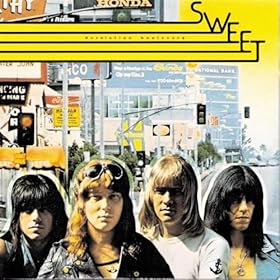
Sweet's Desolation Boulevard album was released in the fall of 1974, shortly after I started law school. 

Desolation Boulevard

"Fox on the Run" was released as a single in March 1975, while the band's other big hit -- "Ballroom Blitz" -- was released in May of that year.  Oddly, both singles were #1 hits in Australia, both hit #2 on the British charts, and both topped out at #5 in the US.  The band's biggest hit in the US was "Little Willy," which made it all the way to #3 in 1973.

I was tempted to feature "Ballroom Blitz" in this post, but I chose "Fox on the Run" for two reasons.  First, I think it is less familiar.  Second, it was featured in the Dazed and Confused soundtrack. 

"Fox on the Run" is about groupies.  Not the most original concept for a 1970's rock song, is it?  The first line of the song is "I . . . don't wanna know your name."  At least the band was honest.

Sweet (who were usually (but incorrectly) referred to as The Sweet) admired the Who -- they recorded "My Generation" and played a medley of  Who songs in their live sets for a number of years -- and Pete Townshend praised the band in 1974.  But Desolation Boulevard sounds more like T. Rex, Gary Glitter, and other British glam-rockers than the Who.

Desolation Boulevard was a top 25 album in the US, hit #13 in Australia, and reached the top 10 in Germany and Canada.  Sweet's next album did about as well, but the band's following LP sold poorly.  Sweet switched labels and switched musical styles as well.  Their final hit single -- "Love Is like Oxygen" (which made it into the top 10 in the US, UK, and a number of other countries) -- sounds more like ELO than ELO does.

The story of the band's subsequent downward spiral is a familiar one.  Lead singer Brian Connolly's drinking problem got out of hand, and the rest of the band weren't exactly poster children for sobriety. 

I don't know if the creators of This Is Spinal Tap had any particular band in mind, but it wouldn't surprise me if Sweet was one of the groups that inspired that great mockumentary.

It's a little embarrassing to admit that I bought Desolation Boulevard.  The music is unbelievably dated, although only about half as dated as the band's clothing and haircuts are.

The haircuts are really appalling.  Actually, that's not fair -- the haircuts would be beautiful if they were on girls.  If you had put Sweet's members in dresses and dropped them off at a singles bar, I guarantee you they would have gotten hit on by half the guys there.

Here's "Fox on the Run":


Here's a link you can use to order from Amazon: