Showing posts with label George Harrison. Show all posts

Thursday, October 24, 2024

George Harrison – "Beware of Darkness" (1970)


Watch out now, take care

Beware of greedy leaders

They take you where you should not go


(You can say that again, boys and girls!)


*     *     *     *     *


Dhani Harrison – George Harrison’s only child – had no idea his father was a musician until he was in elementary school.


“My earliest memory of my dad is probably of him somewhere in a garden covered in dirt, somewhere hot, a tropical garden, in jeans, khakis covered in dirt, just continuously planting trees,” Dhani told Martin Scorsese in 2011. “I think that’s what I thought he did for the first seven years of my life.” 


Opinions differ over whether Paul McCartney, John Lennon, or George Harrison was the best of the Beatles when it came to songwriting.  But there’s no doubt that Harrison was the best of the Beatles at gardening.


*     *     *     *     *


Harrison purchased the Oxfordshire estate known as Friar Park from an order of nuns in 1970.


Friar Park originally belonged to a wealthy lawyer named Sir Frank Crisp, who had created one of the most incredible gardens in England there.  From an article in Country Life magazine:


Crisp’s creations included a vast alpine rock garden that covered four acres, topped by a scale model of the Matterhorn, as well as a series of stalactites, caves, grottos and underground passages populated by a multitude of garden gnomes. . . .


Crisp was a born collector and one of his passions was for sundials of every type, which he installed in an area he called the Dial Garden. Gnomons, astrolabes, armillary spheres and ring dials – all were corralled into his garden and mounted correctly. The layout copied the plan of the long-lost Labyrinth at Versailles in France, but with 39 sundials in place of the original fountains.


But perhaps the most remarkable feature of Friar Park was its topiary garden, which consisted of more than 160 yew trees pruned and trained into a staggering variety of shapes – including columns, urns, obelisks, vases, spirals . . . and sheep:
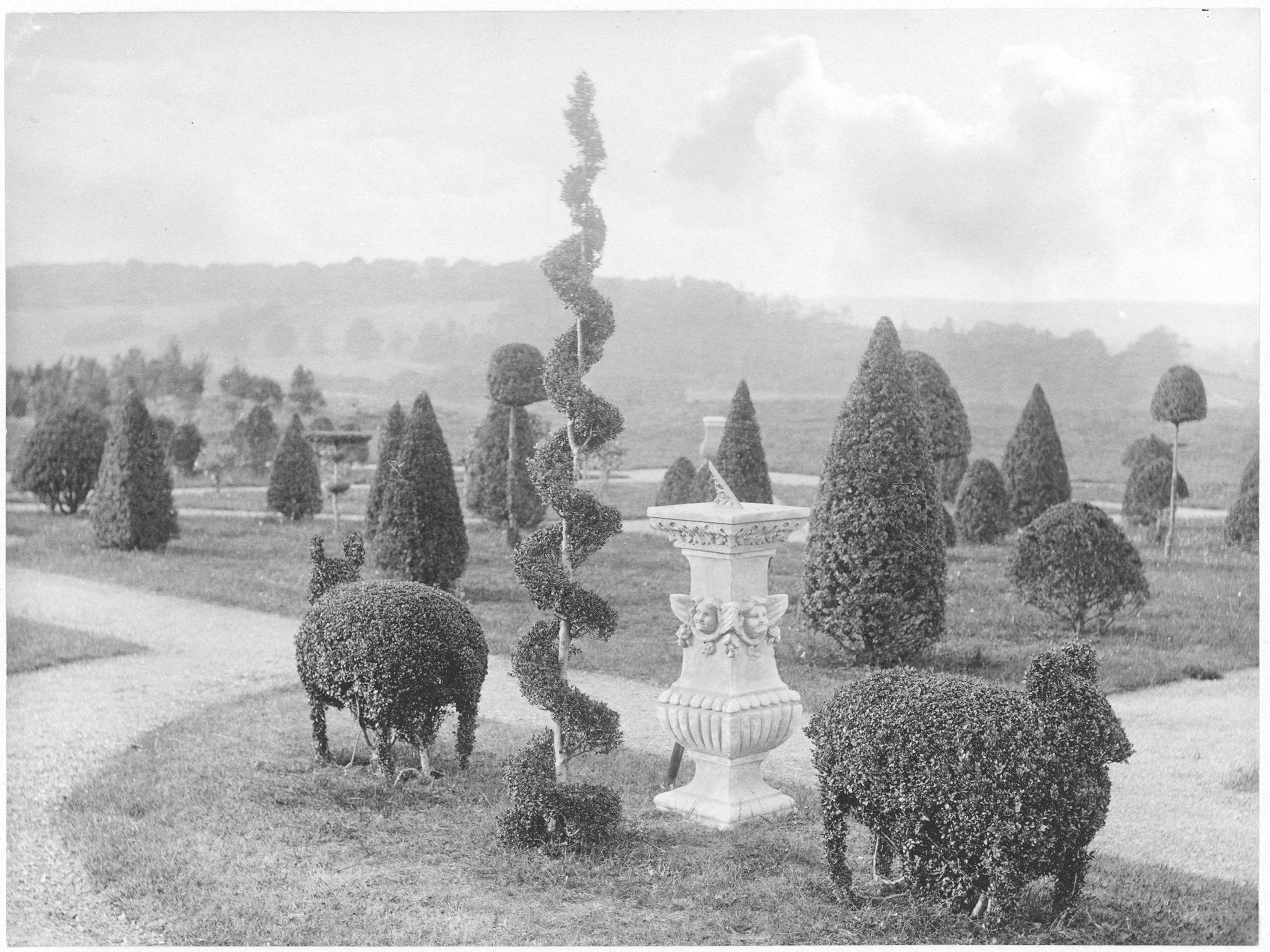

The Friar Park topiary garden
as it was a century ago

The nuns had done their best to maintain Friar Park and its garden after purchasing it in 1951, but the expense of doing so eventually became too much for them.  Enter Harrison, who certainly had the means to restore Friar Park to its previous glories.


According to Country Life, “[t]he topiary garden was completely overgrown, reduced to an impenetrable sea of bushes that had grown into each other and overrun by such weeds as ivy and brambles” when Harrison and his wife Olivia took possession of the estate, and “Sir Frank’s sundials had long since disappeared.”


“George used garden flame-throwers to clear the undergrowth and put two goats to clear the weeds and brambles on the rock garden,” Olivia told Country Life in 2023.  “He hired and oversaw a team of local builders, who cleared ceramics and shopping trolleys out of the lake, which the nuns had allowed to be used as a dumping ground.  And he personally oversaw the workmen he hired to cement the leaks and lay new pipework so that the lakes could be filled again.”  


The overgrown yews were pruned back to their trunks.  After they grew back, new topiaries were carved.  Today, the topiary is a mix of traditional and non-traditional forms, including hexagons, pagodas, bullseyes, and waves.


The Friar Park topiary garden today

Country Life calls the “impeccably maintained” topiary garden at Friar Park “a masterpiece – one of the most important in all Europe.”  


Click here to read the entire Country Life article about Friar Park and the Harrisons.


Click here to watch a documentary about Friar Park.


*     *     *     *     *


Harrison wrote “Beware of Darkness” – also a masterpiece – at about the same time that he bought Friar Park.  


The song’s lyrics reflect the influence of Harrison’s deep involvement with the Radha Krishna Temple.  He had invited members of the temple to stay at Friar Park – in part to help him with the restoration of the house and gardens, but mostly in hopes of bringing an intensely spiritual aura to the property.


Click here to learn more about the Radha Krishna Temple.


Click here to listen to “Beware of Darkness,” the antepenultimate member of the 2024 class of inductees into the 2 OR 3 LINES “GOLDEN DECADE” ALBUM TRACKS HALL OF FAME.


Click here to buy “Beware of Darkness” from Amazon.


Friday, December 8, 2017

Cream – "Badge" (1969)


Then I told you about our kid
Now he’s married to Mabel

I’ve read that “our kid” is Cockney slang for “little brother.”  That would make the “Badge” lyrics quoted above slightly less puzzling.

*     *     *     *     *

The story goes that each of the members of Cream were supposed to write a song for the group’s aptly-named final studio album, Goodbye, but that Eric Clapton wasn’t able to come up with anything by himself.  So he sat down with his friend, George Harrison, and wrote “Badge.”  


This was in 1968, years before Harrison’s wife, Pattie Boyd, divorced him and moved in with Clapton – but perhaps not long before Clapton first got the hots for Boyd.  

The story goes that Harrison had written “bridge” next to the lyrics for the song’s bridge, which Clapton misread as “badge” – hence the song’s title.  

While Harrison and Clapton were laughing about the “bridge”/“badge” misunderstanding, Ringo Starr walked in three sheets to the wind and suggested the line about the swans that live in the park.

Harrison and Clapton (1969)
(By the way, Pattie Boyd said the reason she left Harrison was the fact that he had a number of affairs while they were married – including one with Ringo Starr’s wife, Maureen.  I’m not sure if that was before or after Boyd had an affair with Faces guitarist Ronnie Wood, who later replaced Mick Taylor in the Rolling Stones.)

*     *     *     *     *

The last 2 or 3 lines discussed the Civil War-era High Bridge near Farmville, Virginia, which has been converted from a railroad bridge to one suitable for use by hikers and bikers.

It also discussed a different kind of bridge – the musical bridge, which is a section of a song that is usually inserted between the verses of a song, and which contrasts musically with those verses.  The particular musical bridge that was the subject of that discussion was the bridge (or “middle eight”) of “Ticket to Ride” by the Beatles.

Cream
The bridge in “Badge” – which begins at 1:07 of the song – is the most interesting part of that song.  It really steals the show from the verses.  (“Badge” doesn’t have choruses.)

Like all great bridges, the bridge in “Badge” contrasts with the verses, but also complements them.  It’s not one of those bridges that sounds like it should have been the foundation of a whole different song.

*     *     *     *     *

Shortly before “Badge” was recorded, Eric Clapton joined the Beatles at Abbey Road Studios to play the lead guitar part on Harrison’s song, “While My Guitar Gently Weeps.”

George Harrison returned the favor and played rhythm guitar when Cream recorded “Badge.” 

For legal reasons, neither Clapton’s nor Harrison’s name could appear on those records.  (The rhythm guitar part on “Badge” was credited to “L’Angelo Misterioso” – or “Mysterious Angel.”)

George and Ringo at Abbey Road Studios
Some people think Harrison played the lead guitar part that accompanies the bridge in “Badge.”  The guitar arpeggios that introduce the bridge do sound very Abbey Road-ish, but most sources say that Clapton – not Harrison – is the one playing there.

*     *     *     *     *

“Badge” is a very economical song.  It clocks in at less than three minutes long.  

The song featured in the previous 2 or 3 lines, “Ticket to Ride,” is about 30 seconds longer . . . although there is less there there.

The Beatles stretched “Ticket to Ride” by repeating everything – both verses are repeated, and the bridge is repeated as well.  (If you eliminated all the repeated lines from “Ticket to Ride”  it would be about half as long as “Badge.”)

*     *     *     *     *

Cream was a fabulous band.  Like the Jimi Hendrix Experience, Cream had only three members – such groups were known as “power trios” back in the day – but all three were extremely talented.  It’s amazing that such near-perfect music could be produced by only three musicians.

While Eric Clapton is the household name among Cream’s members, it’s possible that he wasn’t as good a guitarist as Jack Bruce was a bassist or Ginger Baker was a drummer. 

Here’s “Badge”:


Click below to buy the song from Amazon:

Wednesday, February 24, 2016

Derek and the Dominos – "Layla" (1970)


Tried to give you consolation
When your old man had let you down

Everyone knows that Eric Clapton wrote “Layla” for Pattie Boyd when she was still married to his close friend and musical collaborator, George Harrison.  

George Harrison and Pattie Boyd
What you may not know is that the song was named for the heroine of 12th-century Persian poet Nizami Ganjavi’s most famous work, Layla and Majnun.

In case you’re wondering how the hell Eric Clapton became acquainted with a 12th-century Persian poem, he received a copy of it from Ian Dallas, a Scottish playwright and actor who had converted to Islam in 1967, taking the name Abdalqadir as-Sufi.    

In Layla and Majnun, a young man named Qays becomes so obsessed with a young woman named Layla that the people in his community begin to refer to him as Majnun (which means “madman”). 

Layla and Majnun
Layla’s father refuses to allow her to wed Qays.  Instead, he marries her off to a rich merchant.  The heartbroken Qays leaves his tribe’s camp and wanders in the surrounding desert until he dies. 

Unlike Qays, Clapton eventually got what he wanted.  From Boyd’s autobiography:

We met secretly at a flat in South Kensington. Eric Clapton had asked me to come because he wanted me to listen to a new number he had written.

He switched on the tape machine, turned up the volume and played me the most powerful, moving song I had ever heard. It was “Layla,” about a man who falls hopelessly in love with a woman who loves him but is unavailable.

Eric Clapton and Pattie Boyd
He played it to me two or three times, all the while watching my face intently for my reaction.  My first thought was: “Oh God, everyone's going to know this is about me.”

I was married to Eric's close friend, George Harrison, but Eric had been making his desire for me clear for months.  I felt uncomfortable that he was pushing me in a direction in which I wasn't certain I wanted to go.

But with the realization that I had inspired such passion and creativity, the song got the better of me.  I could resist no longer.

Pattie Boyd's autobiography,
"Wonderful Tonight"
Clapton also wrote “Wonderful Tonight” for Boyd.  (He penned that song just before attending Paul and Linda McCartney’s annual Buddy Holly party with her.)  

Pattie divorced Harrison (who had written “Something” for her) and eventually married Clapton in 1979.  But they separated after only a few years.  Apparently man – or woman – does not live by love songs alone.

“Layla” is actually two songs in one.  Clapton wrote the first part – the part with the words and the famous Duane Allman guitar riff.  After recording that part of “Layla,” Clapton heard Derek and the Dominos drummer Jim Gordon playing a piece on the piano in the recording studio, and asked Gordon if he could use it in “Layla.”

Martin Scorsese famously used Gordon's piano coda in Goodfellas:


By the way, Jim Gordon used a hammer and a butcher knife to murder his mother in 1983.  He’s been in prison ever since.

Here’s “Layla”:


Click below to buy the song from Amazon: