Showing posts with label Eric Clapton. Show all posts

Sunday, February 23, 2020

Eric Clapton – "Blues Power" (1970)


Bet you didn’t think I knew
How to rock ’n’ roll

I play keyboards, not guitar – so I’m not qualified to judge Eric Clapton’s technical ability as a guitarist.

But what this year’s “29 Posts in 29 Days” is about is whether a recording artist is overrated or underrated based on the quality of his or her recorded music – not on his or her ability as an instrumentalist or a singer or a songwriter.  

By that criterion, Clapton is clearly overrated – at least as a solo artist.

*     *     *     *     *

Type “Eric Clapton overrated underrated” in a Google search box and you’ll see that a lot more people see him as overrated as underrated.


David Hayter of Guitar Planet magazine has written that the young Clapton “played with both an effortless sauntering swagger and a luscious melting tone that could pierce one moment and ooze seductively the next.”  

But Hayter thinks Clapton peaked a long time ago:

His glory lays in the distant, distant past.  [After] the halcyon days of youth, when his sound was a revelation . . . Clapton quickly began to wane, and Slowhand set about an arduous three and half decades of meandering jams, indulgent and unspectacular live performances, and innovation free LPs.

Many critics think Clapton was more of a borrower than a creator.  They give Clapton little credit for what the Yardbirds, Cream, Blind Faith, and Derek and the Dominoes accomplished.  “Left to Clapton, Cream would have played half-hour versions of Robert Johnson's ‘Crossroads’,” wrote Kieron Tyler of the Guardian.   “And the thrilling guitar on ‘Layla’ was played by Duane Allman.”

There’s little doubt that Clapton’s solo records are mediocre at best.  Most of his best-known covers (like “I Shot the Sheriff,” “Cocaine,” and “Knockin’ on Heaven’s Door”) are inferior to the originals, while his most successful originals (like “Lay Down Sally,” “Wonderful Tonight,” and “It’s in the Way That You Use It”) do nothing for me except make me change the channel when I hear them on my car radio.

*     *     *     *     *

“Blues Power” – which was released on Clapton’s eponymous debut solo album in 1970 – was co-written by Clapton and Leon Russell.  It sounds like it’s 99% a Russell song, but I could be wrong.


The Eric Clapton album featured many of the same musicians who played on the Delaney & Bonnie & Friends album, On Tour with Eric Clapton, which had been released earlier that same year – Leon Russell, Delaney and Bonnie Bramlett, drummer Jim Gordon, bassist Carl Radle, keyboard player Bobby Whitlock, and saxophonist Bobby Keys.

Click here to listen to “Blues Power.”

Click below to buy the song from Amazon:

Thursday, February 28, 2019

Eric Clapton (ft. Marcy Levy) – "The Core" (1977)


I can burn
Without fuel

“The Core” – which was released on Eric Clapton’s Slowhand album in 1977 – isn’t as well known as “I Shot the Sheriff,” or “Lay Down Sally,” or “Wonderful Tonight,” or “Cocaine.”


But I think it’s the best song on any of Clapton’s solo albums – thanks in large part to the saxophone playing of Mel Collins, the Hammond B3 work of Dick Sims, and especially Marcy Levy’s vocals.  

*     *     *     *     *
It’s only fair that Marcy Levy shared lead vocal duties on “The Core,” since she and Eric Clapton co-wrote that song.  (She also co-wrote “Lay Down Sally.”)

Levy, who was born in Detroit in 1952, decided to move to Tulsa after meeting Leon Russell.  (Levy sang back-up vocals on Bob Seger’s Back in ’72 album, which was recorded at Russell’s Oklahoma recording studio.)  

Through Russell, she met Eric Clapton – who was smack dab in the middle of his “Tulsa Sound” period – and ended up touring and recording with him for four years.

Eric Clapton and Marcy Levy in 1975
Levy was a highly sought after back-up singer, and she had some success as a songwriter.  But she wanted a solo career.

Unfortunately, her debut solo album – which was released in 1982 – didn’t sell and her record company dropped her.

A few years later, Levy hooked up with Bananarama’s Siobhan Fahey to form Shakespears [sic] Sister.  Their second album, which was titled Hormonally Yours – both women were pregnant at the time it was recorded – spent over a year on the Billboard album charts and eventually went double platinum:  


Levy called herself Marcella Detroit while she was with Shakespears Sister.  She used that moniker on the first two solo albums that she recorded after Shakespears Sister broke up, but reverted to her birth name when she formed the Marcy Levy Band in 2002.  

But when the Marcy Levy Band split up several years later, she went back to calling herself Marcella Detroit.   (So confusing!)

*     *     *     *     *

Have you figured out the theme of this year’s “28 Songs in 28 Days” yet?

It’s as plain as the nose on your face: all the songs featured on 2 or 3 lines this month were by artists who recorded under names other than those they were born with.

Except for Eric Clapton, that is.

Marcy Levy performing with
Eric Clapton in London in 2018
Like Bobby Darin, Clapton was born to an unmarried teenage mother whose family wanted to conceal her pregnancy.  Each man grew up thinking that his grandmother was his mother, and that his mother was his older sister.

Clapton was born a few months before the end of World War II.  His father was a married Canadian soldier who was shipped off to combat before young Eric was born, and who returned to Canada and his wife after the war was over.  

Clapton’s grandmother’s first husband was named Clapton – he was the biological father of Clapton’s mother.  But Eric grew up thinking his grandmother and her second husband – a man named Jack Clapp – were his parents.  His grandmother told him the truth when he was nine years old.  

A lot of people think Clapton’s real name is Eric Clapp – he himself would have thought that was his name when he was a young child – but his mother’s surname was Clapton, so that is presumably the name on his birth certificate.

*     *     *     *     *

Click here to listen to “The Core.”

Click on the link below to buy the song from Amazon:

Friday, December 8, 2017

Cream – "Badge" (1969)


Then I told you about our kid
Now he’s married to Mabel

I’ve read that “our kid” is Cockney slang for “little brother.”  That would make the “Badge” lyrics quoted above slightly less puzzling.

*     *     *     *     *

The story goes that each of the members of Cream were supposed to write a song for the group’s aptly-named final studio album, Goodbye, but that Eric Clapton wasn’t able to come up with anything by himself.  So he sat down with his friend, George Harrison, and wrote “Badge.”  


This was in 1968, years before Harrison’s wife, Pattie Boyd, divorced him and moved in with Clapton – but perhaps not long before Clapton first got the hots for Boyd.  

The story goes that Harrison had written “bridge” next to the lyrics for the song’s bridge, which Clapton misread as “badge” – hence the song’s title.  

While Harrison and Clapton were laughing about the “bridge”/“badge” misunderstanding, Ringo Starr walked in three sheets to the wind and suggested the line about the swans that live in the park.

Harrison and Clapton (1969)
(By the way, Pattie Boyd said the reason she left Harrison was the fact that he had a number of affairs while they were married – including one with Ringo Starr’s wife, Maureen.  I’m not sure if that was before or after Boyd had an affair with Faces guitarist Ronnie Wood, who later replaced Mick Taylor in the Rolling Stones.)

*     *     *     *     *

The last 2 or 3 lines discussed the Civil War-era High Bridge near Farmville, Virginia, which has been converted from a railroad bridge to one suitable for use by hikers and bikers.

It also discussed a different kind of bridge – the musical bridge, which is a section of a song that is usually inserted between the verses of a song, and which contrasts musically with those verses.  The particular musical bridge that was the subject of that discussion was the bridge (or “middle eight”) of “Ticket to Ride” by the Beatles.

Cream
The bridge in “Badge” – which begins at 1:07 of the song – is the most interesting part of that song.  It really steals the show from the verses.  (“Badge” doesn’t have choruses.)

Like all great bridges, the bridge in “Badge” contrasts with the verses, but also complements them.  It’s not one of those bridges that sounds like it should have been the foundation of a whole different song.

*     *     *     *     *

Shortly before “Badge” was recorded, Eric Clapton joined the Beatles at Abbey Road Studios to play the lead guitar part on Harrison’s song, “While My Guitar Gently Weeps.”

George Harrison returned the favor and played rhythm guitar when Cream recorded “Badge.” 

For legal reasons, neither Clapton’s nor Harrison’s name could appear on those records.  (The rhythm guitar part on “Badge” was credited to “L’Angelo Misterioso” – or “Mysterious Angel.”)

George and Ringo at Abbey Road Studios
Some people think Harrison played the lead guitar part that accompanies the bridge in “Badge.”  The guitar arpeggios that introduce the bridge do sound very Abbey Road-ish, but most sources say that Clapton – not Harrison – is the one playing there.

*     *     *     *     *

“Badge” is a very economical song.  It clocks in at less than three minutes long.  

The song featured in the previous 2 or 3 lines, “Ticket to Ride,” is about 30 seconds longer . . . although there is less there there.

The Beatles stretched “Ticket to Ride” by repeating everything – both verses are repeated, and the bridge is repeated as well.  (If you eliminated all the repeated lines from “Ticket to Ride”  it would be about half as long as “Badge.”)

*     *     *     *     *

Cream was a fabulous band.  Like the Jimi Hendrix Experience, Cream had only three members – such groups were known as “power trios” back in the day – but all three were extremely talented.  It’s amazing that such near-perfect music could be produced by only three musicians.

While Eric Clapton is the household name among Cream’s members, it’s possible that he wasn’t as good a guitarist as Jack Bruce was a bassist or Ginger Baker was a drummer. 

Here’s “Badge”:


Click below to buy the song from Amazon:

Wednesday, February 24, 2016

Derek and the Dominos – "Layla" (1970)


Tried to give you consolation
When your old man had let you down

Everyone knows that Eric Clapton wrote “Layla” for Pattie Boyd when she was still married to his close friend and musical collaborator, George Harrison.  

George Harrison and Pattie Boyd
What you may not know is that the song was named for the heroine of 12th-century Persian poet Nizami Ganjavi’s most famous work, Layla and Majnun.

In case you’re wondering how the hell Eric Clapton became acquainted with a 12th-century Persian poem, he received a copy of it from Ian Dallas, a Scottish playwright and actor who had converted to Islam in 1967, taking the name Abdalqadir as-Sufi.    

In Layla and Majnun, a young man named Qays becomes so obsessed with a young woman named Layla that the people in his community begin to refer to him as Majnun (which means “madman”). 

Layla and Majnun
Layla’s father refuses to allow her to wed Qays.  Instead, he marries her off to a rich merchant.  The heartbroken Qays leaves his tribe’s camp and wanders in the surrounding desert until he dies. 

Unlike Qays, Clapton eventually got what he wanted.  From Boyd’s autobiography:

We met secretly at a flat in South Kensington. Eric Clapton had asked me to come because he wanted me to listen to a new number he had written.

He switched on the tape machine, turned up the volume and played me the most powerful, moving song I had ever heard. It was “Layla,” about a man who falls hopelessly in love with a woman who loves him but is unavailable.

Eric Clapton and Pattie Boyd
He played it to me two or three times, all the while watching my face intently for my reaction.  My first thought was: “Oh God, everyone's going to know this is about me.”

I was married to Eric's close friend, George Harrison, but Eric had been making his desire for me clear for months.  I felt uncomfortable that he was pushing me in a direction in which I wasn't certain I wanted to go.

But with the realization that I had inspired such passion and creativity, the song got the better of me.  I could resist no longer.

Pattie Boyd's autobiography,
"Wonderful Tonight"
Clapton also wrote “Wonderful Tonight” for Boyd.  (He penned that song just before attending Paul and Linda McCartney’s annual Buddy Holly party with her.)  

Pattie divorced Harrison (who had written “Something” for her) and eventually married Clapton in 1979.  But they separated after only a few years.  Apparently man – or woman – does not live by love songs alone.

“Layla” is actually two songs in one.  Clapton wrote the first part – the part with the words and the famous Duane Allman guitar riff.  After recording that part of “Layla,” Clapton heard Derek and the Dominos drummer Jim Gordon playing a piece on the piano in the recording studio, and asked Gordon if he could use it in “Layla.”

Martin Scorsese famously used Gordon's piano coda in Goodfellas:


By the way, Jim Gordon used a hammer and a butcher knife to murder his mother in 1983.  He’s been in prison ever since.

Here’s “Layla”:


Click below to buy the song from Amazon:

Tuesday, August 4, 2015

Yardbirds – "I'm Not Talking" (1965)


The things I say at midnight 
I ain't gonna say in daylight

(Actually, it's not the things I say at midnight that I worry about – it's the things I say at one in the morning, or two in the morning, or sometimes even later.)

The next nine installments of 2 or 3 lines are going to be all about the music.  (That's right – no tales of my misspent youth, no travelogues, no windy philosophizing.)  You think 2 or 3 lines is just a wildly successful pop music blog, and that it is.  But it's also a high-concept piece of performance art.

We'll feature three versions (the original and two covers) of three different songs.  (Three times three is nine, of course.)  One song is going to lead to the next, which will lead to the next . . . until we're back where we're starting – with the Yardbirds.

The original Yardbirds (1963)
The Yardbirds were ahead of their time . . . which wasn't necessarily a good thing for them.

They had five consecutive top-20 singles in the U.S. between April 1965 and June 1966 – all of which still sound great today – but none of their albums cracked the top 50, and they were miles behind the Beatles and Stones in popularity.

A few years later, the rock music landscape looked very different.  Rock groups focused more on albums than singles, and heavier, blues-inspired bands like Cream, the Jeff Beck Group, and especially Led Zeppelin were all the rage.

Cream's lead guitarist, Eric Clapton, got his start as a member of the Yardbirds.  He was succeeded as the band's lead guitarist by Jeff Beck, who was in turn replaced by Jimmy Page – the lead guitarist of Led Zeppelin, which he formed in 1968 when his fellow Yardbirds decided to pack it in.

Beck, Page, and Clapton
Clapton, Page, and Beck are #2, #3, and #5 (respectively) on Rolling Stone's "100 Top Guitarists List."  All three have been inducted into the Rock and Roll Hall of Fame more than once – Clapton as a member of the Yardbirds, as a member of Cream, and as a solo artist; Beck as a member of the Yardbirds and as a solo artist; and Page as a member of the Yardbirds and as a member of Led Zeppelin.  

"I'm Not Talking" was a cover of of a 1964 song written by jazz pianist/singer Mose Allison.  The Yardbirds' version was the second track on their first studio album, For Your Love. 


Most of the tracks on that album featured Eric Clapton, who had left the band several months before the album was released in June 1965.  But three of the tracks – including "I'm Not Talking" – were from Jeff Beck's first sessions with the Yardbirds.

"I'm Not Talking" has a devilishly irregular rhythmic structure.  I've spent considerable time trying to count it out, but it's been all for naught.  (If you think you've figured out how to notate it, please tell me what you've come up with – I'd love to see it.)

The next 2 or 3 lines will feature an even more complicated cover of "I'm Not Talking," and then we'll look at the Mose Allison original.  That will lead to a post about a Mose Allison cover of a different song, another cover of that song . . . anyway, we'll eventually get back to the Yardbirds.

So sit back and prepare to enjoy three full weeks of 100% narcissism-free 2 or 3 lines posts . . . promise!

Here's "I'm Not Talking" by the Yardbirds:


Click below to buy the song from Amazon:

Sunday, July 14, 2013

Blind Faith -- "Had to Cry Today" (1969)


I'm taking the chance 
To see the wind in your eyes
While I listen
You say you can't reach me
But you want every word
To be free

Guitar World magazine recently named what it believed were the 20 greatest supergroups of all time.  Click here if you'd like to read it.

Here’s how Guitar World defined a supergroup:

1. There have to be at least three members.  (In other words, two big stars getting together and playing with more-or-less anonymous backing musicians is not a supergroup.)

2. They have to have released at least one album – no all-star jams.

3. A majority of their band members have to have been in well-known bands before the supergroup formed.

4. A supergroup cannot be formed by a well-known musician joining a pre-existing band.

Blind Faith: superest supergroup?
I think that’s a pretty good definition.  Ideally, you’d like to see all the band’s members be stars – although it’s rare that every member of a supergroup is a star of equal magnitude.  (It’s like an all-star baseball team.  Everyone on an all-star team is recognized as a very good player, but not everyone is equally good – you always have a few superstars whose talents dwarf even other all-stars.)

Given that, who is the greatest rock supergroup of all time?

Guitar World says Cream, and there are others out there whose supergroup rankings are also topped by Cream.  There’s no doubt that Cream was a fabulous group.  But was Cream really a supergroup?

Eric Clapton was a member of the very successful Yardbirds before joining Cream, so he qualifies on that count.  The other members of Cream – bassist Jack Bruce and drummer Ginger Baker – came from the Graham Bond Organisation, which was a highly-respected British blues/jazz group that was not commercially successful and didn’t make much of an impression on the public before breaking up.  So I’m not sure Cream really qualifies as a supergroup.

*     *     *     *     *

Clapton and Baker’s next band, Blind Faith, clearly does qualify.

Clapton and Baker were certainly superstars on the basis of Cream alone.  The band’s keyboard player and lead vocalist, Steve Winwood, came to Blind Faith by way of Traffic (one of the greatest rock groups of all time) and the Spencer Davis Group, which wasn’t too shabby either.

Steve Winwood and Eric Clapton in 2007
The remaining member of Blind Faith, bassist Ric Grech, wasn’t nearly as famous as Clapton, Baker, or Winwood.  He came to the supergroup from Family, a progressive rock/psychedelic group that had several top ten albums in the UK, but sold very few records in the U.S.

But I don’t think having one less well-known member disqualifies Blind Faith from being a supergroup.  The other three members were much bigger stars, but Grech certainly was no amateur – and (fairly or unfairly) bass players are usually the least-noticed band members.  

I also think supergroups should have a relatively short life – one or two albums at most.  (Think Edna St. Vincent Millay:  “My candle burns at both ends/It will not last the night/But ah, my foes, and oh, my friends/It gives a lovely light!”)  Blind Faith released only one studio album – which was eponymously titled (of course) – and toured for only a few months before breaking up shortly after that album’s release.

*     *     *     *     *

The Blind Faith album sold half a million the first month after its release, and made it to #1 on both the American and British charts.  The original album cover featured a topless pubescent girl holding a vaguely phallic silver spaceship model.  That cover was replaced before the album was released in the U.S.

The original Blind Faith cover
Here's the story behind the album as told by photographer Bob Seidemann:

I received a phone call from Polydor Records' London office.  It was an assistant of Robert Stigwood, Clapton's manager.  Cream was over and Eric was putting a new band together.  The fellow on the phone asked if I would make a cover for the new unnamed group.  This was big time. It seems though the western world had for lack of a more substantial icon, settled on the rock and roll star as the golden calf of the moment. . . .
I could not get my hands on the image until out of the mist a concept began to emerge.  To symbolize the achievement of human creativity and its expression through technology, a space ship was the material object.  To carry this new spore into the universe innocence would be the ideal bearer, a young girl, a girl as young as Shakespeare's Juliet.
If she were too old it would be cheesecake – too young and it would be nothing.  It was the beginning of the transition from girl to woman, that is what I was after.  That temporal point, that singular flare of radiant innocence.  Where is that girl?
I was riding the London tube . . . when the subway doors opened and she stepped into the car.  She was wearing a school uniform, plaid skirt, blue blazer, white socks and ball point pen drawings on her hands.  It was as though the air began to crackle with an electrostatic charge.  She was buoyant and fresh as the morning air.


Photographer Bob Seidemann
I approached her and said that I would like her to pose for a record cover for Eric Clapton's new band. Everyone in the car tensed up.
She said, "Do I have to take off my clothes?"  My answer was yes.  I gave her my card and begged her to call.  I would have to ask her parent's consent if she agreed.  When I got to Stigwood's office I called the flat and said that if this girl called not to let her off the phone without getting her phone number.  When I returned she had called and left her number.
[A friend and I] headed out to meet with the girl's parents.  It was a Mayfair address.  This was a swank part of town, class in the English sense of the word.
[We] made our presentation, I told my story, the parents agreed.  The girl on the tube train would not be the one, she was shy, she had just passed the point of complete innocence and could not pose.  Her younger sister had been saying the whole time, "Oh Mummy, Mummy, I want to do it, I want to do it."  She was glorious sunshine.  Botticelli's angel, the picture of innocence, a face which in a brief time could launch a thousand space ships. 

 . . . I called the image "Blind Faith" and Clapton made that the name of the band.  When the cover was shown in the trades it hit the market like a runaway train, causing a storm of controversy.  At one point the record company considered not releasing the cover at all.  It was Eric Clapton who fought for it. 
Times have certainly changed, have they not?  What would happen today to parents who did something like this?

*     *     *     *     *

The girl on the album cover's identity remained a secret until 1994, when a British newspaper reporter tracked her down and wrote a story about her.

Mariora [Goschen], now a 36-year-old graphics programmer with an 11-year-old daughter, was on holiday  . . . in Big Sur, California, when I spoke to her.  "I have only just started to find the whole thing amusing," she said.  "At the time it was a nuisance, being recognized in the streets."

"The nudity didn't bother me.  I hardly noticed I had breasts. . . . [W]hen people tell me they can remember what they were doing when they first saw the cover, and the effect it had on them, I'm thrilled to bits."


Mariora Goschen as an adult
*     *     *     *     *

Guitar World ranks Blind Faith #7 on its list of the greatest supergroups.  The MSN Entertainment website also placed Blind Faith #6 in its top ten supergroup ranking. 

That’s WAY too low.  Ranking Blind Faith behind the Traveling Wilburys, Bad Company, Velvet Revolver, Audioslave, and Them Crooked Vultures is crazy – when you consider their superstar quotient and their musical output, none of those groups compares with Blind Faith.

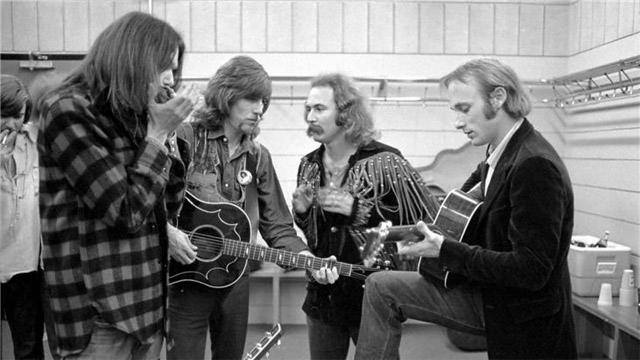
I think the only classic supergroup that competes with Blind Faith for the #1 spot in the rankings is Crosby, Stills, Nash & Young.  David Crosby came from the Byrds, Graham Nash came from the Hollies, and Stephen Stills and Neil Young were alums of Buffalo Springfield – all of which were great bands.  

And all four of them were accomplished songwriters and musicians who contributed significantly to the group’s records – this wasn’t a case of one supergroup member being the equivalent of Napoleon, the pig who was more equal than the other animals in George Orwell’s Animal House.

L to R: Young, Nash, Crosby and Stills
I can’t argue with you if you think CSN&Y is the superest supergroup of all time.  But I’m going with Blind Faith.  

Blind Faith’s album – especially Steve Winwood's three compositions -- is like nothing else I’ve ever heard.  It really left you wanting more.  But the band self-destructed so quickly that we’ll never know what it could have been. 

Blind Faith was the rock-and-roll equivalent of James Dean – to borrow the famous line from the 1949 movie, Knock on Any Door, they lived hard, died young, and left a very good-looking corpse. 

*     *     *      *     *

Click here to listen to the first track from the Blind Faith album, "Had to Cry Today."  

Click on the link below to buy the song from Amazon: