Showing posts with label Elvis Costello. Show all posts

Tuesday, February 8, 2022

Elvis Costello – "Mystery Dance" (1977)


She thought that I knew
And I thought that she knew
So both of us were willing 
But we didn't know how to do it

[NOTE: Elvis Costello – who was born Declan Patrick McManus – wrote some  remarkably catchy power-pop songs with remarkably smart lyrics.  There was never any question that an Elvis Costello song from one of his first three albums would be included in the 2 OR 3 LINES "SILVER DECADE" HALL OF FAME.  The only question was which of his songs I would choose, because there are probably a dozen on those albums that are deserving of that honor.]  

*     *     *     *     *

"Mystery Dance" moves right along – it's only one minute, 38 seconds long.

I almost rendered the last two lines quoted above as sobothofuswerewillingbutwedidntknowhowtodoit to indicate the breakneck pace at which Elvis Costello sings this song, but I was afraid that doing so would confuse some of my less clever readers.  (You know who you are!)

I recently wrote about taking ballroom dancing lessons when I was in the sixth grade.  These lines from "Mystery Dance" certainly apply to me when I was in the sixth grade, except for the fact that there was no "she," so only one us was willing but didn't know how to do it.


A later verse is also apropos of moi in the sixth grade:

I was down under the covers
In the middle of the night
Tryin' to discover
My left foot from my right

(I'm not sure that Mr. Costello is really talking about feet here.)

You can see those pictures 
In any magazine
But what's the use of looking 
When you don't know what they mean?

My sixth-grade self would certainly not have said "what's the use of looking?" at those pictures, although my sixth-grade self certainly wouldn't have known what they meant. 

*     *     *     *     *

"Mystery Dance" came up on my iPod recently as I riding the northern end of the Baltimore & Annapolis Trail, which is a rail trail that doesn't actually go to either Baltimore or Annapolis.  (The railroad right of way that was converted to the B&A Trail did.)

The northern terminus of the trail is in Glen Burnie, Maryland, a modest Baltimore suburb.  (Extremely modest.)

The trail goes past a local bar that has one characteristic that is very important to me as a potential customer: the beer there is very cheap:


I'm reminded of the time when my daughter Caroline showed me a short story she had entered in a student writing competition at her college.  It was set in northwestern Arkansas, when my mother's family hails from.  In the story, a young soldier who has come home after seeing action in Iraq goes out drinking with a high-school buddy.  The two friends order a pitcher of Yuengling and catch up on what's new since the soldier shipped out.

"Whoa," I said to my daughter.  "These boys wouldn't know Yuengling from a premier grand cru Bordeaux.  You should have them order Coors or Budweiser."  (It's not that Yuengling is a fancy beer – it's an old-fashioned, working-class brew – but I didn't think it was likely to be available on tap at the bars in that part of the country.  Was I wrong?)  

Drink too much of that cheap beer, however, and you might be in the market for the services of another nearby Glen Burnie business:


I like the "7 days a week" statement.  Too few businesses in this country put the customer's needs first.  This guy gets it!

But Glen Burnie's not all about cheap beer and bail bondsmen.  Here's a picture of a sheet-metal sculpture that adorns the rail trail.


Click here to see some of the other works created by the sculptor, Mary Ann Mears.

The rail trail also features something called the "Planet Walk."  (They allow pedestrians as well as bikers to use the trail, which annoys the crap out of me – especially if its almost impossible to pass the pedestrian easily he or she is towing such a wide load that it makes you want to say, "Hey – only one person per pair of pants!") 

The Planet Walk begins with a large sculptural representation of the sun and a bunch of boring educational stuff.


As you continue down the trail, you see small metal disks labeled with the names of each planet and how far that planet is from the sun.


The distance separating each of these disks is proportionate to the actual distance between the planets.  For example, the marker for Earth is roughly a tenth of a mile from the sun.  But you have to go about a mile before you get to Saturn.  That's because Saturn is ten times further away from the sun than the earth is.

I turned around shortly after passing Saturn – well short of URANUS.

(Tell the truth – you're expecting me to say something tasteless, aren't you?  I thought about it, but decided that doing so was just too easy.)

*     *     *     *     *

There's a parking lot just south of Baltimore-Washington International airport that connects to the B&A Trail.  Every few minutes, a plane coming in for a landing flies right over the parking area.


A lot of bikers park in that lot, of course, but there are usually a few families with folding chairs and a cooler fill of cold drinks who set up shop next to the lot so they watch the planes land.  

It's pretty interesting to see them get very large and very loud on their approaches to BWI, but one Southwest 737 looks pretty much like the next.  (By the way, 197 out of the 355 domestic flights that depart from BWI every day are Southwest flights.  Another 44 are flights on AirTran, which Southwest just acquired.  Southwest rules BWI!)  

*     *     *     *     *

Maybe those families had nothing better to do because they had lost their cable TV and internet access after the derecho storms that had roared through the DMV (the District of Columbia, Maryland, and Virginia) the night before.

Click here if you don't know nuthin' about derechos.

Twenty-four hours after the derecho had moved on, a million customers of the area's biggest electric utilities (or 45 % of their entire customer base) were still without electricity, and the utilities were saying it would be a full week before all those people would have juice.  


That's even worse than it sounds, because the temperatures reached 104 the day the storms hit -- the highest temperature ever recorded in the Washington area in June.

We don't have cable or internet, our cell phones work only intermittently (presumably because some cell towers were blown over or are without power), and there are about a million big-ass tree limbs littering my back yard.  But we never lost our power.  I got 99 problems, but electricity ain't one.

(Note: One full week after the storm hit, there were a small number of people in the area who still didn't have electricity.  That day, the high in Washington, DC was 105 degrees.  It actually hit 106 -- which would have tied the all-time record high for Washington -- but it stayed there for only one minute.  It seems that a temperature has to persist for three full minutes before it is official.)

*     *     *     *     *

Click here to view a absolutely boffo live performance of "Mystery Dance."

Click here to listen to the studio recording of the song, which was released on Elvis Costello's debut album, My Aim Is True.

Here's a link you can use to order the song from Amazon:

Wednesday, January 20, 2021

Elvis Costello – "Less Than Zero" (1977)


Let’s talk about the future now

We’ve put the past away


An over/under bet is a wager on whether a certain number is exceeded or not exceeded by the end of a sporting event.


The most common over/under bet is on the total number of points scored in a game.  For example, the over/under on the final score of the Kansas City Chiefs–Cleveland Browns playoff game this year was 57.  


The Chiefs won 22-17, so there were a total of 39 points scored in that game – that’s less than 57, so if you’d bet the under instead of taking the over you would have won.


Here’s one more example.  The Green Bay Packers–Los Angeles Rams final was 32-18.  The over/under for that game was 45.  Since the two teams combined for 50 points – which is more than the 45 over/under number – those who bet the over won.


*     *     *     *     *


I don’t think any of the online betting sites was offering an over/under bet on how many people will get arrested at the Biden inauguration today – or how many of those people will eventually be convicted.


To come up with a reasonable betting line, I took a look back at the news coverage of Trump’s 2016 inauguration, when 234 people were arrested for smashing store windows, throwing rocks and bricks at police officers, and other crimes.


How many of those people were eventually convicted?  Zero.


The first six defendants who went on trial were all acquitted by the Washington, DC juries who heard their cases.  After going oh-for-six, the U.S. Attorney apparently threw up his hands and dropped the charges against everyone else.


*     *     *     *     *


Part of the reason for the prosecutors’ lack of success in the 2017 cases was the use of “black bloc” tactics by the rioters, who wore black clothing, ski masks, scarves, sunglasses, motorcycle helmets, or other face-concealing and face-protecting items to conceal their identities and hinder criminal prosecution:


From a 2017 article in the Washington Post:


They’ve been around for decades, but in the past three months they’ve been especially visible: protesters in head-to-toe black clothing and ski masks, charging through the streets in public demonstrations, provoking police and leaving a trail of broken windows and flaming piles of debris in their wake.


Pockets of them sowed chaos during peaceful protests in Portland the week Donald Trump was elected president, smashing electrical boxes and spray-painting buildings, and prompting a volley of rubber bullets from authorities.


They turned out by the hundreds at Trump’s inauguration in January, vandalizing [buildings] and torching a limousine in downtown Washington.


*     *     *     *     *


Here’s more on the 2017 inauguration from an article that appeared on a local National Public Radio affiliate’s website:


As the District careens toward Donald Trump’s inauguration, a group of local activists is doing everything in its power to make sure that the day’s events are besieged with bedlam.


“The number of counter protesters showing up is off the charts,” says Legba Carrefour, a participant with the D.C. Counter-Inaugural Committee. “We want to undermine the legitimacy of the incoming administration by ruining the inauguration.”


It is one of around a dozen groups that plan to express their deep displeasure with the results of the election. . . .


Throughout the day, hundreds or thousands of protesters plan to paralyze morning traffic into the city, create blockades at checkpoints, march without permits, and possibly disrupt the [inaugural] parade. . . .


“We’re talking about no peaceful transition,” Carrefour says. On President Barack Obama’s call for a calm, successful transition, he adds: “We really reject that.”


As the French say, “Plus ça change, plus c’est la même chose.”


*     *     *     *     *


How about we just go with the 2017 figures and make 234 and zero the over/under for the number of arrests today and the number of convictions that result from those arrests, respectively?  


If I were a betting man, I’m not sure whether I’d go over or under for the number of arrests.  


As you may have heard, there’s an unprecedented level of security in DC today – for one thing, there are roughly 25,000 National Guard troops in town.  


So I’m guessing that there will be either a lot more arrests today than in 2016, or a lot fewer – but I have no idea which.  Therefore, I’m passing on that bet.


But I’ll happily take the over on the number of convictions for two reasons:


First, I doubt that DC juries will take it easy on any Trump diehards who get arrested today.  


But more importantly, how in the hell can you take the under when the over/under number is zero?  (I’ve forgotten 99% of what I learned in math class, but I’m pretty sure there’s no number that’s less than zero.)


*     *     *     *     *


Elvis Costello’s record company wanted him to play his latest UK single, “Less Than Zero,” when he appeared on Saturday Night Live for the first time in 1977.  


Elvis Costello on SNL in 1977

But Costello was afraid that the song’s references to British fascist politician Oswald Mosley would go right over the heads of Americans.  So after playing a few bars of “Less Than Zero,” Costello and the Attractions suddenly stopped and jumped into “Radio, Radio” instead.


Click here to listen to “Less Than Zero.”


Click below to buy the record from Amazon:


Friday, November 1, 2019

Dave Edmunds – "Girls Talk" (1979)


Thought I heard you mention my name
Can't you talk any louder?

As unbelievable as it may seem, today marks the tenth anniversary of everyone’s favorite little pop music blog . . . the one, the only 2 or 3 lines (and so much more).


Many people overlook the and so much more part of my blog’s name.  Perhaps that’s because I usually refer to the blog simply as 2 or 3 lines.  Or perhaps it’s because I put the and so much more in parentheses, and parenthetical expressions are considered to be “nonessential” by the grammar powers-that-be.  

Don’t sleep on and so much more.  One could argue that the and so much more stuff is not only essential to the blog, but is even essentialer than the 2 or 3 lines part.

It’s certainly something to think about, n’est-ce pas?

Oui, oui, oui!  But not right now.

Because right now it’s time for 2 or 3 lines to give you a heapin’ helpin’ of and so much more in the form of an interview with . . . none other than 2 or 3 lines himself!

(In parentheses, yes – but nonessential?  NO!)
That’s right!  2 or 3 lines is going to interview 2 or 3 lines!  It’s groundbreaking . . . it’s unprecedented . . . it’s meta to the meta power!

But most of all . . . it’s sooooo 2 or 3 lines (and so much more)!

Without further ado . . .

*     *     *     *     *

2 or 3 lines:  Let’s begin at the beginning.  Tell me about the genesis of 2 or 3 lines.

2 or 3 lines:  That story really begins in 1980 – a couple of years after I graduated from law school and moved to Washington, DC.  I discovered a radio show called “Mystic Eyes” on the old WHFS and started recording it on cassette tapes.  The DJ played records that I never heard anywhere else, including one that became a particular favorite of mine – I thought it was maybe the best rock song ever, but I didn’t know the name of the song or the group that recorded it.  


Q: Didn’t the DJ announce the titles of the songs he played?

A: He did, but I would usually hit “pause” on my cassette deck when the music ended and the DJ started talking – trying to conserve tape, I suppose.

Q: So how did you manage to identify the mystery song? 

A:  About 25 years after I first heard it, I plugged a very distinctive phrase from its lyrics into a search engine (probably Alta Vista, not Google – this was a long time ago) and got exactly one hit.  That hit took me to the website of a Los Angeles band called The Last, where I found everything I wanted to know about "She Don't Know Why I'm Here.”  (You can click here to go to that website.)

Q: And that inspired you to create 2 or 3 lines?

A:  I wanted to tell the story of how I finally figured out what the song was, but mostly I wanted to share the song – which is relatively obscure – with a wider audience.  That gave me the idea of doing a blog about other great records that had somehow fallen through the cracks.

Q: On the same day you posted about "She Don't Know Why I'm Here,” you wrote sort of a FAQ for 2 or 3 lines titled “What? Who? Why?”  It states that “[w]ho I am and how I became what I am today is very relevant to the songs I've chosen to feature on this blog, but . . . [t]his blog is more about the music than it is about me.”

A:  I really should revise that.  A lot of 2 or 3 lines posts are more about me than they are about the featured songs.

Q:  A lot of your posts are quite autobiographical.

A:  “Narcissistic” is another word that has been used to describe them.

*     *     *     *     *

Q:  You’ve said that the first year of 2 or 3 lines was probably its best year.  In 2016, you wrote that your blog “started to go downhill in 2013, I think.  Since then there have been flashes of brilliance, but they’re getting to be few and far between.”  Do you still feel that way?

A:  Absolutely.  I’ve started cleaning up my old posts – by “clean up,” I mean I fix broken links, change the font so the appearance of the old post is consistent with the appearance of newer ones, and so on – and I am often almost moved to tears by how good the old posts are compared to most of my recent ones.

Life was good during
the Golden Age of Greece
Q:  The ancient Greeks had a Golden Age, a Silver Age, a Bronze Age, and an Iron Age.  What age would you say 2 or 3 lines is currently in?

A:  Maybe the Crap Age?

Q:  What makes the older posts better?

A:  The best posts from the “Golden Age” of 2 or 3 lines always began with a great song – usually (although not always) a song that wasn’t very well-known.  Some of those posts focused almost entirely on the song – I might have analyzed the song’s lyrics or musical structure at length, or discussed the life of the songwriter or performer who recorded it.  But the more interesting posts addressed topics that had only a tangential relationship to the song.  The song was the starting point, but where the post went from there was unpredictable – the journey was more important than the destination.

Q:  What changed?

A:  After a few years, I was having a harder time coming up with interesting content.  A lot of my best posts have autobiographical elements, but my life isn’t all that interesting – I had only a limited supply of good stories to tell about myself.  So it became something of a struggle to come up with interesting content – I would have to pull my topic from a newspaper or magazine, then find a song that had a connection to that topic.  Half the time, the song was an afterthought – sometimes I didn’t even like the song, but featured it simply because it fit the content of the post.

Q: Is part of the problem that you committed to writing three posts a week?

A:  Absolutely.  At the beginning, I would only do a post when the spirit moved me, which wasn’t very often.  I produced only 21 posts in the first six months after I started 2 or 3 lines – that’s less than one post per week.  I more than tripled my output over the next six months, and settled into a three-posts-a-week schedule after that.  Plus I started posting daily in February, which meant I was cranking out about 170 posts a year.

Q:  Here’s how you answered an interviewer who asked you a few years ago what the biggest problem with 2 or 3 lines was: “The fact that I insist on doing three posts a week even when I don’t have anything to say.  In the last couple of years, I’ve been too busy and too distracted to write three good posts a week.  So I’ve written three crappy posts a week.”  Given that, why did it you insist on maintaining the three-posts-a-week schedule for so long?

A:  I’m stubborn.  I’m also lazy, but my decision to go from three posts a week to two posts a week wasn’t really motivated by laziness.  I’m spending as much time on 2 or 3 lines as ever, but I’m hoping that devoting the same amount of time to fewer posts will mean those posts will be better.  

Q:   You retired from your law firm two years ago, so I assume it’s easier to find time for  2 or 3 lines?  

A:  You would think so, but so far it hasn’t worked out that way.  Somehow, it’s become harder for me to find the time to write.

*     *     *     *     *

Q:  You say that the decision to cut back from three to two posts weekly wasn’t the result of laziness.  But I have to say that you’ve done some things recently that seem to indicate that laziness may be at work here.  For example, your June and July posts were mostly recycled posts that you had previously published.


A: My June and July posts featured the new class of inductees into the 2 OR 3 LINES "GOLDEN DECADE" HIT SINGLES HALL OF FAME and the 2 OR 3 LINES "GOLDEN DECADE" ALBUM TRACKS HALL OF FAME.  It should come as no surprise that I had previously written about most of those songs – after all, they’re some of the greatest rock songs of all time.  I didn’t hold anything back when I wrote those original posts – if I had written new posts about the same songs, they would have been redundant at best and inferior at worst.  Plus I went to Europe in June and to Cape Cod in July.  Maybe you work year round and don’t take vacations or holidays, but I do.  I could have just shut 2 or 3 lines down during my vacations, but instead I prepared the hall of fame posts in advance of my departure so my loyal readers wouldn’t have to go weeks without 2 or 3 lines.

Q: What about last month, when 2 or 3 lines consisted of recycled posts from 2009-2010?

A: In case you’ve forgotten, this is the TENTH ANNIVERSARY of 2 or 3 lines, which is kind of a big deal.  I decided to mark the occasion by picking out a few of the very best posts from the blog’s first year of existence and republishing them.  What you refer to as “recycled” posts represent the crème de la crème of the first year of 2 or 3 lines, and those readers who became aware of 2 or 3 lines only recently deserve the chance to read them.  Plus this past October was a very busy month for me – I’ve been working on a lot of very special surprises for my readers, which we can talk about later in this interview.  

*     *     *     *     *

2 or 3 lines:  I’m sure you thought long and hard before choosing the song you would feature on the tenth anniversary of 2 or 3 lines.  Why “Girls Talk”?

2 or 3 lines:  It’s a great song.  In fact, it may be my favorite song not to have been featured on 2 or 3 lines to date – I’m surprised that I haven’t written about it already.

Q:  Elvis Costello, who wrote “Girls Talk,” is a favorite of yours.  But you’ve chosen to feature the Dave Edmunds cover of the song, which was released in 1979 on his Repeat When Necessary album:


A.  The story goes that Costello handed Edmunds a cassette tape with a rough demo of “Girls Talk” on it one day and said, “Here’s a song for you.”  Edmunds wasn’t crazy about the song.  But he liked the opening line – “There are some things you can’t cover up with lipstick and powder” – so he decided to spend some time coming up with a completely different arrangement.  

Q:  Costello recorded the song a year later, and his version is quite different.

A:  I’ll take the Edmunds “Girls Talk” any day of the week.  Costello deserves credit for writing the very clever lyrics, but Edmunds’ arrangement is just as important.

Q:  What makes the arrangement so noteworthy?

A:  For one thing, listen to the introduction.  You expect the opening two-measure guitar riff to be repeated four times, but Edmunds jumps in and starts singing after only three repetitions of that riff – plus the song changes keys when he starts singing.  You’re immediately thrown a little off balance, but the song has already found a solid groove, so it doesn’t lose you.  When the guitar solo begins, there’s another key change just to keep things interesting.  The arrangement is unconventional, but not so much that it’s annoying. 

[NOTE: Here endeth part one of the 2 or 3 lines interview of 2 or 3 lines.  Click here to go to part two of the interview.]

*     *     *     *     *

Click here to read what Dave Edmunds told Carl Wiser of Songfacts about “Girls Talk.”

Click here to listen to the Elvis Costello version of “Girls Talk.”

Click here to listen to the Dave Edmunds recording, which was a top five single in the UK.  (I told you it was better than the Costello version.)

Click here to buy the Edmunds version of “Girls Talk” from Amazon.


Thursday, February 7, 2019

Elvis Costello – "I'm Not Angry" (1977)


Spent all my time in a vanity factory
Wonderin’ when they’re gonna come
And take it all back

After completing secondary school in Liverpool, the teenaged Declan Patrick MacManus – who would later become Elvis Costello – worked as a data entry clerk at Elizabeth Arden, a well-known cosmetics and fragrance company.  

The line from today’s featured song about spending time in a “vanity factory” is a reference to that Elizabeth Arden job.

*     *     *     *     *

Declan MacManus’s father Ross was a jazz trumpeter and singer who called himself Day Costello, and his son performed in clubs and pubs in London as D. P. Costello.  When he signed his first record contract, his manager suggested that he use Elvis as his first name even though he looked a lot more like Buddy Holly than Elvis Presley in those days.


MacManus legally changed his name to Elvis Costello in 1977 – the same year that his first album, My Aim Is True, was released – but changed it back to Declan MacManus in 1986.

*     *     *     *     *

MacManus and jazz pianist Diana Krall were married in 2003 at Elton John’s castle in England.

Krall has won five Grammys but he has taken home only one – the 1999 Grammy for “Best Pop Collaboration with Vocals,” which he and Burt Bacharach shared for their recording of “I Still Have That Other Girl.”

Diana Krall and Elvis Costello in 2003
Costello has recorded 30-plus studio albums during a career that has spanned over four decades.  His records have been much more successful in the UK than in the U.S., where he’s had only one top 10 album and only one top 20 single.

Stupid Americans – Elvis is an exceptional songwriter, and his early albums were among the very best of their era.

*     *     *     *     *

Click here to listen to “I’m Not Angry.”  (When someone titles a song “I’m Not Angry,” you can bet that he actually is angry.)

Click on the link below to buy the song from Amazon:

Tuesday, November 18, 2014

Elvis Costello (ft. Burt Bacharach) -- "Toledo" (1998)


And does anybody in Ohio
Dream of that Spanish citadel?

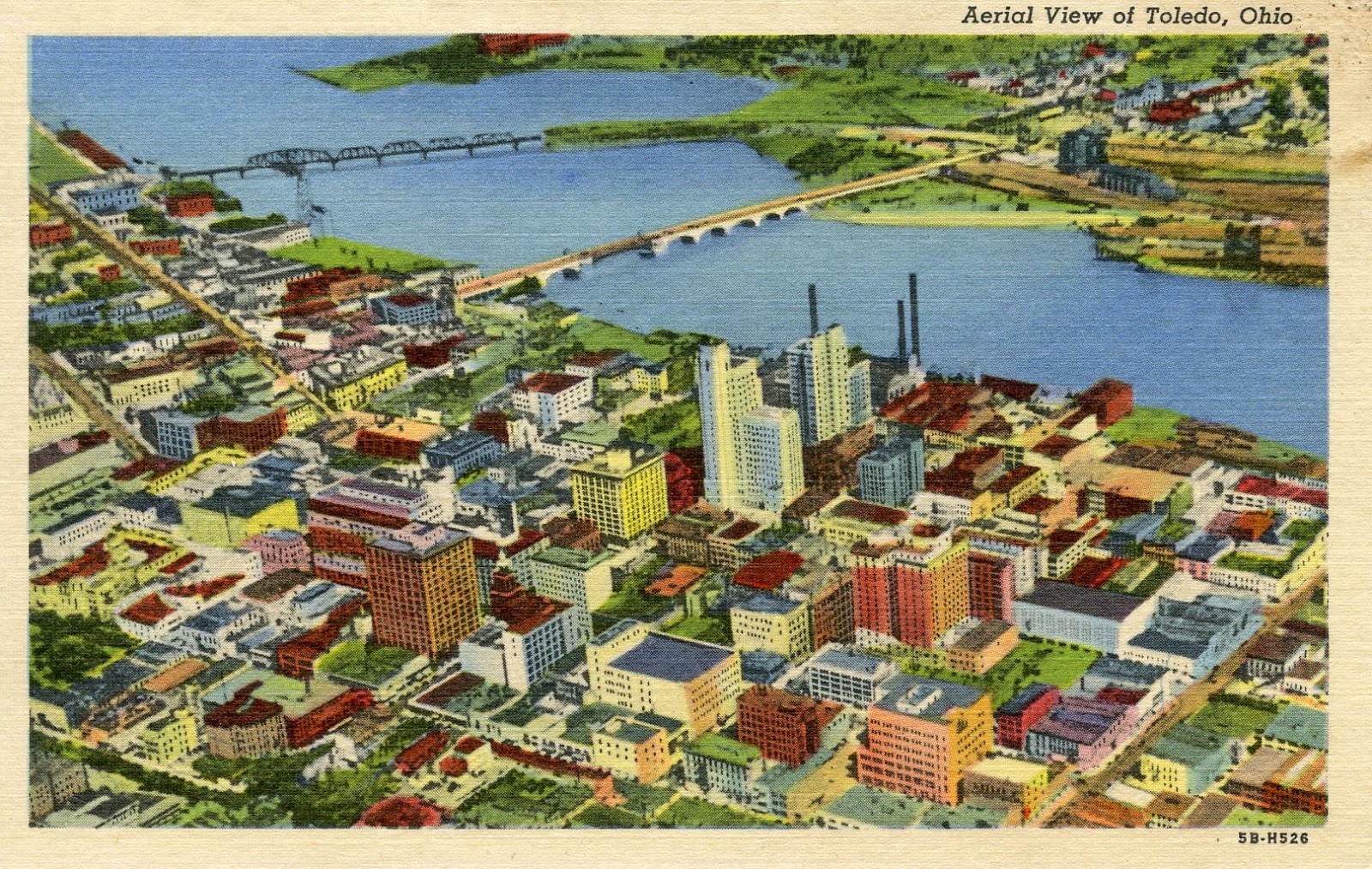
Toledo, Ohio was founded in 1833 when two existing towns – Port Lawrence and Vistula – merged.

Toledo, Ohio in 1945
It's not clear why the residents of the new city chose to name it after the ancient Spanish city of Toledo.  One story is that Washington Irving, who spent several years researching and writing in Spain, suggested the name to his brother, who was a resident of the Ohio Toledo.  

Another legend is that the name was suggested by Two Stickney, who caused the only casualty of the "Toledo War" – an otherwise bloodless border dispute between Ohio and Michigan – when he stabbed a Michigan deputy sheriff who was attempting to arrest One Stickney, Two's older brother.

Two Stickney, hero of the Toledo War
(The brothers' father, Benjamin Franklin Stickney – named after his famous great-uncle – said that he named his sons One and Two so they could pick their own names when they grew up, but they stuck with One and Two instead.  You can click here if you'd like to read more about the eccentric Benjamin Franklin Stickney.)  

Yet another story gives credit for the choice of Toledo to a local merchant who said the name "is easy to pronounce, is pleasant in sound, and there is no other city of that name on the American continent."

*     *     *     *     *

Toledo, Spain 
(photo by Tnarik Innael)
The original Toledo is an ancient Spanish city with a rich cultural and architectural heritage.  Our featured song accurately describes the Spanish Toledo as a "citadel" – the old part of the city is located on a mountaintop overlooking the Tagus River, the longest river on the Iberian Peninsula.  

One of Toledo's most famous residents was the artist Doménikos Theotokópoulos, who is better known by his nickname – El Greco ("the Greek").

A presumed self-portrait by El Greco
El Greco was born in 1541 on the Greek island of Crete, which then belonged to the Republic of Venice.  After learning to paint in Crete, he moved to Venice and then to Rome, where he opened a workshop.  In 1577, he moved to Madrid and then on to Toledo, where he lived until his death in 1614.

*     *     *     *     *

The National Gallery of Art in Washington, DC, has seven paintings by El Greco.  I recently attended the press preview of a new NGA exhibition marking the 400th anniversary of El Greco's death that features his NGA paintings along with several others from other Washington and Baltimore museums.

Here's Saint Martin and the Beggar:

National Gallery of Art
And here's Madonna and Child with Saint Martina and Saint Agnes:

National Gallery of Art
Those two paintings, both of which are in the NGA's permanent collection, once hung opposite one another, flanking the central altar in the Chapel of Saint Joseph in Toledo, Spain.

*     *     *     *     *

Perhaps the most interesting of the eleven works in the exhibition is Laocoön, the only surviving El Greco painting with a mythological subject:

National Gallery of Art
Laocoön was a Trojan priest who warned his countrymen to beware of the Trojan Horse.  In the Aeneid, Virgil has Laocoön say these words:

Do not trust the horse, Trojans
Whatever it is, I fear the Greeks even bearing gifts

But Laocoön was punished by a Greek-friendly god -- Athena, Poseidon, or Apollo, depending on the teller of the story -- for his attempt to defeat the Greek subterfuge.  Giant sea serpents slithered up from the sea and strangled Laocoön and his two sons.  

According to one source, however, Laocoön was actually punished for having sex with his wife on holy ground sacred to the gods.

In any event, Laocoön's warning wasn't heeded and the Greeks' sneak attack on Troy was successful.  

Art historians believe that El Greco's painting was inspired by this ancient sculpture of Laocoön and his sons, which was excavated in Rome 1506 and is now on display in one of the Vatican museums:


*     *     *     *     *

El Greco's Laocoön sets the scene outside the gates of Toledo.  Toledo is featured in a number of El Greco's paintings, including several that depict Biblical scenes that took place far away from Spain.

El Greco's only two surviving landscapes both depict Toledo.  "View of Toledo," which is owned by the Metropolitan Museum of Art in New York City, is a dramatic painting that takes some liberties with the actual configuration of the city's buildings:

Metropolitan Museum of Art
The National Gallery of Art's El Greco exhibition can be viewed in the NGA's West Building through February 16, 2015.  Click here to learn more.

*     *     *     *     *

"Toledo" is from the 1998 album Painted from Memory, which features a dozen songs co-written by Elvis Costello and Burt Bacharach.

Click here to see a video of a live performance of "Toledo."

Click here to buy the version of the song that appeared on Bill Frisell's 1999 album, The Sweetest Punch, which consists of jazz arrangements of the Painted from Memory songs.  (Most of the tracks on that album are instrumentals, but Costello did sing on "Toledo.")