Thursday, October 24, 2024

George Harrison – "Beware of Darkness" (1970)


Watch out now, take care

Beware of greedy leaders

They take you where you should not go


(You can say that again, boys and girls!)


*     *     *     *     *


Dhani Harrison – George Harrison’s only child – had no idea his father was a musician until he was in elementary school.


“My earliest memory of my dad is probably of him somewhere in a garden covered in dirt, somewhere hot, a tropical garden, in jeans, khakis covered in dirt, just continuously planting trees,” Dhani told Martin Scorsese in 2011. “I think that’s what I thought he did for the first seven years of my life.” 


Opinions differ over whether Paul McCartney, John Lennon, or George Harrison was the best of the Beatles when it came to songwriting.  But there’s no doubt that Harrison was the best of the Beatles at gardening.


*     *     *     *     *


Harrison purchased the Oxfordshire estate known as Friar Park from an order of nuns in 1970.


Friar Park originally belonged to a wealthy lawyer named Sir Frank Crisp, who had created one of the most incredible gardens in England there.  From an article in Country Life magazine:


Crisp’s creations included a vast alpine rock garden that covered four acres, topped by a scale model of the Matterhorn, as well as a series of stalactites, caves, grottos and underground passages populated by a multitude of garden gnomes. . . .


Crisp was a born collector and one of his passions was for sundials of every type, which he installed in an area he called the Dial Garden. Gnomons, astrolabes, armillary spheres and ring dials – all were corralled into his garden and mounted correctly. The layout copied the plan of the long-lost Labyrinth at Versailles in France, but with 39 sundials in place of the original fountains.


But perhaps the most remarkable feature of Friar Park was its topiary garden, which consisted of more than 160 yew trees pruned and trained into a staggering variety of shapes – including columns, urns, obelisks, vases, spirals . . . and sheep:
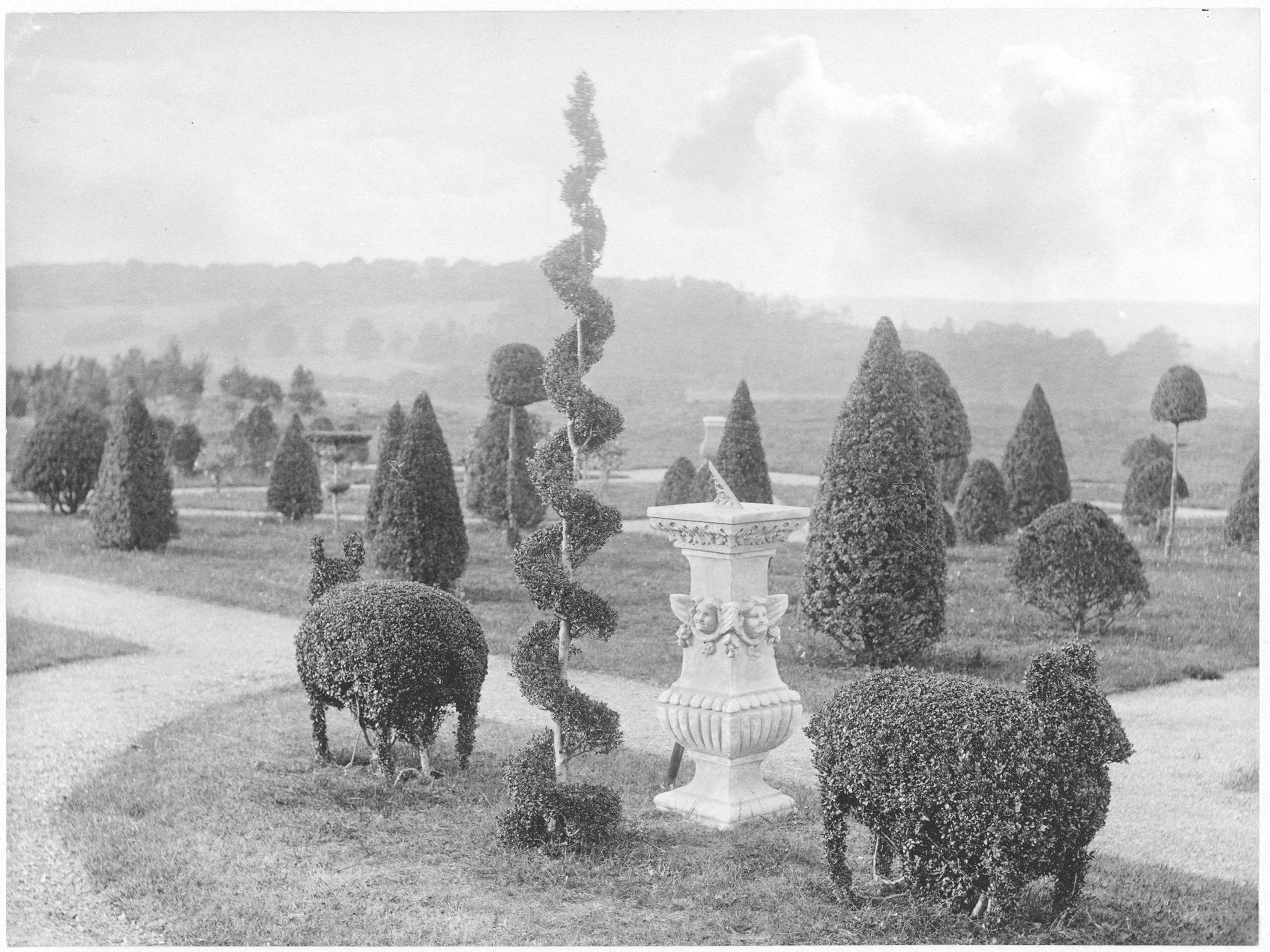

The Friar Park topiary garden
as it was a century ago

The nuns had done their best to maintain Friar Park and its garden after purchasing it in 1951, but the expense of doing so eventually became too much for them.  Enter Harrison, who certainly had the means to restore Friar Park to its previous glories.


According to Country Life, “[t]he topiary garden was completely overgrown, reduced to an impenetrable sea of bushes that had grown into each other and overrun by such weeds as ivy and brambles” when Harrison and his wife Olivia took possession of the estate, and “Sir Frank’s sundials had long since disappeared.”


“George used garden flame-throwers to clear the undergrowth and put two goats to clear the weeds and brambles on the rock garden,” Olivia told Country Life in 2023.  “He hired and oversaw a team of local builders, who cleared ceramics and shopping trolleys out of the lake, which the nuns had allowed to be used as a dumping ground.  And he personally oversaw the workmen he hired to cement the leaks and lay new pipework so that the lakes could be filled again.”  


The overgrown yews were pruned back to their trunks.  After they grew back, new topiaries were carved.  Today, the topiary is a mix of traditional and non-traditional forms, including hexagons, pagodas, bullseyes, and waves.


The Friar Park topiary garden today

Country Life calls the “impeccably maintained” topiary garden at Friar Park “a masterpiece – one of the most important in all Europe.”  


Click here to read the entire Country Life article about Friar Park and the Harrisons.


Click here to watch a documentary about Friar Park.


*     *     *     *     *


Harrison wrote “Beware of Darkness” – also a masterpiece – at about the same time that he bought Friar Park.  


The song’s lyrics reflect the influence of Harrison’s deep involvement with the Radha Krishna Temple.  He had invited members of the temple to stay at Friar Park – in part to help him with the restoration of the house and gardens, but mostly in hopes of bringing an intensely spiritual aura to the property.


Click here to learn more about the Radha Krishna Temple.


Click here to listen to “Beware of Darkness,” the antepenultimate member of the 2024 class of inductees into the 2 OR 3 LINES “GOLDEN DECADE” ALBUM TRACKS HALL OF FAME.


Click here to buy “Beware of Darkness” from Amazon.


Monday, October 21, 2024

Creedence Clearwater Revival – "I Heard It Through the Grapevine" (1970)


You could have told me yourself
That you love someone else 
Instead I heard it through the grapevine

[NOTE: Creedence Clearwater Revival’s cover of “I Heard It Through the Grapevine” is actually a cover of a cover of a sort of cover.  Smokey Robinson and the Miracles were the first to record the Norman Whitfield–Barrett Strong song for Motown, but their version wasn’t the first to be released.  The song was next recorded by Marvin Gaye, but his version wasn’t the first to be released either.  That honor went to the Gladys Knight & the Pips version, which was released in 1967 and promptly went to #1 on the Billboard “Hot 100.”  I think the Creedence version is best described as a cover of the Marvin Gaye cover, which was released subsequent to the Miracles and Pips records and was clearly the best of the three quality-wise.  (By the way, the Gaye cover surpassed the Gladys Knight & the Pips cover as the best-selling Motown single up to that time.)  In any event, the Creedence cover – which was one of the members of the initial class of the 2 OR 3 LINES “GOLDEN DECADE” COVER RECORDS HALL OF FAME, and is now a member of the 2 OR 3 LINES “GOLDEN DECADE” ALBUM TRACKS HALL OF FAME as well – doesn’t sound much like any of the Motown versions, which is one of the reasons it’s a great cover.  What follows is a lightly edited version of my original February 17, 2011 post about this record.]

*     *     *     *     *

If I had to pick one band that personifies good ol' American-style rock and roll music, it would be Creedence Clearwater Revival.

Here's what the Rock and Roll Hall of Fame says about Creedence:


Creedence Clearwater Revival . . . were progressive and anachronistic at the same time.  An unapologetic throwback to the golden era of rock and roll . . . [t]heir approach was basic and uncompromising, holding true to the band members’ working-class origins.


The term "roots rock" had not yet been invented when Creedence came along, but in a real way they defined it, drawing inspiration from the likes of Little Richard, Hank Williams, Elvis Presley, Chuck Berry and the artisans of soul at Motown and Stax.  In so doing, Creedence Clearwater Revival became the standard bearers and foremost celebrants of homegrown American music.


*     *     *     *     *


"I Heard It Through The Grapevine" was a huge hit – not once, but twice – for Motown artists before CCR recorded it.


Their version of "Grapevine" was released on the Cosmo's Factory album in July 1970.  That was only about 18 months after Marvin Gaye's version of the song had reached the #1 spot on the Billboard "Hot 100."


Creedence's cover of the song is eleven minutes long.  You might think that's too long, but it isn't.  (I wouldn't mind if it was an hour long.) 

It has the no-frills feel of a live performance – compared to the Motown versions, it's a white T-shirt and a pair of blue jeans.

By the way, did you know that CCR performed at Woodstock?  Thanks to the Grateful Dead's endless jamming, Creedence didn't take the stage until 3 AM.  CCR frontman John Fogerty thought their performance wasn't up to snuff, so they are missing from the movie and the original soundtrack album.  (The 25th-anniversary Woodstock box set does include six CCR songs.) 

CCR at Woodstock
Here's one other odd fact about Creedence, which never got the respect it deserved:  the band never had a #1 hit, but had five #2 singles.  ("Grapevine" was not one of them.)

Click here to listen to CCR's cover of "Grapevine."

Click here to buy the record from Amazon.


Friday, October 18, 2024

Steve Miller Band – "Living in the U.S.A." (1968)


Where are you goin' to?
What are you gonna do? 

[NOTE: Today we welcome “Living in the U.S.A.” into thE 2 OR 3 LINES “GOLDEN DECADE” ALBUM TRACKS HALL OF FAME.  What follows is a lightly edited version of the original 2 or 3 lines post featuring that recording, which appeared on May 15, 2016.]  

Richard Linklater’s delightful new movie, Everybody Wants Some!! – it’s title is taken from the name of a Van Halen song – has a wonderful soundtrack that includes disco, country, punk, funk, and classic rock songs.  (You can click here to read what I said about that movie in a previous 2 or 3 lines.)


The spiritual predecessor to Everybody Wants Some!! is Linklater's 1993 movie, Dazed and Confused, which was named after the last track on side one of Led Zeppelin’s eponymous debut album – perhaps the greatest rock album from start to finish ever recorded.

The music on the Dazed and Confused soundtrack isn’t as varied.  In that movie, Linklater stuck mostly to artists whose music was popular on album-oriented rock stations in the seventies – Aerosmith, Deep Purple, Alice Cooper, Foghat, ZZ Top, Kiss, Lynyrd Skynyrd, and Steve Miller.

*     *     *     *     *

Steve Miller was born in Milwaukee in 1943.  His parents were the best man and maid of honor at Les Paul and Mary Ford’s wedding.  Paul encouraged the very young Miller to continue practicing the guitar.

Steve Miller and Les Paul in 2000
When the family moved to Dallas in 1950, Miller attended the fancy-schmancy St. Mark’s School with Boz Scaggs.  The two attended the University of Wisconsin together and formed a band that played at a few clubs in Madison.

Miller left college without earning a degree and moved to Chicago, where he played with Muddy Waters, Howling’ Wolf, Buddy Guy, and other blues greats.  After stops in New York City and Austin, he loaded up his VW bus and drove to San Francisco, where he hooked up again with Boz Scaggs and formed the Steve Miller Band in 1966.  

*     *     *     *     *

I bought Steve Miller’s Anthology album – which included today’s featured song, “Living in the U.S.A.” – in 1973, when I was a junior in college.  It’s a two-record compilation with tracks from five of Miller’s first seven albums.


After releasing Anthology, Steve Miller took a sharp turn in the direction of Schlocktown.  Over the next five years, he cranked out big radio hits like “The Joker,” “Take the Money and Run,” “Rock’n Me,” “Fly Like an Eagle,” “Jet Airliner,” and “Swingtown.”  Those songs weren’t exactly bad, and they weren’t exactly good.  

What they were exactly were hits.  Everyone of them made it into the top twenty, and two made it all the way to number one.

I’ll stick with “Living in the U.S.A.,” thank you very much.  It’s loose and chaotic and sounds like everyone involved in recording it had a great time.  It opens with a recording of a drag racer’s engine and closes with one of the great random lines of all time: “Somebody give me a cheeseburger!”

Click here to listen to “Living in the U.S.A.”

Click here to buy that recording from Amazon.

Tuesday, October 15, 2024

The Band – "Chest Fever" (1968)


“She’s stoned,” said the Swede

And the moon calf agreed


“Chest Fever” is a hot mess – but hot messes are not unwelcome in the 2 OR 3 LINES “GOLDEN DECADE” ALBUM TRACKS HALL OF FAME.


The track opens with a dramatic organ solo – which is said to have been inspired by Bach’s Toccata and Fugue in D minor – performed by Garth Hudson.  (Unlike the vast majority of rock and jazz organists, Hudson eschewed the Hammond B-3.  He preferred a Lowery organ.) 


Garth Hudson and his Lowery organ

Robbie Robertson gets the songwriting credit for “Chest Fever,” but I’m not sure that it’s really accurate to say that the song’s lyrics were “written.”


Robertson says that the lyrics were improvised in the recording studio because lead singer Richard Manual needed something to sing while the group was rehearsing the song.  He never got around to rewriting the words.


“I’m not sure that I know the words to ‘Chest Fever’,” Robertson later told an interviewer.  “I’m not even so sure there are words to ‘Chest Fever’.”  


Click here to read the lyrics to “Chest Fever.”


Click here to listen to “Chest Fever.”


Click here to buy that recording from Amazon.


Saturday, October 12, 2024

Original Broadway Cast of "Hair" – "The Flesh Failures (Let the Sunshine In)" (1968)


Listening for the new-told lies
With supreme visions of lonely tunes

[NOTE:  I’ll never forget seeing a touring production of Hair when I was a sophomore in college.  I would have happily dropped out of college and joined the tour if they had had a job for me.  But they didn’t – so I stayed in college and eventually started writing this wildly popular little blog.  I’ve loved Hair since I bought the soundtrack over 50 years ago, and I'm pleased to be bestowing a double honor on it this year.  Last month, the Fifth Dimension’s “Aquarius/Let the Sunshine In” was inducted into the 2 OR 3 LINES “GOLDEN DECADE” HIT SINGLES HALL OF FAME, and today I’m inducting the original Broadway cast’s recording of “The Flesh Failures (Let the Sunshine In)” into the 2 OR 3 LINES “GOLDEN DECADE” ALBUM TRACKS HALL OF FAME.  What follows is a slightly edited version of the second 2 or 3 lines post about that latter recording, which was published on April 10, 2020.]


*     *     *     *     *

Today’s featured recording popped up on my iPod on Wednesday, while I was on a coronavirus-defying bike ride in Columbia, Maryland.

That ride took place only a few days after the birth of my sixth grandchild but first granddaughter, Eliza – whose desire to depart from her mother’s body was so urgent that there was no time for her parents to drive to the hospital.  She had to be delivered at home by a crew of EMTs from the local fire station.

The only way Eliza could be more beautiful is if she was twins:


*     *     *     *     *

Today – Good Friday – the high temperature where I live was only 48 degrees.  (The low tonight is supposed to get down to 36.)

But two days ago, it was 77 degrees here when I loaded up my bike and headed to Columbia to ride the Lake-to-Lake-to-Lake Trail.  

I started by circling Lake Elkhorn:


Then I rode to Lake Kittamaqundi:


My next destination was Wilde Lake:


After I circumnavigated Wilde Lake, I reversed course and headed back to my starting point.

*     *     *     *     *

Columbia is not a city – it’s a “census-designated place” consisting of ten unincorporated villages.

But it’s the second-most populous community in Maryland (after Baltimore), with just over 100,000 residents.

Sixty years ago, the area that Columbia’s villages occupy today was mostly farmland.  But in 1962, developer James Rouse started quietly buying up land with the intention of building a planned community.  He eventually purchased 140 separate parcels of land covering a total of more than 14,000 acres.

A statue of James Rouse and his partner (and brother) Willard Rouse overlooks Lake Kittamaqundi.  Some wag has put face masks on both statues, which are not six feet apart:

The Rouse brothers

*     *     *     *     *

“The Flesh Failures (Let the Sunshine In)” is the final song on the 1968 original cast recording of the Broadway musical Hair


I was a high-school junior when I bought the album, and I played it to death – but usually behind closed doors so my parents would not hear the shocking lyrics!

Click here to listen to the original Broadway cast recording of “The Flesh Failures (Let the Sunshine In).”  Pay close attention at 1:42 of the track, when Lynn Kellogg and Melba Moore go to town.

Lynn Kellogg
Click here to buy that recording from Amazon.

Wednesday, October 9, 2024

Rolling Stones – "The Lantern" (1967)


My face, it turns a deathly pale

You’re talking to me through your veil

I hear you wail!


Their Satanic Majesties Request is the Rolling Stones album that rock critics love to hate.  Hell, even Keith Richards and Mick Jagger hated it.  


Richards once said the album as a whole was “a load of crap.”  


“It’s not very good,” Jagger has opined.  “There’s two good songs on it.  The rest of them are nonsense.”


I’m guessing that the two songs Jagger likes are “2000 Light Years from Home” and “She’s a Rainbow,” because those are the only two songs on the album that the Stones have ever performed in concert.  (Richards also liked those songs.)


*     *     *     *     *


I bought Satanic Majesties soon after it was released in December 1967, and I’ve always liked it.  (I admit that there are a couple of weak tracks on it, but I think most of the songs on it are winners.)


Did your copy have the famous
lenticular cover?  (Mine did.)

So when I decided to induct a track from that album into the 2 OR 3 LINES “GOLDEN DECADE” ALBUM TRACKS HALL OF FAME, it wasn’t to choose just one.


I thought about going with one of the two identified by Jagger and Richards as their favorites.  But which one?  


I went back and forth between them – both were worthy, and I couldn’t decide which one I thought was better.


2 or 3 lines isn’t afraid to zig where others zag, and that’s what I did when I picked “The Lantern.”  (I almost went with “Gomper,” which is pretty good.  But I couldn’t bear to sully my wildly popular little blog with such an ugly song title.) 


IMHO, the best element of the record is the piano playing of Nicky Hopkins.  He was as integral to the sound of the Rolling Stones in the late sixties and early seventies as Keith or Charlie or anyone else.


*     *     *     *     *


I’m not the only rock music savant who gives two thumbs up to “The Lantern.” 


For example, Matthew Greenwald of Allmusic had this to say about the “underappreciated” track:


“The Lantern” is a psychedelic folk song . . . . Some excellent guitar riffs from Keith Richards on both acoustic and electric foreshadow his layered work on Beggars Banquet and Let It Bleed, and drive a subtle, but slightly bluesy melody that is one of the album’s best.  Lyrically, the song seems to have literary inspirations, not unlike some of Syd Barrett's Pink Floyd songs of the period.  


Greenwald also praised the “very restrained and beautiful horn arrangement,” which he believed exhibited “true craftsmanship.”


*     *     *     *     *


Enough of that blah, blah, blah.  You probably don’t care what some rock critic you’ve never heard of has to say about “The Lantern,” and I don’t either.  


We just care about what 2 or 3 lines has to say . . . right?


I CAN’T HEAR YOU!


*     *     *     *     *


Click here to listen to “The Lantern.”


Click here to buy that recording from Amazon.