The gassed and flaccid kids Are flung across the stars
The psychodramas And the traumas gone
The songs are left unsung And hung upon the scars
[NOTE: I first wrote about our next 2 OR 3 LINES “GOLDEN DECADE” HIT SINGLES HALL OF FAME song – a work of genius that was written by Tandyn Almer, who suffered from bipolar disorder and lived in obscurity in Washington, D.C., for many years before he died in 2013 – back in 2010. What follows is a slightly edited version of my original post.]
* * * * *
I'm looking at the KQYX "Pepsi Sing-a-Long Survey" for May 26, 1966 (the week I turned 14).
KQYX was the top 40 station in my hometown – Joplin, Missouri – when I was a teenager. KQYX's frequency was 1560, so its weekly surveys featured the "Top 15" and the "Plus 60," plus five "KQYX climbers" and a "Pick Hit of the Week" – altogether, 81 songs.
A KQYX "Pepsi Sing-a-Long Survey"
One of my nerdier hobbies as a kid was listening to faraway AM radio stations. It's called "DX'ing" – "DX" is ham-radio shorthand for a distant station. (I still remember most of the clear-channel AM stations that I could reliably pick up – 700 was Cincinnati, 750 was Atlanta, 760 Detroit, 780 Chicago, 820 Dallas, etc., etc., etc.)
Some of the guys who were in the AM DX'ing club I joined for a few years also collected printed radio station top-record lists and traded them, so I have dozens of such lists from large and small radio stations around the country.
* * * * *
I think it's amazing how many great songs – and what a diverse group of great songs – are on this KQYX survey. (I've provided links to Youtube videos for some of these songs.)
"When a Man Loves a Woman" (Percy Sledge) was #1 that week – not a personal favorite of mine, but a well-known classic.
The Supremes held down to the #2 spot with "Love Is (Like an Itching in My Heart") – not one of their biggest hits, but classic Motown.
#3 was Bob Dylan's "Rainy Day Women #12 and 35." ("Everybody must get stoned" – I'm a little surprised that one got airplay in Joplin).
#5 was "Groovy Kind of Love," by the Mindbenders ("When I'm feelin' blue/All I have to do is /Take a look at you/Then I'm not so blue" – a classic "British Invasion" song).
#20 – "Did You (Ever Have to Make Up Your Mind)"/Lovin' Spoonful.
#21 – "Good Lovin' "/Young Rascals. (This was one of the songs the band I was in with Jack Davidson, Joe Davis, Bruce Hodson, and Jim Matthews played a year or so later at the South Junior High 9th-grade coronation. I remember listening to this 45 over and over and over.)
#26 – "Eight Miles High"/Byrds. (I was never a big Byrds fan, but this is an astonishingly original song – everything about it is distinctive and unique. To me, one of the top 10 AM-radio songs of all time.)
And last but not least, we come to today's featured record – one of the "climbers" that week. "Along Came Mary" was the first successful single from the Association – not its biggest hit (they had two #1 singles and a #2 in 1966 and 1967), but its best song by far, IMHO.
* * * * *
I wonder how many of the songs on the current Billboard pop chart will be remembered 44 years from today. One thing no one can argue with, my friends, is that we had great music when we were growing up. I'm sure May 26, 1966 was a pretty typical week – I bet I could pick any five weeks from 1965, 1966, 1967, 1968, 1969, or 1970 at random and that the list of current hit songs from at least four out of the five would compare very favorably to this week's list.
Take another look at the listing above – Supremes, Bob Dylan, Mamas and Papas, Simon and Garfunkel, Beach Boys, Rolling Stones, Byrds, Yardbirds . . . and I left off the songs by Stevie Wonder, Dave Clark Five, Herman's Hermits, Roy Orbison, the Animals, The Four Tops, etc.
* * * * *
There are a few top-tier artists of that era who were missing from the list that week, however – most notably a band from Liverpool that wasn't bad.
Why were the Beatles MIA the week of May 26, 1966? The Beatles had a #1, #2, and #3 in 1966 – not exactly a bad year for them – but two of those had risen and then fallen off the charts by the time May 26 rolled around, and their best single of the year ("Yellow Submarine"/"Eleanor Rigby") wasn't released until August.)
But the rest of the list is so strong, you hardly miss them – that's saying something, isn't it?
Click here to see a video of the Association performing "Along Comes Mary" on the Smothers Brothers Comedy Hour.
I can see for miles, And miles, And miles, And miles, And miles!
[NOTE: I first wrote about our next 2 OR 3 LINES “GOLDEN DECADE” HIT SINGLES HALL OF FAME song in January 2011. What follows is a slightly edited version of my original post.]
James Wood is an English literary critic who now teaches at Harvard and writes for the New Yorker. (He fancy, huh?) He wrote an essay about The Who's original drummer, Keith Moon, for the November 29, 2010, issue of that magazine.
That essay is one of the best pieces of nonfiction writing I have ever read. It is so good in so many different ways that I hardly know where to begin.
Keith Moon
Wood's essay is mostly about Keith Moon, but it is also about rock drumming technique generally, about the emotional essence of drumming, about adolescence, about what it means to be an artist or a performer, and a lot more -- all in roughly 2000 words.
I've always thought "I Can See For Miles" is one of the most original and interesting rock songs of all time. I would put it in my all-time "top ten" list of rock songs, and it would be as good a choice for #1 on that list as any other.
"I Can See For Miles" was the Who's biggest hit single in the U.S., and reached #9 on the Billboard Hot 100. Pete Townshend called it "the ultimate Who record." Paul McCartney wrote "Helter Skelter" in an attempt to top "I Can See For Miles." (I don't think he succeeded, but both are great songs -- both sound like nothing else ever recorded.)
The best thing about "I Can See For Miles" is Keith Moon's drumming. Years ago, I had a realization that this song was the only one I had ever heard where the drums were really the lead instrument. That may sound like an absurd statement -- but I stand by it.
James Wood says that all other rock drummers -- even the best ones -- are essentially timekeepers. They take advantage of the small interstices between a song's phrases to insert brief drum rolls or other "curlicues," but the beat is the most important thing for them. Like the bass player, the drummer is a supporting player – not the star of the show.
In Wood's words, "Keith Moon ripped all this up." He believes that "[t]he first principle of Moon's drumming was that drummers do not exist to keep the beat. He did keep the beat, and kept it very well, but he did it by every method except the traditional one."
Moon was not a supporting player, according to Wood. Moon "saw himself as a soloist playing with an ensemble of other soloists."
Keith Moon's big-ass drum kit
Wood has hit the nail squarely on the head. And calling Moon a soloist has nothing to do with drum solos – Moon didn't really do drum solos, which are almost always a waste of time.
I was pleased to see that Wood managed to work "enjambment" into his essay. In poetry, enjambment is when a thought doesn't stop when there's a metrical break at the end of a line, but carries over into the next line. I wasn't really familiar with that concept until I was writing my post about Patricia Barber's "The New Year's Eve Song," which is built on enjambment.
In "Behind Blue Eyes," Wood notes that Moon doesn't just insert a self-contained "fill" during the break that occurs between the end of one vocal line and the beginning of the next one, but rather "fails to stop at the obvious end of the musical phrase and continues with his rolling break, over the [dividing] line and into the start of the next phrase. Moon is the drummer of enjambment."
Click here to listen to "Behind Blue Eyes" -- there are no drums until about 2:20 into the song.
Click here for an isolated track of just the drums.
Wood believes that one reason Keith Moon was so appealing was that he was a drummer "who was the drums." That's "not because he was the most technically accomplished of drummers but because his joyous, semaphoring lunacy suggested a man possessed by the antic spirit of drumming. He was pure, irresponsible, restless childishness."
Like Wood, I had a fairly extensive classical music education. And like him, I really wanted to be a rock drummer.
I was a pretty good student pianist, but sometimes I played the piano like I was playing the drums. I remember one performance of "Aquarius/Let the Sunshine In" by our high school jazz band where I was incredibly frustrated by the fact that the horns and drums were drowning me out.
I kept pounding out chords louder and louder, but it was to no avail -- even though I was playing on a big-ass Baldwin grand. (Maybe the audience heard me, but I couldn't hear myself over all the effing trumpets and trombones and saxophones.)
Finally I just started ripping off glissando after glissando, which really tore up my fingers because I was digging into the keyboard so deeply.
Wood actually taught himself to play on a friend's drum kit, and he knows a lot more about the specifics of drumming techniques than I do. One of the great things about his article is how he describes in detail exactly what more traditional rock drummers (like Ringo Starr and John Bonham) do, but does so in such a way that almost any rock music fan can understand and appreciate even the finer points he makes.
All I know is that whenever I'm in the right mood – and let's not kid ourselves: alcohol is one of the best ways to create that mood – I become a drummer when I'm listening to rock music. My thighs are usually my surrogate drums, although a car steering wheel works pretty well, too. I don't really do air guitar. I do drums.
James Wood
As I said, Wood's essay covers a lot more than just Keith Moon and rock drumming. He describes Moon's playing as being "like an ideal sentence, a sentence I have always wanted to write and never quite had the confidence to do; a long, passionate onrush, formally controlled and joyously messy, propulsive but digressively self-interrupted, attired but dishevelled, careful and lawless, right and wrong. Such a sentence would be a breaking out, an escape. And drumming has always represented for me that dream of escape, when the body surrenders its awful self-consciousness."
Wood also says that while playing classical music, or writing poetry, or painting may result in "trancelike moments and even stages of wildness and excess, the pressure of creating lasting forms demands discipline and silence." But rock music – and especially rock drumming – "is noise, improvisation, collaboration, theatre, showing off, truancy, pantomine, aggression, bliss, tranced collectivity. It is not concentration so much as fission."
Perhaps the most well-known line from any Who song is "Hope I die before I get old." Keith Moon did exactly that. He was only 32 when he died of a massive overdose of a sedative that had been prescribed to alleviate his alcohol withdrawal symptoms. (He was trying to dry out on his own.)
I would never say that it was a good thing for someone to die at age 32. But I'm glad I didn't see Keith Moon performing at age 63 with Pete and Roger at last year's SuperBowl.
Click here to read the James Wood article in its entirety.
If you think it's too much work to read, you can click here to listen to a New Yorker podcast that features Wood talking about Moon.
Finally, you can click here to watch a video of the Who lip-synching "I Can See For Miles" on television. Note that Keith Moon and his famous double bass drum kit have been positioned in front of the rest of the band:
Al Kooper was the multitalented musical genius behind the first Blood, Sweat & Tears album. But he also discovered Lynyrd Skynyrd (producing and performing on “Sweet Home Alabama” and “Free Bird”), produced the delightfully outré debut album of the Tubes, and played on albums by the Rolling Stones, the Who, Jimi Hendrix, B. B. King, and many others.
Kooper was just an unknown 21-year-old when Bob Dylan showed up at the Columbia Records studio in New York City in 1965 to record “Like a Rolling Stone.”
Al Kooper and Bob Dylan
He had been invited to the recording session as a guest of producer Tom Wilson, but he hoped to persuade Wilson to let him play guitar. But unbeknownest to Kooper, Dylan had invited the great blues guitarist Mike Bloomfield to attend the session as well. Kooper knew that Bloomfield was a far superior guitarist, so he instead asked Wilson to let him play a Hammond B-3 organ on the track. Wilson at first refused Kooper’s request, but Kooper wouldn’t take no for an answer.
Kooper’s famous organ riff is the key musical element of “Like a Rolling Stone.” But what makes just about everyone agree that the song one of the best singles of all time – Rolling Stone magazine ranked it #1 on its “500 Greatest Songs of All Time” list – were the lyrics.
* * * * *
What’s the most important element of a great single? Is it the words? The music? The arrangement/production/performance?
I think the words are the least important of those three elements. So while no one would deny Dylan was a great lyricist – he even won the Nobel Prize for Literature a couple of years ago (which was a mistake) – a lot of his records are musically pretty pedestrian.
Like the Grateful Dead and Bruce Springsteen, Dylan recorded some truly great songs. But I think there’s a lot of dross relative to the amount of musical gold they produced.
(“Wow,” you might be thinking right now. “This guy just dismissed three of the most revered recording artists of all time. Who the hell is he?”)
* * * * *
Click here to watch a very entertaining music video for “Like a Rolling Stone.” The video is interactive, allowing you to surf 16 simulated television channels – each of which features a television personality lip-syncing the lyrics. The channels you can flip through include a cooking show, “The Price Is Right,” a home-shopping show, “Pawn Stars,” a tennis match, a cartoon, a “History Channel” documentary, and BBC News.
You’ll see two buttons on the left side of the screen as you watch the video. Don’t be afraid to click on them to change channels.
You can click on the link below to buy the song from Amazon:
[NOTE: I chose to feature this 2 OR 3 LINES "GOLDEN DECADE" HIT SINGLES HALL OF FAME song way back in 2011, on the first anniversary of my wildly successful little blog. "The House of the Rising Sun" was a stick of dynamite when it was released in 1964, and it’s still a stick of dynamite today. Ralph McLean of the BBC called it "a revolutionary single," after which "the face of modern music was changed forever." (No sh*t, Sherlock!) Bob Dylan once told John Steel (who was the Animals’ drummer) that when he first heard the Animals’ recording of the song on his car radio, he "jumped out of his car" and "banged on the bonnet" . . . and decided to go electric. Here's a slightly revised version of my original two-part post about "House of the Rising Sun." ]
INTRODUCTION
A full year has passed since I brought 2 or 3 lines into life, kicking and screaming and generally making a nuisance of himself by constantly demanding attention. Mighty oaks from little acorns grow, after all.
I thought long and hard before deciding which song I would write about to kick off year 2 A.B. ("anno bloggus"). The Animals' "House of the Rising Sun" fully deserves the honor I have decided to bestow upon it. It's a song that I dare say is quite familiar to almost everyone who is reading this post – so familiar that perhaps we only half-listen to it when it pops up on the local "oldies" station.
"House of the Rising Sun" is an absolutely relentless song that has not lost a bit of its power in the 45-plus years since its release. Is there a single thing that could be done to improve it? I don't think so.
Eric Burdon first heard "House of the Rising Sun" sung in a club in Newcastle, England, by an English folk singer. The song was probably between 50 and 100 years old at that time, and had been recorded by a number of prominent American folk singers (unbeknownst to Eric and his mates).
The Animals started playing the song during a tour with Chuck Berry, often closing their act with it. Audiences seemed to love it, which convinced producer Mickie Most that it might have some potential as a single.
Well, Mickie was right. The song was a #1 hit in both the UK and the US – where it was the first #1 hit by a "British invasion" group other than the Beatles. It sold a million copies in 5 weeks in the US alone. Critics and rock historians have been virtually unanimous in praising it.
Believe it or not, the Animals recorded "House of the Rising Sun" in one take. One take! (The producer later said that the whole recording process took at most 15 minutes, start to finish.)
This is a "not all about me" post, but I have to tell one personal story. "House of the Rising Sun" was part of the Rogues' repertoire. I think we performed it in public at least once -- at a Twin Hills' pool party one summer evening, which was attended by about a dozen kids, I think.
As the keyboard player, I naturally loved any song that gave me such a prominent role – and I think this was the one song I was allowed to sing. (I had a relatively low voice – so did Jim Morrison – and for some reason we thought this song would work with a baritone/bass lead vocal.) It's hard for me to imagine I was capable of singing and playing the organ part simultaneously. Maybe someone else ended up singing it.
THE STORY OF "HOUSE OF THE RISING SUN"
Let's start with the words of the song, and its history. Then we're going to analyze the music. The lyrics tell an interesting tale but the music is what makes the Animals' version of "House of the Rising Sun" so compelling.
The story the song tells seems fairly straightforward. The singer (presumably a male given that Eric Burdon is the singer) laments how a place in New Orleans called the "House of the Rising Sun" has ruined his life. The first verse (quoted above) is a spoiler – we know the singer's life has been ruined as a result of that evil place, but we don't know why.
We learn about the narrator's upbringing in verse two. His mother – no doubt she tried to keep him on the straight and narrow – was a hardworking type, while his father relied on Lady Luck for his daily bread:
My mother was a tailor
She sewed my new bluejeans
My father was a gamblin' man
Down in New Orleans
I picture the father as a dandy – sort of a Yancy Derringer type.
Yancy Derringer
It's not clear whether the third verse is about the father or the son – or both – but what is clear is that we have added alcohol to the gambling:
Now the only thing a gambler needs
Is a suitcase and trunk
And the only time he's satisfied
Is when he's on a drunk
Did the son follow the father into the "House of the Rising Sun," falling prey to the same vices his father did? Or did the son succumb to its evils all by himself? We can't say for sure. What we can say is that something very bad happened to our hero there:
Oh mother tell your children
Not to do what I have done
Spend your lives in sin and misery
In the House of the Rising Sun
The singer will have plenty of time to ponder his crimes and vices, because he's going to the poke for a nice long spell:
Well, I got one foot on the platform
The other foot on the train
I'm goin' back to New Orleans
To wear that ball and chain
To make sure we didn't miss the point, the singer then repeats the first verse – damning the "House of the Rising Sun" once more for all the lives it has ruined.
* * * * *
What do you think the "House of the Rising Sun" was? My assumption is that it was one of those all-purpose dens of iniquity that were such a prominent feature of frontier towns – a combination saloon-gambling house-whorehouse. (Maybe there was even an opium den in the back.)
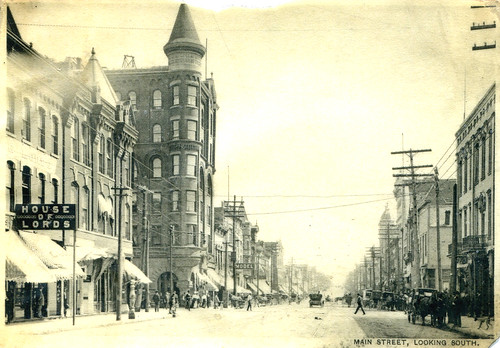
Main Street, Joplin (circa 1900) --
the "House of Lords" is at the far left
My home town – Joplin, Missouri – had a famous gilded palace of sin called the "House of Lords" back in the Gay Nineties. But what comes to mind when I try to imagine what the "House of the Rising Sun" was like is the "Gem," a saloon that opened in Deadwood, South Dakota at the height of the famous Black Hills gold rush, and which is depicted in the HBO series Deadwood.
The fictional "Gem" is a very sordid place. So is the fictional Deadwood. You can find a cup of coffee in the mornings, but from about 9 a.m. on, the beverage of choice is whiskey. Once the miners have knocked back a few shots, they're ready to gamble and have a little female companionship. The prostitutes are a pretty nasty-looking bunch, although they aren't quite as repulsive as the miners.
The life expectancy in Deadwood is pretty short. There's plenty of disease to go around. If you strike it rich, there's a good chance you'll get killed in a drunken brawl (usually involving gambling or one of the whores) while enjoying your riches, or simply murdered during a robbery. Inconvenient dead bodies are taken to "Chinaman's Alley" and sold to the Chinese butcher, who feeds them to his pigs. Mmmm, mmmm, good!
"Deadwood" working girl
I remember only three female characters in the whole town who weren't whores. One was the sheriff's wife – she was his brother's widow, and you were obliged in those days to step in and marry your brother's wife if something happened to him.
The second was a transplanted New Yorker whose deceased husband had lucked into a major gold find. But she got pregnant out of wedlock (by the sheriff), and was an on-again, off-again opium addict, so she was no paragon of virtue.
The third was Calamity Jane, who dressed like a man, cursed like a man, and was such an out-of-control drunk that she usually woke up each morning soaked in her own urine.
The first two of these women were married, and those were the only two married women I remember. Every other female in Deadwood was single and ready to mingle. (If you had the money, honey, they had the time.) It wasn't exactly a place known for its strong family values.
Some believe that the song's title is a reference to the Orleans Parish women's prison, which they say had an entrance gate with a rising sun design.
The prison theory fits the "ball and chain" line in the song, but a women's prison?
You see, the earliest versions of "The House of the Rising Sun" featured a female narrator singing in the first person. Here are lyrics that folklorist Alan Lomax published in 1941, several years after he first heard the song sung by Georgia Turner, a 16-year-old Kentucky coal miner's daughter. (She died of emphysema at age 48, having received a grand total of $117.50 in royalties for her recording of "House of the Rising Sun.")
There is a house in New Orleans
They call the Rising Sun.
It's been the ruin of many a poor girl
And me, O God, for one.
If I had listened what Mama said
I'd be at home today.
Being so young and foolish,
Let a rambler lead me astray.
Go tell my baby sister
Never do like I have done
To shun that house in New Orleans
They call the Rising Sun.
My mother she's a tailor
She sewed these new blue jeans.
My sweetheart, he's a drunkard, Lord,
Drinks down in New Orleans.
The only thing a drunkard needs
Is a suitcase and a trunk.
The only time he's satisfied
Is when he's on a drunk.
Fills his glasses to the brim
Passes them around.
Only pleasure he gets out of life
Is hoboin' from town to town.
One foot is on the platform
And the other one on the train.
I'm going back to New Orleans
Most of the pre-Animals recordings – including those done by Woody Guthrie, Leadbelly, Pete Seeger, Dave Van Ronk, Joan Baez, and Bob Dylan – featured these lyrics (or some variation on them) but were muscially quite varied.
The Animals denied that their arrangement was inspired by Dylan's version. Dylan was wowed by the Animals' single when he heard it on a car radio, but stopped performing the song because many fans – unaware that his recording had been released over two years before the Animals' version was recorded – believed he had copied the Animals.
* * * * *
I don't know whether the Animals changed the lyrics so that a male was the narrator, or whether they heard someone else perform it that way. The original lyrics do hang together a little better, I think.
But it always bothers me a little to hear a male sing a first-person song about a woman, or vice versa, so I'm glad the Animals did the song from a male's point of view.
The best (or worst) example of that I can offer of a transgendered song that just didn't cut it is Linda Ronstadt's version of the Lowell George song, "Willin'."
"Willin'" is sung by a "drunk and dirty" truck driver, who's not above smuggling cigarettes or transporting illegals across the border to make an extra buck – a modern-day cowboy, driving the lonely highways of the desert Southwest:
It seems that the woman in the original version of "House of the Rising Sun" is heading to prison because she killed her sweetheart. (In some recordings, he is a "gambler," not a "rambler.") Or was she busted for prostitution? Or maybe the "ball and chain" is meant figuratively, not literally, and she is heading back to the house of ill repute out of economic necessity because her lover has deserted her. Maybe she is fed up with his drinking. (Maybe you have a different theory.)
Cherchez la femme!
So how did the hero in the Animals' version of the song end up in a ball and chain? What terrible thing happened at the "House of the Rising Sun" anyway? Did he kill a gambler who was cheating at cards? Did he kill his father for abusing his mother?
I say cherchez la femme. I suspect a woman was the root of the problem. Maybe he fell in love with a working girl there and killed her – or a customer of hers – in a fit of whisky-fueled jealousy one night.
Or maybe he didn't kill her, but just threw a pot of hot coffee in her face so other men wouldn't want her (like Lee Marvin did to Gloria Grahame in The Big Heat):
Booze, or drugs, or gambling may have had something to do with our boy ending up in shackles, headed for the big house. But trust me, there was a woman involved. That's for sure . . . that's for damn sure.
IT'S THE MUSIC, STUPID
On to the music. If you don't play an instrument, you may want to skip ahead – but if you do have a guitar or a piano, feel free to use the chords below to play the song yourself.
The song begins with 8 bars of guitar arpeggios (basically a chord played one note at a time – going up in pitch and then back down), with a chord change on the downbeat of each bar – the progression is Am, C, D, F, Am, E, Am, and E.
There is never a chord change in the middle of a measure, or on an off-beat – there's no syncopation. That's one reason the song is so relentless. Its tempo is constant (until the slight slowing – or ritardando – at the very end) and the always-on-the-first-beat accents (reinforced by the accompanying chord changes) are as regular as heartbeats – but somewhat speeded-up heartbeats.
The time signature is a quick 6/8 – really two units of three beats apiece -- with the accent on the first of the three beats: ONE two three one two three. (Many 4/4 versions of this song have been recorded, but the 6/8 time signature is a very important part of why the Animals' version works so well.) The twitchy three-beat figures ratchet up the tension the listener feels as the song progresses.
There are six verses – each is 14 measures long (plus one syllable), and each is followed by an 8-measure instrumental bridge, the chords of which are the same as the chords in the introduction.
Here's the first verse, with the chords added:
There is a house in New Orleans
Am C D F
They call the Rising Sun
Am C E7 E7
And it's been the ruin of many a poor boy
Am C D F
And God I know I'm one
Am E (Am)
Yes, I know that's 15 chords, not 14. The way I see it, the last word of each verse is sung on the first beat of the 8-bar bridge.
(I don't want to get bogged down in minutiae, but another way to look at the musical structure of "House of the Rising Sun" is to say that it consists of 18-measure verses and a 6-measure bridge. Actually, the most accurate way to describe the structure may be to say that there are 18-measure verses and 8-measure bridges, each paired set of which has 22 measures. The two transitional measures – whether you think of them as the last two bars of the verse, or the first two bars of the bridge – really do double duty. It's like one voice sings for 18 measures, and a second voice sings for 8 measures – but the second singer begins to sing when the first one still has two measures to go. Capisce? Probably not, but let's not worry about it any longer.)
Eric Burdon sings the first verse accompanied by only the guitar arpeggios. Alan Price sort of sneaks in on his Vox Continental organ during the instrumental bridge between the first and second verses, and the organ increasingly dominates as the song progresses.
The Animals
After three verses, Price gets a 14-bar solo – the solo functions as sort of a 7th verse, with the usual 8-measure instrumental bridges on either side of it. (Or 18 and 6, or 18 and 8 equalling 22.) He is joined by guitarist Hilton Valentine, playing chords instead of arpeggios, which carry quite a bit more force. This is when all hell starts to break loose.
The organ and guitar back off a little when Burdon returns with the fourth verse, but quickly crank it back up for the fifth verse – as does the singer. Nothing's held in reserve.
But the song doesn't end there – there's a sixth verse (actually, it's the first verse repeated once more), and it is just as loud and fast and intense as the previous verse was . . . only more so.
After Burdon sings the last line of the last verse, you finally get to catch your breath. The song ends with a 18-measure instrumental coda, which is twice as long as the introduction or the between-verse bridges. The tempo slows down just a bit – I would mark it decelerando, not ritardando. (To me, ritardando is like putting on the brakes. Decelerando is taking your foot off the accelerator.) You realize that you've been breathing shallowly and so you're a little short of oxygen, so you take a nice deep breath as the song decelerates.
The whole experience reminds me of the last time I rode one of those modern thrill rides that teenagers love but no sane adult views with anything other than abject terror. You start climbing relatively slowly, but it doesn't take long before the scary stuff begins. There's a bit of a break about halfway through and you let your guard down a bit – just in time to get scared silly by a vertical loop that takes you a full 360 degrees. But before you have a chance to fully recover from that, it's time for a couple of head-over-heels corkscrew 360s.
The "Alpengeist" at Busch Gardens (Williamsburg, VA)
Finally, you start to coast, gradually slowing down until the brakes are finally applied and you come to a complete stop. You climb out of the ride wishing you could lie down for a few minutes with a cool washcloth on your forehead until your heart rate returned to normal and your brain started functioning properly again.
By the way, this discussion is about the original 4:29 version of the song. A hastily edited 2:58 version was released in the U.S. as a single. We will speak of it no more.
APRES LES "ANIMALS,"LE DELUGE
A whole lot of people did "House of the Rising Sun" after the Animals did – including (in no particular order) Bachman-Turner Overdrive, Bon Jovi, Toto, Tori Amos, Duran Duran, Gary Glitter, Sinead O'Connor, David Allan Coe, and the Seamonkees. Don't waste your time.
Click here for another Spanish version – a 1972 recording by a rock band from Colombia that seems to have gone by Gene-sis, Genesis, and Genesis de Colombia:
The ride's over, folks – if you made it all the way to the end, I'm impressed by your endurance.
But before bringing this post to a close, I'd like to reflect for just one moment on the first year of 2 or 3 lines.
When you're the creator of a wildly popular blog like 2 or 3 lines, you have very little time to rest on your laurels – you've got to keep your eye on the prize. If you're not moving forward, you're moving backwards. That's just simple physics, n'est-ce pas?
But one startling statistic should not go unremarked. I'm not talking about the record-breaking numbers of hits and page views that 2 or 3 lines is achieving month after month after month. I'm talking about the content that generated all those hits and page views.
The first six months that 2 or 3 lines was in existence, I produced 18 posts. The last six months, I produced 73 – yes, I said 73! In fact, I wrote more posts in October alone than in the first six months of 2 or 3 lines. (And as the quantity of posts increased, did the quality fall off? Well, maybe just a little.)
So don't tell me that 2 or 3 lines is just a hobby – a diversion – a pleasant way to while away some of my leisure time. No, no, no, no, no . . . it is much more than that. It is a force of nature – an unstoppable force and an immovable object, all rolled up into one. It's a big deal, and don't you ever forget that.
In the words of Maino's "All the Above" (a song that could just as well have been written about 2 or 3 lines):
How the hell could you stop me?
Why in the world would you try?
I go hard forever
That's just how I'm designed
That's just how I was built
See that look in my eyes . . .
Take a look
And you can tell that I'm destined for greatness
I did take my foot off the accelerator a little bit this week, and took my time for a change. Every 2 or 3 lines post is very special, but I wanted this one to be very very special – so I gave this truly great record all the time and effort it so richly deserved.
But this post took a lot out of me, so don't be surprised if I sort of phone in the next one. (You can't expect a magnum opus every time.)
Th-th-th-that's all folks. Hasta luego . . . hasta la vista . . . hasta yo mama!
* * * * *
Click on the link below to order "House of the Rising Sun" from Amazon:







 Posts
Posts

