Tuesday, December 17, 2013

Justin Timberlake, Oscar Isaac, and Adam Driver -- "Please, Mr. Kennedy" (2013)


I'm six foot two
So perhaps you'll
Tell me how to fit into a
Five-foot capsule

Hey -- I'm six foot two, too!  What a coinkidink!  (I used to be six foot three, but I was so much younger then . . . I'm older than that now.)

NOTE:  I know there are a lot of grammar nerds who read 2 or 3 lines.  FYI, "six foot two" is correct -- if you don't believe me, click here.  If you still don't believe me, consider this:  "Five foot two, eyes of blue/But oh! what those five foot could do!"  I rest my case.

ANOTHER NOTE:  I had quite a tussle with the ol' spell-checker over "coinkidink."  Did you know it is the classical Latin pronunciation for coincidence?  

Inside Llewyn Davis, which was written and directed by Ethan and Joel Coen, is a movie about a folk singer who is having a tough time making a name for himself in the Greenwich Village folk-music scene of 1961.


The movie is currently in very limited release in the U.S.  (It goes wide later this week.)  So it's almost certain that you haven't seen it yet.  

But 2 or 3 lines has seen it.  2 or 3 lines saw it at a press screening in Washington, DC, last week although 2 or 3 lines did not attend that press screening as a member of the press.  

That's about as much as I'm going to say about that -- anything more about that evening will be provided strictly on a need-to-know basis.  (2 or 3 lines works in mysterious ways, its wonders to perform.)  The last time I looked, you mos' definitely did NOT have a need to know.

Llewyn Davis (Oscar Isaac) and friend
I liked Inside Llewyn Davis a lot.  Most of the time, my opinion of a movie is highest when I'm in the moment -- after a few hours or a few days of reflecting on it, my enthusiasm may wane a bit.  The opposite is happening here -- the more I think about Inside Llewyn Davis, the more I think I like it.  

But that doesn't mean I would expect everyone to like it.  I think many people who will see it will walk out and say, "Meh."

One of the highlights of the movie is its soundtrack was produced by T-Bone Burnett.  He also produced the soundtrack for the Coens' O Brother, Where Art Thou?, which includes the traditional American folk song, "I Am a Man of Constant Sorrow."


The Inside Llewyn Davis soundtrack contains a number of traditional folk songs.  (Davis offers this definition of a folk song: "If it was never new and never gets old, it's a folk song.")

But it also contains "Please, Mr. Kennedy," a brilliant and hilarious original song about a reluctant astronaut who pleads with President Kennedy not to send him into outer space.  

Here's the scene from the movie where "Please, Mr. Kennedy" is performed by Oscar Isaac (who plays the title character), Justin Timberlake (who plays a folk singer who is a friend of Llewyn Davis), and Adam Driver (who plays a third folk singer).


Click here to read an interview of Burnett, Isaac, and Driver about the writing and recording of the song.

I said that "Please, Mr. Kennedy" was an original song.  But strictly speaking, it's not an original song.

The "Please, Mr. Kennedy" songwriting credit lists not only T-Bone Burnett, Justin Timberlake, and Ethan and Joel Coen, but also Ed Rush and George Cromarty.

That's because Rush and Cromarty, who recorded as the Goldcoast Singers, wrote a song called "Please, Mr. Kennedy" (which released on a 1962 album titled Here They Are! The Goldcoast Singers) that is essentially the same song as the Inside Llewyn Davis "Please, Mr. Kennedy," but with new lyrics.  Click here to listen to that song.


But that's not the whole story.  

In 1961, Motown released a single by Mickey Woods that is also called "Please, Mr. Kennedy."  It's a pretty big leap from that song to the Goldcoast Singers' song, but it is also about a guy asking President Kennedy not to draft him -- not because he is opposed to the war, but because he wants to marry his best girl first.  (The singer would also be satisfied if his best friend -- who he suspects of having designs on his girl -- were to be drafted at the same time.)


And you can go back a little further still.  The Mickey Woods' "Please, Mr. Kennedy" may have been inspired by Larry Verne's "Mr. Custer," which was a #1 hit single in 1960.  

"Mr. Custer" is sung by a private in the 7th Cavalry who begs General Custer to leave him behind if he insists on fighting the Battle of Little Bighorn:

There's a redskin a-waitin' out there
Just a-fixin' to take my hair
A coward I've been called 
'Cause I don't wanna wind up dead or bald


The Inside Llewyn Davis "Please, Mr. Kennedy" has been nominated for the "Best Original Song" Golden Globe.  But it won't be nominated for an Academy Award -- or it won't be unless the Academy committee that nominates songs for the "Best Original Song" Oscar changes their rules.  That's because the Academy's rules limit eligibility for that award to a song that "consists of words and music, both of which are original and written specifically for the motion picture."  

Forrest Wickman of Slate is not happy about this state of affairs because he believes that the Inside Llewyn Davis song is an adaptation that is "transformative" -- which happens to be a term of art that is fraught with significance for copyright lawyers (and which won't be explained further here because you're not paying me $670 an hour) -- and that represents a "form of genius" equal (or superior) to that of creating a song from scratch (if such a thing is really possible).

The Coens, Burnett, Timberlake, and Oscar Isaac put in hours and hours overhauling the song entirely: In addition to adding the countdown at the beginning and Driver’s ad libs, Burnett himself wrote "10 or 15 verses."  The Coens then "edited and refined and changed" these verses.  Together they kicked around and recorded multiple versions over the course of weeks, before the performers finally shaped the final version under Burnett and the Coens’ direction.  It was a perfect example of the kind of "creative interaction between the filmmaker(s) and the composer(s)" that the Academy explicitly values.

But the Academy’s rules, as they exist today, don’t reward this kind of creativity. In fact, it’s dismissal of this kind of creativity that prevented the Academy from recognizing classics like "Gangsta's Paradise" and "Fight the Power" from
Dangerous Minds and Do The Right Thing because they used samples. 
I couldn't agree more.  

Once again, here's "Please, Mr. Kennedy":


Click below to buy the song from Amazon:


Sunday, December 15, 2013

Donna Fargo -- "The Happiest Girl in the Whole U.S.A." (1972)


Skip-a-dee-doo-dah, thank you Lord 
For making him for me
And thank you for letting life turn out the way
That I always thought it could be

"The Happiest Girl in the Whole U.S.A." is possibly the most surprising musical choice ever for a Nike TV commercial -- they usually feature somewhat less syrupy songs.  (Think "Revolution" by the Beatles, "Search and Destroy" by Iggy Pop and the Stooges, "List of Demands" by Saul Williams, and other of that ilk -- loud, intense and high-energy.)

"The Happiest Girl in the Whole U.S.A." was a #1 country hit for Donna Fargo in 1972, and made it to #11 on the Billboard "Hot 100."  The singer is a newlywed who is singing to her new husband, and she couldn't be happier -- performing the simplest household chores fill her with delight because she's married the man of her dreams.

The Nike commercial that uses this song as its soundtrack features women softball players -- including members of the 2008 United States Olympic softball team.

The U.S. softballers at the 2008 Olympics
That was the last year women's softball was an Olympic sport.  It wasn't included in the 2012 Olympics, and it won't be part of the 2016 Olympics either.  Whether it is reinstated in 2020 or later is anyone's guess.

Why was softball dropped from the Olympics after the 2008 games -- which was only the fourth Olympics to feature it?

Most suspect that the Olympic powers-that-be decided that the United States was simply too dominant in women's softball.

Pitcher Jennie Finch
Ironically, the USA did not win the 2008 gold medal after winning the 1996, 2000, and 2004 golds easily.  The 2008 gold medalist was Japan, which edged the Americans in the gold medal game.

The Americans had cruised past Japan 7-0 in the preliminary round, and prevailed once again in the semifinals by a 4-1 score.  After the Japanese edged Australia, 4-3, in the bronze medal game, the Japanese shocked the heavily-favored American team in the ultimate contest, 3-1.

This Nike commercial was shot and broadcast before the American softballers' shocking defeat.  It alternates shots of the Olympic team's members in action with shots of high schoolers and even younger players.

Let's watch it now:


I love this commercial because I love girl jocks.  (I'm sorry if that is politically incorrect language, but "female athletes" sounds so stiff.)

Please don't jump to the conclusion that there's anything prurient about my love for girl jocks.  The fact that my younger sister and my daughters were such good athletes has a lot more to do with it.

My sister was one of the first female athletes inducted into her college's athletic hall of fame -- and she was voted in on the basis of her accomplishments in two sports, basketball and softball.  I saw her play exactly one basketball game, and I never saw her play a college softball game.  (She was a pitcher.) 

That's because I was almost exclusively interested in my own life back in those days.  I didn't pay much attention to anyone else.

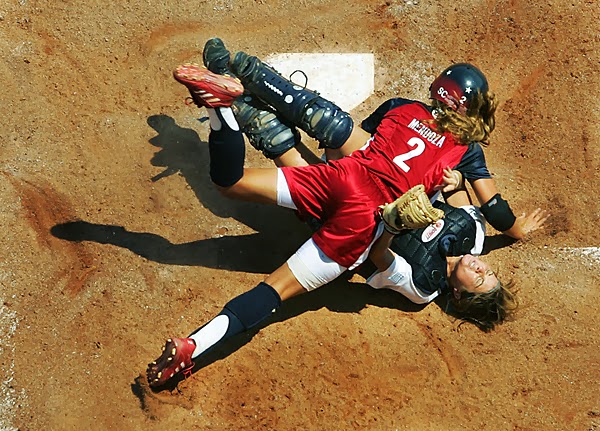
U.S. Olympian Jessica Mendoza trying to score
I tried to make up for that when my daughters started playing sports soon after they started grade school.  I rarely missed a basketball or soccer game of theirs, and when I did have to miss one because I was out of town or when a game was cancelled due to bad weather, I would get very salty.  

I don't remember ever being sorry for choosing one of their games over working or anything else.  (There's an old saw to the effect that no dying man ever said "I wish I had spent more time at the office."  I second that emotion, boys and girls.)

This commercial goes heavy on the slow-motion shots, two of which I especially like. 

The first is at 0:14, and features a very young pitcher who is rotating her hips almost violently in order to generate torque and increase her arm speed and, consequently, the velocity of her pitch.  The second (at 0:43) is a shot from the catcher's point of view of a batter swinging and missing at a fastball -- the ball gets larger and larger and the viewer feels like her or she is going to get hit by it right between the eyes.  But at the last second, there's a cut to  a shot of the catcher snagging it.

There are some wonderful small touches in the commercial.  Near the beginning of the spot, several players are shown riding in a golf cart, their insouciant postures essentially indistinguishable from that of male players in a similar situation.  The fact that they are jocks is much more significant than the fact that they are girls.

The 2008 Olympic softball team off the field
And notice the very quick closeup (at 0:17) of a softballer's hand gripping a chain-link fence, her nails painted a delicate coral-pink color.    

I wonder why "The Happiest Girl in the Whole U.S.A." was chosen as the musical accompaniment for this spot.  

I suppose we could simply focus on the title (which is the last line of the chorus) and say that the song is simply a statement of the utter joy that these girls (or women) feel when they are on the softball field with their teammates.  

But as noted above, the song as a whole is about a young newlywed who glories in a very traditional marriage -- albeit a marriage where the young husband seems to share equally in the household chores:

You make the coffee
I'll make the bed
I'll fix your lunch
And you fix mine

But the fundamental point of this song is that the singer would never have been truly happy without a husband -- for her, having a man to love is absolutely necessary to her feelings of fulfillment.


Do the softball players in the Nike commercial feel the same way as the singer?  Some of them may.  But others may find their fulfillment in athletics or a career, not in a traditional marriage.

That's especially true for gay female athletes, of course.  They aren't thanking God "for making him for me."

Very few of the athletes in the 2012 London Olympics were openly gay.  According to CBS News, only 23 of the more than 10,000 athletes who participated in the 2012 Olympics were "out" -- 20 women and three men.  

It is widely thought that there are many more gay female athletes than gay male athletes, but I couldn't find any hard evidence to back up that perception.

It is also widely thought that it is harder for a gay male athlete to come out than it is for a gay female athlete.  But it's not at all clear that's true either.  

Straight male athletes aren't really threatened when a teammate announces he is gay -- the public perception is that male athletes are generally straight, and the fact that there are occasional exceptions to that rule doesn't call into question the heterosexuality of the typical male athlete.

But as Dr. Pat Griffin (an expert on LGBT issues in sports) has noted, “I think straight women historically have been very concerned with the image of sports and being tagged with the lesbian label, which has lead to a lot of division among woman in sports.”

Brittney Griner
It does seem to be true that gay female athletes who come out of the closet are subject to much less scrutiny than gay male athletes.  When female basketball superstar Brittney Griner acknowledged last April that she was a lesbian, there wasn't much attention paid to that.  But when Jason Collins -- a relatively unknown NBA veteran -- became the first active male professional athlete playing a major team sport in the United States to come out, his story was all over the newspapers, ESPN, and sports-talk radio.

One reporter attributed that to the fact that "[a]n openly gay female athlete almost isn't news.  A lesbian in the locker room conforms to a stereotype, just as a straight male athlete is a stereotype."

Or perhaps the two announcements were treated so differently because women's sports never get nearly as much attention as men's sports -- regardless of the subject.

As I noted above, the enjoyment I derive from watching girl jocks is due in large part to the pleasure and pride I felt when I watched my sister and daughters play sports.  When I watch this commercial, I see them -- and their teammates -- in every one of the softball players who are shown throwing a ball, swinging a bat, or simply running to first base.


To me, every one of those girls is strong and graceful and utterly beautiful.  More importantly, every one of them seems to be having the time of her life.  

Two lines appear on the screen near the end of this commercial:  "We have softball.  You can have everything else." 

For most female softball players, that's no doubt something of an exaggeration.  But I hope each one of them has felt that way on occasion.  Perhaps during the moment of exhilaration that follows a diving catch or a game-winning hit -- or perhaps after a devastating defeat like the one the 2008 U.S. Olympic team suffered against Japan, when teammates hugged each other and the tears flowed.  

Here's a live recording of "The Happiest Girl in the Whole U.S.A.":


Click below to order the song from Amazon:

Friday, December 13, 2013

Eagles of Death Metal -- "Don't Speak (I Came to Make a BANG!)" (2006)


I'm too smooth
You never see me coming 
I'm never in a hurry
I'm just movin' fast 

Those words could have been written about 2 or 3 lines, boys and girls – am I right, or am I right?

Today's featured song was the soundtrack for a fabulous Nike TV commercial.  2 or 3 lines has featured a couple of other fabulous Nike TV spots in the past – click here to read about one of them one – and there are many, many more I plan to feature in the future.  (Many of the best music videos ever made are Nike commercials.)

This particular fabulous Nike TV commercial was directed by Guy Ritchie, who also directed Lock, Stock and Two Smoking Barrels and Snatch and the Robert Downey, Jr., Sherlock Holmes movies, and who is directing a "Man From U.N.C.L.E." movie scheduled to be released in 2014.  (The actors who were considered for the Napoleon Solo role in that movie included George Clooney, Leonardo DiCaprio, Ryan Gosling, Ewan McGregor, Matt Damon, Christian Bale, Michael Fassbender, Bradley Cooper, Jon Hamm, and Tom Cruise.  But the final choice was . . . Henry Cavill?)

Guy Ritchie with Madonna
But Ritchie's most remarkable accomplishment was marrying Madonna in 2000, divorcing her in 2008, and walking away with a divorce settlement in excess of 50 million pounds!!!

Madonna was a believer in Kabbalah (an esoteric and mystical offshoot of Judaism) during those years, and Ritchie also followed Kabbalah during the years they were married.  One Kabbalah spiritual leader later said that Ritchie has been circumcised in adherence to Kabbalah tradition – or, as the Daily Mail put it in 2011, he "agreed to say sayonara to his foreskin" to please Madonna.

Would I do that for 50 million pounds?  In a New York minute -- you would have to be a "F*cking Moron" to turn down that deal.  (NOTE: "F*cking Moron" is a trademark of A Brie Grows in Brooklyn, which is "The Official Young, Smart, and Hip Blogger of 2 or 3 Lines.")

I'd give up a lot more than a foreskin for 50 million pounds if you catch my drift.  (I'm 61 years old, and while I like to say that "61 is the new 16," I already have four children – and I don't a see new young wife with childbearing hips anywhere on my horizon.)

SI-2K MINI
Ritchie's Nike spot (which is titled "Take It To The Next Level") tells the story of a young Dutch soccer player who is signed by the English Premier League football club, Arsenal, and who eventually ends up playing for his national team in the World Cup.  It features a number of world-class footballers, including Cristiano Ronaldo and Wayne Rooney.

The most remarkable thing about the video is that it was shot from the point of view of the young soccer player – you see everything as if through his eyes.  This was accomplished with the help of a Silicon Imaging SI-2K MINI (which combines a digital videocamera with recording software and a 160GB hard drive) mounted to the head of the player.  Click here to read more.


Eagles of Death Metal was formed in 1998 by Josh Homme (who also founded Queens of the Stone Age) and Jesse Hughes.  The story behind the band's name may be the best band-name story ever:

Despite their band name, Eagles of Death Metal is not a death metal band. Hughes stated that a friend was introducing Josh Homme to the death metal genre. When he played a song by the Polish band Vader and made a claim that the song was within the death metal genre, Homme then referred to Vader as "The Eagles of Death Metal."  After hearing this phrase, he wondered what a cross between the Eagles and a death metal band would sound like.  In a 2003 interview Homme described the sound of the band as a combination of "bluegrass slide guitar mixed with stripper drum beats and Canned Heat vocals." 

None of that makes a lick of sense, does it?  

Here's the director's cut of Ritchie's Nike spot:


Here's "Don't Speak (I Came to Make a BANG!)", from the band's 2006 album, Death by Sexy:


Click below to buy the song from Amazon:

Tuesday, December 10, 2013

Brasil '65 -- "So Nice (Summer Samba)" (1965)


Should it be you and me?
I can see it could be nice

I think too much.  I plan too much.  I try to explain things rather than just accepting them.  

Worst of all, I try to make things happen rather than allowing them to happen.  (How foolish and futile a strategy that is!)

Sometimes you just have to trust in God or destiny or kismet or luck or coincidence or whatever you want to call the force that runs the universe and everything in it.


You may think that you are in control of things, but you aren't. 

Of course, that doesn't mean you aren't responsible for your actions, and that your actions don't have important consequences.  

But the most important moment in your life by far was the moment of your conception -- and you had absolutely nothing to do with that, did you?

Think about it for a moment.  The average human male ejaculates about 180 million sperm cells at a time.  (You fellas out there are feeling pretty damn proud of yourselves right now, aren't you?)  So the odds against you becoming you was 180 million to one.

The Fates: Atropos, Lachesis, and Clotho
Actually, it's even worse than that.  Fifty years ago -- which corresponds more closely to the time when I and most of my friends were conceived -- human males ejaculated an average of 380 million sperm.

But is the moment of your conception really the most significant moment of your life?  Is it any more important than the moment that your mother was conceived, your father was conceived, each of your grandparents was conceived, etc., etc., etc.?  

If all that is too biological for you to be comfortable with, think about this.  What were the odds that your mother and father would meet and decide to get married?  Weren't there about a zillion things -- most of them tiny little details -- that could have prevented that from happening?

A word to the wise . . .
It's rather terrifying, isn't it?  The fact that you and I exist is an almost incomprehensibly unlikely event.  (I'm rather fond of my own existence, so I don't care to contemplate all this too closely.) 

Forget about the odds against each of us existing in the first place.  Think about the most critical events of your life, and how easily they could have turned out differently -- if you had made some mundane decision that resulted in your being at a different place at the critical time, or at the critical place but at a different time.  Even a few seconds one way or the other might have made all the difference.

Does that mean your life is a product of mere coincidence?  Of course not.

An astronomer once said about an unusual event he had observed, "This is just too much of a coincidence to be a coincidence."

The poet Byron was also a skeptic when it came to coincidence:

A "strange coincidence," to use a phrase
By which such things are settled nowadays.

Novelist Vladimir Nabokov had this to say about coincidence:

A certain man once lost a diamond cufflink in the wide blue sea, and twenty years later, on the exact day . . . he was eating a large fish -- but there was no diamond inside.  That’s what I like about coincidence.

(I don't know what the hell it means either, but it's a pretty good story.)

Yuuko Ichihara
I'll give the last word on this subject to Yuuko Ichihara, who is a fictional manga character:

There is no such thing as coincidence in this world.  There is only the inevitable.

Whether coincidence is what one writer has defined as "God's way of remaining anonymous" or whether it is simply coincidence may not matter as much as the fact that you and I can't do anything about it.  Things are going to happen to you that are beyond your control.  You'd better learn to roll with the punches when that happens -- or even to embrace it.

I learned an important lesson while choosing a song to write about today.  

It all started when I was outside shoveling snow and ice off my sidewalk and driveway this afternoon.  OF COURSE I had my iPod and was listening to music as I shoveled.


To be specific, I was listening to The Very Best of the Arbors.  Don't even try to pretend that you've heard of the Arbors, because I know you haven't.  Until recently, I knew only a tiny, tiny bit about the Arbors and I have mad skills when it comes to this sh*t -- and you do not.  (Don't worry your pretty little heads about who the hell the Arbors are, OK?  I'm going to be telling you a lot more about them in the very near future, so just take a chill pill until then.)

Anyway, I'm listening to an Arbors song -- for the very first time, I might add -- and I make a snap decision to feature it on 2 or 3 lines.  In fact, I made a snap decision to feature it in the very next 2 or 3 lines.

A couple of hours later, I'm sitting at the computer, scrolling through iTunes until I get to my Arbors songs.  I don't know the name of the song I had been listening to, so I listen to brief snippets of several Arbors tracks and eventually find "So Nice (Summer Samba)."

Then I do a little research on that song, which turns out to have been written in 1964 by two Brazilian brothers.  (The guy who wrote the English lyrics was Norman Gimbel, who also wrote the English lyrics to "The Girl from Ipanema.")  

An instrumental version of the song recorded in 1966 by the Walter Wanderly Trio, who called it "Summer Samba (So Nice)" instead of vice versa made it to #26 on the Billboard "Hot 100."  That same year, Johnny Mathis, Vikki Carr, and Connie Francis all recorded it, and one source says that all three of their versions were on one or another Billboard chart at the same time.  Close to 200 artists altogether have covered the song.


I chose to feature the original recording of the song -- performed by the Sergio Mendes Trio and singer Wanda de Sah (sometimes known as Wanda Sá) under the name Brasil '65 -- in part because it was the original version but mostly because it's a really good version.  

So I started to write.  I had several reasons for deciding to feature the song.  One of the less significant reasons I did so was that it was cold and icy outdoors -- which made it a good time to write about a song titled (or subtitled) "Summer Samba."  (That's the way the mind of 2 or 3 lines works, boys and girls.)

But later in the day, I was listening to the Arbors album again while walking my dog when I suddenly realized that the song I had originally decided to feature wasn't "So Nice (Summer Samba)" but another Arbors cover of a vaguely similar-sounding Brazilian song, "Mas Que Nada (Pow Pow Pow)."

Sergio Mendes with his wife, singer
Gracinha Leporace in 1971
By an odd coincidence -- assuming there is such a thing -- Sergio Mendes and Brasil '66 (which was Brasil '65 with a reshuffled lineup) also recorded that song. 

When I figured out that I had started to write about the wrong song, did I go back and start all over again?  Of course not.  

After all, God or destiny or kismet or luck or coincidence or whatever you want to call the force that runs the universe and everything in it brought this song to my attention.  I didn't get to it by the shortest and most direct route, but I did get there.  Far be it from me to question such things.

And you know what?  It turns out that this is a wonderful little song -- a breath of balmy Brazilian air on a bitterly cold day.

Wanda de Sah
The performance is relaxed and effortless and altogether charming, especially Wanda de Sah's vocals.  (Check out that delightful accent.)  The lyrics are simple and straightforward, and seem to come straight from the heart.

The singer doesn't ask for very much:

Someone to hold me tight
That would be very nice
Someone to love me right
That would be very nice . . .
Someone to take my heart
And give his heart to me
Someone who's ready to
Give love a start with me
Oh yes -- that would be so nice!

Indeed it would.  

So what do you say?  Shall we give it a try?  

Should it be you and me?  
I can see it could be nice!

Here's "So Nice (Summer Samba)":


Click below to buy the song from Amazon:

Sunday, December 8, 2013

Procol Harum -- "Hotel Grand" (1973)


It's serenade and sarabande, 
The nights we stay at Hotel Grand 
Les nuits qu'on passe à l'Hotel Grande

I own a lot of record albums.  A few of my friends over the years have owned more, but not many.

I started buying albums in the mid-1960s.  I'm not sure which of my LPs was the first one I bought.  


It might have been Jan and Dean's 1963 album, Surf City (and Other Swingin' Cities), which featured not only the title track but also a number of other songs that referenced cities (including "Kansas City," "Memphis," "Detroit City," ""Way Down Yonder in New Orleans," and -- surprisingly -- "I Left My Heart in San Francisco").


Or it could have been the Beach Boys' 1964 concert album, Beach Boys Concert, which featured hits like "Fun, Fun, Fun" and "The Little Old Lady from Pasadena" and "I Get Around."  But I was most excited by the Beach Boys' cover of "Long Tall Texan," a novelty country song that was a minor hit for Murry Kellum in 1963, and is definitely not in the same class as "I Get Around."  (I was only 12 when that album was released, after all.)


It even might have my first Rolling Stones album, December's Children, which included "Get Off of My Cloud," "As Tears Go By," and "Route 66."  (Sadly, the Stones' version of "Route 66" -- unlike the original Bobby Troup recording -- left out any mention of Joplin, Missouri, which is my hometown.)


I didn't buy a lot of albums when I was a kid -- yo no tengo mucho dinero! 

I remember buying five albums on one red-letter day in 1969, when they were on sale for $2.22 each.  I know that Iron Butterfly's In-A-Gadda-Da-Vida, the Doors' Soft Parade, and Janis Joplin's I Got Dem Ol' Kozmic Blues Again Mama! were among them.  But I don't remember where I bought them.  (I would have said Walmart, but a friend of mine pointed out to me that the first Walmart in Joplin didn't open until 1972.  So maybe I bought them at Arlan's, a discount store that stood at 15th and Rangeline in 1969 -- Walmart later took over that space.  Or maybe it was Katz, another long-defunct discount retailer whose Joplin store was located at 7th and Rangeline.)


I picked up the pace in college, but there was so much music around the residence halls that you didn't need to buy a lot of albums -- your roommates or neighbors were usually happy to share their records.

I won Johnny Bond's Greatest Hits album by being the first person to call the Rice University radio station (KTRU) and answer some obscure trivia question.   Most of the old country songs on that album were about either cars ("Hot Rod Lincoln" and "Great Figure Eight Race" -- you don't see many figure-eight races any more) or getting drunk ("Three Sheets in the Wind," "Ten Little Bottles," and "Sick, Sober, and Sorry").


I bought a lot of records while I was in law school -- I got most of my records at the Harvard Co-operative Society (the "Coop"), but picked up quite a few cut-outs (including two Big Star albums and two New York Dolls albums and some Todd Rundgren albums) at the scruffy little record stores located in and around Harvard Square.

I kept buying albums after graduating from law school and moving to Washington, DC, in 1977.  There were a lot of interesting record stores in Dupont Circle and Georgetown, and I continued to search for obscure but worthwhile LPs in the cut-out bins.  Those were the days of "new wave" music (think the Talking Heads and Elvis Costello) and edgy music from New York City (Ramones, Blondie, Television, etc.).


I think my album purchases tapered off considerably in the 1980s -- I don't remember buying many records then.  I got a CD player in 1991, and I'm not sure if I ever bought another vinyl album after that.  

I bought a lot of crappy albums over the years.  Unlike today, when it's easy to at least listen to short samples of all the songs on an album and there are tons of online reviews available, we were generally dependent on radio airplay.  Very few radio stations played more than two or three cuts from most albums, so buying an album by a new group was pretty hit or miss.

All too often, I'd hear one or two great songs from a new album on the radio, go out and buy the album, and find out that all the other songs on it SUCKED.


God only knows what inspired me to buy Procol Harum's Grand Hotel album, which was released in 1973, but I have a theory.

When I was working at one of my brutish but usually well-paying summer jobs while I was in college, I would buy at least one album per week.  I'd get paid on Friday, swing by the bank to deposit my check, get a $20 bill for spending money, and hit Walmart to buy a record.  Sometimes I couldn't find anything I really wanted, but that didn't stop me from buying something -- including, mayhaps, Grand Hotel.

(The same thing happened years later, when I had three small children.  My wife and I would get a babysitter and go to a movie every Sunday afternoon.  We saw some really bad movies back then.)

Procol Harum
Procol Harum, a British progressive rock band, is best known for its debut single, "A Whiter Shade of Pale," which was a #1 hit in the UK and a #5 hit in the United States.  The song was based on a melody from a Bach cantata, and featured extremely obscure lyrics.

Click here if you'd like to know where the band got its name.

Grand Hotel was Procol Harum's sixth studio album.  I was sort of a sucker for fancy-pants, pseudo-intellectual groups with arch lyrics (think 10cc and Sparks) back in those days.  But I don't really have an excuse for falling for this enormous pile of bullish*t.  Mea culpa, mea culpa, mea maxima culpa!

Here's the first verse of our featured song:

Tonight we sleep on silken sheets 
We drink fine wine and eat rare meats 
On carousel and gambling stake 
Our fortunes speed, and dissipate. 
It's candlelight and chandelier, 
It's silver plate and crystal clear. 
The nights we stay at Hotel Grand 

I don't think I need to quote any more.  You get the picture . . . and it's not a pretty one.


A sarabande is a triple-meter dance (like a waltz) that first became popular in the New World colonies of Spain.  Baroque composers like Bach and Handel routinely included a 3/4 (or 3/2) sarabande movement in their suites.  ("Grand Hotel" is mostly in 4/4  but does have some 3/4 sections.) 

I thought about spotlighting the second song on the Grand Hotel album, "Toujours L'amour."  Here's a sample verse from that oh-so-sophisticated little ditty:

I'm thinking of renting a villa in France
A French girl has offered to give me a chance
Or maybe I'll take an excursion to Spain
And buy a revolver and blow out my brains

I vote for Spain.

Here's "Grand Hotel":


Click below to buy the song from Amazon:

Friday, December 6, 2013

Persuaders -- "Thin Line Between Love and Hate" (1971)


Here I am laying in the hospital
Bandaged from feet to head 
I'm in the state of shock
Just that much from being dead
I didn't think my woman
Could do something like this to me

Think again, pardner -- think again.

You best believe they can absolutely do something like that to you.  And they will if you make one false move . . . take one false step.


Initially, things were going so well for the singer of this song:

It's five o'clock in the morning
And I'm just getting in

Hmmm . . . I wonder what kept him from getting home before five o'clock in the morning.  (Maybe traffic was really bad?)

I knock on the door
A voice sweet and low says, "Who is it?"
She opens up the door and lets me in
Never once do she say, "Where have you been?"

I've seen some things that are too good to be true, but this is definitely the too-good-to-be-truest thing ever.

She says, "Are you hungry? 
Are you hungry, honey? Did you eat yet?"

(By the way, the Persuaders sing "hungry" as "hongry."  These guys are the real deal.)

"Are you hongry?"
As a matter of fact, honey, I am feeling a little peckish.  Drinking, dancing, and rolling in the hay with strange trim definitely gives a man an appetite.

All the time she's smiling, never once raises her voice 
It's five o'clock in the morning
And I don't give it a second thought

But the next thing he knows, he's is the hospital -- bandaged from head to toe and lucky to be alive.  And shocked . . . yes, shocked . . . that his woman "could do something like this to me."

Guys are pretty stupid generally, but this guy is a f*cking moron.  He gets home at five o'clock in the morning and thinks it's no big deal because his wife doesn't scream at him, but rather speaks in a voice "sweet and low," asking him if he's hungry -- how about some scrambled eggs and bacon, honeybabysugarpie?

So he "doesn't give it a second thought."  He gets home at five o'clock in the morning and he thinks he's actually going to get away with all that crap he's been doing all night. 

Wrong, moron!  As soon as you turn your back, she is going after your you-know-whats with the hedge trimmers!

Radio Raheem, a character in
Spike Lee's
Do the Right Thing
As our featured song says, it is a thin line between love and hate.  And as the writer, professor, political activist, and Holocaust survivor Elie Wiesel said in 1986 -- the year he won the Nobel Peace Prize -- "The opposite of love is not hate, it's indifference."  True dat, boys and girls.  

The woman in the song is far from being indifferent about her man strolling in at five o'clock in the morning.  Indifference doesn't put people in the hospital "just that much from being dead."

It's also a thin line between being a smartass (which is fine -- at least I think it is) and being an assh*le (which is bad).  2 or 3 lines walks right up to that line on a regular basis, and might even have stepped over it once or twice.


Let's take a vote.  How many times do you think 2 or 3 lines has stepped over the line between being a smartass and being an assh*le?

A.  Once.

B.  Twice.

C.  Not sure exactly, but a lot more than just once or twice.

D.  Not sure exactly, but a lot more than C.

E.  Only once, but when he stepped over the line he never stepped back.

I don't know why I'm bothering to ask my readers to vote.  You don't click on my ads when I beg you to -- oh, a few of you do (and I know who you are), but most of you ignore my ads -- so why are you going to stir themselves from your sloth-like lassitude to express an opinion on this question?

The Persuaders were a New York City R&B vocal group that formed in 1969.  Their biggest, "Thin Line Between Love and Hate," reached #1 on the Billboard R&B chart in 1971.  It's been covered by a lot of people.

Here's the Pretenders' cover of the song:


Here's the original Persuaders' recording:


Here they are performing the song on Soul Train:


Click below to buy the song from Amazon: