Sunday, November 11, 2012

Beatles -- "You Never Give Me Your Money" (1969)


One sweet dream
Pick up the bags and get in the limousine
Soon we'll be away from here

The 16-minute, 14-second medley that takes up most of the second side of Abbey Road is a pop music tour de force.  It dazzled me the first time I ever listened to it, and it still does today.  (Actually, I could do without "Sun King," but the other 14 minutes make up for that.)


I don't remember the exact date I purchased Abbey Road -- which was the last album the Beatles ever recorded -- but it had to be sometime between October 1 (when the record was released in the United States) and November 7 (the day that I and several of my friends left Joplin for a visit to the University of Missouri at Columbia).


I had recorded Abbey Road on to a cassette tape simply by playing the album on the phonograph in my parents' Magnavox console stereo, positioning a portable, battery-operated monaural cassette recorder between the console's speakers, pushing the "record" button, and hoping that no one rang the doorbell or called on the telephone before the record ended.  I don't suggest this techniques for serious audiophiles, but it was the only option I had.


My parents forbade me to take the cassette recorder with me on the trip to Mizzou, but I ignored them.  I don't know why they forbade me, but I'm guessing it was a combination of two things.  

First, while a battery-operated cassette tape recorder wasn't exactly a major appliance, my parents had a very modest income and were very careful with their possessions -- they knew there was a good chance I would lose the recorder or drop it, or at least wear out the batteries.

Second, I think my parents thought it was a good idea to say "no" to my requests at least half the time as a matter of principle.  Better for me in the long run to have too little fun rather than too much.  (I used to find myself hesitating before saying "yes" when my kids asked me if they could spend the night with a friend when they were young.  I had absolutely no good reason to deny their request, but the example set by my parents made me think twice before giving in -- maybe fun is something that should be given to kids in small doses.)

The weekend that my friends and I spent at the University of Missouri was one of the great experiences of my high-school years.

Mizzou coeds in 1969
We were hosted by a professor and his family, who owned a big old two-story house with a porch and an attic -- where we listened to his son's band practice Saturday night after going to see Butch Cassidy and the Sundance Kid.  (More about that in a future 2 or 3 lines.)

Earlier that day, we had attended the Missouri-Oklahoma football game.  (More about that to come as well.)  

Before that, I had time to hang out at the University of Missouri bookstore – which was almost as exciting for me as the football game or the movie.  I had never seen a real bookstore, and I was almost overwhelmed by the selection there.

For a 17-year-old pseudo-intellectual, a university bookstore circa 1969 was tall clover indeed.  I fancied myself a devotee of the Beats, and bought a poster of Allen Ginsberg (my parents never let me tape it to the wall of my room -- might damage the paint, you know) at the University bookstore.


I also bought the City Lights "Pocket Poets Series" paperback edition of Ginsberg's Howl and Other Poems.  The City Lights Bookstore, a cultural lodestone which was located in San Francisco's North Beach, was co-founded by poet Lawrence Ferlinghetti, who started publishing books as well as selling them soon after City Lights opened in 1953.  The ACLU defended Ferlinghetti when he was arrested and tried on obscenity charges when he published Howl in 1956.  (He was eventually acquitted.)

The first book in the “Pocket Poets Series” – all of which were small enough to fit easily into a pocket – was a collection of Ferlinghetti’s own poetry.  He also published poetry by Denise Levertov, William Carlos Williams, Gregory Corso, Malcolm Lowry, and Jack Kerouac.

I also bought Ferlinghetti’s 1961 collection of poems, Starting from San Francisco – which had a picture of Machu Picchu on the cover for some reason.

I still have my copy of that book:


Later that year, our English teacher asked us to assemble a notebook of our favorite poems.  I don’t recall many of my choices – I think we were supposed to pick 20 or 25 poems.  

I’m pretty sure I included Randall Jarrell’s “The Death of the Ball Turret Gunner.”  Here it is in its very brief entirety:

From my mother's sleep I fell into the State,
And I hunched in its belly till my wet fur froze.
Six miles from earth, loosed from its dream of life,
I woke to black flak and the nightmare fighters.
When I died they washed me out of the turret with a hose.
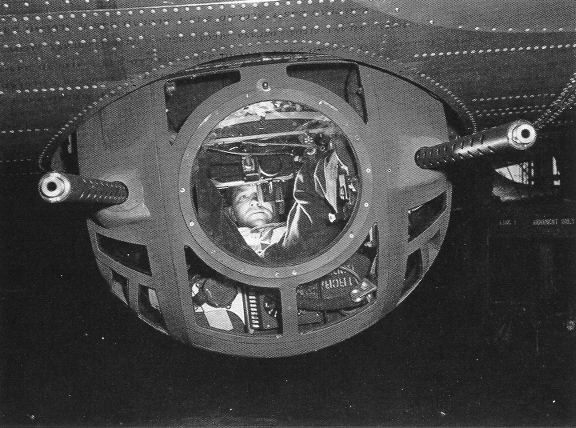


A B-17 ball turret gunner
I think I also included some lines from Howl, which was probably not a great idea – remember, the government considered Howl to be obscene, largely because of its explicit references to homosexual acts.  (To say Ginsberg was out of the closet is an understatement.  He held nothing back in Howl.)

I remember the title of a Ferlinghetti poem I put in my notebook as well: “Tentative Description of a Dinner to Promote the Impeachment of President Eisenhower.”

My teacher was not impressed with my selections.  (I should have known better, but I obviously didn’t.)

I also left the university bookstore with a couple of 6" x 9 1/2" spiral-bound notebooks with a drawing of "The Columns" on their covers.  ("The Columns" are six limestone Ionic columns that once supported the portico of the first academic building on the Mizzou campus.  That building was completed in 1843, but burned down in 1892.  "The Columns" survived the blaze and are now an iconic campus landmark.)


I still have those notebooks, which I used as journals, or to write some very forgettable poetry in, or for various lists.  

I’m a big fan of lists.  For example, when I lived in San Francisco in 1981, I used to watch reruns of The Rockford Files and Kojak and note the name of each episode and the guest stars in this notebook for some reason.

Kojak seemed to have the better male guest stars -- including such notables as Richard Gere, Harvey Keitel, Christopher Walken, William Hurt, Leslie Nielsen, Eli Wallach, and Bernie Kopell (the ship's doctor on The Love Boat).


One of my U. of Missouri notebooks
The Rockford Files attracted a better class of female guest stars -- Rita Moreno, Linda Evans, Lindsay Wagner,  Stephanie Powers (a/k/a "The Girl from U.N.C.L.E."), and Leslie Charleson (the star of my favorite soap opera, Love Is a Many-Splendored Thing).

Here's an interesting coincidence.  Daniel J. Travanti guested on Kojak.  Veronica Hamel guested on Rockford.  Several years, they starred together as police captain Frank Furillo and his love interest, public defender Joyce Davenport, on Hill Street Blues.


Here's "You Never Give Me Your Money":


Here's a link you can use to buy the Abbey Road CD from Amazon:

Thursday, November 8, 2012

Big & Rich -- "8th of November" (2005)


On the 8th of November 
The angels were crying 
As they carried his brothers away 

Big & Rich's Comin' to Your City album, which includes the "8th of November," was released almost 40 years to the day after the Vietnam War battle that is the subject of the song.


The 173rd Airborne Brigade -- the first major U.S. Army combat unit to be deployed to Vietnam -- arrived there in May 1965, and participated in over 50 combat operations before returning to the U.S. six years later.

The "Sky Soldiers" had a peak strength of about 3000 soldiers.  I don't know how many different men served in the 173rd in the six years it fought in Vietnam, but 1736 died there.  The Brigade's soldiers were awarded 13 Medals of Honor and over 6000 Purple Hearts.


On the 8th of November, 1965, units of the 173rd were conducting a search-and-destroy operation code named "Operation Hump" about 30 miles northeast of Saigon.

Companies B and C of the 1st Battalion were ambushed by some 1200 Viet Cong troops the morning of the 8th.  The Americans repelled the attacks, and the Viet Cong eventually withdrew into the jungle.

Some 48 Americans were killed, and many more wounded.  The official estimate of the enemy's casualties was 400 dead, although some believe it was twice that number.


One of the wounded was Niles Harris, a friend of Big & Rich.  He was one of a group of 30 soldiers who were isolated during part of the battle.  

Harris met Big & Rich (a/k/a/ "Big Kenny" Alphin and John Rich) when the duo were performing in Deadwood, South Dakota in 2003.  The three men shared a beer or two that night, and Harris showed the musicians around the Black Hills the next day.  He told them about his Vietnam experience, and they were inspired to write a song about it.

Niles Harris with Big & Rich
Harris was a typical infantry soldier of that era:

Said goodbye to his momma
As he left South Dakota 
To fight for the red, white and blue 
He was 19 and green
With a new M-16 
Just doing what he had to do 

Here's the song's description of how November 8 began for Harris:

He was dropped in the jungle
Where the choppers would rumble 
With the smell of napalm in the air 
And the sergeant said,
"Look up ahead!" 

The 1200 enemy soldiers descended on Harris and his comrades "like a dark, evil cloud." 

With the fire raining down
And the hell all around 
There were few men left standing that day 

An M-16 rifle
Harris was 58 when the song was written, some four decades after that battle.  Every 8th of November, he pays tribute to the men of the 173rd who died that day:

He puts on a gray suit
Over his Airborne tattoo 
And he ties it on one time a year 
And remembers the fallen
As he orders a tall one 
And swallows it down with his tears 

"8th of November" may be "awkwardly jingoistic," as one reviewer described it.  It's also sentimental and manipulative and mawkish.  

But I don't mind any of that a bit.  Anytime I'm on a bike ride to Lake Needwood and "8th of November" pops up on my iPod, I hit the repeat button at least three or four times -- and I sing along to the chorus at the top of my lungs.  

Here's "8th of November" (featuring Niles Harris):


Click here to order the song from Amazon:

Tuesday, November 6, 2012

Alice Cooper -- "Elected" (1972)


Top prime cut of meat, I'm your choice
I wanna be elected!

Today's the big day.  In less than 24 hours, we should know who the next President of the United Staes is.  

We'll also know the identities of thousands of other officeholders: Senators and U.S. Representatives, governors, lieutenant governors, state attorneys general, state legislators, county executives, mayors, county and city councilmen and councilwomen, board of education members, county sheriffs, clerks of court, registers of wills, and countless others.  

But everyone's focused on the ne plus ultra of American elective office . . . the most powerful man in the world (after Chuck Norris) . . .  the capo di tutti capi . . . the POTUS.

I wish he was running for President!
I'll be watching the election results tonight for the same reason I watch "SportsCenter" on ESPN -- because I'm interested in knowing who the winners and losers are.  But the outcome won't matter that much to me -- nor should it.  I'll wake up tomorrow morning and go to the same job, I'll come home tomorrow night to the same house and family and dog and cat, etc., etc., etc.

That's the great thing about the United States, boys and girls -- for 99% of us, it really doesn't matter that much who wins and who loses.  Sure, most of us have a preference for one candidate or the other.  But your life over the next four years is probably going to be pretty much the same regardless of who the President is.  

So don't get all bent out of shape if your guy falls short.   Look on the bright side and count your blessings: we won't have to watch any political ads on TV for the next year or so.

Speaking of political ads, the Obama campaign has raised $632 million ($423 million from large contributions) for this election, while the Romney campaign has raised $389 million ($316 million from large contributions).  If my math is correct, that's over a billion dollars -- most of it spent in just a few states.  You and I may be glad that the campaign is almost over, but the TV and radio stations, local newspapers, direct-mail companies, and robocallers are fat and happy tonight.

The Billion Dollar Babies album cover
"Elected" was the third track on Alice Cooper's sixth studio album, Billion Dollar Babies, which was released in 1973.  But it was released as a single in 1972 -- October 7 to be precise, exactly one month before the 1972 election.

The 1972 election was a doozy.  President Richard Nixon's renomination was never in doubt.  But the Democratic nomination was up for grabs.

A total of 15 men and women sought that nomination.  Ted Kennedy would likely have won the nomination if he had run, but he declined to do so.  (Mary Jo Kopechne had died in his car in July 1969, but many people were apparently prepared to overlook his behavior that night and the lies he told about what happened.)


That left Senator Ed Muskie of Maine, the 1968 vice-presidential nominee, as the favorite.  The 1968 presidential nominee, Hubert Humphrey, also ran.  But neither man did very well.

The eventual winner was South Dakota Senator George McGovern, a "dove" who looked like a longshot at first.  (The darling of the doves in 1968, Eugene McCarthy, also sought the nomination but didn't get very far.)

Senator Henry "Scoop" Jackson of Washington, a more conservative Democrat, and Alabama Governor George Wallace, who said he no longer favored racial segregation but did oppose school bussing, were McGovern's most serious opponents.

(New York Congresswoman Shirley Chisholm, the first African-American woman to run for President, won three primaries but never had a real chance to prevail.  Hawaii Congresswoman Patsy Mink, the first Asian-American of either sex to contend for the nomination, ended up with only a single delegate.)

Seven different Democrats won primaries in 1972
Wallace not only won primaries in four Southern states, but also finished first in the Michigan and Maryland contests.  But his chances of winning the nomination ended when was shot four times and left paralyzed on May 15. 

McGovern went into the convention with plenty of delegates to win a first-ballot victory, but the convention was chaotic.  McGovern chose Missouri's Senator Thomas Eagleton to be his running mate, but a number of the delegates who were unhappy with McGovern made their displeasure known by not voting for Eagleton.

In fact, the delegates voted for some 70 different men and women for the vice-presidential nomination.  Even Chairman Mao Tse-Tung (or Mao Zedong, if you prefer) of China got a vote.

Eagleton and McGovern
Within days, it was discovered that Eagleton had undergone shock treatment for depression.  After first saying he backed Eagleton "1000 per cent," McGovern changed course and asked Eagleton to step down.  His first six choices to replace Eagleton declined, so McGovern turned to Kennedy brother-in-law Sargent Shriver to fill the void.

President Nixon was pretty popular in 1972, largely because he was credited with having achieved détente with China and the Soviet Union.  McGovern was viewed as an extreme liberal by many voters -- he was accused of being the candidate of "amnesty, abortion, and acid" by fellow Democrat Hubert Humphrey in the Nebraska primary campaign, and that label stuck.

The result was a landslide of historic proportions.  Nixon won 60.7% of the popular vote, while McGovern won only 37.5%.  The Electoral College tally was even more one-sided: 520 for Nixon, 17 for McGovern.  (Only Massachusetts and the District of Columbia favored McGovern, who died last month at age 90.)

We all know what happened to President Nixon, of course.  Within two years of the 1972 election, he was forced to resign from office due to the Watergate scandal.    

"Elected" made it to #26 on the U.S. charts.  Oddly, it did better abroad, reaching the top 10 in the UK, Ireland, Germany, Austria, and the Netherlands.  (Not France, of course.  France always has to be different.)

Alice Cooper strikes a patriotic pose
I bought Billion Dollar Babies and several other Alice Cooper albums back in the day, and I think he's very underrated.  Most people remember him for his female name, his excessive makeup and weird outfits, and his over-the-top, horror-movie-inspired live shows.

But good old Alice (who was born Vincent Damon Furnier in Detroit in 1948) knew how to write memorable songs.

By the way, David Byrne said that Billion Dollar Babies inspired him to write "Psycho Killer," the first song he ever wrote and arguably the greatest Talking Heads song ever.  

"Elected" has lines that seem like they were written for both candidates.

Don't these lines fit the typical Democrat's view of Mitt Romney's image?

A Yankee doodle dandy in a gold Rolls-Royce
I want to be elected!

And these lines could have been written about Barack Obama:

I never lied to you, I've always been cool
I want to be elected!

Here's the music video for "Elected."  Alice makes a pretty compelling campaigner.  (Don't miss the chimp's entrance with the wheelbarrow of cash at about 1:40.)


And here's a link you can use to buy it from Amazon:

Sunday, November 4, 2012

Moose -- "Little Bird (Are You Happy In Your Cage?)" (1992)


Then maybe I'd have something more
Something more than getting older

In the spring (wrote Alfred Lord Tennyson) a young man's fancy turns to thoughts of love.

In the fall, however, a young man's fancy turns to thoughts of moose -- at least that seems to be true of young men (and not-so-young men) who live in Maine.

DIFW logo
Earlier this year, my daughter Caroline moved to Maine to take a job in the state Department of Inland Fisheries and Wildlife (or "DIFW," for short).

To say that my daughter is not exactly an outdoorswoman would be an understatement.  She's athletic and fit, but she'd never been fishing and never been hunting -- never even held a gun -- before taking that job.

Her talents are more in the artistic direction, as this photo of one of her creations demonstrates:


One of Caroline's first assignments was to work on the annual Maine moose-hunting permit lottery.  

Since 1980, the DIFW has awarded permits to hunt moose through a lottery.  This year, there were 3725 hunting permits up for grabs.  But there were 54,338 applicants for those permits.  (The DIFW estimates the Maine moose population at about 76,000 animals.)

The DIFW lottery is extremely complex.  In the first place, residents don't compete against nonresidents -- it's almost like there are two separate lotteries -- and residents have a much better chance of winning.  (No more than 10% of permits are allowed to go to nonresidents, while almost 30% of applicants are from out of state.)

Your best chance of winning is if you are willing to accept any available permit.  But if you have your heart set on a bull moose instead of a cow, or you want to hunt in a particular geographic area, your odds of succeeding are longer.

The good news is that the more years you've entered without winning, the better shot you have.  That's because you get "preference points" for each unsuccessful entry.  A first-time entrant from Maine has about a 1.5% chance of winning.  But a Mainer who's been trying since 1998 without bagging a permit has a 33.9% chance of winning.

The moose permit lottery is a big, big deal in Maine.  The drawing is held live each June -- it's the culmination of a weekend-long "Moose Lottery Festival," which features a fishing contest, turkey shoot, bowling and archery competitions, sailing regatta, art show, baked-bean supper, and the finals of the "World Invitational Moose Calling Contest."

Waiting for the moose lottery drawing to begin
Hundreds attend the drawing live, while others sit at their computers and eagerly wait for the winners' names to be posted online.  (My daughter said that when there was a brief delay in posting the winners' name to the DIFW website, they were flooded with e-mails from anxious entrants.)

All I know about moose is that they are enormous -- the bison is the only North American animal that is larger than the moose, which can weigh well over a thousand pounds and stand six or seven feet tall at the shoulder --  and that if you hit one in your car, you are in a world of hurt.  

Not only do moose weigh a lot, but have very long legs.  If a typical passenger car hits a moose, it will likely break the moose's legs and cause its body to fall on to the hood and crash into the windshield.  If you're sitting in the front seat when you hit a moose, you can pretty much kiss your you-know-what goodbye.

Aftermath of moose-automobile collision
Some people think that you're better off speeding up if you see that your car is about to collide with a moose.  The guys on the MythBusters TV show tested that theory by constructing a six-foot-tall, 620-pound rubber moose and running a car into it while speeding up, slowing down, or maintaining a constant speed.  It turns out that slowing down is the best strategy.

I kept running into moose -- not literally -- when I was in Maine last weekend to visit Caroline and to attend a very special wedding.  (Click here to read about that wedding.)

Here's a big-ass moose head that hangs on the wall of the Broad Arrow Tavern in Freeport, Maine, the town where Caroline lives:


Freeport is best known as the headquarters of that legendary seller of clothing and outdoor equipment, L. L. Bean.  The first product sold by L. L. Bean, which is celebrating its 100th anniversary this year, was the legendary "Maine Hunting Shoe," or "Bean Boot."  Today, the company has an enormous mail-order operation, 115 retail stores (including ten in Japan), and annual sales of about $1.5 billion.

Here's a store display of a 1940s-vintage Bean boot, plus a small axe, a compass, and various other woodsy items:


Here's the biggest Bean boot in the world:


The main L. L. Bean store in Freeport -- which is open 24 hours a day, 365 days a year -- also has a big-ass stuffed moose head:


There are plenty of other stuffed animals on display at the Bean store:


For my money, the most amazing taxidermy item in the Bean store is a display titled "The Final Charge."

In May 2006, a resident of New Sweden, Maine, found the remains of two bull moose on her property.  The moose had died after their antlers had become locked while they battled during the previous fall's rut.  (Cherchez la femme!)  She donated the antlers to the DIFW.

DIFW asked L. L. Bean to help pay for a taxidermist to reconstruct the two moose, using their antlers -- which have remained locked ever since that fateful encounter -- as the basis for the tableau.

"The Final Charge"
"The Final Charge" was unveiled in September 2009.  It is usually encased within a specially-built viewing diorama at Bean's flagship store, but can be taken on the road in a custom-built trailer.  Caroline tells me that the DIFW gets many requests to bring "The Final Charge" to events all over Maine.

Perhaps the fearsome collision that caused the antlers to lock also killed the two moose instantly.  But I fear that it didn't, and that those two magnificent bull moose suffered terribly before eventually starving or succumbing to predators because they were unable to defend themselves.  

It's like something out of an ancient myth.  Imagine two magnificent warriors, each determined to have a fair maiden for his own.  They engage in hand-to-hand combat and eventually die in one another's grasp, unable (or unwilling) to call off the battle.  

Moose was an indie rock band who formed in London in 1990, taking its name from guitarist K. J. "Moose" McKillop's nickname.  (The UK doesn't even have moose.)  They were the first so-called "shoegaze" band.  

"Shoegaze" was an alternative rock subgenre characterized by droning, distorted guitars that peaked in the early 1990s.  The name was supposedly applied to Moose by a reviewer who saw them play a concert at which their lead singer taped the song lyrics to the floor and looked down at them as he sang.  (Another theory is that shoegaze guitarists often used several different effects pedals and had to look down at them in order to operate them correctly.)  The term was then applied to other bands playing the same style of music.


Over the next decade, Moose released four studio albums and several singles and EPs, none of which sold very well despite generally favorable reviews.  Like so many cult bands who never found a larger audience, Moose eventually gave up.  

Here's "Little Bird (Are You Happy In Your Cage?)," the first single from Moose's 1992 album, XYZ.  It's not really a classic shoegaze song -- it's more melodic . . . more of a pop song.


Click here to buy the song from Amazon:

Thursday, November 1, 2012

Steppenwolf -- "It's Never Too Late" (1969)


Your eyes are moist, you scream and shout
As though you were a man possessed
From deep inside comes rushing forth
All the anguish you suppressed

I took three years of Latin in high school, and I remember only two quotes.

One is Gallia est omnis divisa in partes tres — "All Gaul is divided into three parts."  That's the opening line of Julius Caesar's Commentaries on the Gallic War.

The other is Dum spiro spero — "While I breathe, I hope" — which is usually attributed to Cicero, the master of Latin prose.

Marcus Tullius Cicero (106 BC — 43 BC)
I'll come back to Dum spiro spero a little later.  But first, we have a special occasion to celebrate.

Actually, we have two special occasions to celebrate.  We'll get the less important one out of the way so we can focus on the more important one.

*     *     *     *     *

2 or 3 lines is three years old today!  (And what a big boy he is for a three-year-old . . . 427 posts big!)

I was concerned that Hurricane Sandy might cause enough chaos to force me to delay this third anniversary post.  It seemed likely that we would suffer a sustained power outage and a lengthy internet service interruption.

But that storm caused surprisingly little damage and disruption in my neighborhood.  So the celebration of the third birthday of my wildly popular little blog is taking place on schedule.  

So three cheers for 2 or 3 lines!  Or two cheers, if you're not feeling up to three.  Either two or three cheers will work.

*     *     *     *     *

I had several ideas for today's anniversary post.  I've been saving a couple of my favorite records for a rainy day, and thought about writing about one of them. 

But I attended a very special wedding last Saturday, and decided that I had to write about it.

This way to the wedding!
So there I was, sitting under a tent on the lawn of an oceanfront inn in a small town in Maine with several dozen other folks, waiting for the bride to walk down the aisle and join her husband-to-be for their wedding ceremony.

Seeing the woman I will refer to as "D" as she made her entrance on the arm of her father was an almost overwhelming experience.  Not because she looked beautiful in her long white lace-trimmed wedding dress — although she certainly did look beautiful — but because I was seeing her for the first time in 35 years.

The last time I had seen D, she was a 20-year-old college student.  Now she was a 55-year-old mother of three.  She looked different, but she also looked exactly the same.

The happy couple – in 1974
Seeing her made me feel the same way I feel when I look at photographs of my adult children that were taken when they were six, or eight, or twelve years old.  First, you revel in the happy memories that those pictures produce.  Then, you are staggered by the realization of how much of your life has passed — and how quickly it all happened.  It can all be almost too much to bear.

*     *     *     *     *

I had met D for the first time in the fall of 1974, when I was a first-year law student and she was the girlfriend of my friend "M," who lived a few doors down the hall from me in our law school dormitory.  

She was a college freshman that year.  M was a graduate law student — he already had a law degree, and was pursuing a master's in law.  He was at the law school for only one year, but we spent a lot of time together.

I saw M and D occasionally over the next couple of years.  I went to visit M in New York City a couple of times, and he came up to Cambridge every so often to visit D.  Every so often I would see D walking to class or running errands — her college was directly across the street from my law school dorm.  Once she even fixed me up on a blind date with one of her friends. 

I graduated from law school in 1977 and moved to Washington, DC — later I lived in San Francisco and Philadelphia.  M's law firm sent him to Paris for a few years and to Mexico City for a few years, but eventually he gave up the practice of law and went into business in the small town in upstate New York where he had gone to college.  

We spoke occasionally over the years — only very occasionally, I'm sorry to say.  We hooked up on Facebook a couple of years ago, and have exchanged brief notes regularly since then.  But we hadn't met face to face in 35 years until last Saturday, at his and D's wedding.

*     *     *     *     *

One of the gifts I brought to the wedding was a bottle of wine that M had given me when I was in law school.  M and I had decided to educate ourselves about wine by buying a very modest bottle every Friday to share and discuss.  He was kind enough to give me a bottle of '69 Chateau Montrose — a very credible red Bordeaux — for my graduation (or perhaps some other occasion).


I had taken the bottle to my parents' house after finishing law school and that's where it remained for the next 35 years or so.  I remembered it was there a couple of years ago after M and I reconnected on Facebook, and I decided to bring it to the wedding and present it to him as a tangible reminder of our law-school friendship — and of the days when he and D were young and in love.

*     *     *     *     *

The program that was handed out at the wedding tells the story of how M and D got back together after so many years.  

M had never been previously married.  That surprises me a little — M is a very nice guy, not to mention good-looking, athletic, smart and successful.  

In old movies, when someone asked a bachelor why he had never gotten married, the usual answer was "I guess I never met the right girl."  In M's case, I suspect the reason was that he had met the right girl, but the right girl — D — wasn't available when he was ready to get married.

D had married after graduating from college, and had three children.  She had grown up in Connecticut, but lived out west for a number of years before moving to a charming little Maine town in the 1990s.

The view from outside the wedding tent
M tracked D down (with the help of her college's alumni office) in 2001.  They agreed to meet for dinner shortly after 9/11.

Here's what their wedding program says about what happened next:

M's bursting excitement about the reunion caused him to blurt out a proposal over dinner, on their first night together!  D, needing some peace and calm in her life at that time, was a bit blown away by M's energy and persistence, and the reunion was anything but a dream come true!

Reading between the lines a little, here's how I might translate that paragraph:

Bursting with excitement — and fortified by a few drinks — M blurted out a proposal on their first night together in many years.  D was completely freaked out by this display of temporary insanity and ran for the hills as fast as she could go.

(Take a minute to read the four lines I quoted at the beginning of this post — now you know why I chose those lines.)

*     *     *     *     *

I probably shouldn't joke about what happened that evening.  I'm sure it was very painful for M — I can imagine how sorry he was that he had acted so impulsively.

I'm very sympathetic to M because there have been a couple of times in my life when I came very close to throwing caution to the wind and making a similar declaration.  

One case involved someone I had known for a long time but only as a friend.  One day I was suddenly filled with regret that we had only been friends — it hit me that she might have been the one — and I was tempted to lay things on the line like M did.

But I kept my feelings to myself.  Maybe that was smart — I have no reason to think that the woman felt the same way about me, and even if she had been interested in me, she likely would have reacted in the same way that D reacted in 2001 if I had surprised her by baring my soul.

Or maybe it was just cowardly.  Maybe I was more afraid that she would say "yes" than I was that she would say "no."

*     *     *     *     *

In April 2011, M and D met once more — ten years after that ill-fated evening when M shocked D with his sudden proposal.  This time, things clicked — the two of them decided they were ready to complete the journey that they had begun in 1974.  In July of this year, M proposed once more and D happily accepted.

I'm not sure how M maintained his composure throughout the wedding service.  My emotions were running at high tide, and I was just a spectator.

Another view of the wedding site
Everyone I spoke to at the wedding had the same reaction — they were all thrilled for M and D, but they were also very aware that they were witnessing the culmination of a remarkable drama that had many twists and turns before it ended happily.

I had liked both M and D very much, and it was great to see such nice people looking so happy.  

But I was also pleased for myself.  M was a close friend, but our jobs took us to different parts of the world after the year we spent at law school together, and we eventually lost touch for many, many years.  I was very happy to have him as a friend again, and getting reacquainted with D to boot was a wonderful bonus.

And I was pleased for another reason.  The fact that M and D's story had a happy ending made me hopeful.  

That happy ending had been deferred for a very long time.  But the delay did not defeat them.  When the time for them to be together finally arrived, they had enough optimism and courage and faith in one another to seize the opportunity.

Do they regret not doing this 35 years ago?  I'm sure they must, at least at times -- who in their situation wouldn't look back and think about what might have been?  Life is short, and 35 years is a long time.

But as Saul Bellow wrote,

The past is no good to us.  The future is full of anxiety.  Only the present is real — the here-and-now.  Seize the day!

*     *     *     *     *

The narrator of T.S. Eliot's "The Love Song of J. Alfred Prufrock" wanted to seize the day, but was too paralyzed by fear and indecision to ask the "overwhelming question" that might have led to his finding happiness: 

Do I dare
Disturb the universe?
In a minute there is time
For decisions and revisions which a minute will reverse

From a "Prufrock" comic book by Julian Peters
Prufrock understood the consequences of his failure to dare:

I grow old . . . I grow old . . .
Do I dare to eat a peach? . . .
I have heard the mermaids singing, each to each
I do not think they will sing to me

We all grow old — one day at a time.  But one day at a time eventually turns into 35 years.  

When you reach that point, you have two choices.  You can say the words that John Greenleaf Whittier called the saddest words of tongue or pen: "It might have been!"

Or you can "seize the day."  You can "dare disturb the universe."  

That's what M and D chose to do.  I congratulate them for their choice.  They're an inspiration to me.

Remember the Cicero quote I mentioned earlier?  Dum spiro spero — "While I breathe, I hope."

Or as Steppenwolf put it in the song I'm featuring today, "It's never too late to start all over again."

I'm still breathing.  And I'm still hoping.  But what am I going to do?

*     *     *     *     *

Click here to listen to "It's Never Too Late," which was released in 1969 on Steppenwolf's At Your Birthday Party album. 

Click here if you'd like to buy that recording from Amazon.

Tuesday, October 30, 2012

Nirvana -- "Rape Me" (1993)


Hate me
Do it and do it again
Waste me
Rape me, my friend

Only one week -- just seven little days -- until election day!

This post is likely to be misunderstood -- but I'm going to post it anyway.  

Richard Mourdock is the Republican nominee for the Senate in Indiana.  On October 23, during a televised debate with two opponents, Mourdock was explaining his position on abortion.  Mourdock would allow abortion in a case where the mother's life was threatened, but he would not allow it otherwise -- even if the pregnancy resulted from a rape. 

Richard Mourdock (center)
(NOTE:  I want to make something clear before I go any further.  I have an opinion on this issue, but whether I think Mourdock is right or wrong isn't important.  What is important is that we acknowledge that there are two sides to the issue, and that the people who take the other side deserve to be taken seriously and treated with respect -- assuming that they are sincere in their beliefs and honest about their views.  I have no doubt that Richard Mourdock was speaking sincerely and honestly on this issue.  And I have no doubt that just about everyone else who was involved -- Democrats and Republicans alike -- were much more interested in gaining a political advantage than they were in addressing the issue on the merits.)

While explaining his position on the issue, Mourdock said something that generated a firestorm of criticism from his political opponents:

I struggled with it myself for a long time, but I came to realize that life is a gift from God.  And, I think, even when life begins in that horrible situation of rape, that it is something that God intended to happen.

Some interpreted Mourdock's statement as meaning that God intended rape to happen.  The Louisville Courier-Journal (which should know better) said that, as did Mourdock's opponent, Joe Donnelly (who generally opposes abortion, although he would allow it in cases of rape or incest).  He did his best to spin Mourdock's comments in a way that would benefit his own chances in the election:
The God I believe in and the God I know most Hoosiers believe in does not intend for rape to happen, ever.  What Mr. Mourdock said is shocking and it is stunning that he would be so disrespectful of survivors of rape.
(Not really -- but I guess that all's fair in love and political campaigns.)
Mourdock maintained that he was misunderstood -- that he wasn't saying that rape was God's will.
I think that God can see beauty in every life.  Certainly, I did not intend to suggest that God wants rape, that God pushes people to rape, that God wants to support or condone evil in any way.  I spoke from my heart.  And speaking from my heart, speaking from the deepest level of my faith . . . I would be less than faithful if I said anything other than life is precious, I believe it's a gift from God.

I'm sure Mourdock was speaking honestly when he said that.  And I can't really argue with his logic.  After all, if you believe that all life is a gift from God, how could you come to any other conclusion?  (By the way, I also believe that it would be logical for opponents of abortion to oppose capital punishment, and for opponents of capital punishment to oppose abortion -- even though it seems that most people say, "Damn logic, full speed ahead" when it comes to those issues.)


Sally Quinn of the Washington Post gave credit to Mourdock: 
Mourdock made the horrible mistake of telling the truth about what he believes.  He actually believes that abortion is murder.  And he actually believes that God creates life.
A spokeswoman for President Obama's campaign said Obama "felt those comments were outrageous and demeaning to women."   (The chairman of the Democratic National Committee described Mourdock's comments as "outrageous and demeaning to women."  I don't think that choice of words was coincidental -- sounds like everyone is reading from the same script.)
How exactly does Mourdock's statement demean women?  I don't get that at all.  If you disagree with his position on the merits, so be it.  But the Democrats aren't interested in having a serious debate with  Mourdock on the merits of the issue -- they are playing politics pure and simple.  
The Democrats want to win the Indiana Senate seat, and they'll do pretty much anything it takes to do so (including twisting Mourdock's words).  Does that surprise anyone?  It shouldn't -- that's what politicians do, right?
Mourdock's fellow Republicans we're just as bad.  To quote Sally Quinn again, 
All hell has broken loose among his fellow Republicans.  They are twisting themselves into pretzels trying to criticize him and support their Christian beliefs at the same time.  Mitt Romney, who has a campaign ad out supporting Mourdock, has said that Mourdock’s remarks were not in line with his views. . . .
All of these guys are anti-abortion.  They believe life begins at conception. Therefore, they believe an abortion is murder.  So if that’s true, how can they possibly believe it is okay to murder a fetus (a fully realized person in their eyes) simply because of the way the child was conceived?  This is baffling.  I admire Mourdock for telling the truth about what he believes.  
As Quinn pointed out, the problem for the Republicans is that logical consistency doesn't always make for good politics.

Mitt Romney with Richard Mourdock
Let's do the math.  There are people in this country who support unrestricted abortion rights -- abortion on demand, if you will.  (They're probably voting Democratic.)  
There are people who believe it is wrong to abort a child, and would severely limit or ban abortions altogether.  They're probably voting Republican.
That leaves the people who are somewhere in the middle.  They would allow abortion in certain cases, and deny it in others.  Maybe they support parental notification, or other ancillary restrictions.  Or maybe they just aren't sure exactly where to draw the line.
Both parties are engaged in a delicate balancing act.  They have to hold on to their core voters while attracting those who are somewhere in the middle.  That usually requires them to engage in what the Richard Gere character in the movie version of the musical, Chicago, called the "old razzle-dazzle":
Give 'em the old three-ring circus
Stun and stagger 'em
When you're in trouble, go into your dance


Richard Mourdock refused to hide behind his wizard's curtain and try to fool people into thinking he was something different than what he really was (to mix my movie metaphors).  His position is logical and consistent.  But logic and consistency can be pretty confining -- most politicos prefer to maintain a little more room to maneuver.
We'll know in a week whether the Democrats or the Republicans won the election in Indiana.  But it would be a mistake to forget that there's a lot more at stake here than a U.S. Senate seat.

The Washington Post's website features a column by Glenn Perdue, a 50-year-old man whose biological mother was raped but who chose adoption over abortion.  Click here if you'd like to read the entire article.

Here are some excerpts:

Both parties have politicized abortion.  Many strong anti-abortion Republicans have bowed to pressure to moderate their position on abortion now that we are past the primaries and heading towards the general election.  The result is the rape, incest, and life-of-the-mother exception to make the anti-abortion position more palatable for centrist voters.  While I understand the political move, the abandonment of principle is disappointing.
While both parties have politicized abortion, I find myself particularly confused by the Democratic position on this issue.  Generally, my Democratic friends want to help others and provide a voice for the voiceless.  They are good people with good hearts.  The obvious irony is that unborn children are the most helpless, voiceless, and innocent of all human beings.  Yet in Democratic politics, the unborn child rarely merits an honorable mention in the abortion debate.  The political cynic in me thinks that this is because unborn children cannot vote and thus don’t have the political value of an adult woman that believes her right to choose trumps my right to live.
But most troubling to me in the abortion debate is the absence of a real discussion about adoption as an alternative. . . . My biological mother (who recently passed away) went back to western Illinois after giving birth to me, attended cosmetology school, married a good man, and had two more beautiful children.  She went on to have a good life after giving me life.  But just as important is the fact that by giving me life, she gave my father a son, and gave my children a dad. . . .
Perdue points out something here that is often overlooked.  When an unwanted child is aborted instead of delivered and given up for adoption, that not only has enormous consequences for that child.  It also has enormous consequences for the family that might have adopted him or her, for the children that child might have grown up to become the parent of, and so many other people.
The recent controversy over abortion involving U.S. Senate candidates Richard Mourdock and Joe Donnelly of Indiana is both telling and sad.  In their Oct. 23 debate, Mourdock made statements about his belief in the sanctity of life, even in cases of rape.  His words were twisted and shamefully mischaracterized by Donnelly, the DNC, and the Obama campaign to suggest that Mourdock (and by extension, Republicans) were somehow pro-rape and a threat to women’s health care.
Like Sally Quinn, Glenn Perdue gives Mourdock credit for speaking honestly.
Having viewed Mourdock’s debate statements and subsequent comments several times, it is obvious that he is a sincere, religious man that was standing by his beliefs – despite how politically inconvenient they may be.  He is not pro-rape or a threat to women’s health care and was respectful of Democrats and Republicans that have differing beliefs in his remarks.  Mourdock believes that life begins with conception and that abortion should only be an option in cases involving a threat to the life of the mother.  Mourdock stated that “Life is a gift from God” and that “Even when life begins in that horrible situation of rape, that it is something that God intended to happen.”
Looking at my life, my children, and the people we all touch, I believe that I am something that God intended to happen, just as Mourdock said.  Even if the manner in which I was conceived was imperfect and not intended by God, my life is most certainly a gift from God.  Mourdock, I thank you for your courage and conviction in being a voice for the voiceless unborn children of rape.
That "courage and conviction" will likely cost Mourdock the election.  I'd like to think that if he loses, he will walk away from the election with his head held high -- proud that he had the courage of his convictions.  There's no shame in losing an election just because your views are not held by the majority -- what's shameful about speaking honestly, doing your best to persuade the voters to adopt your views, and then let the chips fall where they may?

I wonder if Mourdock would take back his words if he could.  I think most politicians in his shoes would.


Here's "Rape Me," which was released in 1993 on Nirvana's third and final studio album, In Utero.  
Click here to buy the song from Amazon: