Saturday, March 27, 2010

Trouble Funk -- "Hey Fellas" (1982)


Hey fellas
Do you want to take time out
To get close to the ladies?

One reviewer has written that Trouble Funk's best songs "consist of an irresistible beat and an unforgettable phrase" – which sums up "Hey Fellas" very well.

"Hey Fellas" is one of the happiest songs I know – it is very hard to maintain your bad mood when this song is playing. (Believe me, I've tried.)

This is another song I know about only because of my public library – I can't imagine I would have stumbled across it otherwise. (I've now added a "library" label to each post about a song that I discovered that way. I've also added "not about me" and "all about me" labels to distinguish the posts that are mostly about the music from those that are mostly about me. This is an increasingly rare "not about me" post.)

It's on The Sugar Hill Records Story, a five-CD box set that has the essential hits released by Sugar Hill Records, the New York City-based label that brought rap/hip-hop to the masses.

*     *     *     *     *

Trouble Funk was a Washington, DC go-go band, and its first album was released by Sugar Hill in 1982 – it was, in the words of Gyrofrog creator Joe Castleman, "an opportune moment in musical history which straddled the apogee of disco and the burgeoning of rap." 

 Why go-go never really caught on outside of Washington is something of a mystery. Wikipedia has a very good article on the history of go-go and the musical characteristics that defined the genre, and I recommend it as a good starting point for those who know as little about go-go as I do.

From Gyrofrog's review of the Live CD:

Trouble Funk's go-go sound is characterized by call-and-response interplay with the audience, as well as lots and lots of percussion (as critic John Leland has noted, "in no other North American music does the cowbell play such a major role").  Like earlier funk bands, Trouble Funk features several horn players, as well as a scratchy rhythm guitar . . . . Additionally, since the music is made for dancing, the emphasis is on rhythm, rather than melody ; the horn and keyboard riffs re-emphasize the beat more than the tune . . . . Other than the heavy interaction with the audience, the vocal style is essentially identical to early rap.  Therefore, the main difference between go-go and rap music seems to be that go-go employs a full band; why go-go has not caught on as well as hip-hop has is quite puzzling.

Unique to go-go is the use of not only standard conga drums but also "junior congas," which are 8" and 9" in diameter and about half as tall as the standard congas, a size rarely seen outside of go-go:

According to Wikipedia, they were first used by Rare Essence when they were just getting started and couldn't afford enough full-sized congas, and have become ubiquitous in the go-go scene ever since.

*     *     *     *     *

Washington had a very rich and diverse local-music scene in the early 1980's, highlighted by go-go and the "straight edge" hardcore punk movement. Trouble Funk occasionally shared the stage with "harDCore" bands like Minor Threat. I lived in DC during that era, but I pretty much missed all that -- I certainly never ventured into the venues where go-go and hardcore bands played.

I have a feeling that Trouble Funk must be mentioned in one or more books by Washington novelist George Pelecanos. He drops the names of many, many worthy local bands.

*     *     *     *     *

Two brief anecdotes. I have a friend who went to Vassar College (class of '89) and says that Trouble Funk played on campus when he was a student there. Not exactly the band's usual audience. 

 (When my oldest son was looking at colleges, this friend told me he should go to Vassar because the Princeton Review college guide had said Vassar had the happiest students in the country. When I told him that wasn't really one of my primary criteria in choosing a college for Nick, he looked me in the eye and said in a very serious tone of voice: "Don't you want your son to be happy?")

Another friend has a daughter who used to sneak out to local go-go shows when she was 15 or 16 and had to lie about her age to get admitted to the clubs. (Sometimes the apple doesn't fall far from the tree.)  

When she returned home after attending a Trouble Funk show in Langley Park, MD, one night, she somehow neglected to mention that there had been shots fired outside after the show.  

There are some things your parents don't really need to know. 

[NOTE: My friend later told me that her daughter may have been attending a Backyard Band show when she heard the gunshots – not a Trouble Funk show.  But it makes a better story if we say it's Trouble Funk, and 2 or 3 lines is not exactly The New York Times when it comes to journalistic standards.]

*     *     *     *     *

Trouble Funk is still around. Until recently, they played every Friday night at a Holiday Inn in Alexandria, VA.

Here's a link to a July 2009 Washington Post review of a Trouble Funk appearance at the 9:30 Club in DC, which unfortunately attracted only 200 or so fans.

Click here to watch the first 10 minutes or so of that show. (For some reason, the band always seems to start their shows with their horns playing the theme song from The Andy Griffith Show.)

That show paid tribute to one of the band's founders, Robert Reed, who had recently succumbed to pancreatic cancer.  Here's his New York Times obituary.

Click here to listen to “Hey Fellas.”


Click on the link below to buy the record from Amazon:


Saturday, March 13, 2010

Raconteurs -- "The Switch and the Spur" (2008)


Any poor souls who trespass against us
Whether it be beast or man
Will suffer the bite or be stung dead on sight
By those who inhabit this land


This is a very odd song.

Actually, that's an understatement.  It's an extremely odd song – unless you think a song told from the point of view of a rattlesnake who has just delivered a lethal amount of venom into an escaped outlaw isn't odd. (If you don't, I'd say that you might be a little odd.)

Rattlesnakes ahead!
Off the top of my head, I can't think of a song with an odder subject.  System of a Down's Old School Hollywood – which is about the singer's experience playing in a celebrity baseball game in Los Angeles with Tony Danza and other B-listers – is pretty odd, but I don't think it comes close to a song featuring a rattlesnake gloating about adding another notch to its belt.


*     *     *     *     *

I had never heard this song until earlier today, but I knew almost immediately that I'd be blogging about it. 

What sold me initially was the trumpet hook – think Latin-type fanfare. (Not salsa-dancing Latin, more bullfighter-ish . . . or spaghetti Western-ish.)  Once that little trumpet riff gets into your brain, you might as well introduce yourself and offer it a seat – it's going to be staying around for a while.

The song tells a Western-movie kind of story about a man who breaks out of jail and is making his escape across a burning desert on an Appaloosa horse. (You can almost hear the Sons of the Pioneers crooning, "Cool . . . clear . . . water" in the background.) 


The horse shies when they encounter a rattlesnake, and the man is thrown from the saddle – breaking his hand, but more significantly falling within range of the deadly rattler.  He remounts the horse after he is bitten, but he's a dead man riding:

The poison pumps through his veins
There's no stopping this
And now he's powerless
Still holding the reins

After delivering the lines quoted at the beginning of this entry, the snake throws down a verbal gauntlet on behalf of not only himself but also all of his deadly brethren – scorpions and the like – to any beast or man who is foolish enough to invade their turf: "You shall never return!"


*     *     *     *     *

As you may know, the Raconteurs was formed by Jack White of the White Stripes and his pal, Brendan Benson.  I was completely unaware of the 2008 Raconteurs CD this song is from – Consolers of the Lonely – until I stumbled across it at the public library a couple of weeks ago:


By the time I had heard this song the second time, I was hooked.  I have sort of an addictive personality, and I'll probably listen to it over and over and over on the way to and from my refereeing assignment tonight.  (God help any of my kids who are stuck riding with me somewhere in the next few days.)


*     *     *     *     *

Click here to learn more about the Stylophone, a $19.95 pocket synthesizer invented in 1967 that was sold mostly to kids but was also used by some serious musicians then and now – including the Raconteurs, who sponsored a contest inviting fans to send in videos of themselves playing Stylophones.  

There's a Youtube video of a dual-Stylophone performance of "The Switch and the Spur" by a fan that you've got to see.  Click here to view it.


A Stylophone
Click here to listen to "The Switch and the Spur" in its entirety (sans Stylophone).

Finally, click here for a video of a live performance of the song – it's very good, and the drummer (Patrick Keeler) is an absolute beast . . . but there's no trumpet!

Click on the link below if you'd like to order the song from Amazon:

Monday, February 8, 2010

Imperial Teen -- "Room With a View" (2007)


And it's never as good
As it was in rehearsal . . .
Can we try it again?

This is a song I became absolutely obsessed with a few months ago – I listened to it at least a couple of times every I took a bike ride.  It's not always easy locating it on my last-generation iPod Shuffle, but I keep clicking until I find it.

I have this song on my iPod thanks to my local public library.  A couple of years ago, I figured out how easy it was to use the library website to search for CDs, reserve them, and get them delivered to my local branch – all for free. (This doesn't make up for all the tax dollars of mine that the government has wasted over the years, but it's a start.)

After plugging in the names of all the good bands I knew into the library's search engine, I got out my trusty RollingStone Album Guide and plugged in the names of all the bands they liked but that I had never heard of.  Eventually I moved on to Pitchfork and other review sites and plugged in the names of all the bands on their "top 20" and "top 50" and "top 100" lists.

Somehow I came across The Hair the TV the Baby and the Band by Imperial Teen in the course of that search.  I had never heard of them, but I reserved the CD, imported it, and added it to my iPod.   

*     *     *     *     *

I don't have any of Imperial Teen's other music, and I know next to nothing about the band. 

I do know that band member Roddy Bottum (born Roswell Christopher Bottum III, and one of the first male rock stars to "come out" and tell the world he was gay) was a member of one of my MTV-video-era favorites, Faith No More. (You kids don't remember when MTV played music videos all the time? Take my word for it -- it's true.)

You surely remember the chorus to their song, "Epic," don't you?

What – is – it?
It's it!
What is it?
It's it!
What is it?

Click here to listen to "Epic."

*     *     *     *     *

It usually takes me some time to start liking new music – new songs rarely grab me the first or second time i listen to them.

But I hate to spend time listening to music I don't know and don't like (or at least don't like yet) when I could be listening to the good old stuff – hence, my major music-related problem, which is a lack of supply of good new stuff.

After my first time through The Hair the TV the Baby and the Band, I wasn't very impressed.  But I stuck with it and listened to it a few more times.  I eventually decided that about half the songs were pretty good.

"Room With A View" really sneaked up on me.  It's a song that I seem to have an unlimited tolerance for.  I only know about half the words, but that doesn't keep me from singing it loudly on my bike rides, which is probably quite disconcerting to the people I pass.

The song is about a struggling band that is hoping for its big break.  But right now, things aren't going too well for them:

We are working so hard
And we're betting the farm
Charge it all to the card
Seventh time is a charm

Of course, those lines could apply equally to anyone who pulls up stakes and goes looking for new opportunities far away from home, or who goes into debt to get a new business off the ground – dreaming big dreams about future success because they believe in what they are selling, but also aware that they could end up in a very precarious position financially if their dreams never materialize.

I don't know if the title was inspired by the E. M. Forster novel (or the James Ivory movie based on that novel) or not.  I do know that there are a bunch of songs with the same title by other people, so don't take shortcuts when you Google for the lyrics.

The no-words part about 3/4 of the way in is probably my favorite thing about the song – it's great to sing along with. (Three of my kids have graduated from college in the past four years, and that means I've been treated to way too many performances by student a cappella groups. This song would be a much better choice than most of the crap they seem to go for.)  The ascending major scales at the end of that section (played on a piano, or electronic piano) are a wonderful touch. The song builds nicely and it's the right length – not too long, not too short, just right.

*     *     *     *     *

I used the first two lines quoted above in a short story I wrote some time ago.  The two main characters hear the song one night, and the male character tells the female character that he rehearses for their dates – but after the dates are over, not before. 

He explains that after he drops her off and is driving home, he thinks about all the nonsense he has said over the course of the evening, and how he wishes he could better communicate his feelings to her.  What he actually says to her is never as good at what he says in his "rehearsals" as he is driving home.

I need to go back to the story and add the third line from the song that I quote above –  "Can we try it again?"  That's what the character really wants to do – start the evening over from the beginning, edit out all the silly or clumsy things he said, and explain more articulately how he feels about her – that even though they don't know each other very well and he has no idea whether she has feelings about him like he has about her, that he has high hopes for them.

Actually, I think the character would like to go back to the very beginning of their relationship.  He worries that the he has made a poor initial impression that he will never entirely be able to overcome.  

That thought drives him a little loco – after all, he can't rewrite their history at this point.  And even if he is able to figure out what exactly it is that he did wrong – which is doubtful – will she give him a real chance?

To me, that's the worst possible scenario – coming to an important realization, but doing so too late.  It's one thing to be in over your head in a situation – you never really had a chance to succeed, so while you regret the failure, you can't really blame yourself.  

It's infinitely more painful to know exactly what you did wrong, but be unable to turn the clock back so ou can avoid your initial missteps.

Click here to listen to "Room With a View."

Click on the link below to buy the record from Amazon:

Sunday, January 3, 2010

Tubes – "What Do You Want From Life?" (1975)


What do you want from life?
A meaningless love affair
With that girl that you met tonight?

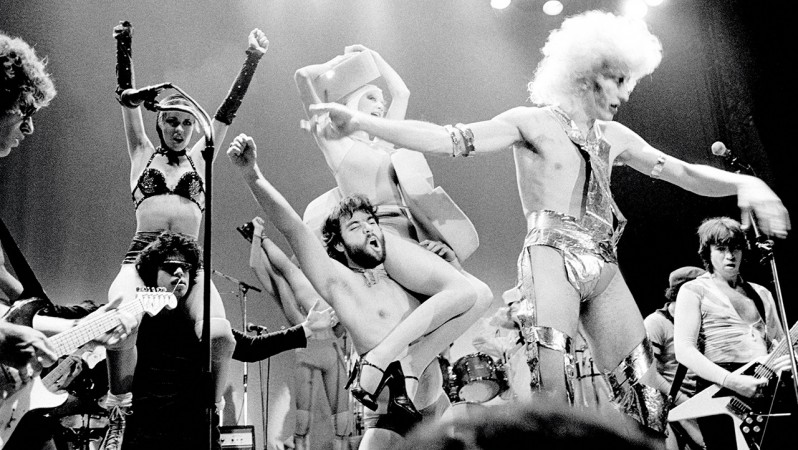
I was in law school when The Tubes' first album (The Tubes) came out in 1975.  That fall, as part of their "Ad Hoc Rock" tour, they came to Cambridge to play two nights at the small Harvard Square theatre (seating capacity: 383) that was home to the famous Hasty Pudding Theatricals.


The Tubes' eponymous debut album cover
I'm not sure how I heard about the Tubes – maybe I read about them in the local free alternative newspaper, the Boston Phoenix, or maybe Charles Laquidara played their music on WBCN. In any event, I bought a ticket to the first show.

It was the second-best rock concert I ever attended. The best concert I ever attended was the following night, when I went back and saw the show again – but this time, from backstage.

How did I pull that off? Glad you asked. Pull up a chair and I'll tell you all about it.


*     *     *     *     *

The day after seeing the Tubes for the first time, I was wandering through the record department of the Harvard Cooperative Society (a/k/a/ "the Coop") and saw a backstage pass for the previous night's concert stuck to a Tubes album cover. As I recall, it was blue and there was a date handwritten in a blank space on the pass – the date of the previous night's show (October 3, 1975, to be precise). 


The Tubes (circa 1975)
I figured I had nothing to lose, so I peeled the pass off the record's cover, stuck it on my shirt, and presented myself at the theatre that night. Apparently no one on duty knew what day it was, so I was politely escorted to the backstage area and left alone. (Apparently, they were all color-blind as well, because the passes for October 4 show that everyone else backstage was wearing were yellow.)

So I watched the show from backstage. That is, when I wasn't gawping at the female dancers who performed with the Tubes as they changed costumes, which was most of time.


*     *     *     *     *

I was online a couple of nights ago, trying to track down any details about the concert I could find. Lo and behold, I hit the mother lode – a site called
"The Tubes Project", which includes large chunks of video from the Tubes' early concert tours, as well as copies of reviews and news stories about the band. The site even had information about a planned documentary movie about the Tubes – here's a link to the trailer for that documentary.

[NOTE: as of 2019, "The Tubes Project" website had disappeared.  I'm guessing the planned documentary is kaput, which is a real shame.]

Amazingly, the site had three reviews of the band's performances in Cambridge that I attended – one from the Boston Globe, one from Newsweek, and one from Rolling Stone.

From
the Boston Globe review:

[F]rom the moment lead singer Fee Waybill strutted on stage in a white tux for a put-down [of] overconsumption entitled "What Do You Want From Life," the Tubes were manic surgeons cutting on the flesh of pop America's soul. Part theater and part music, they unleashed a witty and satiric 90-minute barrage of 15 tunes that were impressively tight but seldom crossed the line into slickness.


From the Newsweek piece:

If
Mad Magazine's Alfred E. Neuman became a rock star he would probably slip into a silver-lame jumpsuit, put on a pair of 18-inch platform shoes and swish on to the stage like a stoned-out lead singer named Quay Lewd. Quay is actually a refreshingly perverse character created by the Tubes, a rock theater spectacle currently on its first national tour . . . .

"What do you want from life?" the band sang recently from the stage of Harvard's venerable Hasty Pudding Club as TV monitors flashed shots of washer-driers and microwave ovens and two hideously smiling boob-tube hostesses buried a "contestant" in boxes of Tide. The 23-member group . . . also whipped through "Mondo Bondage," a vamp of black leather, skin and silver studs, and brought down the house when Quay sang "White Punks on Dope." 

"It's not Jonathan Swift," one Harvard spectator punned, "but it's not slow."

A Tubes concert poster
Finally, an excerpt from the Rolling Stone review that took (and still takes) the words right out of my mouth:

The Tubes' antic amorality is not only very funny but so intimately attractive that we end up wishing the party would never end. The circus atmosphere naturally extends to the audience, because the Tubes' fantasies are our fantasies as well. . . . [I]t is impossible for the observer not to revel, to some extent, in such gloriously insane nihilism. When I grow up I want to run away and join the Tubes.

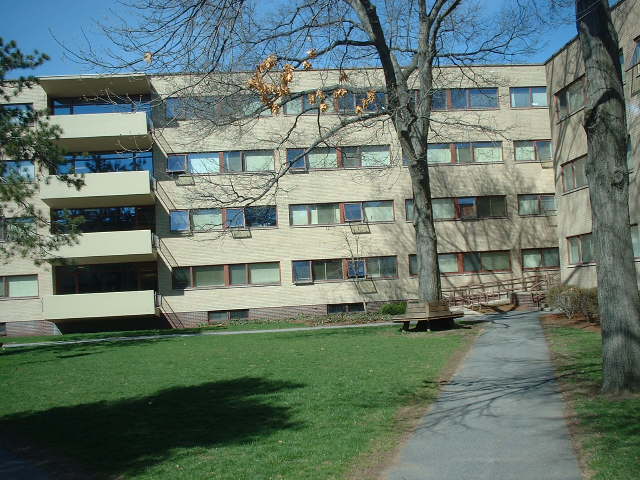
And that reviewer had a sweet gig at Rolling Stone. By contrast, I was just a poor second-year law student -- sentenced to live in a tiny room in one of the concrete-block Gropius dorms at Harvard Law School and suffer through a nasty Massachusetts winter. If he wanted to run away and join the Tubes, just imagine how much more badly I wanted to run away and join the Tubes. (Plus I had an additional reason for wanting to do so – I had seen the Tubes' dancers in a charmingly dishabille condition while observing from backstage.)


*     *     *     *     *

"White Punks on Dope" may have been the band's signature song – they closed their shows on this tour with it – but "What Do You Want From Life?" (which was the band's opening song) was their real tour de force.

The first half of that song was a series of possible answers to the question asked in the song's title, which ranged from bizarre to pathetic:

What do you want from life?
To kidnap an heiress and threaten her with a knife?
What do you want from life?
To get cable TV and watch it every night?

Some were more short-term in nature:

What do you want from life?
A meaningless love affair with that girl that you met tonight?

The last stanza suddenly turns serious, and perhaps comes a little too close to the truth for comfort:

What do want from life
Someone to love and somebody you can trust?
What do you want from life?
To try and be happy while you do the nasty things you must?

The second half of the song shifts gears suddenly. Lead singer Fee Waybill informs you that you can't have any of those things, but as an American citizen you are entitled to a number of other items. 

The Tubes performing "What
Do You Want From Life?"
He declaims a list of said items in the manner of Johnny Olson or some other TV game-show announcer racing through the list of prizes that the lucky winner will be taking home that day. His reading becomes more and more frantic as he pours on the crescendo and the accelerando -- so much accelerando, in fact, that you miss about half the jokes. (Of course, since about half the jokes miss being funny, it's no big loss.)

The items on the list include:

A foolproof plan and an airtight alibi

(Think about it.)

A year's supply of antibiotics.

(This was 1975, remember, and people weren't quite as hygienic in those days.)
A personally autographed picture of Randy Mantooth

(Mantooth played a paramedic on the long-running NBC television series, "Emergency!" I suppose you could say the show was the 1975 equivalent of "E.R." -- but Mantooth never enjoyed the success of George Clooney.)

A Las Vegas wedding, a Mexican divorce

(Might as well be prepared.)

A baby's arm holding an apple

(I already have one of those, of course.)

The highlight of this part of the song for me is when the announcer reads a long series of names of cars -- most real, a couple made up (like "Mort Moriarty," which isn't a car at all but the name of the Tubes' manager):

A new Matador, a new Mastodon, a Maverick, a Mustang, a Montego, a Merc Montclair, a Mark IV, a Meteor, a Mercedes, an MG, or a Malibu, a Mort Moriarty, a Maserati, a Mack truck, a Mazda, a new Monza!

Click here to see a video of the Tubes performing the song in San Francisco just a few weeks before I saw them. 

The second side of The Tubes features three other Tubes classics that were highlights of the live show. First, there's "Mondo Bondage" – the live performance featured Fee Waybill and lead dancer Re Styles doing a leather-clad pas de deux – which includes one of the great rhyming couplets in rock history:

I could run off the Jamaica
If this bondage I could breaka

Next comes "What Do You Want From Life?" – which is followed by "Boy Crazy," a song about a girl who grew up just a little too fast:

Petting heavy didn't bother you
Your eighth grade teacher showed you what to do
Failed your English and Biology
But you learned the facts of life from A to Z


But the final song of the album is the song the Tubes are best remembered for today – the band's signature and most tongue-in-cheek song, "White Punks on Dope."

Other dudes are living in the ghetto
But born in Pacific Heights don't seem much betto
We're white punks on dope
Mom and dad moved to Hollywood
Hang myself when I get enough rope
Can't clean up, though I know I should


My life intersected these songs unexpectedly in the summer of 1978, after I had graduated from law school and had started working for the federal government in Washington, DC. That summer, a group of my friends and I went to half a dozen or show midnight showings of the Rocky Horror Picture Show at the long-gone Key Theatre in Georgetown. (That's a story for another post.)


Fee Waybill performing
"White Punks on Dope"
People showed up early to get good seats, and the theatre was usually filled at least half an hour before the movie started. To entertain the crowd, the Key's management would play the second side of The Tubes – with "White Punks on Dope" leading right into the movie. nbsp;

Click here to view a high-quality video of a live London performance of "White Punks on Dope" (with "born in Beverly Hills" substituted for "born in Pacific Heights").

Finally, click here to watch a video of German singer Nina Hagen performing her version, the lyrics of which are entirely different – "White Punks on Dope" has become "I Gawk at the TV."

*     *     *     *     *

Click here to listen to today's featured song, "What Do You Want From Life?"

And click on the link below if you want to buy "What Do You Want From Life" from Amazon: