Tuesday, August 16, 2022

Bob Dylan – "Subterranean Homesick Blues" (1965)


Twenty years of schooling

And they put you on the day shift


[Strictly speaking, this record is not eligible for the 2 OR 3 LINES "GOLDEN DECADE" ALBUM TRACKS HALL OF FAME.  Membership in that hall of fame is limited to records that were not hit singles.  “Subterranean Homesick Blues” was technically a top-40 record because it was listed at #39 on the Billboard “Hot 100” for exactly one week.  That’s hardly what anyone would consider to be a hit single, of course – and since it clearly doesn’t belong in the 2 OR 3 LINES “GOLDEN DECADE” HIT SINGLES HALL OF FAME, I’m including it in the album tracks hall of fame instead.  It’s just too good a song to disqualify on the basis of a technicality.  What follows is an edited version of my original October 5, 2021, post about “Subterranean Homesick Blues,” which includes Bob Dylan’s most often quoted lines” “You don’t need a weatherman/To know which way the wind blows.”]


*     *     *     *     *


“Like a Rolling Stone” is the best record Bob Dylan ever recorded – it’s arguably the best record made in the sixties – but “Subterranean Homesick Blues” has the best lyrics Dylan ever wrote.  


That’s saying something, because Dylan won the Nobel Prize for Literature for his song lyrics.  That was a ridiculous decision, of course – song lyrics need to be sung along with their accompanying music, not put on a printed page and read like poetry – but there’s no doubt Dylan wrote some amazing lyrics.


Of course, Dylan’s lyrics would have been even better if he had run them by me before finalizing them – they could have used a bit of editing.


*     *     *     *     *


To wit: consider these lines from “Stuck Inside of Mobile with the Memphis Blues Again,” which are spoken to the singer of the song by a shady young woman named “Ruthie”:


Your debutante knows what you need

But I know what you want


Dylan is clearly saying that Ruthie is offering the singer something more satisfying than his prissy little debutante girlfriend if offering.


(Not the same Ruthie.)

But instead of saying that the debutante know what he needs while Ruthie knows what he wants, shouldn’t it be the other way around?  


I’m guessing that the debutante may know what the singer wants – or at least what he thinks he wants, and has told her he wants – but she can’t provide what he really needs deep down inside.  After all, he may not know himself what he really needs.


Ruthie can fulfill his needs because she has a much deeper understanding of him than he has of himself – and a much deeper understanding of him than the debutante.


So shouldn’t the line read as follows?


Your debutante knows what you want

But I know what you need


*     *     *     *     *


Today’s featured song contains another example of a Dylan lyric gone awry.


Think about the lines quoted at the beginning of this post:


Twenty years of schooling

And they put you on the day shift 


Dylan is making the point that the world is F.U.B.A.R. – after all, it makes no sense for someone to be sent to school for twenty years and then given a factory job.


But Dylan should have used night shift in those lyrics – not day shift.  


The day shift is almost always preferable to the night shift.  Working the night shift will play havoc with your body clock, making it difficult for to sleep well.  And it will likely also play havoc with your relationships because most people work during the day, not at night.


It’s bad enough to go to school for twenty years and end up working the day shift at a factory, but it adds insult to injury to end up working the night shift – that’s a real kick in the pants, especially for someone with that much edumacation.


*     *     *     *     *


I think Bob Dylan’s a little overrated – he did write a lot of bad songs, after all – but the genius of “Subterranean Homesick Blues” can’t be denied.  The lyrics are insane in the membrane, and I love the irregularity of the lines – the record’s herky-jerky line structure is something that differentiates it from every other record of that era.


Click here to listen to “Subterranean Homesick Blues,” which was released in 1965 on Bringing It All Back Home, Dylan’s fifth studio album.


Click below to buy the record from Amazon:


Friday, August 12, 2022

Led Zeppelin – "Good Times Bad Times" (1969)


Good times, bad times

You know I’ve had my share


I’m pretty sure the New York Yankees were in a foul mood when they flew out of St. Louis last Sunday after dropping three close games to the Cardinals.


I’m absolutely sure that I was in just as foul a mood after watching those games.


*     *     *     *     *


In 1978, Bucky Dent – a woeful hitter who was batting ninth that day – shocked the world by hitting a three-run home run that gave the Yankees the lead in their one-game playoff with the Boston Red Sox after both teams had finished the regular season tied for first place in the American League’s Eastern Division.


The Yankees held on to that lead, completing their unprecedented comeback from what was once a 14-game deficit.  Ever since, the fans of the choking-dog Red Sox have referred to the Yankee hero as “Bucky F*cking Dent.”


Last Sunday I witnessed a shocking home run by a major-league shortstop whose hitting was even more pitiful than Dent’s.  


Paul F*cking DeJong striking out 

That home run – by the man I will hereinafter think of as “Paul F*cking DeJong” – was the absolute nadir of my trip to St. Louis last weekend to see the Yankees-Cardinals series.  It may have been the absolute nadir of my entire life. 


*     *     *     *     *


The Yankees and Cardinals played three games last weekend.   The Friday and Saturday games were pretty bad.  But Sunday’s game was absolutely horrific.


I’m prone to hyperbole in my 2 or 3 lines posts – to put in another way, I lie a lot – but “absolutely horrific” is no exaggeration.


For one thing, there was the weather.  I checked the temperature about an hour after the game began, and it was 95 degrees – but thanks to the humidity and lack of a breeze, my weather app said that it felt like a mind-boggling 108 degrees.:


I was sitting a few rows behind the first-base dugout, which meant that I was completely exposed to the sun for most of the game.  By the 3rd inning, every single square inch of my shorts and shirt was wet with perspiration – you would have thought I had gotten caught in a sudden summer shower sans umbrella if you had seen me.


*     *     *     *     *


Every one of the three Yankees-Cardinals confrontations last weekend was a sellout – the attendance figures for each game easily exceeded the stadium’s official seating capacity.


In fact, the Saturday night game broke the stadium’s all-time attendance mark.  The new Busch Stadium opened in 2006, and has hosted an All-Star Game and several dozen postseason games – including ten World Series games – but last Saturday night’s contest attracted more fans than any of those games.  (Such is the magnetic attraction exerted by the greatest professional sports franchise the world has ever seen.)


The Sunday game drew almost as many spectators, which ensured that there would be l-o-n-g lines at the concession stands and bathrooms – and also guaranteed that there would be no vacant seats next to you.  


Sure enough, my section was stuffed with people – most of whom were not only sweaty and smelly, but also packed enough extra pounds that I had even less elbow room than I had had on my sold-out Southwest Airlines flight from Washington, DC to St. Louis last Friday.


*     *     *     *     *


Other than Paul F*cking DeJong’s home run and the beastly weather conditions, the worst thing about the Sunday game was that it lasted four hours and 25 minutes – making it the longest nine-inning MLB game of the 1600-plus contests played so far this year.   


If the Yankees had won, I wouldn't be complaining about the heat and the interminable length of the contest.  Hell, if the Bombers had fallen behind by a sufficiently large margin that I could have abandoned the game early without worrying about missing something, I would have been OK.


But my boys hung close throughout the excruciatingly tedious game, never falling behind by more than a run or two until the very end, when DeJong broke open the game with a three-run roundtripper in the bottom of the 8th.


I suppose I should be grateful to him.  In the top of the 9th inning, Yankee leadoff hitter D. J. LeMahieu knocked one out of the park.  If DeJong had not homered, LeMahieu’s blast would have tied the game, and we would likely have been subjected to an hour or two of extra-inning torture.


*     *     *     *     *


Serious baseball fans will know that Paul F*cking DeJong has been the Cardinals’ primary shortstop since 2017.


He was an above-average hitter in 2017 and 2018, an average hitter in 2019, and a below-average hitter in 2020 and 2021.  


But DeJong really stunk up the joint this season.  His batting average as of May 8 was .130, which I’m guessing was the worst batting average of any everyday player in either league.  Not surprisingly, the Cardinals exiled him to their Memphis minor-league team at that point, and kept him there for most of May, June, and July.  


Paul F*cking DeJong striking out again

He was only 3-for-16 with seven strikeouts in his first week back with the Redbirds.  But then the Yankees – who had the best record in baseball at the time – came to St. Louis.  Suddenly Paul F*cking DeJong became Babe F*cking Ruth.


I was at the first game of the Yankees-Cardinals series last Friday.  After striking out in his first two at-bats, DeJong came to the plate in the 8th inning to face the Yankees previously unhittable All-Star closer, Clay Holmes, with two outs and two men on base and the New Yorkers clinging to a 3-2 lead.  


DeJong swung late on the first pitch he saw from Holmes, slicing a seeing-eye liner to right field that landed barely fair.  Suddenly, the Cardinals led 4-3 – which was how the game ended.


That double raised DeJong’s batting average from .137 to a gaudy .146.  He went 0-for-3 on Saturday, but on Sunday, he walked twice and hit a double before crushing the three-run home run in the penultimate inning and turning a 9-8 nail biter into a 12-8 laugher.


If I had had a fifth of gin and a bottle of Ambien handy, I might have shuffled myself off this mortal coil for once and for all at that point.  Fortunately for all you fans of 2 or 3 lines – who wouldn’t know what to do without my wildly popular little blog – I didn’t have access to said gin and Ambien.


*     *     *     *     *


The extraordinarily slow pace of the Sunday game was largely due to the fact that no fewer than 11 pitchers pitched in it – most of them entering in the middle of an inning, which necessitated leisurely mound conferences, long saunters in from the bullpen, and lots of warmup pitches.


Those 11 pitchers threw a mind-boggling total of 380 pitches — of which 144 were balls.  (Watch the box scores for the next few weeks, and let me know when you see a nine-inning  game with 144 or more balls.  I have a feeling I won’t be hearing from you.)


The Cardinals’ starting pitcher, a wily (and whiny) veteran named Adam Wainwright, lasted only four innings.  He threw 111 pitches in those four innings – enough pitches to get a really good pitcher through an entire game – and yielded eight hits, four walks, and six runs.  It was a terrible performance . . . but the Yankees starter was even worse. 


*     *     *     *     *


The Yankees outhit their opponents 16 to 11 on Sunday, but left 12 men on.  Despite their inefficiency with runners on base, they might still have won if not for the home plate umpire, who had no clue what was a ball and what was a strike.  


Click here to read an article from USA Today that says that the umpire missed 20 calls in the first six innings alone – the worst of which was calling a ball that was over four inches off the plate a strike.  (If he had called it what it was – a ball – it would have resulted in a bases-loaded walk instead of a strikeout.  So it clearly cost the Yankees at least one run, and might have cost them more.)


According to UmpScorecards.com, that umpire’s inaccuracy cost the Yankees 3.01 runs – and the Cardinals won by three.  Imagine that . . .


*     *     *     *     *


Getting swept by the Cardinals was particularly upsetting because they aren’t a very good team.


Sure, they will likely make it to the playoffs this year – largely because they play in the weakest division in baseball.  (Three of the four other teams in their division – the Pirates, Reds, and Cubs – are the 2nd, 3rd, and 4th worst teams in the entire National League.  Each is 20 games or more below .500.)


The Cardinals have two outstanding hitters, Nolan Arenado and Paul Goldschmidt.  And their rookie DH, Brendan Donovan, is pretty good at getting on base – although he has no power at all.  (He’s hit only two homers in 81 games.)


But the rest of their hitters range from pretty bad to absolutely terrible.  The batting averages of the remaining players in the Sunday lineup were .256, .244, .230, .225, .208, and .157 – and none of them had more than seven home runs.  (Yankees slugger Aaron Judge had twice as many home runs single-handedly as those six players plus Donovan had combined.)


Aaron Judge is a very large man

“If the Yankees are so good and the Cardinals are so bad, how did the Cardinals sweep the series?” you ask.


Baseball teams are usually quite streaky – they get hot for a while, and then they go cold.  


A wise man once pointed out that a team is never as good as it looks during a winning streak, and never as bad as it looks during a losing streak.  The Yankees weren’t as good as they looked in the first half of the year, when they were winning at a pace that would have broken records if they had been able to maintain it for a full season.  And they’re not as bad as they looked over the past two weeks – including last weekend’s series in St. Louis.


It didn’t help that the Yankee lineup was missing two of their most dangerous batsmen, Giancarlo Stanton and Anthony Rizzo, who had combined for 51 homers and 127 RBIs so far this season.  But even without those two bats, the New York hitters were actually superior to their opponents – the sweep was more the result of bad luck than underperformance.  (The Yankees outhit the Cardinals 28 to 21 over the weekend.)


*     *     *     *     *


Enough whining about the games.  Let me shift gears and talk about the non-baseball aspects of my St. Louis trip for a bit.


I’ve never flown anywhere just to watch a baseball game before, and I wouldn’t have flown to St. Louis just to see the Yankees take on the Cardinals.  


But when my sister (who is a huge Cardinals fan) and I were together in June for my late mother’s memorial service, she mentioned that the Yankees were coming to St. Louis to play the Redbirds.  


That doesn’t happen often.  (Because the two teams play in different leagues, the Yankees come to St. Louis only once every six years.)  So I said – less than half seriously – that maybe we should meet in St. Louis for the weekend and see the games together.  She thought that was a great idea. 


I’m fortunate to have the time and the means to make a trip like this, but it’s not the kind of thing I usually do – I’m not really a spur-of-the-moment kind of guy.


Also, there have been a lot of horror stories about flight delays and cancellations recently.  It would have been awful if we had bought tickets to these games – which weren’t cheap – and then not be able to attend all of them because one of our flights got delayed or cancelled.


I was still on the fence a couple of weeks before the games were scheduled to be played.  But my two best high-school friends, who I hadn’t seen in years, both live in St. Louis.  I called them, and both were amenable to a get-together if I did decide to make the trip.  


I made plane reservations the next day.


*     *     *     *     *


One of my friends invited all of us to come to his home Saturday afternoon for lunch.  I figured we’d have time for a nice visit before my sister and I had to leave for the Saturday night game.  (We didn’t purchase tickets to that game in advance, figuring we could either get them online at the last minute, or just watch the game on the oversize TV monitors at Ballpark Village, a large outdoor restaurant and entertainment complex adjacent to the stadium.)


We ended up hanging around with my friends so long that we almost missed the game entirely.  We made it to a nearby sports bar just in time to watch the last couple of innings.  (The Yankees lost 1-0, so we hadn’t missed much.)


Paul F*cking DeJong striking out yet again

Why didn't we leave earlier as we had planned?  This will sound odd, but it was almost as if there was some force field preventing us from leaving my friend’s house that evening.  Even after we finally got up from his dining-room table and headed outside to our cars, we all ended up standing around in the driveway and talking for another half an hour or longer.


I often have trouble ending a conversation.  I sometimes keep one going single-handedly – or, more accurately, single-mouthedly.  


But it wasn’t just me doing the talking that evening – my friends also seemed reluctant for the gathering to end.  We kept dredging up names from our high school days, and retelling stories we had told each other multiple times in the past.


I have a lot of friends from high school, from law school, from my various jobs, and from other contexts that I have neglected to keep in regular touch with.  When I do finally get together with these people, it’s always a delight.  So why do I repeatedly let five years, or ten years, or even longer pass before belatedly making contact, and then try to catch up for years of lost time in the course of a single lunch or dinner?


It's partly because I’m a creature of inertia.  I follow my daily routine – which is mostly a solitary one – and all too rarely remember to yank myself out of my rut by the scruff of my neck.


*     *     *     *     *


What’s true of friends is truer of family, of course.


My sister (and only sibling) is seven years younger, so she was just a kid when I left home to go to college.  Since then, we’ve never lived in the same city – currently I live in the Washington, DC area, while her home is in Texas.


Our visits over the years were mostly limited to a few days around Christmas, trips to one-off events (like weddings), or brief get-togethers at our parents’ home.  Now that both of our parents have died, we need to work a little harder to make time to see each other. 


When I drove my sister to the St. Louis airport after that horrible Sunday game for her flight back to Texas, I was half-thinking to myself that I wished I had just stayed home rather than spending all that time and money just to watch my team lose three ugly games.


But then my sister told me how much she had enjoyed our weekend.  “How long has it been since you and I have done something together – just the two of us?” she asked.


I was touched by that – as I was touched by how complimentary she was of me as a big brother when we were talking with my friends.


*     *     *     *     *


On the drive back to my hotel after dropping her off for her flight, I realized that the outcome of the games really didn’t matter – what counted was spending time with two of my oldest and closest friends and my only sibling.


I really had no business being in a foul mood that Sunday evening.  My sister saw the big picture much more clearly – she had the right attitude.


Of course, it's easy to have the right attitude when your team hadn’t just lost three games to PAUL F*CKING DEJONG.


*     *     *     *     *


I may live to regret some of my selections for the 2 OR 3 LINES “GOLDEN DECADE” HALLS OF FAME, but I will never regret choosing “Good Times Bad Times.”  (Or “MacArthur Park.”)


Led Zeppelin couldn’t have picked a better song as the first track of their first album – everything about it is perfect.  As I said when I wrote about it a year ago,


I can’t imagine how “Good Times Bad Times” could have been improved – Robert Plant’s vocals are great, John Paul Jones’s bass guitar is great, Jimmy Page’s lead guitar (which was fed through a Leslie speaker) is great, and John Bonham’s drumming is especially great.  


Click here to listen to “Good Times Bad Times.”


Click on the link below to buy the song from Amazon:


Tuesday, August 9, 2022

Pink Floyd – "Great Gig in the Sky" (1973)


Now that I’ve announced the 2022 inductees into the 2 OR 3 LINES “GOLDEN DECADE” HIT SINGLES HALL OF FAME, it’s time to present the 2022 inductees into the 2 OR 3 LINES “GOLDEN DECADE” ALBUM TRACKS HALL OF FAME.


But before I do that, I need to take care of one bit of unfinished business that concerns the 2021 class of that hall of fame.


*     *     *     *     *


Did none of you notice that the 2021 class of the 2 OR 3 LINES “GOLDEN DECADE” ALBUM TRACKS HALL OF FAME had only nine members – not the usual ten?


That’s because I was on vacation when my post about the tenth new inductee was scheduled for publication.  


But things have a way of slipping between the cracks when I’m not around to ride herd over the motley crew of scatter-brained millennials who work [sic] at 2 OR 3 LINES World Headquarters.


There’s an old saying that I think applies to what goes on when I’m out of the office:


*     *     *     *     *


“When the cat’s away, the mice will play” is a rather trite expression.  You’ve probably heard it a thousand times.


But the reason that saying is used so often is that it frequently hits the nail very squarely on the head.  That’s why “When the cat’s away, the mice will play” is a universal expression used the world ’round.


Ever wonder who first said “When the cat’s away, the mice will play”?


From the Grammarist website:


The expression when the cat’s away the mice will play is derived from a Latin phrase, “Dum felis dormit, mus gaudet et exsi litantro.”  A literal translation is “When the cat sleeps, the mouse leaves its hole, rejoicing.” This medieval Latin phrase gave rise to similar expressions in many different languages. 


For instance, the Russian translation is “Без кота мышам раздолье,” which literally means “Without a cat, there is freedom for mice.” The German translation is “Wenn die Katze aus dem Haus ist, tanzen die Mäuse auf dem Tisch,” which when literally translated means “When the cat is out of the house, then the mice dance upon the table.” 


The Spanish translation may be either “Cuando el gato no está los ratones hacen fiesta,” which one may translate as “When the cat is not here, the mice have a party,” or “Cuando el gato no está, los ratones bailan,” which means “When the cat is not here, the mice dance.” 


*     *     *     *     *


The album track that was supposed to be the tenth and final member of the 2021 class of the 2 OR 3 LINES “GOLDEN DECADE” ALBUM TRACKS HALL OF FAME was Pink Floyd’s “Great Gig in the Sky,” which was released in 1973 on the legendary The Dark Side of the Moon LP.


What follows is a lightly edited version of my original February 10, 2014 post about “Great Gig in the Sky” – which is currently the only instrumental album track to be honored with induction into my wildly popular hall of fame:


*     *     *     *     *


How can a record that has a singer be an instrumental?  

I'll tell you, boys and girls -- just hold your horses for a moment.

Michael Jackson's Thriller is usually considered to be the biggest-selling album of all time, but Pink Floyd's The Dark Side of the Moon isn't far behind.  It appeared on Billboard's top albums chart shortly after it was released in 1973, and stayed there for an astonishing 741 consecutive weeks -- that's over 14 years.  


If you were in high school or college in 1973 and you didn't buy this album, either you had a boyfriend or girlfriend who did own it or there was something seriously weird about you.

The Dark Side of the Moon was not only enormously popular among fans but also highly admired and respected by musicians.  I've met quite a few really talented professional musicians in the course of doing 2 or 3 lines over the past four-plus years, and I've never heard one of them say anything negative about this record.

Richard Wright
"Great Gig in the Sky" started out as a chord progression composed by Pink Floyd keyboard player Richard Wright.  When the group decided to record it, they tried adding various spoken word samples – for example, snippets of recordings of NASA astronauts speaking during space missions – but they weren't happy with the results.

Finally, just as they were finishing up work on the album, the band decided to have a female singer improvise a vocal to accompany the instrumental track.  The album's engineer, Alan Parsons, suggested they hire Clare Torry, a 25-year-old backup singer.

Here's the rest of the story, told in the form of quotes from those involved that appeared in a 2003 Rolling Stone piece celebrating the album's 30th anniversary:

Roger Waters
Roger Waters (Pink Floyd singer/songwriter and co-founder):  ["Great Gig in the Sky"] was something that Rick [Richard Wright] had already written.  It's a great chord sequence. . . . I've no idea whose idea it was to have someone wailing on it.  Clare [Torry] came into the studio one day, and we said, "There's no lyrics. It's about dying – have a bit of a sing on that, girl."

Alan Parsons
Alan Parsons:   [Clare Torry] had done a covers album; I can remember that she did a version of "Light My Fire."  I just thought she had a great voice.  When the situation came up, they started head-scratching, saying, "Who are we going to get to sing on this?"  I said, "I've got an idea – I know this girl."  She came, and in a couple of hours it was all done.  She had to be told not to sing any words: when she first started, she was doing "Oh yeah baby" and all that kind of stuff, so she had to be restrained on that.  But there was no real direction – she just had to feel it.

David Gilmour
David Gilmour (Pink Floyd guitarist):  Clare Torry didn't really look the part.  She was Alan Parsons's idea.  We wanted to put a girl on there, screaming orgasmically.  Alan had worked with her previously, so we gave her try.  And she was fantastic.  We had to encourage her a little bit.  We gave her some dynamic hints: "Maybe you'd like to do this piece quietly, and this piece louder."  She did maybe half a dozen takes, and then afterwards we compiled the final performance out of all the bits.  It wasn't done in one single take.

Clare Torry
Clare Torry:  I went in, put the headphones on, and started going "Ooh-aah, baby, baby – yeah, yeah, yeah." They said, "No, no — we don't want that. . . . Try some longer notes," so I started doing that a bit.  And all this time, I was getting more familiar with the backing track.  That was when I thought, "Maybe I should just pretend I'm an instrument."  So I said, "Start the track again."  One of my most enduring memories is that there was a lovely [headphone] balance.  Alan Parsons got a lovely sound on my voice: echoey, but not too echoey.  When I closed my eyes — which I always did — it was just all-enveloping; a lovely vocal sound, which for a singer, is always inspirational.

So that's why "Great Gig in the Sky" – which is dominated by a singer – is an instrumental. 

By the way, Clare Torry was paid only 3o pounds for her performance – which was the flat daily rate for a studio musician.  In 2004, she sued Pink Floyd and its record company, claiming that she was really the co-writer of the track and should receive songwriting royalties.  The case was settled out of court, and all CDs manufactured after the date of the settlement give writing credits to both Wright and Torry.

*     *     *     *     *

Click here to listen to "Great Gig in the Sky," the tenth and final member of the 2 OR 3 LINES "GOLDEN DECADE" ALBUM TRACKS HALL OF FAME.  (Better late than never, right?)

Click below to buy the song from Amazon:

Friday, August 5, 2022

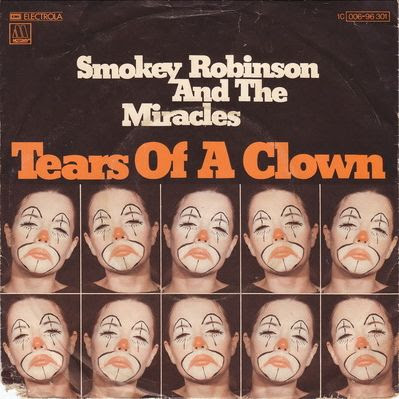
Smokey Robinson & the Miracles – "Tears of a Clown" (1970)


Just like Pagliacci did

I try to keep my sadness hid


I’m aware of three well-known popular songs that make reference to the famous Leoncavallo opera, Pagliacci. 


The first is “The Masquerade is Over,” an Allie Wrubel-Herb Magidson collaboration that was first recorded in 1939:


I guess I’ll have to play Pagliacci

And get myself a clown’s disguise

And learn to laugh like Pagliacci

With tears in my eyes


The song was covered by everyone from Sarah Vaughan to Patti Page to Marvin Gaye to Stevie Wonder to Peggy Lee to José Feliciano to Aretha Franklin to . . . well, you get the picture.  Click here to listen to Sarah Vaughan’s 1956 recording.


Enrico Caruso in Pagliacci

“Mister Sandman” – a #1 hit for the Chordettes in 1954 – includes these lines:


Mister Sandman, bring us a dream

Give him a pair of eyes with a come-hither gleam

Give him a lonely heart like Pagliacci

And lots of wavy hair like Liberace


Click here to listen to the Chordettes’ version of “Mister Sandman.”


Today’s featured song – “Tears of a Clown” – also makes reference to “Pagliacci” in the lines quoted at the beginning of this post.  


*     *     *     *     *


Pagliacci – which was a big hit when it was first performed 1892, and remains very popular among contemporary opera fans – has a “play within a play” structure (like Shakespeare’s A Midsummer Night’s Dream and Chekhov’s The Seagull).


The opera is about a troupe of traveling actors who are putting on a play in which a character named Pagliaccio learns the identity of his adulterous wife’s lover and stabs both of them.  We have a case of life imitating art here: the actor who portrays Pagliaccio is actually married to the actress playing his wife, who is having a real-life affair with the actor who has the role of her lover in the play.  


When Pagliaccio stabs his wife and her lover in the play, he’s not just acting – he really stabs his wife and her lover, killing both of them.


That must have come as quite a surprise to the audience.


*     *     *     *     *


Did you notice that the character’s name is “Pagliaccio” – not “Pagliacci”?  All three of the songs discussed above mistakenly use “Pagliacci” when they really meant “Pagliaccio.” 


“Pagliacci” – which is the title of the opera – is the plural form of the Italian word for “clown.”  “Pagliaccio” – the name of the character who murders his wife and her lover – is the singular form of that word.  


It’s not unusual for even a major character in a play not to be identified by his given name.  For example, Our Town has the “Stage Manager,” and Cabaret has “The Master of Ceremonies” – famously portrayed by Joel Grey in the 1972 movie.  


There’s good reason to identify the main character in Pagliacci simply as “The Clown” because that is his role in the play with the play (or the play within the opera.)


*     *     *     *     *


“Tears of a Clown” – the final member of this year’s group of inductees into the 2 OR 3 LINES “GOLDEN DECADE” HIT SINGLES HALL OF FAME – was originally released on the 1967 Smokey Robinson and the Miracles album, Make It Happen.  


Three years later, some genius decided to release it as single in the UK, where it promptly went to #1.


When it was subsequently released as a single in the U.S., it went to #1 just as promptly.  (Better late than never.)


Click here to listen to “Tears of a Clown,” which is yet another note-perfect Motown production. 


Click on the link below to buy the record from Amazon:


Tuesday, August 2, 2022

Norman Greenbaum – "Spirit in the Sky" (1969)


Never been a sinner

I never sinned


In 2011, the readers of Rolling Stone magazine were asked to vote for their favorite one-hit wonders of all time.  “Spirit in the Sky” was voted #3.


Today, that record joins several other memorable one-hit wonders (e.g., “96 Tears” and “Na Na Hey Hey Kiss Him Goodbye”) in the 2 OR 3 LINES “GOLDEN DECADE’ HIT SINGLES HALL OF FAME.


*     *     *     *     *


Norman Greenbaum’s greatest claim to fame prior to “Spirit in the Sky” was “The Eggplant That Ate Chicago,” a 1967 novelty record released by a Greenbaum-led psychedelic group named Dr. West’s Medicine Show and Junk Band.


Norman Greenbaum in 1969

Greenbaum was inspired to write “Spirit in the Sky” after seeing the flamboyant country singer Porter Wagoner perform a gospel song on television:


I thought, “Yeah, I could do that,” knowing nothing about gospel music, so I sat down and wrote my own gospel song.  It came easy.  I wrote the words in 15 minutes.


I always assumed that Greenbaum was a “Jews for Jesus” type who had written today’s featured song after converting to Christianity, but he remains an observant Jew.  


*     *     *     *     *


Greenbaum submitted a simple, acoustic-guitar-accompanied demo of the song to his record company.  But producer Erik Jacobsen had a radically different vision of the record, juicing up the very simple song with heavily-distorted electric guitar, lots of drums, and a local female gospel trio as backup singers.


The result was a #3 hit single that remained in the Billboard “Hot 100” for 15 weeks, and sold two million copies.


It’s been covered frequently, and is featured in a number of movie soundtracks.


*     *     *     *     * 


Nothing about “Spirit in the Sky” sounds like any other single from the “golden decade” era.  Hit songs rarely have a religious theme, and I can’t think of another record with a more distinctive arrangement.  It sounded great when it was released 50-odd years ago, and it sounds just as good today.    


Norman Greenbaum in 2020

A few years ago, Greenbaum – who has lived off “Spirit in the Sky” royalties for decades – told a interviewer that he has heard from funeral directors who have said that only “Danny Boy” is requested more often by people arranging funeral services.  


I find that a little hard to believe, but what do I know?


*     *     *     *     *


Click here to listen to “Spirit in the Sky.”


Click on the link below to buy the record from Amazon: