Sunday, June 11, 2017

Cyrkle – "Red Rubber Ball" (1966)


The roller-coaster ride we took is nearly at an end
I bought my ticket with my tears
That's all I'm gonna spend

Imagine you’re standing on a subway platform, thinking about nothing in particular as you wait for your train to arrive.

Suddenly you notice that someone who is standing ten yards down the platform looks exactly like you.

Before you can react, she steps off the platform directly into the path of the oncoming train and is squashed flatter than Wile Coyote after an encounter with an ACME asphalt roller.

That’s how Orphan Black –a Canadian sci-fi TV series that airs in the U.S. on BBC America – began.

It turns out that the two doppelgangers on the subway platform are actually a couple of clones left over from a failed collaboration between the military and some renegade scientists.

And those two aren’t the only clones.  New ones keep popping up.  

*     *     *     *     *

I’m not really a science fiction guy.  But I was looking for a new TV series to watch a few weeks ago, and New Yorker television critic Emily Nussbaum had given Orphan Black a positive review.  

My local library had its first four seasons available on DVD, so I went for it.

Nussbaum’s favorite thing about Orphan Black was its star, Tatiana Maslany:

[Maslany] delivers a performance so magnetic that it transforms the show into something with staying power, a near must-watch.  Maslany plays eight clones.  Through digital trickery, her characters play scenes with one another – bickering, bonding, and strategizing. . . . This could easily come off as a circus trick, a gimmick.  And yet it doesn’t: with her observant black eyes, wide smile, and an array of wigs, tics, and accents, Maslany makes herself invisible in a situation that practically demands hammy showmanship.  It’s a tour de force of subtlety.  She has chemistry with herself.

Five of Maslany's clones
Jill Lepore was equally ga-ga about Maslany in a New Yorker article that appeared a year after Nussbaum’s review:

“Orphan Black” stars the prodigiously talented twenty-nine-year-old Tatiana Maslany as a small population of clones. Maslany is the best thing about “Orphan Black,” with the writing a close second. . . . Really, she is breathtaking. 

Nussbaum thinks Maslany’s standout characters are Alison (a suburban-soccer-mom-turned-drug-dealer clone) and Helena (a crazy, abused-by-nuns Ukrainian assassin clone). 

But Alison is something of a caricature.  She's part Breaking Bad, part I Love Lucy.  

And Helena is about as realistic a character as Boris Badenov.  (It’s hard to say whether Helena or Boris has a less convincing accent.) 


Don’t get me wrong: Alison and Helena are as entertaining as all get-out.  But Maslany’s portrayal of them is hardly the “tour de force of subtlety” that Nussbaum thinks it is.  I don’t believe in either one of those characters.  Consequently, I don’t feel for either one of those characters.

*     *     *     *     *

From Lili Loofbourow’s lengthy piece about Maslany and Orphan Black in the New York Times Magazine:

In its subject matter, “Orphan Black” broods on the nature-nurture debate in human biology, but in its execution, the show cleverly extends the same question to matters of genre.  What does the exact same woman look like if you grow her in the petri dish of “Desperate Housewives” or on a horror-film set in Eastern Europe?  What about a police procedural?  The result is a revelation: Instead of each archetype existing as the lone female character in her respective universe, these normally isolated tropes find one another, band together and seek to liberate themselves from the evil system that created them.

By structuring the story around the clones’ differences, “Orphan Black” seems to suggest that the dull sameness enforced by existing female archetypes needs to die.  Early in the first season, there is a serial killer hunting down the clones ­– it turns out to be Helena, the Ukrainian – who ritualistically dismembers Barbie dolls after dyeing their hair to match that of her next victim.  It’s a creepy touch, but one that can also be read as a metacriticism of how women are used on TV: the punishing beauty standards to which they’re held, the imposed uniformity. . . . Our low tolerance for difference among female characters means that they will almost always be less interesting, less memorable and less beloved than their male counterparts.  In this context, Helena becomes a kind of hero, slaughtering televisual conformity and constituting, in both her savagery and her warmth, a radical expansion of what women on television can be. 

Archetypes . . . tropes . . . metacriticism?  Gee, I thought Orphan Black was just a science-fiction thriller.  I didn’t realize that when crazy-pants Helena slaughtered her enemies that she was actually plunging a knife into television conformity and expanding the scope of what a female television character could be. 

Jill Lepore agrees with Loofbourrow that most television series do very badly by their distaff characters.  She finds Maslany’s performance to be notable because she portrays a plethora of interesting females:

On television, women don’t usually play grownup human beings; they play slightly oversize children, helpless and pouty, driven by appetites they can’t possibly understand. . . .

There are very few good roles for women on television, and Maslany plays nine of them.

(If you’re paying attention, you may have noticed the discrepancy between Nussbaum’s statement above that Maslany plays eight clones, and Lepore statement that she portrays nine.  That’s because new clones keep popping up every season, and Lepore’s article was written a year after Nussbaum’s.)

Lepore then jumps a couple of more sharks in the service of gender politics, claiming that the show is “obsessed with female reproductive organs,” and stating that “the show’s go-to wound is the puncture: the act of penetration.”  (Which isn’t really true.  Some Orphan Black characters do get stabbed, but others get shot with guns or blown up with hand grenades.  And most of the stabbing is performed by females – which makes it a stretch to view it as “penetrative.”)

*     *     *     *     *

After making it to the end of the third season of Orphan Black, I’m beginning to have second thoughts about my choice of viewing material.  The show’s plot twists and turns are becoming hard to swallow with a straight face.  

Orphan Black has a “Perils of Pauline” quality – the cliffhangers follow one another in rapid succession.  No sooner does one of the clones untie herself and walk away from the railroad track just before the train comes than a different one frees herself from the sawmill conveyor belt just before she is rent asunder.

Plus you almost never know whether a character is a good guy or a bad guy.  There’s so much double-crossing and triple-crossing going on in Orphan Black that you are rarely confident that you know what’s going on.

This kind of dramatic sleight of hand is intriguing up to a point.  But I think the writers have lost track of which of the cups that the red rubber ball is hiding under.   

Be that as it may, I don’t change TV shows in midstream.  Once that I’ve gotten all the way through the first episode of a series, I will stick with it to the bitter end . . . which is my plan for Orphan Black.

*     *     *     *     *

If you watch Orphan Black, you’ll notice that the episodes have rather odd titles.

For example, the titles of the season one episodes are quotes from Charles Darwin’s On the Origin of Species.  Given the subject matter of the series, that makes sense.

The third season’s episode titles are taken from President Eisenhower’s farewell address, which famously warns the nation to be wary of the “military-industrial complex.”

And the titles of the fifth and final season’s episodes are quotes from the poem “1695,” which was written about a hundred years ago by the American poet, Ella Wheeler Wilcox.

Wilcox’s best-known poem, “Solitude,” opens with these lines:

Laugh, and the world laughs with you;
Weep, and you weep alone.


*     *     *     *     *

The Cyrkle were managed by Brian Epstein, the manager of the Beatles, which may explain why the group was chosen to be the opening act for the Fab Four’s final American tour in the summer of 1966.


The Cyrkle was formed by Don Danneman and Tom Dawes, who met while they were students at Lafayette College.  Both men later wrote advertising jingles for a living.  (Dawes wrote the “plop, plop, fizz, fizz” jingle for Alka-Seltzer, among others.)  

“Red Rubber Ball,” which was co-written by Paul Simon and Bruce Woodley (of the Seekers) made it to #2 on the Billboard “Hot 100” in July 1966.  “Paperback Writer” kept the Cyrkle out of the top spot.  

Here’s “Red Rubber Ball”:


Click below to buy the song from Amazon:

Friday, June 9, 2017

Rolling Stones – "Play With Fire" (1965)


But don't play with me
’Cause you're playing with fire

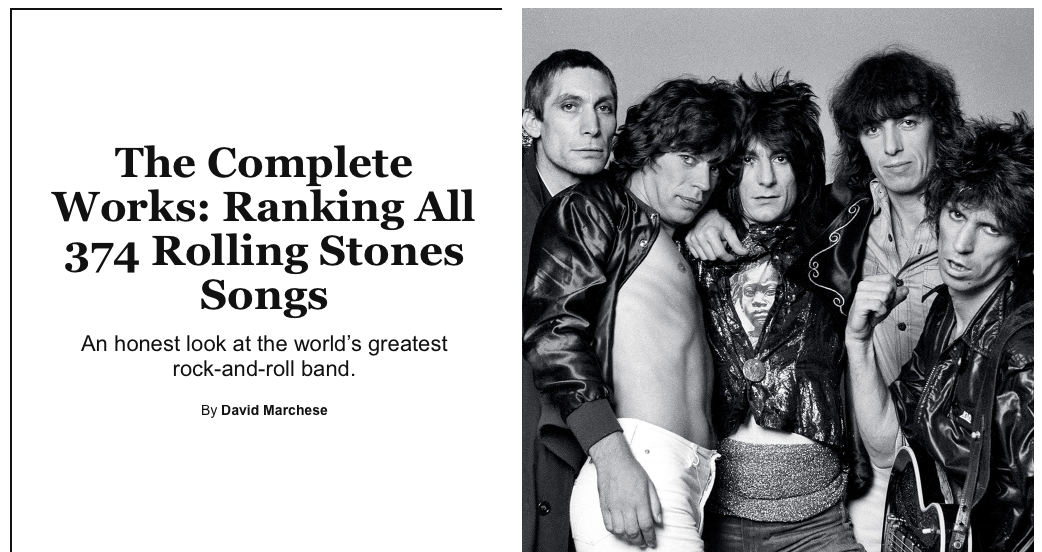
The previous 2 or 3 lines discussed David Marchese’s ranking (on Vulture.com) of 374 Rolling Stones songs.  Click here to see Marchese’s picks.


One thing that struck me after I pondered Marchese’s list is just how many forgettable songs the Rolling Stones recorded.  

I think the Stones are the crème de la crème of all rock groups.  But out of the 374 songs on Marchese’s list, only two or three dozen could be called masterpieces.

Of course, the same is true for the other great classic sixties bands – the Who, the Kinks, the Beach Boys, and even the Beatles.

Yes, you heard me right.  The Beatles recorded many enjoyable pop songs in their early years.  But most of those songs are too lightweight to be thought of as “great” by anyone who wasn’t a 14-year-old girl when the Beatles first toured the United States.  

And the Beatles recorded a fair number of absolute stinkers.  “Maxwell’s Silver Hammer,” “Octopus’s Garden,” and “When I’m Sixty-Four” are just a few of their truly terrible songs.  And while Sgt. Pepper and the “White Album” are considered by many to be the Beatles’ two best albums, both are full of songs that are mediocre at best and godawful at worst.  


But the Stones’ best album, Let It Bleed, doesn’t contain a single stinker.

*     *     *     *     *

With the benefit of 20-20 hindsight, it’s clear that the smartest thing the Beatles ever did was break up when they did – which was clearly after they had peaked, but not by long.  The Stones’ post-Exile on Main St. albums have some good songs, but the dross on those records overwhelms the gold by a wide margin.  (Be honest.  If you had a chance to see the Stones perform live tomorrow, would you be the least bit upset if they said they weren’t playing any of the songs they recorded after 1972?)

The Beatles recorded a lot of crap as individuals, but the group’s reputation didn’t suffer as a result because the albums those songs were released on weren’t Beatles albums – they were John Lennon albums, or Paul McCartney albums, or George Harrison albums, or Ringo Starr albums.  

*     *     *     *     *

The Beatles as a group released 17 studio albums in the U.S.  (Fourteen of them went to #1 on the Billboard album charts, while the other three peaked at #2.)  

The Beatles as individuals released almost four times as many studio albums than the Beatles released  as a group.


John Lennon released eleven studio albums before he was murdered in 1980, while George Harrison released twelve before his 2001 death.  

Would you believe that Ringo Starr has released 18 studio albums?  (Only two made it to the top ten.)

And Paul McCartney has released a whopping 29 studio albums in the U.S.  (That includes five “classical” albums.)

I think that one CD would easily hold all the individual John, Paul, George, and Ringo songs that I’d ever want to listen to.  

The same is true for the dozen studio albums the Rolling Stones released subsequent to Exile on Main Street.

*     *     *     *     *

Marchese ranks three post-Exile songs in his top 25: “Start Me Up” (#18), “Miss You” (#11), and “Beast of Burden” (#3).

None of the three would be in my top 100.  (“Beast of Burden” at #3?  Are you kidding me?)

There are seven early Stones songs – that is, songs that were released when I was in junior high – in Marchese’s top 25: “19th Nervous Breakdown” (#25), “She’s a Rainbow” (#23), “Let’s Spend the Night Together” (#20), “Ruby Tuesday (#14), “Have You Seen Your Mother, Baby, Standing in the Shadow?” (#9), “Satisfaction” (#8),  and “Paint It Black” (#6). 

That’s not bad.  “Paint It Black” and “Satisfaction” definitely belong in the top ten.  (Sure, we’ve all heard “Satisfaction” a zillion times, but it’s a one-of-a-kind song.  And it has as much attitude as any song before or since.  It has held up very well.)

Then . . .
I’d move “Let’s Spend the Night Together” and “19th Nervous Breakdown” down in the rankings a bit.  (They have “Satisfaction”-ish attitude, but rely a little too much on Sturm und Drang – “Satisfaction” is a much smarter song.)  I think Marchese ranks “Ruby Tuesday” too high as well – it’s an interesting song, but it’s really more of a Beatles song than a Stones song.

Marchese doesn’t include a single pre-“Satisfaction” song in his top 25.  He does rank “She Said Yeah” at #27, which is about right.  (It’s a stick of dynamite – the best of the Stones’ early R&B covers.)  But “It’s All Over Now” (#75), “The Last Time” (#90), and especially “Play With Fire” (#125) deserve to be  much higher in the rankings.

*     *     *     *     *

The remaining 15 songs in Marchese’s top 25 come from the Stones’ peak years – 1968 to 1972 – when they released Beggars Banquet, Let It Bleed, Sticky Fingers, and Exile on Main St.

Marchese is correct to say that the golden age of the Stones began with the release of “Jumpin’ Jack Flash” in 1968.  (It was recorded at the same time as the songs that ended up on Beggars Banquet, but was not included on that album.)  Marchese ranks it #4, and I can’t argue with him.  It’s an iconic Stones record – perhaps only “Satisfaction” is more iconic.

“Honky Tonk Women” is another iconic Stones song that wasn’t included in a studio album.  (A country-western version titled “Country Honk” was released on Let It Bleed.)  Marchese ranks it at #7, which I think is way too high.  I was never a huge fan of this song – Jagger works hard to sell it, but I’m buying it.  And I don’t think it has aged particularly well.

“Sympathy for the Devil” and “Street Fighting Man” are the obvious Beggars Banquet to put near the top of the rankings, but I think you have to include “Stray Cat Blues” in the top 25 as well.  It’s a song you rarely heard on the radio, probably because of concerns that the FCC would come down hard on any station that dared to play such an unapologetically sleazy song.

Which is exactly why “Stray Cat Blues” would be in my top 25.  It’s a very unsettling song – especially to parents of teenaged girls.

 . . . and now
Only one Exile on Main St. song – “Tumbling Dice” – makes Marchese’s top 25.  I agree with him that Exile doesn’t have a lot of first-rank songs, but “Soul Survivor,” “Torn and Frayed,” and several other tracks from that album are clearly better than “Tumbling Dice.”  (“Soul Survivor” is a very underrated song – it’s definitely top-25 material.)

Marchese has high regard for Sticky Fingers, ranking no fewer than six songs from that album in his top 25.  I wouldn’t put “Brown Sugar” at #10 – it’s a quintessential Stones song, but I don’t think it’s one of their very best.  And I’d move “Wild Horses” – which is not a quintessential Stones song – down from #12.  (Ditto for “Moonlight Mile,” which Marchese puts at #16.)

“Can’t You Hear Me Knocking” and “Dead Flowers” (#15 and #21, respectively) are also atypical Stones tracks, but I like both of them.  (I think “Dead Flowers” is the best of all the Stones’ country-style songs by far.)

That leaves “Sway” at #22, which I might put ahead of all the other Sticky Fingers songs instead of bringing up the rear.

Let It Bleed is the consensus choice for the best Stones album of all time, and Marchese ranks four songs from that album in his top 25.  

I’m not sure that “Let It Bleed” deserves the #24 spot, but that’s close enough for government work.

“Monkey Man” is an excellent choice.  I might even move it up a few spots from #19, which is where Marchese placed it.  

“Live With Me” is just as good as “Monkey Man,” and should be ranked much higher than #74.

Marchese ranks “You Can’t Always Get What You Want” as the best Stones song of all time.

If you ask me, “You Can’t Always Get What You Want” tries to do a little too much.  It’s seven-plus minutes long, and contains “at least four ecstatic peaks,” according to Marchese – the Stones pull out all the stops and throw in everything but the kitchen sink (including the 200-odd voices of the world-renowned London Bach Choir). 

What’s my choice for the #1 spot?  “Gimme Shelter” – no ifs, ands or buts about it.

The Stones’ bark was often worse than their bite, but there’s nothing phony about “Gimme Shelter” – it’s as menacing as all get-out.

There’s a reason that the Maysles brothers named their famous documentary about the deadly Altamonte concert Gimme Shelter:


Here’s what Marchese has to say about the song:

As they were in 1969, as they are now, rape, war, and murder are just a shot away, and the band plays to that evil truth with savage intensity.  Mick’s distorted blues harp and vengeful singing and Keith’s serrated lead guitar burn, eternally, with prophetic heat.  And Merry Clayton’s astonishingly intense vocals represent backup singing at its height.  Ominous and forever dead-on, “Gimme Shelter” isn’t just apex Stones . . . it’s as apocalyptic as rock music gets.

Marchese knows that “Gimme Shelter” deserves the numero uno spot, but he wimps out and ranks it #2:

Look, maybe “Gimme Shelter” was the band’s true peak, and that song lives in the darkness the Stones knew so well, knew better than any other band, but I’m putting [“You Can’t Always Get What You Want”] at the top.  It lets a little light in.
  
Light, schmight.  2 or 3 lines isn’t afraid to give itself to the dark side.  It can handle the truth.

And the truth is that “Gimme Shelter” is the #1 Stones song of all time.  

*     *     *     *     *

2 or 3 lines featured “Gimme Shelter” some time ago.  (You can click here to read what I had to say about it.)  So today’s featured song is “Play With Fire,” which was released in 1965.  

David Marchese ranks it as the Stones’ 125th-best song, but it deserves to be ranked much higher than that.

Jagger and Richards are the only Rolling Stones to appear on “Play With Fire,” which was recorded in Los Angeles the day before the group left to tour Australia.  Phil Spector played bass – actually, he played a tuned-down electric guitar – and frequent Stones collaborator Jack Nitzsche played harpsichord and the Chinese gong known as a tam-tam.

“Play With Fire” is about a rich London girl who is slumming around with a guy from the wrong side of the tracks.  She’s playing with fire, and she’s going to get burned.

Do you remember when the Stones – especially Mick Jagger – seemed menacing and dangerous?  I think a lot of us really felt that way fifty years ago, although it seems almost laughable today.

Here’s “Play With Fire”:


Click below to buy the song from Amazon:

Tuesday, June 6, 2017

Rolling Stones – "Sing This All Together" (1967)


Pictures of us beating on our drum
Never stopping ’til the rain has come

The pop culture website Vulture.com recently ranked all 374 Rolling Stones songs from best to worst. 

The list includes all the songs from the Stones’ studio albums, plus some singles and B-sides that were never included on albums, some songs released on live albums that were never recorded in the studio, and several previously unreleased songs that were included on the 2010 deluxe edition of Exile on Main St.  

From Vulture.com
I could imagine giving all the Stones’ songs letter grades based on relative quality – A+, A, A-, B+, and so on.  But attempting to rank 374 songs from best to worst is a ridiculous endeavor.  (Surely Marchese doesn’t really believe that the difference between #373 and #374 – or #273 and #274, or #173 and #174 – is meaningful.) 

I’m not going to waste your time talking about the lower-ranking songs, a disproportionate number of which are from the group’s more recent albums – which is as it should be.  (I’m as big a Rolling Stones as you’re going to find, but with a few exceptions, I could quite happily live without their post-Exile on Main St. albums.)


Marchese puts only a few post-1972 Stones songs in his top 50, but I don’t think any of them belong there.  For example, he inexplicably ranks two songs from 1978’s Some Girls album – “Beast of Burden” and “Miss You” at #3 and #11, respectively.  That’s crazy.  

*     *     *     *     *

Marchese doesn’t rank the Stones’ albums – at least not explicitly.

But it’s possible to derive album rankings by adding up the individual ranking numbers for each song on an album and dividing by the number of songs.  The higher the average ranking for the songs on an album, the better the album is.  (Does that make sense?  I think so.)

Based on that calculation, Marchese believes that Let It Bleed – whose ten songs have an average ranking of 38.5 – is the best Rolling Stones album.  

I couldn’t agree more.

Simply the best
Marchese’s lowest ranked Let It Bleed song is “You Got the Silver,” which he puts at #104 – comfortably in the top third of all Stones songs.  Six of the album’s ten songs are in his top 40 songs, including his #1 (“You Can’t Always Get What You Want”) and his #2 (“Gimme Shelter”).

The songs on Sticky Fingers have an average ranking of 54.4, making it Marchese’s second-ranked album.  

Marchese’s highest ranked Sticky Fingers song is “Brown Sugar” at #10.  His #12, #15, #16, #21, and #22 songs are all from that album – in other words, he thinks six of best 22 Rolling Stones songs ever are from Sticky Fingers.

A lot of critics think that Exile on Main St. is the best Stones album.  That’s odd to me because almost no one thinks The Beatles – better known as the “White Album” – is the Beatles’ best album, and The Beatles is for the Beatles what Exile is for the Stones.  

Both are two-record albums that include some great songs, but have as many misses as hits – I think each would have been much better as a one-record album.  (Given the bad blood between the members of the Lennon-McCartney and Jagger-Richards songwriting duos when those albums were recorded, it’s not surprising that those albums contain a number of less-than-memorable songs . . . and something of a miracle that they include as many good songs as they do.)


Marchese give the 18 songs on Exile on Main St. an average ranking of 60.5 – just a few spots worse than the average ranking for Sticky Fingers.  No song from Exile is ranked higher than #17, but only one of the album’s tracks is ranked lower than #88.  

I don’t get it.  I think Exile suffers from too much Keith Richards and not enough Mick Jagger.  Everyone loves good ol’ Keith, but he’s really a supporting player – not the equal of Jagger when it came to songwriting.  Mick was the brains behind the operation, and Exile suffers from Jagger’s apparent lack of engagement.  Too many of the songs are rootsy, bluesy, country-ish, gospel-ish, jammy, and loosey-goosey.  (Jagger has said that the album is “a bit overrated, to be honest,” and he’s right.)

I also have a problem with Marchese’s rankings of the individual Exile songs.  His favorite is “Tumbling Dice,” which was the most popular single from the album.  (I remember when “Tumbling Dice” was released.  I was in college, and was a huge Stones fan – so I rushed out and bought the single, anticipating something great.  It wasn’t painful to listen to, but it wasn’t very interesting.  Compared to “Gimme Shelter” or “Sympathy for the Devil” or “Jumpin’ Jack Flash,” it was boring.)

While I think “Soul Survivor” is the album’s strongest song by far, Marchese has it smack dab in the middle of the Exile pack.


The biggest bone I have to pick with Marchese is the extent to which he disses Their Satanic Majesties Request, the Stones’ most eccentric, outré album.  (Marchese isn’t the only critic who has a low opinion of that album, of course – it was universally panned when it was released.)  

Their Satanic Majesties Request may be a little over the top – OK, it’s way over the top – but Marchese gives its songs an average ranking of 242.2.  To add insult to injury, he ranks the last track from side one of the album, “Sing This All Together (See What Happens),” as #374 out of the 374 ranked songs.

*      *      *      *      *

Today’s featured song, “Sing This All Together,” is the first track from Their Satanic Majesties Request.  Marchese somehow overlooked “Sing This All Together” and didn’t rank it.  Or perhaps his editor got confused and deleted it because he thought it was the same thing as “Sing This All Together (See What Happens).” 

Here’s “Sing This All Together,” which may be the most Beatles-esque song the Rolling Stones ever recorded:


Click below to buy “Sing This All Together” from Amazon:

Sunday, June 4, 2017

Rolling Stones – "Dead Flowers" (1971)


I'll be in my basement room
With a needle and a spoon

Which musical genre do you think has the most mentions of illegal drugs?

Is it hip-hop/rap?  Rock?  Folk?

A recent study of the lyrics of over one million songs concluded that country songs mention drugs most frequently.  (You can click here to read more about that study.)

That’s right, boys and girls.  A country song is more likely to contain a drug reference than a rock song, a folk song, or a rap song.  

Are you surprised to learn that rap songs are least likely to refer to illicit drugs – even though certain the recordings of certain well-known rap performers (Eminem, Lil Wayne, Jay-Z, and Wu-Tang Clan among them) are packed with drug references?

What controlled substances are mentioned most often in recorded music?  Marijuana is #1 by a significant margin – over 30% of all the songs that mention drugs refer to weed.  Cocaine is second at 22%, followed by acid, pills, meth, and heroin.  

While marijuana is the most likely drug to be mentioned in rock, pop, hip-hop, and country songs, cocaine is #1 in – surprise – folk songs.


Here’s a list of the terms that were searched for by the researchers who did this study: acid, Adderall, addy, Ativan, bars, blotter, blow, blues, blunt, bud, buddha, chronic, cid, cocaine, coke, crack, crank, dank, dope, dose, doses, dro, ecstasy, gak, h, heroin, hydro, ice, joint, key, lean, Lortab, LSD, lucy, marijuana, MDMA, meth, methamphetamine, microdot, molly, morphine, OxyContin, Percocet, piff, pill, pot, powder, purp, Promethazine, roxy, speed, sizzurp, spliff, syrup, tab, tabs, tar, tweak, upper, Valium, Vicodin, weed, white, x, and Xanax. 

If you're familiar with all those terms, you might think about calling Addictions.com’s 24-hour addiction hotline at 1-800-654-0987.

*     *     *     *     *

Keith Richards met the late Gram Parsons in 1968, when Parsons was with the Byrds.  He moved in with Keith after he left the Byrds, and the two spent hours at the piano playing country-western weepers.

Some people believe that Parsons deserves at least some of the credit for writing “Wild Horses,” which is officially a Jagger-Richards composition.  (Parsons and the Flying Burrito Brothers released a cover of the song about a year before the Stones’ version was released on Sticky Fingers.)

The only album cover to feature a working zipper
The other country song on Sticky Fingers is today’s featured song, “Dead Flowers.”  

David Marchese of Vulture.com recently ranked 374 Stones songs from best to worst.  “Dead Flowers” came in at #21 – that's pretty high.

Here’s his explanation of why he thinks the song deserves such a lofty ranking:

The pleasure of the Stones’ takes on country music comes from the tension between the commitment and accuracy of the band’s music and the irony and detachment of the singer’s vocals.  “Dead Flowers” is a near-perfect example of this.  Charlie and Bill’s relaxed trot, Keith’s full acoustic-guitar strumming, and Mick Taylor’s faux-pedal-steel lead lines have real authenticity.  And over there is that glittery bumpkin Jagger, twanging away about shooting up in the basement. 

I'm not sure that “irony and detachment” fully captures how Mick Jagger hammed it up on many of the country-style songs the Stones recorded.  (Listen to “Dear Doctor” from Beggars Banquet, and you’ll see what I mean.)  But he plays it relatively straight on “Dead Flowers.”

*     *     *     *     *

Marchese neglected to mention Ian Stewart’s honky-tonk piano playing, which I think is the best thing about “Dead Flowers.”

Ian Stewart with the Stones
Stewart was an original member of the Stones, but manager Andrew Loog Oldham thought the group should have at most five performers on stage.  Stewart didn’t look the part of a pop star, so he drew the short straw.  

He accepted his demotion gracefully.  He became the band’s road manager, and played piano on a number of memorable Stones records – including “Honky Tonk Women,” “Let It Bleed,” “Brown Sugar,” and “It’s Only Rock ’n’ Roll (But I Like It).”

Stewart died of a heart attack in 1985, when he was 47 years old.  He was inducted into the Rock and Roll Hall of Fame with the rest of the Stones in 1989.

*     *     *     *     *

Here’s “Dead Flowers”:


Click below to buy the song from Amazon:
Friday, June 2, 2017

No Cash – "Run Your Pockets" (2003)


Run your motherf*ckin’ pockets
Give me all you got!

When I was in my forties, I used to run a 10K race every year.  The happiest day of the year for me was the day after my annual race, when I knew it would be 364 days until I had to run another 10K.

One year, the other runners included a guy who ran backwards for the entire distance, and a guy who juggled three balls as he ran the race.  I’m happy to say I finished ahead of both of those runners.

Juggling during a race is
now known as "joggling"
I wish I knew how to juggle.  (Maybe I’ll take juggling up when I retire from my law firm later this year.)  

But even if I did, I probably wouldn’t have thought to juggle while running in a 10K.  And I would never  have asked a judge to let me juggle in court to help prove that I was not guilty of attempted robbery.

*     *     *     *     *

They say that a man who acts as his own lawyer has a fool for a client.

That proverb is often attributed to Abraham Lincoln, but it appears in an 1814 book by English clergyman Henry Kett.  I wouldn’t be surprised if Kett stole it from an even earlier writer, but that’s not important – what is important is that a man who acts as his own lawyer has a fool for a client.

Twenty-year-old Orlando Melendez plans to represent himself in his upcoming criminal trial in Springfield, MA.  But he proved that he was a fool long before he made that decision.

The night of December 12, 2016, Melendez attended what must have been the mother of all parties.  

Orlando Menendez
Early the next morning, he walked into a Cumberland Farms convenience store, pulled a green toy gun from his pocket, and told the store clerks to “run your [vulgarity],” which the clerks interpreted as a demand that they hand over the money in the cash register.  (They assumed “run your [vulgarity]” was a variation on “run your pockets,” which is a slang term meaning “Give me whatever valuables you’re carrying in your pockets.”)

It’s easy to be a Monday-morning quarterback, but I have to question why Menedez didn’t bring a black toy gun.  (I’m no expert when it comes to firearms, but I’m pretty sure real guns aren’t green.)  In any event, Melendez seems to have been rattled by a customer unexpectedly walking into the store, and he left without any money.

A few blocks later, he was arrested by police.  According to the arrest report, Melendez said “I must have committed at least 20 crimes in the last seven hours.”  

A Cumberland Farms store
The next day, he pleaded not guilty to attempted unarmed robbery and possession of a deceptive device (the toy gun) during the commission of a crime.

His court-appointed lawyer made some pretty good arguments at his bail hearing.  He pointed out that no one was hurt and no money was taken from the store.  “Run your [vulgarity]” wasn’t necessarily a demand for money, so it’s not clear that Melendez was trying to rob the store – although his brandishing the toy gun was a little suspicious.  (Are you as curious about what that vulgarity was as I am?)

“He had been at a party and had a lot to drink,” the lawyer explained, trying to make lemonade from the lemons his client had given him.

He also pointed out that Melendez had a steady job and a GED.  “He's a young man who has made some mistakes, but he's looking to improve his life and move on and upward if he can,” the lawyer said.

That lawyer was fighting an uphill battle.  His client had been arrested only a few weeks earlier for stealing a car, and was on probation in two other criminal cases.  Not surprisingly, the judge sent Melendez to the poke pending trial.

*     *     *     *     *

Melendez fired his lawyer in February, choosing to represent himself at his pretrial hearing last week.

During that hearing, Melendez explained that he was just clowning around when he walked into that convenience store.  To prove it, he asked the judge to permit him to juggle three wadded-up pieces of paper for 20 seconds at his trial.  

“The keystone to his defense is: he’s literally a clown,” Melendez argued in a handwritten motion.  


(Maybe he wrote that motion in the third person so it wasn’t so obvious that he was representing himself.)  But whatever his thinking was, the motion was denied by the judge.  

The juggling act would be “not only the simplest, but the only possible proof that the defendant is a jester,” the motion said.  Denying his motion would be to deny his Fifth and Fourteenth Amendment rights to a fair trial, Melendez argued.

Any guesses as to how the judge ruled on that motion?

*     *     *     *     *

“Run Your Pockets” is from a 2003 album of the same name by No Cash, a hardcore punk band from Pennsylvania.

The "Run Your Pockets" album cover
Here’s what one reviewer had to say about the album:

[“Run Your Pockets”] is not a disc for the faint-hearted . . . . [I]f you consider yourself conservative, steer clear of this disc.  I repeat, steer clear of this disc.  But if you're open-minded, have some major qualms with society, and have a hankering for brutal punk, then by all means give “Run Your Pockets” a listen. . . . Revolution and questioning authority are definitely the pervasive themes here, making for quite a bold record, played at warped [sic] speed. 

I’m not sure whether Orlando Melendez had major qualms with society and a hankering for brutal punk when he walked into that Springfield convenience packing a green toy gun, or if he was simply hammered, blitzed, smashed, annihilated, sh*t-faced, and three sheets to the wind.

What I am sure of is that Orlando Melendez had a fool for a lawyer.

Here’s “Run Your Pockets”:


Click below to buy the song from Amazon:

Tuesday, May 30, 2017

Beatles – "Good Night" (1968)


Now the sun turns out his light
Good night, sleep tight

I was mildly excited to learn a couple of weeks ago that SiriusXM satellite radio was adding “The Beatles Channel” to its lineup.  


I gave “The Beatles Channel” a shot before I gave up on it.  Actually, I gave it several shots.  But the dross-to-gold ratio is unacceptably high.

“The Beatles Channel” is a misnomer.  The music on that channel includes a lot of non-Beatles stuff.  (The Beatles released only 12 studio albums.  That’s not a lot of content when you’re a satellite radio company and you’ve got 24 hours of programming a day to fill.)

There are a fair number of covers of Beatles songs on “The Beatles Channel” – like Regina Spektor’s cover of “While My Guitar Gently Weeps.”


There are also a fair number of Beatles covers of songs by other artists – like their forgettable 1964 cover of Carl Perkins’s forgettable 1957 record, “Everybody’s Trying to Be My Baby.”


“The Beatles Channel” also plays the original recordings of some of the songs the Beatles covered – like Buddy Holly’s 1958 recording of “Crying, Waiting, Hoping.” 

It seemed like about every third song on “The Beatles Channel” was a live Paul McCartney recording of a non-Beatles song.  (I’m guessing that SiriusXM must have been able to negotiate some rock-bottom royalty payments for the McCartney solo catalog.)

There were also a fair number of John Lennon songs.  The typical McCartney solo song is pretty bad, but the typical Lennon solo recording is worse – especially when he teams up with Yoko Ono.

As Exhibit A, the prosecution would like to offer into evidence Lennon’s 1980 recording, “Beautiful Boy (Darling Boy),” which was written for John and Yoko’s son, Sean.  


(That song contains a famous John Lennon quote: “Life is what happens to you while you're busy making other plans.”  It looks like Lennon “borrowed” that line – perhaps from a 1957 issue of Reader’s Digest.)

“The Beatles Channel” also programs plenty of miscellaneous gasbaggery – call-in shows, recorded interviews with celebrities or self-proclaimed Beatles experts, etc., etc.  For example, the first day’s programming featured Larry King yakking about meeting Paul McCartney backstage before one of Sir Paul’s Las Vegas appearances.  (Would you believe me if I told you that interview was more about Larry King than it was about Paul McCartney?)

When “The Beatles Channel” finally gets around to playing an actual Beatles record, the odds are that it will not be a good one.

Let's face it.  The Beatles recorded a number of great songs, but they also put out a lot of crap.

To wit: 


*     *     *     *     *

John Lennon had two sons by two different mothers, and he wrote both of them a lullaby.

The less said about “Beautiful Boy (Darling Boy)” – which was inspired by his younger son Sean (whose mother was Yoko Ono) and which I mentioned above – the better.

I second that emotion for “Good Night,” which was written for his elder son, Julian, whose mother Cynthia was pregnant when John married her in 1962.  

John said shortly before his death that he didn’t love Julian any less because he wasn’t a planned child: 

He’s still my son, whether he came from a bottle of whiskey or because they didn't have pills in those days.

That's nice.

*     *     *     *     *


“Good Night” is the last song on The Beatles, the two-record album that is better known as the “White Album.”  When I heard it the first day that “The Beatles Channel” was on the air, I did not recognize it – I don’t remember ever hearing it before.

Since everyone I knew in college owned a copy of the “White Album,” that’s hard to explain.  

The only Beatle who had anything to do with the recording of “Good Night” was Ringo Starr, who sings the song’s clichéd lyrics over a lush orchestral arrangement.  (God only knows why John asked Ringo to sing a lullaby written for his child rather than singing it himself.)

One versatile musician and Beatles aficionado of my acquaintance told me that “Good Night” is widely regarded as the worst of all Beatles songs.

To that, I reply “Maxwell’s Silver Hammer,” “Octopus’s Garden,” “Yellow Submarine,” and – last and almost certainly least – “When I’m Sixty-Four.”  Which is not to say that “Good Night” isn’t a very bad song.

The Beatles’ army of copyright lawyers has managed to keep even a mediocrity like “Good Night” off Youtube.  So i'm not able to share it with you.

Click below to buy the song from Amazon: