Showing posts with label Yoko Ono. Show all posts

Tuesday, May 30, 2017

Beatles – "Good Night" (1968)


Now the sun turns out his light
Good night, sleep tight

I was mildly excited to learn a couple of weeks ago that SiriusXM satellite radio was adding “The Beatles Channel” to its lineup.  


I gave “The Beatles Channel” a shot before I gave up on it.  Actually, I gave it several shots.  But the dross-to-gold ratio is unacceptably high.

“The Beatles Channel” is a misnomer.  The music on that channel includes a lot of non-Beatles stuff.  (The Beatles released only 12 studio albums.  That’s not a lot of content when you’re a satellite radio company and you’ve got 24 hours of programming a day to fill.)

There are a fair number of covers of Beatles songs on “The Beatles Channel” – like Regina Spektor’s cover of “While My Guitar Gently Weeps.”


There are also a fair number of Beatles covers of songs by other artists – like their forgettable 1964 cover of Carl Perkins’s forgettable 1957 record, “Everybody’s Trying to Be My Baby.”


“The Beatles Channel” also plays the original recordings of some of the songs the Beatles covered – like Buddy Holly’s 1958 recording of “Crying, Waiting, Hoping.” 

It seemed like about every third song on “The Beatles Channel” was a live Paul McCartney recording of a non-Beatles song.  (I’m guessing that SiriusXM must have been able to negotiate some rock-bottom royalty payments for the McCartney solo catalog.)

There were also a fair number of John Lennon songs.  The typical McCartney solo song is pretty bad, but the typical Lennon solo recording is worse – especially when he teams up with Yoko Ono.

As Exhibit A, the prosecution would like to offer into evidence Lennon’s 1980 recording, “Beautiful Boy (Darling Boy),” which was written for John and Yoko’s son, Sean.  


(That song contains a famous John Lennon quote: “Life is what happens to you while you're busy making other plans.”  It looks like Lennon “borrowed” that line – perhaps from a 1957 issue of Reader’s Digest.)

“The Beatles Channel” also programs plenty of miscellaneous gasbaggery – call-in shows, recorded interviews with celebrities or self-proclaimed Beatles experts, etc., etc.  For example, the first day’s programming featured Larry King yakking about meeting Paul McCartney backstage before one of Sir Paul’s Las Vegas appearances.  (Would you believe me if I told you that interview was more about Larry King than it was about Paul McCartney?)

When “The Beatles Channel” finally gets around to playing an actual Beatles record, the odds are that it will not be a good one.

Let's face it.  The Beatles recorded a number of great songs, but they also put out a lot of crap.

To wit: 


*     *     *     *     *

John Lennon had two sons by two different mothers, and he wrote both of them a lullaby.

The less said about “Beautiful Boy (Darling Boy)” – which was inspired by his younger son Sean (whose mother was Yoko Ono) and which I mentioned above – the better.

I second that emotion for “Good Night,” which was written for his elder son, Julian, whose mother Cynthia was pregnant when John married her in 1962.  

John said shortly before his death that he didn’t love Julian any less because he wasn’t a planned child: 

He’s still my son, whether he came from a bottle of whiskey or because they didn't have pills in those days.

That's nice.

*     *     *     *     *


“Good Night” is the last song on The Beatles, the two-record album that is better known as the “White Album.”  When I heard it the first day that “The Beatles Channel” was on the air, I did not recognize it – I don’t remember ever hearing it before.

Since everyone I knew in college owned a copy of the “White Album,” that’s hard to explain.  

The only Beatle who had anything to do with the recording of “Good Night” was Ringo Starr, who sings the song’s clichéd lyrics over a lush orchestral arrangement.  (God only knows why John asked Ringo to sing a lullaby written for his child rather than singing it himself.)

One versatile musician and Beatles aficionado of my acquaintance told me that “Good Night” is widely regarded as the worst of all Beatles songs.

To that, I reply “Maxwell’s Silver Hammer,” “Octopus’s Garden,” “Yellow Submarine,” and – last and almost certainly least – “When I’m Sixty-Four.”  Which is not to say that “Good Night” isn’t a very bad song.

The Beatles’ army of copyright lawyers has managed to keep even a mediocrity like “Good Night” off Youtube.  So i'm not able to share it with you.

Click below to buy the song from Amazon:

Tuesday, August 21, 2012

Beatles -- "I Want You (She's So Heavy)" (1969)


I want you
I want you so bad
It's driving me mad
It's driving me mad

Like Devo's "Gut Feeling/(Slap Your Mammy)," this song is really two conjoined songs – as its title indicates.

The first half of the Devo track and the second half of this track are both constructed with unusual five-bar musical phrases, although they differ when it comes to time signatures–- 4/4 for Devo, 6/8 here.

Given the many similarities between the two songs, you're probably wondering why this post didn't immediately follow the Devo one.  That would have been the best thing to do pedagogically, but that's not the way a wildly popular blog like 2 or 3 lines works – our lead times are long and getting longer.  (I'm already working on the lineup of featured songs for February 2013.)  

My iPod served up "She's So Heavy" a couple of days after we slotted in the Devo post, and I immediately noticed the five-measure phrase the Beatles used.  But trying to shoehorn this post into the blog at the last minute would have been like trying to parallel park one of those gynormous Royal Caribbean cruise ships–- not worth the effort that would have been required.

Big-ass cruise ship
(You ladies out there might better appreciate the situation if you think about fashion shows.  The shows for spring/summer 2013 fashions will be held in September and October of this year.  What would happen if it was January and Alexander McQueen or Dolce & Gabbana had a brainstorm for a dreamy new summer frock while walking the dog and listening to their iPod?  They wouldn't bump something else from their spring/summer line to make room for the new design – they'd just hold it over until 2014.)

*     *     *     *     *

Five is a very unstable number in musical rhythm.  A five-beat measure sounds like it has one beat too many, or one too few.  Just try to dance to 5/4 music.

The dominant numbers when it comes to rhythm are two, three, and four (which breaks down into two twos, of course).  Time signatures based on three -- 3/4 and 6/8, for example -- are common, but three-beat rhythmic units are usually combined in groups of four or eight or some other even number.  It's unnatural to have a musical phrase that doesn't have an even number of measures.

A five-unit musical structure usually breaks down to a two plus a three, and the break between the two and the three is usually somewhat abrupt.  Click here to listen to the famous Dave Brubeck jazz standard, "Take Five."  It has a 5/4 time signature, but each measure breaks down into a three followed by a two -- 1-2-3-4-5.

*     *     *     *     *

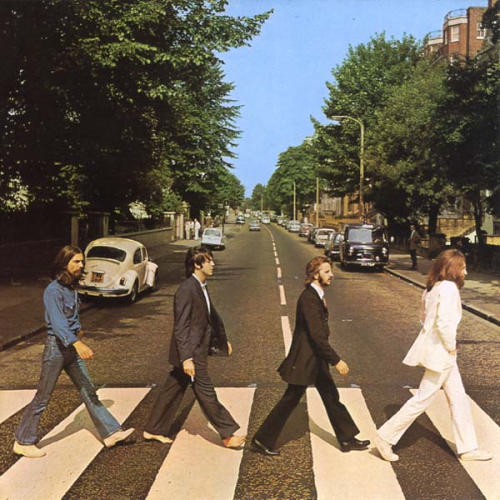
I'm a big fan of Abbey Road, which was the last album the Beatles recorded before going their separate ways, although not the last album they released.  But it's a very uneven piece of work.  

That's not surprising given the dysfunctionality of the Beatles' relationships with one another at that time, not to mention the quantity of drugs they were consuming.

Most of side two of the album is taken up with a brilliant medley of eight distinct songs.  Paul McCartney was primarily responsible for five of the eight, and those five (especially "You Never Give Me Your Money," "She Came in Through the Bathroom Window," and "Golden Slumbers") are greatly superior to John Lennon's three – especially the gibberish that is "Sun King."

By contrast, side one is a mess.  "Come Together" is not very interesting musically – it's just too repetitive.  "Something" is awful.  "Maxwell's Silver Hammer" is awfuler – an example of McCartney at his worst.  (The other Beatles hated it.  Lennon refused to play on the track, calling it "more of Paul's granny music.")  "Oh! Darling" is a waste of time.  "Octopus's Garden" is an embarrassment.

The Beatles prepare to shoot
the Abbey Road album cover
That leaves "I Want You (She's So Heavy"), which is a Lennon love song written about Yoko Ono – but let's not hold that against it.

Lennon later explained the lyrics to Rolling Stone magazine: "When you're drowning, you don't say, 'I would be incredibly pleased if someone would have the foresight to notice me drowning and come help me.'  You just scream."  Of course, most people would scream even more loudly if Yoko was the person who responded to the cry for help.

This song is very long (almost 8 minutes long – the only longer Beatles' track was "Revolution 9," which is mostly just noise) but has extraordinarily simple lyrics.  Only 14 different words were used, and one of them ("babe") doesn't really count.

I just realized that it's possible to turn this song into a haiku.  (I left out "babe," but I used every other word in the song.)

She is so heavy
You know I want you so bad
It's driving me mad

"I Want You (She's So Heavy)" opens with a five-bar introduction – the chords for the five measures (played not as chords but as arpeggios) are D minor, D minor, E7, Bb7, and A+5 (i.e., A with an augmented fifth).  The last three minutes or so of the song essentially repeat that same five-chord progression over and over.


The song ends abruptly, as if someone in the studio tripped on an electrical cord and jerked the plug out of the wall outlet.  But the cold ending was no accident – the track went on for another 20 seconds or so, but Lennon told the engineer to end it here.

Props to Paul McCartney for a very interesting bass line.  And Billy Preston does a nice job (as usual) on the Hammond B3.

The final overdubbing session for this song took place on August 11, 1969.  That was the last time all four Beatles were in a recording studio together.

Abbey Road was released in the United States on October 1 of that year.  I made a cassette tape of it and took it on a trip to the University of Missouri on November 7.  (I was a high-school senior at the time.)  I was originally planning to tell you about that trip in this post, but I think I'll save that story for later.  (I am such a little tease!)

Click here to listen to "I Want You (She's So Heavy)."

Click on the link below if you'd like to buy the song from Amazon: