Wednesday, June 30, 2010

Modest Mouse -- "The Whale Song" (2009)


I guess I am a scout
So I should find a way out
So everyone can find a way out


Henry David Thoreau visited Cape Cod four times between 1849 and 1857.  (His first visit – in October 1849 – was the basis for his book, Cape Cod.)  

I've visited Cape Cod almost 50 times – the first time was in April 1976, the last time about a month ago.

Thoreau took the brand-new Old Colony Railroad from Boston to Sandwich, rode a stagecoach along what is now Route 6A from Sandwich to Orleans (roughly 35 miles), and walked the 25 or so miles from there to Provincetown, where Cape Cod ends.

I've travelled the same approximate route many times via bus, car and bicycle, and I assure you that things have changed dramatically since Thoreau visited.  

In fact, things have changed dramatically since I first visited in 1976 – taking the "T" from Harvard Square to South Station in downtown Boston, a bus from South Station to Hyannis, a smaller bus from there to Dennis, and walking from the bus stop in Dennis to the house overlooking Massachusetts Bay that my in-laws bought before my wife was born.

*     *     *     *     *

Here's what the front of that house looked like in 1976:


Here's the back of the house today:


If you make a quarter-turn to the left (looking in the direction of 9 o'clock instead of 12 o'clock), this is the view you get:


Another quarter-turn to the left (so the house is directly behind you) gives you this view of Massachusetts Bay:


*     *     *     *     *

For close to two decades now, one of the highlights of my Cape Cod trips has been riding the Cape Cod Rail Trail.  The Old Colony Railroad that Thoreau had ridden to Sandwich had been extended to Provincetown by 1873.  The railroad thrived as a passenger line until highway bridges opened over the Cape Cod Canal and automobiles replaced trains as the preferred way to get to the Cape.  Freight service ended in the 1960's, and the railroad right-of-way between South Dennis and Wellfleet was eventually turned into the Cape Cod Rail Trail. 

The main CCRT is 22 miles long, or 44 miles long from the beginning to the end and back.  (There are some shorter branch trails along the way.)  I usually ride it in three roughly-equal out-and-back segments – that means each day's ride is 14 to 18 miles.  

My iPod Shuffle is a necessary accessory for these rides, of course – like all rail-trails, the CCRT is quite flat so it's no great strain to sing along loudly all the way.  This year, my Blackberry camera came in quite handy as well.

About 1 1/2 miles from the beginning of the rail trail, you cross over the Herring River in Harwich – last year, there was a family of swans visible from this vantage point:


Here's a cranberry bog – you see quite a few of these along the trail:


(In case you're wondering, that's a partly eaten apple on the seat of my rental bike.)

Rhododendrons were at their peak on Cape Cod when we were there last month:


The Pleasant Lake General Store (right on the trail at mile 5) is a nice old-fashioned place to stop for a cold drink or a snack.


Seymour Pond (mile 6) is my usual turnaround point on day one -- it's one of many "kettle ponds" on Cape Cod, which were created by retreating glaciers during the last ice age.  (Thoreau's Walden Pond is also a kettle pond.)


*     *     *     *     *

I always put some new CDs on my iPod to "break in" during these rides, and this year I got familiar with an almost brand-new Modest Mouse CD, No One's First and You're Next.  It has only eight songs, all of which are leftovers from the band's previous two full-length CDs.  

Not surprisingly, there's no particular coherence to the CD – it's not akin to a novel, but more like a collection of short stories featuring different characters.

This song consists of a single four-measure phrase repeated 45 times – each time through is a little different, of course.  The bass guitar does most of the work the first four times through the four-measure phrase, establishing the foundation of the song.  Guitars then join in and the next 18 four-measure phrases are purely instrumental – the music becomes louder, more complex, and more intense.  

The next 11 repetitions of the four-measure phrase feature vocals.  The lines quoted above (with some small variations) are repeated 11 times – I guess you would call these lines a chorus of sorts.  There are also two "verses" that are sung over some of the choruses.

Finally, we go all-instrumental for 12 more repetitions of our four-measure theme.

That probably all sounds like this song must be incredible repetitive and boring, but it isn't.  Don't take my word for it – most reviewers liked it a lot.  One student reviewer (who accurately described the song as "[s]tarting out with a relatively simple melody [that] slowly descends into a sprawling, colorful chaos") thought it was clearly the best song on the CD.

The estimable Robert Christgau gave the CD an A-minus grade, and said that the "The Whale Song" bemoans singer/lyricist's Isaac Brock's "metaphorical uselessness as it demonstrates his capacity for beauty."  (No wonder Christgau has awarded himself the title "Dean of American Rock Critics."  That's some mighty fancy writin'.)

I'll discuss the next song on this Modest Mouse CD and tell you about the rest of my Cape Cod bike ride in my next post.

Click here to watch the official music video for "The Whale Song."  (Don't ask me what it means – I don't have a clue.)

Click on the link below to buy the record from Amazon: 

Sunday, June 27, 2010

Crabby Appleton -- "Go Back" (1970)


And you know it's not right
When you kiss me tonight
You pretend his lips are mine

Crabby Appleton was a short-lived Los Angeles band that released two well-reviewed LPs and opened for some high-profile groups – including the Guess Who, Three Dog Night, and the Doors – before disbanding.

I recently rediscovered the group's biggest single, "Go Back," on a 5-CD compilation set called Forever Changing: The Golden Age of Elektra 1963-1973. (Thank you, Montgomery County Public Library!)


Although its stable of recording artists included the Doors, Elektra Records was not really a rock or pop label – it leaned more towards folk, with artists like the Byrds, Judy Collins, Tom Rush, Phil Ochs, and Richard Farina.  Elektra also signed the amazing, one-of-a-kind Arthur Lee and Love, who supposedly persuaded the label's co-founder, Jac Holtzman, to give the Doors a chance.

But Elektra was not known for perfect little three-minute AM radio singles like "Go Back."

*     *     *     *     *

Crabby Appleton is an odd name for a band.  Anyone out there know where it comes from?

Crabby Appleton's publicity photo
My more mature readers may remember that Crabby Appleton – his slogan was "Rotten to the core!" – was the arch-villain on the "Tom Terrific" cartoon that was featured on the legendary "Captain Kangaroo" TV show, which aired five mornings a week on the CBS television network in the 1950's and 1960's.

Tom Terrific was a boy superhero who wore a funnel-shaped "thinking cap," which enabled him to turn himself into a tornado, a train, or whatever was necessary.

Click here to see the "Tom Terrific" intro.

*     *     *     *     *

We had two television stations in my home town (Joplin, Missouri) back in the day.  One was a CBS affiliate – CBS was the dominant network back then, with the Ed Sullivan, Jackie Gleason and Red Skelton variety shows, plus "Gunsmoke" and "Beverly Hillbillies" and many others – while the other local station carried a mix of NBC and ABC programming.

Much to my chagrin, the second station chose to stick with the fuddy-duddy ABC western "Wagon Train " in 1964, when NBC introduced the coolest TV show ever, "The Man from U.N.C.L.E."  I was beside myself.

The stars of "The Man from U.N.C.L.E."
Click here to see the "long open" to a season-one "The Man from U.N.C.L.E." episode.

*     *     *     *     *

Both my parents worked when I was a kid, so I spent most of my summer days with my grandmother, who lived only a couple of blocks away.  She was very young and very energetic for a grandmother, and really functioned more like a second mother for me.  (When I was born, she was less than a year older than I was when my youngest child was born.)  My mother was only child, and I was an only child until I was almost 7, so I had my grandmother all to myself.

I have vivid memories of my grandmother's cooking.  She did all the standards – hamburgers, fried chicken, mashed potatoes and gravy, etc.

A favorite Saturday lunch to accompany the major-league baseball "Game of the Week" (broadcast by legendary former players Dizzy Dean and Pee Wee Reese) was macaroni and cheese topped with pan-fried sliced bologna.

Dizzy Dean and Pee Wee Reese
When "The Wonderful World of Disney" aired on Sunday evenings, I would watch it while eating my standard Sunday night dinner – scrambled eggs, toast with grape jelly, and a chocolate milk shake.

But the most remarkable dish she prepared was known as "syrup 'n' bread," a favorite breakfast that I speculate was something that was created out of necessity during the Depression.  To make it, you cut up two slices of white sandwich bread into nine bite-sized squares each, placed small pats of margarine on each square, and poured white Karo syrup over it.  (Sort of a poor man's French toast, I guess.)

*     *     *     *     *

There weren't a lot of kids living on my grandmother's block and certainly no summer camps or other planned activities for me, so I spent most of the day in front of the television.  (As I got older, I spent more time reading.  I'd often go to the public library and check out six books – which was the maximum number allowed -- then return them the next day and get six more.)

After starting my days off with "Captain Kangaroo," I watched several game shows – "Jeopardy" (hosted by the smooth and very insincere Art Fleming) was my favorite.  (Yes, I kept score.)

Click here to watch a brief segment from a vintage "Jeopardy" episode.

*     *     *     *     *

At noon, I would have lunch and watch a curious local program called "Melody Matinee," which was obviously aimed at rural housewives and senior citizens.

It featured a country/gospel band (including a guitar player named Earl who was missing the third and fourth fingers on his strumming hand) and a genial host who acknowledged viewers' birthdays and anniversaries and passed along song requests.  (The TV station's website claims that "Melody Matinee" was the longest running local music program in the U.S.)

"Melody Matinee" stars Virgil and Earl
Click here to learn more about "Melody Matinee."

After that, my grandmother watched "As the World Turns" and a couple of other soap operas.  Later in the afternoon, there were old Roy Rogers and Gene Autry reruns, "Three Stooges" reruns, and reruns of "Wrestling with Russ Davis" from the Chicago Amphitheatre.  

Click here to watch a match featuring Gorgeous George, the greatest of all the old-time wrestlers.

*     *     *     *     *  

Back to Crabby Appleton, the villain in the "Tom Terrific" cartoons and the namesake of the band that recorded today's featured song.

I actually thought Crabby Appleton was the villain on "Underdog" – one of the very best cartoon series of my childhood – but Underdog's arch-enemy was actually Simon Bar Sinister.

Here's Crabby Appleton:


And here's Simon Bar Sinister:


I think my confusion is understandable.  One black-and-white mad-scientist cartoon arch-villain looks pretty much like the next one.

By the way, Simon Bar Sinister's name is an example of macaronic language, which mean text that mixes words from more than one language – here, the name is sort of a bilingual pun on a heraldic mark known as a "bend sinister" in English, which indicates there's an illegitimate birth in the family line.  "Barre" – pronounced "bar" – is the French equivalent of "bend."  Hence, Simon Bar Sinister is another way of saying "Simon the Bastard." 

Which he certainly was.  

*     *     *     *     *

The "Underdog" theme song was a classic:

When criminals in this world appear
And break the laws that they should fear
And frighten all who see or hear
The cry goes out both far and near for Underdog!
Underdog!  Underdog!  Underdog!
Speed if lightning, roar of thunder, 
Fighting all who rob and plunder
Underdog!  Underdog!

Click here to listen to that theme song.

Underdog was modeled loosely on Superman.  He was a mild-mannered shoeshine boy who transformed himself into a super-powered hero by taking an energy pill and going into a phone booth to change into a Superman-like costume.  Underdog, who always spoke in rhyming couplets – e.g., 'There's no need to fear/Underdog is here!" – was voiced by Wally Cox, whose television persona was that of a 97-pound weakling, but who was actually strong and athletic.  (He and Marlon Brando were close friends – rumor has it that they were lovers – and their ashes were scattered together in Death Valley after Brando's death.)

Wally Cox and Marlon Brando
Cox is probably best remembered today for his frequent appearances on the old "Hollywood Squares" quiz show.  You can click here to watch an episode of that show that features Cox.  (Cox is asked a question about eight minutes into the show.)

*     *     *     *     *

Click here to hear a cover of the "Underdog" theme song recorded by the Butthole Surfers, of all people.

The Butthole Surfers are a very strange and disturbing band founded by Gibby Haynes and Paul Leary (originally Paul Leary Walthall), who met when they were students at Trinity University in San Antonio in the 1970's.  

Butthole Surfers frontman Gibby Haynes
My sister also went to Trinity – she was a couple of years younger than Haynes, but knew him because they both played basketball.  (He was the men's team captain and also an accounting major – she is still Trinity's career basketball scoring leader and became the first female non-tennis player to be inducted into the Trinity athletic hall of fame several years ago.)


The band's CDs include Locust Abortion TechnicianIndependent Worm Saloon, and Hairway to Steven.  (Think about it.)  

Click here to watch the music video for one of my favorite Butthole Surfers songs, 'Who Was in My Room Last Night?"

*     *     *     *     *

And click here to watch an excerpt from an episode of comedian John Byner's "Something Else" TV show that features Crabby Appleton lip-synching to "Go Back" on Catalina Island in 1970.  (By the way, that video was posted by the band's lead singer, Michael Fennelly, who wrote "Go Back.")

To buy "Go Back" from Amazon, click here:

Tuesday, June 8, 2010

Foo Fighters -- "The Pretender" (2007)


WHAT IF I SAY I'M NOT LIKE THE OTHERS?
WHAT IF I SAY I WILL NEVER SURRENDER?

When he was asked about the meaning of this song, Dave Grohl of the Foo Fighters told an interviewer, "That's the thing with lyrics, you never want to give away specifics, because it's nice for people to have their own idea or interpretation of the song."

You can interpret the song anyway you wish, but before you spend a lot of time mulling the lyrics over, you should be aware that my interpretation is the correct one.  

*     *     *     *     *

In my view, most of the songs on this blog – and most of the songs I listen to – are essentially about me.  

Call me egocentric, call me a narcissist . . . just don't call me late for dinner!

I usually have little trouble finding a very personal relevance in the lyrics of songs I like.  In fact, when I e-mail the lyrics of a song to someone, or make a CD with that song on it, it always surprises me that the other person doesn't immediately see what the song really means – by which I mean what the song means to me.

By the way, I think Narcissus got a bad rap.  After all, Narcissus didn't invade Poland or spill a million billion gazillion barrels of oil into the Gulf of Mexico – he simply was more interested in himself than in Echo or anyone else.  (Ovid tells us he was a very good-looking guy, so let's not be too harsh on him.)  

Today the word "narcissist" implies that one is cunning or manipulative, a pathological liar, shameless and remorseless, and so on.  I certainly don't fit that definition (although I might have to plead guilty if Charles Derber called me a narcissist) and I'm sure you don't either.

*     *     *     *     *

But back to the song.  

As I see it, the lines quoted above represent a defiant statement of a man's refusal to be manipulated or controlled by the one he desires.  The "I" of the song declares that he is "not like the others" – he's one of a kind.  (Spoken like a true narcissist:  narcissists perceive themselves as special and unique.)  

He then announces his refusal to be handled or "played" by the other.  (Narcissists are arrogant and feel superior to others–- a subservient position is not acceptable.)  

Finally, he rather grandiosely declares that he will "never surrender."

In reality, of course, we nearly always do surrender eventually – either we are desperate enough that we allow ourselves to be manipulated or exploited, or we finally give up in the face of indifference.

But regardless of reality, this song will forever remain on my iPod, and I will sing these lines like I really mean them when I'm riding my Gary Fisher "Utopia" to Lake Needwood:

Because, to quote the last line of The Sun Also Rises, "Isn't it pretty to think so?"

*     *     *     *     *

Click here to watch the music video for "The Pretender" –
IF YOU THINK YOU CAN HANDLE IT!

Click on the link below if you'd like to buy this record from Amazon:

Wednesday, June 2, 2010

Avengers -- "The American In Me" (1979)


Ask not what you can do for your country
What's your country been doing to you?


Most of you are no doubt familiar with the line from John F. Kennedy's 1961 inaugural speech:  "And so, my fellow Americans: ask not what your country can do for you – ask what you can do for your country."

The lines from today’s featured song that are quoted above turn that quote on its head.

Kennedy's assassination was obviously the inspiration for the first two lines of this song, which pull no punches:

It's the American in me that makes me
Watch the blood
Running out of the bullet hole
In his head

*     *     *     *     *

This post is the last in my series of posts about songs I heard on Steven Lorber’s “Mystic Eyes” program 30 years ago.  

The Avengers
That's because “The American In Me” is the ne plus ultra song of that era – trying to top it would be like Chuck Berry trying to top his opening act, Jerry Lee Lewis after Lewis ended his act by setting his piano on fire.  

Some of the other “Mystic Eyes” songs I've written about are somewhat frivolous.  But there’s nothing light-hearted or tongue-in-cheek here.  The Avengers were not f*cking around.  

There’s another reason to make this the final “Mystic Eyes” post.  I stopped listening to (and recording) that program when I moved to San Francisco in November 1980.  In San Francisco, I started listening to (and recording) a Pacifica radio program that featured hardcore punk bands.  (I plan to do a series of posts on the very obscure music played on the Pacifica program some day.) 

One of the hosts of the Pacifica program was Jello Biafra, the lead singer of the Dead Kennedys and arguably American hardcore punk’s biggest name.  (According to his Wikipedia entry, Jello Biafra – whose real name was Eric Boucher – attended UC-Santa Cruz, where he “studied acting and the history of Paraguay.”)

Many of the bands featured on that program played at the Mabuhay Gardens, a Filipino restaurant and nightclub on North Beach that became the center of San Francisco's hardcore scene – sort of a West Coast equivalent of CBGB.  Among the regulars at “The Fab Mab” was the Avengers.

So this song bridges my “Mystic Eyes” era and my San Francisco sojourn.  

Before we get back to the Avengers, click here to watch a video of the Dead Kennedys' biggest hit, “Holiday in Cambodia” – accompanied by footage from the movie Apocalypse Now.

(Two sticks of dynamite in one post?  That’s the way we roll at 2 or 3 lines.)

*     *     *     *     *

The Avengers were formed in 1977.  On the strength of a 3-song EP and their Mabuhay Gardens appearances, they were chosen to open for the Sex Pistols’ final show at Bill Graham’s Winterland Ballroom.  Steve Jones of the Sex Pistols then produced the band's eponymous (there’s that word again!) EP, which included “The American In Me.”


A couple of the band's original members (including singer Penelope Houston) re-formed the band after the release of a compilation CD in 1999.  In 2006, they performed “The American In Me” with Pearl Jam at the Bill Graham Civic Auditorium in San Francisco.  

Click here to read a 2005 interview with Penelope Houston that discusses the history of the band.

"The American In Me" is a startling song – a real kick in the *ss for anyone who lived through the Kennedy assassination.  It is anti-government from a leftist conspiracy-theory sort of viewpoint (another of its lines is “Kennedy was murdered by the FBI!”), as opposed to being anti-government from a right-wing Tea Party perspective.

Punk/rock music should be anti-government, of course . . . also anti-parent and anti-teacher.   

Without further ado, click here to listen to the Avengers doing “The American In Me.”

If you want to buy this song from Amazon, just click on the link below:

Wednesday, May 26, 2010

Max Frost and the Troopers --"Shape of Things to Come" (1968)


When tomorrow is today

The bells may toll for some


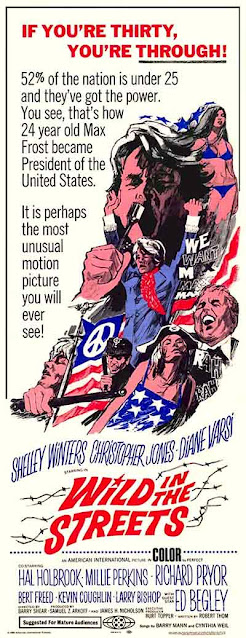
The movie Wild in the Streets was released on May 29, 1968 – the day before my 16th birthday.  


Click here to watch the trailer for that movie – which depicts current realities much more closely that I would have thought possible ten or twenty years ago.


*     *     *     *     *


I saw Wild in the Streets at a drive-in theatre – that's where the movies released by American International Pictures almost always ended up.


American International Pictures (or "AIP") was way, way ahead of other movie studios.  The company's based its strategy of making low-budget movies designed to appeal to teenagers on rigorously logical principles, to wit:


(a) A younger child will watch anything an older child will watch;


(b) An older child will not watch anything a younger child will watch;


(c) A girl will watch anything a boy will watch;


(d) A boy will not watch anything a girl will watch;


Therefore, to catch your greatest audience, you zero in on the 19-year old male.


AIP's most famous director/producer was Roger Corman, who later wrote a book called How I Made 100 Movies in Hollywood and Never Lost a Dime.  He is best known for his series of horror movies based on Edgar Allan Poe stories (all of which were in the public domain, which obviated the need to pay royalties), but he also directed the famous Peter Fonda motorcycle movie, The Wild Angels, and the Shelley Winters gangster movie, Bloody Mama (which featured a very young Robert DeNiro).    


*     *     *     *     *


In 1968, the voting age in the United States was 21.  In Wild in the Streets, a Kennedyesque Senate candidate calls for the voting age to be lowered to 18 – that actually happened three years later, when the 26th Amendment was ratified – and asks rock star cum revolutionary Max Frost to help make that happen.  


But when Frost performs at a televised rally for the candidate, he shocks his sponsors by proposing a more radical revision of the voting age in a song called "Fourteen or Fight."


Click here to see the scene from the movie that features Max and the Troopers playing "Fourteen or Fight."


(Did you notice who the drummer in Max's band is?  That's right – it’s Richard Pryor.)


Max's anthem triggers massive protests and demonstrations throughout the country, and the old-guard politicians cave in almost immediately, agreeing to lower the voting age to 15.  The kids quickly agree to this "compromise" and things quiet down temporarily, but the genie is out of the bottle.  


Christopher Jones as Max Frost

Max's girlfriend is elected to Congress, where she introduces a constitutional amendment to allow 14-year-olds not only to vote, but to hold political office.  Max's allies spike the Washington, DC water supply with LSD, and the amendment passes.  


Max is later elected President, and his administration rounds up everyone over 35 (including his mother, memorably portrayed by Shelley Winters) and sends them to "re-education" camps where they are given daily doses of LSD and live happily ever after.  


*     *     *     *     *


The star of Wild in the Streets was a young actor named Christopher Jones – he was the James Dean of his day, but is virtually forgotten today.  


Jones, who once went AWOL from the army to make a pilgrimage to Dean's family home in Indiana, was cast in a Broadway production of the Tennessee Williams play, The Night of the Iguana, when he was barely 20. He then studied at the Actors Studio under the legendary "method acting" proponent, Lee Strasberg.  A few years later, Jones moved to Hollywood and landed the starring role in a TV series called The Legend of Jesse James.  


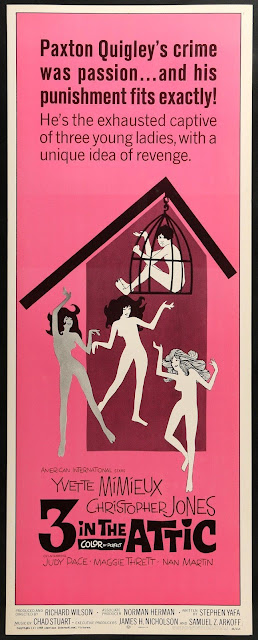
Jones starred in two AIP movies that were released in 1968 -- Wild in the Streets was followed by Three in the Attic, a movie guaranteed to inflame the fantasies of male teenagers even more than Wild in the Streets.


In Three in the Attic, Jones played a college student named Paxton Quigley, who picked up women as thoughtlessly (and about as frequently) as most men pick up the TV remote.  Unfortunately, three different women he is sleeping with at the same time discover what's going on and decide to gang up on him.


Here's where it gets really good.  You know how the three women decide to avenge Paxton's infidelity?  They lure him to the dormitory where one of them lives and lock him in the attic.  They punish him by taking turns having sex with him 24/7.  (I kid you not!)


Apparently this is too much of a good thing for even a healthy young male like Paxton, who is quickly worn to a frazzle – and goes on a hunger strike to protest his ill-treatment.  After a couple of weeks, Paxton's absence from class is noticed, and rumors about what is going on in the attic get back to his college's dean.   Paxton is released from captivity just in the nick of time and is taken to the hospital to recover from his ordeal.  The authorities decide that because Paxton was such a cad, the three women should not be punished.


Three in the Attic, which was filmed on the UNC campus in Chapel Hill, has some remarkably bad lines.  My favorite is the line Paxton uses to pick up Yvette Mimieux: "You have nice hair – it fits the mood of your butt."  (Her response is scornful – "You're infinitely boring" – but it doesn't take long for him to bed her.)


*     *     *     *     *


In 1970, Jones appeared in a serious, big-budget movie – Ryan's Daughter, a romantic drama set in Ireland during World War I and based very loosely on the novel Madame BovaryRyan's Daughter was directed by legendary British director David Lean – who directed the legendary epics The Bridge on the River Kwai, Lawrence of Arabia, and Doctor Zhivago – and also starred Robert Mitchum, Trevor Howard, John Mills (he's the village idiot), Leo McKern and Sarah Miles. 


Click here to watch the trailer for Ryan's Daughter.


The role of the young British army officer that went to Jones was originally written for Marlon Brando.  Peter O'Toole, Richard Harris, and Richard Burton were also considered for the role, but Lean decided he wanted Jones.  The two men did not work well together.  


During the filming of Ryan’s Daughter, Sharon Tate – the wife of director Roman Polanski – was killed by Charles Manson and his followers.  Jones later claimed that he was the father of the baby Tate was pregnant with when she was murdered.


After Tate's death, Christopher Jones walked away from his movie career.  He moved back to Los Angeles and devoted his energy to painting and to being a father to his five children.


*     *     *     *     *


Jones stuck to his guns and shunned Hollywood for a quarter of a century.  Among the movies he could have appeared in but turned down was Pulp Fiction.


But in 1996, Jones had a change of heart and agreed to do a cameo in a crime movie called Mad Dog Time, which featured Jeff Goldblum, Richard Dreyfuss, Gabriel Byrne, Ellen Barkin, Diane Lane, Burt Reynolds, Richard Pryor, Billy Idol, Paul Anka, and Rob Reiner – among others.  


One reviewer said that film was "jaw-droppingly incoherent."  Siskel and Ebert picked it as the worst movie of the year, and Ebert said it was "the first movie I have seen that does not improve on the sight of a blank screen viewed for the same length of time."  


That was apparently enough for Jones – he never appeared in another film. 


[NOTE: Jones died of cancer in 2014, leaving seven children.  He was 72.]


*     *     *     *     *


"Shape of Things to Come" – today’s featured song –was written by the husband-wife team of Barry Mann and Cynthia Weill, who also wrote "You've Lost That Lovin' Feelin'" (a huge hit for the Righteous Brothers), "Kicks" (Paul Revere and the Raiders), "On Broadway" (the Drifters), "We Gotta Get Out of This Place" (the Animals), "I Just Can't Help Believin'" (B. J. Thomas), and many other hit songs.  


The song is credited to Max Frost and the Troopers, which was Christopher Jones's fictional band in Wild in the Streets.  It appears that the singer was Paul Wybier and the band was Davie Allan & the Arrows, a Southern California surf music band that was signed by record producer Mike Curb in 1964.  Curb later signed a deal with AIP to supply it with movie soundtracks.  Allan – best known for his heavily distorted "fuzz" guitar sound – had his biggest hit with "Blue's Theme" an instrumental from the soundtrack for The Wild Angels.


Click here to listen to today’s featured record.


Click on the link below to buy the original “Shape of Things to Come” from Amazon: