Showing posts with label Johnny Gwynn. Show all posts

Sunday, July 7, 2013

Rula Bula -- "The Buccaneer" (2012)


Winds have cornered me
They’re howling like a banshee

Today's 2 or 3 lines presents the third part of our interview with Johnny Gwynn of Rula Bula.  Click here if you missed part two of that interview.

But first I want to finish up the account of my recent trip to Falmouth, MA -- Johnny's hometown.

After completing my ride on the Shining Sea Bikeway in Falmouth, I took my rental bike back to the store when I rented it.  Parked in front of the bike store was this odd-looking contraption:


That's a Bullitt cargo bike, a Danish product that can carry several hundred pounds of freight and claims to be the world's fastest cargo bike.  

Socialite and fashion designer Lilly Pulitzer -- the "Queen of Prep" -- died a few months ago at her Palm Beach home.  But her bright-colored clothing continues to be popular with affluent, preppy women from coast to coast:

Lilly Pulitzer
The Pink Polka Dot in Falmouth is one of many precious little stores that stock Lilly Pulitzer fashions:


My route from Cape Cod to the Providence, RI airport takes me close to Gene's Seafood in Fairhaven, MA:


Gene's hasn't changed a bit in the 25 or so years I've been stopping there.  I ordered fried clams and a Narragansett -- a perfect repast for a hungry biker/blogger:


It's a good thing that I ate when I did.  By the time I got to the Providence airport around 7 PM, nearly all of the restaurants and bars were closed for the evening:


It's time to wrap up our conversation with Johnny Gwynn of Rula Bula:

2 or 3 lines:  Johnny, where does Rula Bula play live -- on the Cape or elsewhere?

Gwynn:  We play a lot more in Boston, Providence, and other New England cities because there really aren't that many places to play on the Cape.  My brother Tyler and I once had a regular gig at The Parrot Bar in Bourne, and I’d love to play somewhere like that again.  It was just this little bar that was off the beaten path, but the folks there were so receptive and let us make our mistakes when we were just getting started and cheered us when we hit our stride.  I wouldn’t mind doing a gig there again.

2 or 3 lines:  What was it like to grow up in Falmouth?  Do you hate all the tourists like me who show up in the summer and cause traffic jams and make the restaurants too crowded?

Gwynn:  Growing up in Falmouth was great as a kid.  There are all these small shops and local hot spots you can ride your bike to and just explore on your own as a kid.  It’s small enough that everyone knows each other for the most part, so everyone is pretty friendly to each other growing up.  Summer time it gets crowded, but that's the price you pay for living on the Cape. 


Cape Cod summer traffic
2 or 3 lines:  Cape Cod has got to be so different in the offseason.

Gwynn:  From July 4 to Labor Day, the town is everyone else’s playground because all the locals are busy working in the restaurants and shops.  While it can be a hassle, you realize that it's because of the crazy tourists that you have summer jobs, and that money's important.  There's also a cool kind of camaraderie that comes with everyone working together in the same places and catching up after hours.  It’s almost a rite of passage for a local to work at some local restaurant as a waiter or cook for a summer.  But the fall is a really nice time on the Cape because its still warm and all the locals come out of the woodwork and get to enjoy the town without tourists.  For twenty- and thirty-somethings, living on the Cape year-round can get painstakingly boring because a lot of the shops and restaurants and bars close up until the next summer, but when you're a kid, fall means it’s your town again.

2 or 3 lines:  What do you like to do to relax?  Are you a beach guy, a fisherman, a sailor, or something else?

Gwynn:  Usually in the summertime I was working crazy hours because of restaurant jobs, but my friends and I would always plan out a few days where we would wake up early and go waterskiing.  We've known each other since elementary school, so even as we get older and schedules are getting more hectic, that's a great way for us to catch up and heckle each other about our skiing runs.  We’ll get out in the boat around 8 AM, when it is still usually very chilly, so we can get in as much skiing in before the water gets too rough.  We’ll ski around Surf Drive Beach or make the trip out to Naushon Island to ski in a little cove out there.  Falling head first into the water at high speeds is quite a way to start your day.  We recently got our hands on a wakeboard and have taught ourselves how to use that so we’ll be playing with that more this summer.  Just one more way we can break a leg.

Surf Drive Beach (Falmouth, MA)
2 or 3 lines:  What would you like to be doing in ten years?

Gwynn;  My dream job is songwriting -- whether for a band of my own or writing for other artists.  When I first picked up the guitar, I thought you were supposed to write your own stuff.  I never learned “Stairway To Heaven,” which is kind of embarrassing, but I’ve always been interested in writing something that people want to listen to.  To write something like a “Wonderwall” or “Baba O’Reilly” or “Born To Run,” something that sort of transcends time and that can get anyone’s foot tapping, that’s something that I strive for.  Money or fame isn’t the big goal -- just to know you’ve stuck a chord that resonates with all types of people, that’s the dream.

2 or 3 lines:  Tell me about writing "The Buccaneer."  Was that an easy song to write?  

Gwynn:  “The Buccaneer” was kind of a monster.  I had a few lines running around my head but nothing definite.  I started to just get really frustrated with it and didn’t know what to write. It wasn’t “writer’s block,” I just wasn’t happy with what I was coming up with.  Then a friend offered me a few writing exercises that just had me write "freestyle"  for a few minutes every day.  I started to piece together lines that focused more on sensory descriptions and vivid adjectives and verbs that set a tone rather than told an overall story.  So to me, that songs seems like more of an exercise than a complete song but lines like "Rattle, rock and roll" and "winds howling like a banshee" really place you in the moment rather than tell you about what it all means.


Rula Bula's Harpoon EP
2 or 3 lines:  The lyrics to Rula Bula's "Swing for the Fences, Kid" include several baseball expressions.  Is there a story behind that song?

Gwynn:  My dad works for the Pawtucket Red Sox, the Triple-A affiliate of the Boston Red Sox.  One of the team's claims to fame is that they were one of the teams in the longest game in organized baseball history -- 33 innings.  I grew up knowing this, but it wasn’t until I read Dan Barry’s book, Bottom of the 33rd, that I learned the stories of the people who played in that game.  Some guys would go on to major league careers while others never got even a "cup of coffee" in the majors.  Whether it’s sports or music or whatever, we all are fighting for that shot -- but once it comes, it’s all about the preparation and persistence that got you there. Writing a song about sports might be one of the tougher things to write about without relying on clichés, but I’m really proud with how it came out.

Wade Boggs discusses the 33-inning game
The 33-inning game between the Pawtucket Red Sox and Rochester Red Wings that Johnny is referring to began on the evening of April 18, 1981.  It was finally suspended at 4:07 am the next morning, after 32 innings and more than eight hours of play.  The 33rd and final inning was played in June, when the visiting Rochester Red Wings next came back to Pawtucket.  

The two most famous players who played in that game were Hall of Famers Cal Ripken and Wade Boggs, who combined that night for 6 hits in 25 at-bats.  Dallas Williams, who got his proverbial "cup of coffee" with the Orioles later that year, went 0-for-13 in the game.

Cal Ripken as a Rochester Red Wing
Perhaps the best story from the game involved Pawtucket relief pitcher Luis Aponte, whose manager told him he could leave the stadium after he had pitched.  Aponte arrived home around 3 AM and was confronted by an angry wife who demanded to know where in the hell he had been.  Aponte swore the game was still going on, and told his wife she could read about it in the Sunday newspaper.  Of course, the game was suspended far too late for the paper's deadline, and Aponte had to wait until Monday's edition was delivered to get out of the doghouse.

One final note about the lyrics to "Buccaneer."  Did you know that a banshee is a female spirit in Irish (or Scottish) mythology?  The banshee is a female fairy who begins to wail when someone is about to die -- especially when the death is going to be a violent one.  Accounts of banshees go back to the 14th century.  

Friday, July 5, 2013

Titus Andronicus -- "The Battle of Hampton Roads" (2010)


And now I’m heading west on 84 again
And I’m as much of an asshole as I’ve ever been
And there is still nothing about myself I respect
Still haven’t done anything I did not later regret
[NOTE:  The "84" refers to the eastern section of Interstate 84, which is the highway you would use to get from Boston to New Jersey if you wanted to bypass New York City.]

In the last 2 or 3 lines, we met Johnny Gwynn of Rula Bula, a native of Cape Cod.  If you missed that post, you can click here to read it.

Before continuing our conversation with Johnny, let's take a brief tour of his home town -- Falmouth, MA.

Falmouth was first settled in 1660 and incorporated in 1686.  It is named after an English town that has the third deepest natural harbor in the world.  

Falmouth's most famous native was Katherine Lee Bates, the author of the poem, "America the Beautiful," which she wrote after riding a mule to the top of Pikes Peak in 1893.


The Bates family home still stands on Falmouth's Main Street:


Bates graduated from Wellesley College, which was then and is still an all-female institution, and later taught English literature there.  She lived for many years in a "Boston marriage" with Katherine Coman, another Wellesley professor.  

The Wellesley dormitory that my wife was living in when I met her was named after Bates:  

Bates Hall at Wellesley College
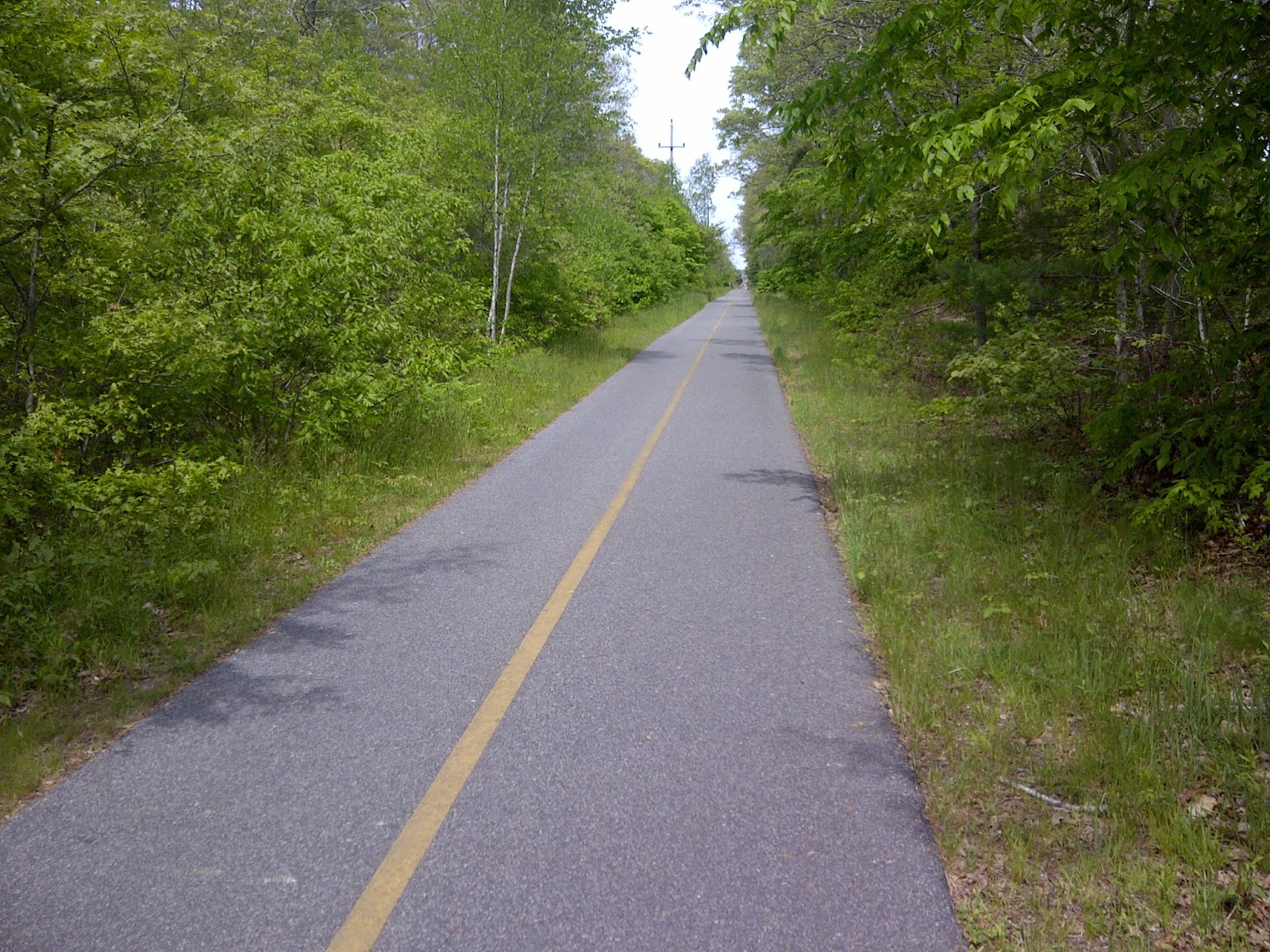
I rented a bike from a store located just a couple of blocks from the Bates home and rode the Shining Sea Bikeway, a rail trail that was named after a phrase from "America the Beautiful."  It runs from North Falmouth to the Woods Hole ferry terminal, which is a 10.7-mile one-way trip.


Like the Cape Cod Rail Trail, the Shining Sea Bikeway has plenty of twists and turns:


My rental bike (which came equipped with fenders and mustache handlebars) was not exactly what I was hoping for, but it got the job done.


The southern part of the Shining Sea Bikeway runs along Surf Drive Beach on Vineyard Sound, which is the body of water that separates Falmouth from Martha's Vineyard.


There are plenty of rosa rugosa shrubs along the trail.  Here's a pink one:


And here's a white one:


The northern part of the trail runs through salt marshes and cranberry bogs:


Last but not least, I spotted these Adirondack-style chaises longues from the trail:


Let's pick up our conversation with Johnny Gwynn of Rula Bula where we left off:

2 or 3 lines:  Who would you say influenced your musical  style?  If I was trying to describe your music to someone who had never heard it, what other groups would I compare you to if I wanted to give them an idea about what you sound like?

Gwynn: I like bands that can rock but also could write a catchy tune.  Oasis, The Clash, Yellowcard, the Dropkick Murphys, Muse, Arctic Monkey, the Foo Fighters, Black Keys, Green Day . . . I used to binge on these groups for weeks and weeks, dissecting each song to figure out why the hell I loved it so much.  If I had to name just one group that was a role model, I'd say the Clash:  their songs were always way different from each other, but you always knew when a song was a Clash song.  They did whatever they wanted to and but the music was always all their own.


The Clash
2 or 3 lines:  What covers do you perform?  Or do you stick to original songs?
   
Gwynn:  Covers are a touchy subject for me. I rarely play them with the band because I’m always afraid people will care more about the cover than the original.  I could play Rula Bula songs all night but if I were to do a cover of “Fortunate Son” or “Wonderwall,” that’s all everyone will remember us for and now we’re pigeonholed.

2 or 3 lines:  Doing covers of well-known songs probably makes the crowd happy.  Is it hard to make your audiences pay attention to unfamiliar originals?

Gwynn:  When I write songs, I am purposely aiming to give them hooks or make them catchy so the audience will at least be moderately interested even if they're hearing them for the first time.  But it’s a tough road to play original songs, especially on the Cape where it seems like bars only want cover bands -- so we have to go elsewhere for gigs.  That being said, I’m getting better at fitting in shortened covers as musical interludes to help keep the audience happy, but I’d rather crash and burn with an original then be remembered at the end of the night for performing a great cover of someone else's great song.

Rula Bula performing live
2 or 3 lines:  Who are some of your favorite current artists?

Gwynn:  Currently I am binging on Top 40 country music.  I’ve been working at a country music radio station and have had to listen to country music at a lot of events.  Most of it is not that interesting musically, but country songwriters are just unbelievably clever when it comes to lyrics.  They have a knack for pulling you into a moment and summing up something so succinctly with just a few simple words.  They take a little nugget of an idea and are able to weave a story from it.    

2 or 3 lines:  What's an example of a good country lyric you've heard recently?

Gwynn:  Luke Brayn’s “Drunk on You” and Florida Georgia Line’s “Cruise” are more pop music than traditional country, and most people would say those songs are really cheesy.  But lyrically, it’s like you’re just hearing a conversation from your buddy put to music.

2 or 3 lines:  I know that you really admire the music of Titus Andronicus.  Tell us why.

Gwynn:  Titus Andronicus really appeals to me because they have the grand ideas of the Who and the lyrical piss and vinegar of Against Me! or “Darkness on the Edge of Town”-vintage Bruce Springsteen.  Their songs have this huge, orchestral quality while still maintaining a punk-rock foundation. Their lyrics just cut right through the music.  The subject matter and delivery of lead singer Patrick Stickles's vocals  feel like you're ripping off a Band-Aid.  It’s like hearing rock for the first time with all the rawness and danger once associated with the genre.  “Four Score and Seven” just kills me and I think it sums up their huge sound and honest (and angsty) lyrical sensibilities.

[We'll wrap up our conversation with Johnny Gwynn in the next 2 or 3 lines.]

Titus Andronicus (which takes its name from an early Shakespeare tragedy) is a band that was formed in Glen Rock, New Jersey, in 2005.  The group has released three albums.


The title of the Titus Andronicus song I've chosen to feature, "The Battle of Hampton Roads," refers to the famous Civil War encounter between two ironclad ships, the Union's Monitor and the Confederacy's Virginia.  (You may know the Virginia as the Merrimack, which was the name of the Union ship that was captured by the Confederates and converted into the Virginia.)  It's the last track on The Monitor, a 2010 concept album with several Civil War-themed songs (including Johnny's favorite, "Four Score and Seven").

Titus Andronicus is a very hard band to get your arms around.  Some people call them a punk rock band, and there are certainly punk elements to some of their songs.  But punk songs are usually very short, and "The Battle of Hampton Roads" is just over 14 minutes long.  (There are four other tracks on The Monitor that are at least seven minutes long.)

As Johnny pointed out, Titus Andronicus sounds at time like a much rawer Bruce Springsteen.  (That's not a surprise given that the band's members hail from New Jersey.)  The group's music also has a Celtic feel at times -- some of their songs remind you of the Dropkick Murphys.

Patrick Stickles of Titus Andronicus
Patrick Stickles, the band's lead singer and principal songwriter, is a 2008 graduate of Ramapo College, a public liberal arts college in Mahwah, NJ.  It comes as no surprise that he (like Johnny Gwynn) was an English major -- his songs are full of literary references.  (One of his songs is titled "Albert Camus.")

To say that his lyrics are dark is the understatement of all understatements.  Here are a few lines from "Four Score and Seven":

Because these humans treat humans 
Like humans treat hogs,
They get used up, coughed up, and fried in a pan.
But I wasn’t born to die like a dog
I was born to die just like a man.

Here are a few more lines from "The Battle of Hampton Roads":

Is there a girl at this college who hasn’t been raped?
Is there a boy in this town that’s not exploding with hate?
Is there a human alive that can look themselves in the face without winking
Or say what they mean without drinking

Stickles generally writes in the first person, and his usual persona is best described as "bloody but unbowed," as these lines from "A Pot in Which to Piss" demonstrate:

I’ve been called out, cuckolded, castrated, but I survived
I am covered in urine and excrement but I’m alive
And there’s a white flag in my pocket never to be unfurled
Titus Andronicus is not for everyone, and I haven't decided whether its music is really for me or not.  Stickles is clearly very smart and well-read, and his lyrics pull no punches -- you have to admire him for not pulling any punches.  Having said that, you're not always in the mood to listen to a guy spill his guts all over your new shoes.  

Here's "The Battle of Hampton Roads":


Use this link to buy the song from Amazon:


Tuesday, July 2, 2013

Rula Bula -- "Just" (2012)


I’m just killing time with
Reckless abandon

On my last visit to Cape Cod, I went to a part of the Cape that I rarely visit in search of someplace new to ride my bike.  

Falmouth is located in the extreme southwestern corner of Cape Cod, and is a good hour's drive from Dennis, the town where my family's house is.


Most people from my part of the Cape rarely visit Falmouth.  Don't get me wrong -- Falmouth is a perfectly nice place.  But it's not easy to get there from where I stay, and the beaches and the restaurants and the shopping in Falmouth are pretty similar to the beaches and restaurants and shopping in my part of the Cape.

There is one particular reason to go to Falmouth.  If you want to go to the island of Martha's Vineyard -- especially if you want to take your car -- Falmouth is the home to the main ferry line to Martha's Vineyard.  (The island is only about seven miles from the Woods Hole ferry dock.)

Sign at the Woods Hole ferry dock
Falmouth is also where musician Johnny Gwynn, who wrote the song "Just," grew up and where he lives today.  

I found out about Johnny and his band, Rula Bula, when I was looking for Cape Cod-related songs to feature on 2 or 3 lines.  (I had a lot of photos from my Falmouth bike ride that I wanted to use, and I needed some suitable songs to accompany them.)  

About a year ago, Johnny wrote an article for a local publication that was titled "The Perfect Cape Cod Soundtrack."  It listed ten songs that mentioned Cape Cod.

Martha's Vineyard ferry unloading truck
2 or 3 lines had already featured two of those songs: Patti Page's "Old Cape Cod," and Vampire Weekend's "Walcott."  And to tell the truth, most of the other songs in Johnny's article kind of sucked.  (Do you really think there's a chance that a quality operation like 2 or 3 lines is going to feature that weak-ass piña colada song by Rupert Holmes?  No way, Jose.)  That wasn't Johnny's fault, of course -- you can't make chicken salad out of chicken you-know-what.

When I listened to Rula Bula's 2012 EP, Harpoon, I knew my problem was solved.  I had the Cape Cod connection I needed, and all four of the songs on that EP were solid -- my only problem was picking just two to feature on 2 or 3 lines.


Before we listen to "Just," let's get acquainted with Johnny Gwynn and learn about Rula Bula.

2 or 3 lines:  Johnny, when and how did you become a musician?  Did your parents give you music lessons when you were a kid, or are you self-taught?

Gwynn:  I played a mean saxophone in my school band, but started to really get into rock music in middle school.  I started taking lessons on a ratty old guitar my sister bought at a yard sale for $5 and I quickly became obsessed, learning technique in there lessons and then listening to my favorite bands and trying to learn their songs by ear.  It was all trial and error, but I just couldn’t get enough.  My dad always complained that if I had put half as much effort into learning French in high school I’d have become fluent.  I can’t speak a lick of French after five years of studying it in high school and college, but I can figure out a song’s chords and structure after just one listen.

2 or 3 lines:  What is the first music you remember liking on the radio?  Who were your favorite groups when you were a teenager?

Gwynn:  I listened to a lot of radio, frantically hitting the scan button to land on anything that piqued my interest -- pop, rock, rap, classic rock, disco. When I was growing up there was a lot of alternative rock on the radio so I was able to hear bands like Green Day, Chumbawumba, and Third Eye Blind.  I also learned about music from my uncle.  He bought tons of CDs and would play all this really cool UK music like Oasis and Fatboy Slim that I really fell in love with even though no one else I knew was listening to it.  My uncle also gave me my first CD, Bringing Down The Horse by the Wallflowers, and I must have worn down the CD from listening to “One Headlight.”  That stuff and the '90s alt-pop-rock really stuck with me because there were songs that had grit and really rocked but could still be liked by everyone.

2 or 3 lines: Tell us about your first band and the first time you performed in public?  

Gwynn:  After only six months of playing the guitar, a friend and I decided to enter a talent show.  We were going to play a Blink 182 song and I was elected to sing.  I can’t stress enough that I was not a natural singer, but balancing singing and guitar playing kept me too occupied to be nervous.  Soon after that I joined a band called Falling To First, which stayed together for a year and a half and played five live shows.  We wrote our own songs, which was a slow process, but playing something original always charged me up.  Even if the song bombed, it was still more thrilling to play music that was all your own.  

Rula Bula's Johnny Gwynn
2 or 3 lines: How did you get from Cape Cod to Arizona?

Gwynn:  I spent a summer at the University of Southern California the summer before my senior year of high school and really fell in love with being at a big school out west, with big-time sports and great music.  I applied to a bunch of schools, and decided to go to Arizona State University.  It had all the things I liked about USC, and the Phoenix music scene had bands like the Gin Blossoms and Jimmy Eat World.  I knew no one in Arizona and had no connection to the place, but just decided I’d take the plunge.  

2 or 3 lines:  Your next stop was Manchester, England.  It's a long way from Arizona to Manchester -- what inspired that move?

Gwynn:  Arizona was great but after a few years I really wanted to go to England -- probably because of  all the Britpop music that had fueled my growing up.  I had my heart set on London until an interview with a counselor who found out I loved music.  “Oh, then you’ll love Manchester!” she said.  Oasis, Joy Division, the Smiths, the Stone Roses . . . that’s where it was at.  Right there, I gave up on London and signed up for Manchester.

2 or 3 lines:  Was Manchester the right place for you?

Gwynn:  I spent ten months in Manchester and fell in love with the city.  By chance I got involved with a small record label that put on shows around the city and got the chance to play my songs at some gigs.  Playing original songs for British kids who dug the music -- man, there was nothing better than that!

2 or 3 lines:  So tell me how Rula Bula got started -- and where you got the name for the band.

Gwynn:  I wrote a ton of stuff in Manchester and once I got back, started recording songs with my brother on drums that become the A-Sides EP I released under my own name.  But I never wanted to be a solo artist so we fleshed out the band with bass and another guitar.  We didn’t have a name for the band until our first gig.  When they asked what the name of the group was, I said “Rula Bula,” which was the name of a bar back in Tempe I would frequent when I was at Arizona State.  Turns out the name means “a raucous good time” in Gaelic, so we decided to run with it.


The Rula Bula pub in Tempe, AZ
[NOTE: The bar Johnny refers to is still going strong in downtown Tempe, which is not a place where you might expect to find an Irish pub.  By the way, there's a traditional folk band from Emyvale, Ireland, that also calls itself Rula Bula -- so don't be confused.]

2 or 3 lines:  Who writes Rula Bula's original songs?  

Gwynn:  I write the music and lyrics to all of Rula Bula’s songs. I do bounce ideas off the band or have my brother, Tyler, take the helm with forming drum beats ('cause mine are usually painfully basic) but I’ve got my hands on the whole process.

2 or 3 lines:  Describe that process -- which comes first, music or lyrics?

Gwynn:  A lot of times I’ll just pick up a guitar or random instrument and just improvise, just jam on my own.  After playing jazz and improvising most of my solos for performances, doing that sometimes just releases an interesting groove that sparks my interest.  “Just” came like that, where I was just running through scales and random riffs and I hit on that guitar line that really caught my ear.  I played it for Tyler and he said, “We gotta keep that.”  

2 or 3 lines:  You make it sound like you let the song come to you.  Do you ever get stuck when you're writing a song?

Gwynn:  If I hit a wall, I immediately put the guitar down and then pick it up again later.  Sometimes it can take months or longer to figure out where I want a song to go.  I just have to wait for another riff or chord progression to reveal itself as a good piece to add to that first riff.


Johnny Gwynn on stage
2 or 3 lines:  So the music comes first and the lyrics come second.

Gwynn:  Yes, lyrics come last.  I beat myself up over lyrics for two reasons.  First, I was an English major in college and I've got to put that degree to work somehow.  Second, I never want my lyrics to come off as clichéd or just mundane.  I want to try to bring something else to the table so I try to go out on a limb and delve a little deeper into what I’m singing.  I remember reading a quote from Aimee Mann who said that for her, she just tried to avoid clichés and write something she’s never heard before in a song.  I try to write in a conversational voice but I also try to fit in weird turns of phrase that really get your attention.  I come from a big Irish family so we have all these weird sayings and expressions that most people had never heard before.  If I can write something that kind of stops the listener in his tracks or that piques the listener's interest because it's a different way of phrasing something, mission accomplished.

2 or 3 lines:  I really like the lyric from this song about "killing time with reckless abandon."  Killing time implies inactivity, while doing something with reckless abandon implies lots of action.  The two would seem to be opposites.  But because time never stands still every moment you waste brings you one moment closer to death, killing time is just about the most foolhardy and reckless activity there is.  What inspired the lyrics for "Just"?

Gwynn:  For “Just,” I was trying to sum up the feeling of being a "townie.”  I was living on the Cape after graduating from college, working entry-level jobs, always ending up at the same bars with the same people -- you know, "same stuff, different day."  As much as you want to get out, it doesn't take long before you start to develop a little indifference.  Before you know it, two months have passed and you’ve gotten nowhere on that plan to move on.  I wanted to communicate the frustration in the staleness of that situation and how you’re just wasting time until you finally make that move.

We'll continue our conversation with Johnny Gwynn in the next 2 or 3 lines.

Click here to listen to Rula Bula's "Just":


As a special treat for all of my loyal readers, I've talked Johnny into giving you a free download of "Just."  Click here to download the song for free.