The sign said
You got to have a membership card
To get inside (GRUNT!)
To get inside (GRUNT!)
[NOTE: I gave birth to 2 or 3 lines on November 1, 2009. That means we'll be celebrating my wildly popular little blog's tenth birthday in just a few days.]
* * * * *
Les Emmerson of the Five Man Electrical Band doesn't sing the word "Grunt!" on today's featured record – he just grunts. And that grunt is the emotional highlight of this song.
We'll get back to this song a little later, but first let's set the stage – which means traveling through another dimension . . . a dimension not only of sight and sound but of mind . . . a journey into a wondrous land whose inhabitants float in a sea of cheap 3.2% beer.
Our destination: Nina's "Green Parrot" bar, in Galena, Kansas. The time: a hot Friday evening in July 1971.
Galena – named after the most commercially important lead ore mineral, which was discovered in abundance in the area in 1877 – is and always has been (as far as I know) a depressed and depressing old mining town.
Within a few months of the discovery of lead ore, Galena was home to 10,000 souls, and its population eventually peaked at 30,000. The 2000 census reported that Galena had only 3287 residents, and I have to think that every single one of them would move away if they had their druthers.
Our destination: Nina's "Green Parrot" bar, in Galena, Kansas. The time: a hot Friday evening in July 1971.
 |
| Galena (with sphalerite) |
Within a few months of the discovery of lead ore, Galena was home to 10,000 souls, and its population eventually peaked at 30,000. The 2000 census reported that Galena had only 3287 residents, and I have to think that every single one of them would move away if they had their druthers.
Of course, I haven't been to Galena in years – I'm basing my opinions on what the town was like in the early 1970's. Maybe things have changed for the better. But I doubt it.
* * * * *
I don't think I ever took today's featured song too seriously, but I'm guessing a lot of people did. I sort of bought into all that counterculture stuff when I was in college, but I wasn't totally committed to it like a lot of people back then were.
"Signs" hit #3 on the Billboard chart in 1971, and was very successfully covered by Tesla in 1990. If you don't remember the gist of it, here's a very learned exegesis courtesy of Wikipedia:
The song was released during an era of social and political change, and its lyrics carry themes of tolerance and inclusion.
In the first verses of the song, the main protagonist (a hippie) expresses his frustration over a series of signs he encounters. One of the signs discourages "long-haired, freaky people" from applying for a job, while another expresses the "trespassers will be shot on sight" threat; yet another proclaims that membership cards are required to get into a club.
 |
While he is able to fool or dissuade his would-be antagonist in the first two instances — first, by tucking his hair up in a cap; the second, by telling the homeowner that God would frown upon his behavior — the protagonist, since he isn't wearing a button-down shirt or tie, is turned away at the door by the club usher.
In the final verse, the hippie shares his experiences of going to a church, where he is finally accepted for who he is. After pointing out a sign reading "Everybody welcome, come in, kneel down and pray," he is asked to contribute to the offering; however, when he realizes he has no money, he takes out a slip of paper, writing on it "Thank you, Lord for thinking about me, I'm alive and doing fine."
Did the author pull this from a paper he did for a college English class ("English 323: Popular Song Lyrics from the Psychedelic Era")? I've never read such constipated prose. "Able to fool or dissuade his would-be antagonist"? "Telling the homeowner that God would frown upon his behavior"? You gotta be kidding me.
* * * * *
I remember this song being on the jukebox at Nina's. Nina's wasn't the only bar in Galena, but it was the one favored overwhelmingly by Joplin teenagers. The summer of 1971 was the summer after my freshman year in college, when – and I am not exaggerating, as several other members of the Parkwood High School class of 1970 can testify – I spent six nights a week at Nina's. (On the seventh day, Nina rested – and I dried out.)
I worked from 7:00 AM to 3:30 PM that summer unloading railroad cars at a grocery warehouse for four bucks an hour.
Did I ever tell you the story about having to unload a Clorox car that had been humped – that's a technical railroad term – a little too brusquely? That resulted in a few dozen cases of gallon jugs of Clorox being crushed, leaving undiluted chlorine bleach an inch or two deep in the bottom of the car? (Where was OSHA when I needed them? My lungs have never been the same.)
And what about the time the Ralston-Purina car got banged around somewhere on the Frisco railroad tracks between St. Louis and Joplin, and after unloading Quaker Oats and Cap'n Crunch and a bunch of other stuff, I came to a few damaged cases of dog and cat food that had been festering inside the cars for several days in the August sun, and were literally crawling with maggots?
Did I ever tell you the story about having to unload a Clorox car that had been humped – that's a technical railroad term – a little too brusquely? That resulted in a few dozen cases of gallon jugs of Clorox being crushed, leaving undiluted chlorine bleach an inch or two deep in the bottom of the car? (Where was OSHA when I needed them? My lungs have never been the same.)
 |
| A vintage Clorox ad |
* * * * *
When my daily shift at the grocery warehouse was over, I came home and took a bath, gobbled down a home-cooked dinner (with nary a words of thanks), and headed out after a "conversation" with my mother.
This "conversation" generally went something like this:
Her: "Where are you going?"
Me: "Out."
Her: "When will you be back?"
Me: "Not too late."
Then it was off to Galena – via old Route 66, part of the nightly convoy of Missouri teenagers heading to Kansas for 3.2% beer, which could be legally purchased by 18-year-olds.
Going in the other direction was an equally heavy stream of Kansas 21-year-olds beating it to Missouri to visit our many classy cocktail lounges – liquor-by-the-drink (not to mention many other accoutrements of civilization) being illegal in Kansas.
 |
It's amazing there weren't more automobile-related deaths and dismemberments at the end of the evenings as both groups returned home (usually much the worse for wear) but it was only about a 10-mile trip, and I don't recall any serious accidents during those summers. However, I do remember a few close calls passing buses and 18-wheelers on the two-lane highway. But my 1970 Olds Cutlass Supreme has a 350-cubic inch V8, so passing didn't take long when you really stomped on the gas.
(NOTICE: Please drink responsibly. Always have a designated driver. Do as I say, not as I did.)
* * * * *
I could talk about Galena for hours. I remember an amazing number of details, like the beer prices at Nina's. My friends and I usually went for quarts of beer – not regular bottles. (We were frugal types – children of children of the Great Depression.) The premium brands – Budweiser, Schiltz, Coors – were 35 cents a quart, while the bargain brands – Pabst, Hamm's, Stag, Busch – went for 25 cents, as I recall.
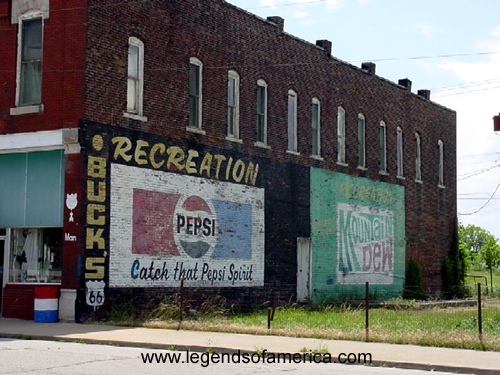
You could get the premium quarts for a quarter each at "Uncle" Buck's Recreation Parlor across the street, plus watch domino games between farmers in bib overalls and play pool on non-coin-operated pool tables, with the balls hand-racked by a gnarly little dude wearing a carpenter's apron full of change. It was right out of a Dickens novel – if Dickens had written any novels about rednecks and beer-soaked teenagers, that is.
We spent so much time at Nina's that we ended up hanging out with the bartenders after hours – a couple of cousins named Ron and Marilyn, who gave us extra beer-company lights and window signs that Nina didn't need.
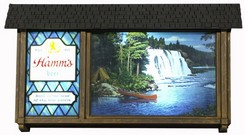
I fondly remember one very chic Hamm's lamp, which was by far the most notable piece of decor in my college apartment:
* * * * *
We spent so much time at Nina's that we ended up hanging out with the bartenders after hours – a couple of cousins named Ron and Marilyn, who gave us extra beer-company lights and window signs that Nina didn't need.
I fondly remember one very chic Hamm's lamp, which was by far the most notable piece of decor in my college apartment:
* * * * *
What did we actually do for those five hours a night, six nights a week? Drinking two quarts of beer didn't take all that much time, and Nina's didn't serve food. (Well, they had chips and Beer Nuts and pickled hard-boiled eggs and SlimJims -- but not much else.)
We didn't dance to the jukebox – I don't think that was allowed. (Nina, the mean, squinty, uncommunicative old woman who owned the joint, had a lot of rules, and you either followed them or got kicked out.) There was a coin-operated pool table, but I rarely played it – I wasn't good enough, and it was always in use. I don't think we played cards while we were at Nina's – spades and hearts were obsessions of ours in those years – although we might have. And there were no TVs to watch.
We didn't dance to the jukebox – I don't think that was allowed. (Nina, the mean, squinty, uncommunicative old woman who owned the joint, had a lot of rules, and you either followed them or got kicked out.) There was a coin-operated pool table, but I rarely played it – I wasn't good enough, and it was always in use. I don't think we played cards while we were at Nina's – spades and hearts were obsessions of ours in those years – although we might have. And there were no TVs to watch.
So I assume we mostly talked. Talked with the girls who came to Nina's – or talked about the girls who came to Nina's (or the girls who didn't come to Nina's).
Sometimes one of the smart, quiet girls from your English class would show up and it would suddenly dawn on you that she was really quite attractive, and you wondered why you never asked her out back in high school because she was not only cute, but also nice and not stuck-up and no doubt would have made a much more satisfactory girlfriend than most of the girls you did pursue.
Sometimes one of the smart, quiet girls from your English class would show up and it would suddenly dawn on you that she was really quite attractive, and you wondered why you never asked her out back in high school because she was not only cute, but also nice and not stuck-up and no doubt would have made a much more satisfactory girlfriend than most of the girls you did pursue.
 |
| A Schlitz "tall boy" can |
* * * * *
Some nights – especially Fridays and Saturdays – we ventured further west, to Baxter Springs or even to Pittsburg, a college town with more varied entertainment opportunities. But most nights, it was Nina's.
I don't know Nina's last name. But I can see her right now, almost 40 years later, wearing a white waitress's uniform, sitting behind a hostess podium just inside the front door, checking IDs under a small desk lamp with her beady little eyes. (It did not matter one whit if you came to Nina's every Monday through Saturday for three months – as I did – because she would still look at you as if she had never seen you before and simply hold out her hand for your driver's license.) I know she died years ago, and I heard they auctioned off the bar's furnishings after her passing.
In 2006, a mine-shaft collapse resulted in the 114-year-old building that housed Nina's being condemned and later razed. Here's what the old gal looked like in her final days:
Click here to read more about Nina's.
In 2006, a mine-shaft collapse resulted in the 114-year-old building that housed Nina's being condemned and later razed. Here's what the old gal looked like in her final days:
 |
* * * * *
I had a hard time deciding which song from Nina's jukebox I should honor. Some of the songs I remember vividly from Nina's were "Long Cool Woman In a Black Dress" (the Hollies sans Graham Nash), "Sweet Hitchhiker" (Creedence Clearwater Revival's last big hit before they broke up), "One Fine Morning" (Lighthouse, who were Canadian – as was the Five Man Electrical Band), and "Liar" (Three Dog Night's darkest single).
 |
| The Five Man Electrical Band |
Then there was "Brandy" (by Looking Glass), a favorite of a girl I hung out with one summer. (I hesitate to say I "dated" her because about the only thing we ever did together was go to Nina's and get drunk.)
At night when the bars close down
Brandy walks through a silent town
And loves a man who's not around
She still can hear him say
She hears him say "Brandy, you're a fine girl –
What a good wife you would be.
But my life, my lover, my lady is the sea"
That song seems to have been a major favorite among girls of that era, but it made no sense to me. Why in the world would a girl like a song about a sailor who told the woman who loved him that the sea was more important to him than she was, and then sailed away for a couple of years.
* * * * *
Maybe those girls agreed with this line from humorist Anne Taintor: "She liked imaginary men best of all."
Here are some more good Anne Taintor lines:
– "Had she punished him enough? How could she be sure?"
– "One just had to admire his deluded self-confidence!"
– "Looking for trouble? Look no further!"
And my all-time favorite:

* * * * *
Hmmm . . . now where was I? Oh, yes . . . now I remember.
Click here to listen to "Signs." (If you're from Joplin, close your eyes and pretend you're hearing it on Nina's jukebox back in 1971.)
Click here to buy "Signs" from Amazon.


 Posts
Posts

