Radio Caroline was a legendary pirate radio station that began broadcasting rock ’n’ roll hits to the UK and Europe in 1964 from a converted Danish ferry anchored in international waters:
(The first record that Radio Caroline played? “Not Fade Away,” by the Rolling Stones.)
The British government, which was determined to maintain its legal monopoly on radio broadcasting, eventually forced Radio Caroline off the air.
But the station later resurfaced as an internet streaming station. Click here to go to its website.
* * * * *
A couple of months ago, I began to follow Suzy Wilde – the self-proclaimed “superannuated rock chick” who broadcasts a weekly Radio Caroline show from her home in the south of France – on Facebook.
Suzy Wilde
Suzy recently challenged her followers to ruin a band’s name by changing one letter.
At first, this seemed like a rather silly attempt to getting more people to post on her Facebook page. But many of the responses posted by her readers were quite brilliant.
Here are some of the best:
– Jethro Dull
– Rolling Scones
– Moldy Blues
– Canned Meat
– Poo Fighters
– Alice Pooper
– Huey Lewis and the Jews
– Guns ’n’ Moses
– The Belch Boys
– The Small Feces
– Cheap Prick
– The Boobie Brothers
– T. Sex
– Pearl Ham
– AC/AC
– DC/DC
– Grand F*ck Railroad
– Blue Öyster Cu*t
and, last but not least:
* * * * *
“Slow Ride” was a top-20 hit for Foghat in 1975.
There’s not a lot to the song, but Foghat stretched the hell out of it.
Director Richard Linklater chose to play “Slow Ride” over the final scene and closing credits of Dazed and Confused. It was the perfect choice.
(I miss Joey Lauren Adams . . . )
Click here to listen to the album version of “Slow Ride” – all eight minutes and 14 seconds of it.
Click on the link below to buy the song from Amazon:
Been dazed and confused for so long it's not true Wanted a woman, never bargained for you
[NOTE: Led Zeppelin may have stolen “Dazed and Confused” from Jake Holmes. But it’s still the best track on what may be the best classic rock album ever, so it should come as no surprise that I chose it for the inaugural class of the 2 OR 3 LINES “GOLDEN DECADE” ALBUM TRACKS HALL OF FAME. Here’s a mashup of three 2015 posts I did on three different recordings of “Dazed and Confused.”]
The Yardbirds went through three of the greatest guitarists in rock music history – Eric Clapton, Jeff Beck, and Jimmy Page – in their five-year history.
When Clapton decided to leave the Yardbirds in 1965, Page was asked if he wanted to replace him. Page declined the offer but recommended his friend Beck, and Beck was hired.
Jimmy Page and Jeff Beck
In May 1966, Beck went into the studio to do some solo recording. He called on Page to help him work up some songs to record.
Page came up with the idea of basing an instrumental on Maurice Ravel’s famous 1928 composition, Boléro (which became enormously popular when it was featured in the Bo Derek movie, 10).
Beck then recruited disaffected Who members Keith Moon and John Entwistle to play drums and bass. Moon showed up for the session, but Entwistle did not, and John Paul Jones – who later joined Jimmy Page in Led Zeppelin – played bass instead.
Keith Moon
The recording of “Beck’s Bolero” went so well that Beck, Page, Moon, and Jones talked about forming a group and doing more recording. According to Page, Moon quipped “Yeah, that'll go down like a lead Zeppelin,” which gave Page the idea for the name of the group he did form after the eventual breakup of the Yardbirds. (John Entwistle has also claimed credit for the quip.)
Page got the songwriting credit for “Beck’s Bolero,” although Beck later said that he should have shared that credit. Page also claimed that he was the record's actual producer, but he did not get the producing credit.
After “Beck’s Bolero” was recorded, Page was invited to join the Yardbirds. During the few months when both Beck and Page were in the group, Beck played lead guitar and Page shifted to bass.
The only comparable situation that comes to mind is seven-time All-Star shortstop Alex Rodriguez shifting to third base when he joined the Yankees, leaving shortstop to Derek Jeter.
A-Rod and the Captain
The popularity of the Yardbirds was declining by the fall of 1966, when Beck was fired from the band and Page took over as lead guitarist.
The band finally broke up in July 1968. Drummer Jim McCarty and singer Keith Reif authorized Page and bassist Chris Dreja to put together a new group – to be called the New Yardbirds – to fulfill a contractual commitment to play a series of shows in Scandinavia that fall.
Page wanted Terry Reid to be the new group’s lead singer. Reid said no, suggesting that Page use Robert Plant instead. Plant then recommended his former Band of Joy bandmate, John Bonham, to be the drummer. When Dreja decided to drop out of the new group, Page recruited John Paul Jones -- the bassist on “Beck’s Bolero.”
The New Yardbirds played the Scandinavian dates, then went into the studio and recorded an album in just nine days. Dreja threatened legal action if the group continued to call itself the New Yardbirds, so they became Led Zeppelin.
Led Zeppelin
Atlantic Records signed them to a contract without ever having seen them perform. The first Led Zeppelin album was released in January 1969, and the rest . . . is history.
* * * * *
That album included a song called “Dazed and Confused,” which also was the title of a song from a relatively obscure 1967 album by Jake Holmes.
Holmes opened for the Yardbirds at the Village Theatre in New York City on August 25, 1967. Holmes performed “Dazed and Confused” that night, which he later described as the night that his song “fell into the loving arms of Jimmy Page.” The Yardbirds’ drummer, Jim McCarty, said years later that he was so impressed by “Dazed and Confused” that he bought the Holmes album the next day so the group could work up a cover of the song.
But the author of a book about the Yardbirds quotes a man who says he saw Jimmy Page himself buying the Holmes album at a particular record store on Bleecker Street. The Yardbirds never recorded “Dazed and Confused” in the studio. But there are several recordings of them performing the song live before they disbanded. Click here to view one of them.
* * * * *
Led Zeppelin recorded “Dazed and Confused” with entirely new lyrics – except for the words of the song’s title. But the arrangement was recognizable as the same basic arrangement that the Yardbirds had used. That’s not surprising since Page was largely responsible for the Yardbirds’ arrangement.) I think most people would say that Jake Holmes’s “Dazed and Confused” is the same song as Led Zeppelin’s “Dazed and Confused.”But Led Zeppelin did not give a songwriting credit to Jake Holmes. Although Holmes heard Led Zeppelin’s “Dazed and Confused” shortly after it was released, he didn’t do anything about it for for more than a decade.
When Holmes did finally write to Page to ask for a shared songwriting credit and some do-re-mi, he never heard back.
* * * * *
Led Zeppelin has been sued several times for copyright infringement. In 1985, veteran blues musician Willie Dixon sued the band, alleging that “Whole Lotta Love” infringed not just one, but two of Dixon’s songs. (The case was settled out of court.) More recently, the estate of the late Randy California claimed that “Stairway to Heaven” infringed California's composition, “Taurus,” which was recorded by the band Spirit in 1967. Holmes finally sued Page in 2010. His complaint was eventually dismissed – probably because the two parties agreed to an out-of-court settlement. While the terms of any such settlement have never been released, it appears that Holmes won at least a partial victory. The Led Zeppelin reunion concert album, Celebration Day – which was released several months after the presumed settlement of the Holmes lawsuit – contains this songwriting credit for “Dazed and Confused”: “Jimmy Page; inspired by Jake Holmes.”
To read more about the controversy over the authorship of “Dazed and Confused,” you can click here – or you can click here -- or you can click here.
Click here to listen to the Led Zeppelin recording of “Dazed and Confused.”
Click on the link below to buy the song from Amazon:
Richard Linklater’s delightful new movie, Everybody Wants Some!! – it’s title is taken from the name of a Van Halen song – has a wonderful soundtrack that includes disco, country, punk, funk, and classic rock songs. (You can click here to read what I said about that movie in a previous 2 or 3 lines.)
The spiritual predecessor to Everybody Wants Some!! is Linklater's 1993 movie, Dazed and Confused, which was named after the last track on side one of Led Zeppelin’s eponymous debut album – perhaps the greatest rock album from start to finish ever recorded.
The music on the Dazed and Confused soundtrack isn’t as varied. In that movie, Linklater stuck mostly to artists whose music was popular on album-oriented rock stations in the seventies – Aerosmith, Deep Purple, Alice Cooper, Foghat, ZZ Top, Kiss, Lynyrd Skynyrd, and Steve Miller.
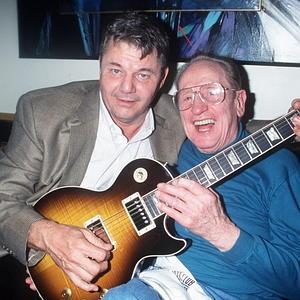
Steve Miller was born in Milwaukee in 1943. His parents were the best man and maid of honor at Les Paul and Mary Ford’s wedding. Paul encouraged the very young Miller to continue practicing the guitar.
Steve Miller and Les Paul in 2000
When the family moved to Dallas in 1950, Miller attended the fancy-schmancy St. Mark’s School with Boz Scaggs. The two attended the University of Wisconsin together and formed a band that played at a few clubs in Madison.
Miller left college without earning a degree and moved to Chicago, where he played with Muddy Waters, Howling’ Wolf, Buddy Guy, and other blues greats. After stops in New York City and Austin, he loaded up his VW bus and drove to San Francisco, where he hooked up again with Boz Scaggs and formed the Steve Miller Band in 1966.
I bought Steve Miller’s Anthology album – which included today’s featured song, “Living in the U.S.A.” – in 1973, when I was a junior in college. It’s a two-record compilation with tracks from five of Miller’s first seven albums.
After releasing Anthology, Steve Miller took a sharp turn in the direction of Schlocktown. Over the next five years, he cranked out big radio hits like “The Joker,” “Take the Money and Run,” “Rock’n Me,” “Fly Like an Eagle,” “Jet Airliner,” and “Swingtown.” Those songs weren’t exactly bad, and they weren’t exactly good.
What they were exactly were hits. Everyone of them made it into the top twenty, and two made it all the way to number one.
I’ll stick with “Living in the U.S.A.,” thank you very much. It’s loose and chaotic and sounds like everyone involved in recording it had a great time. It opens with a recording of a drag racer’s engine and closes with one of the great random lines of all time: “Somebody give me a cheeseburger!”
Once again, 2 or 3 lines has delivered. I promised you nine consecutive narcissism-less posts, and that's exactly what I gave you.
Today, we complete the journey we started three weeks ago when we featured the Yardbirds' cover of "I'm Not Talking" by coming full circle to the Yardbirds and their cover of "Dazed and Confused" -- via the Misunderstood, Mose Allison, Sonny Boy Williamson II, the Who, Led Zeppelin, and Jake Holmes.
The Yardbirds never recorded Jake Holmes's song, "Dazed and Confused," in the studio. But there are several recordings of them performing the song live before they disbanded in 1968.
The Yardbirds left some of Holmes's lyrics as they were, but changed other lines.
For example, in the original "Dazed and Confused," the second lines of both the first and the last verses begin with this question: "Am I being choosed?"
I think that's a brilliant little touch – the singer is so dazed and confused by the mind games being played on him by the (female) object of his affections that correct grammar goes right out the window.
But the Yardbirds' lead singer, Keith Reif, never sang "Am I being choosed?" when they performed the song. I'm guessing the group thought that line would be misunderstood by their audiences.
The Jimmy Page-era Yardbirds
After the Yardbirds broke up, lead guitarist Jimmy Page formed Led Zeppelin, which recorded "Dazed and Confused" with entirely new lyrics – except for the words of the song's title.
The arrangement was recognizable as the same basic arrangement as the Yardbirds used. That's not surprising since Page was largely responsible for the Yardbirds' arrangement. But I think most people would say that Jake Holmes's "Dazed and Confused" is the same song as Led Zeppelin's "Dazed and Confused."
But Led Zeppelin did not give a songwriting credit to Jake Holmes. And although Holmes heard Led Zeppelin's "Dazed and Confused" shortly after it was released, he didn't do anything about it for for more than a decade.
And when Holmes did finally write to Page to ask for a shared songwriting credit and some do-re-mi, he never heard back.
Led Zeppelin has been sued several times for copyright infringement. In 1985, veteran blues musician Willie Dixon sued the band, alleging that "Whole Lotta Love" infringed two of Dixon's songs. (The case was settled out of court.) And only last year, the estate of the late Randy California claimed that "Stairway to Heaven" infringed California's composition, "Taurus," which was recorded by the band Spirit in 1967.
Holmes finally sued Page in 2010. His complaint was eventually dismissed – probably because the two parties agreed to an out-of-court settlement.
While the terms of any such settlement have never been released, it appears that Holmes won at least a partial victory. The Led Zeppelin reunion concert album, Celebration Day – which was released several months after the presumed settlement of the Holmes lawsuit – contains this songwriting credit for "Dazed and Confused": "Jimmy Page; inspired by Jake Holmes."
To read more about the controversy over the authorship of "Dazed and Confused," click here – or click here -- or click here – or better yet, click on all three.
The Yardbirds on "Bouton Rouge"
Click here to watch a wonderful video of the Yardbirds performing "Dazed and Confused" on a French television show called Bouton Rouge ("Red Button").
I closed the last 2 or 3 lines by stating that Led Zeppelin's "Dazed and Confused" may be the best track on the best rock album in history.
And I'm opening this 2 or 3 lines by stating that the lyrics to Jake Holmes's "Dazed and Confused" – which was released in June 1967 – are far superior to the lyrics of Led Zeppelin's "Dazed and Confused" (which was recorded over a year later).
Jake Holmes
In fact, those lyrics are so good that I had a hard time deciding whether to open this post with the first verse (which is quoted above) or the last verse, which I will quote here:
I'm dazed and confused, and it's all upside down
Am I being choosed? Do you want me around?
Secrets are fun to a certain degree
But this one's no fun, 'cause the secret's on me
"Dazed and Confused" was released on "The Above Ground Sound" of Jake Holmes, his 1967 debut album. The ten songs on the album feature Holmes's vocals, two guitars, and a bass, but no drums.
Holmes released an album every year from 1967 to 1971, but none were very successful. He also wrote songs for the Four Seasons and Frank Sinatra, but was most successful as an advertising jungle writer: his most famous jingles are "Be All That You Can Be" (for the U.S. Army) and "I'm a Pepper" (for Dr. Pepper).
Holmes opened for the Yardbirds at the Village Theatre in New York City on August 25, 1967. Holmes performed "Dazed and Confused" that night, which he later described as the night that his song "fell into the loving arms of Jimmy Page" – who was then the lead guitarist of the Yardbirds.
The Yardbirds' drummer, Jim McCarty, said years later that he was so impressed by "Dazed and Confused" that he bought the Holmes album the next day so the group could work up a cover of the song.
The author of a book about the Yardbirds quotes a man who says he saw Jimmy Page himself buying the Holmes album at a particular record store on Bleecker Street.
The next 2 or 3 lines will feature the Yardbirds' cover of "Dazed and Confused."
Here's the original recording of that song. It's fabulous, but it's very quiet at times – so turn up the volume!
Been dazed and confused for so long it's not true Wanted a woman, never bargained for you
The Yardbirds went through three of the greatest guitarists in rock music history – Eric Clapton, Jeff Beck, and Jimmy Page – in their five-year history.
When Clapton decided to leave the Yardbirds in 1965, Page was asked if he wanted to replace him. Page declined the offer but recommended his friend Beck, and Beck was hired.
Jimmy Page and Jeff Beck
In May 1966, Beck went into the studio to do some solo recording. He called on Page to help him work up some songs to record.
Page came up with the idea of basing an instrumental on Maurice Ravel's famous 1928 composition, Boléro (which became enormously popular when it was featured in the Bo Derek movie, 10).
Beck then recruited disaffected Who members Keith Moon and John Entwistle to play drums and bass. Moon showed up for the session, but Entwistle did not, and John Paul Jones – who later joined Jimmy Page in Led Zeppelin – played bass instead.
Keith Moon
The recording of "Beck's Bolero" went so well that Beck, Page, Moon, and Jones talked about forming a group and doing more recording. According to Page, Moon quipped "Yeah, that'll go down like a lead Zeppelin," which gave Page the idea for the name of the group he did form after the eventual breakup of the Yardbirds. (John Entwistle has also claimed credit for the quip.)
Page got the songwriting credit for "Beck's Bolero," although Beck later said that he should have shared that credit. Page also claimed that he was the record's actual producer, but he did not get the producing credit.
After "Beck's Bolero" was recorded, Page was invited to join the Yardbirds. During the few months when both Beck and Page were in the group, Beck played lead guitar and Page shifted to bass.
The only comparable situation that comes to mind is seven-time All-Star shortstop Alex Rodriguez shifting to third base when he joined the Yankees, leaving shortstop to Derek Jeter.
A-Rod and the Captain
The popularity of the Yardbirds was declining by the fall of 1966, when Beck was fired from the band and Page took over as lead guitarist.
The band finally broke up in July 1968. Drummer Jim McCarty and singer Keith Reif authorized Page and bassist Chris Dreja to put together a new group – to be called the New Yardbirds – to fulfill a contractual commitment to play a series of shows in Scandinavia that fall.
Page wanted Terry Reid to be the new group's lead singer. Reid said no, suggesting that Page use Robert Plant instead. Plant then recommended his former Band of Joy bandmate, John Bonham, to be the drummer. When Dreja decided to drop out of the new group, Page recruited John Paul Jones -- the bassist on "Beck's Bolero."
The New Yardbirds played the Scandinavian dates, then went into the studio and recorded an album in just nine days. Dreja threatened legal action if the group continued to call itself the New Yardbirds, so they became Led Zeppelin.
Led Zeppelin
Atlantic Records signed them to a contract without ever having seen them perform. The first Led Zeppelin album was released in January 1969, and the rest . . . is history.
That album included a song called "Dazed and Confused," which also was the title of a Jake Holmes song that the Yardbirds had covered a number of times in concert. The title was not the only thing the two songs had in common.
There's a point to all this exposition. Actually, there's more than one point.
For one thing, the previous 2 or 3 lines featured a Who song, and I needed to build a bridge between that song and Led Zeppelin's "Dazed and Confused."
I'm also building a much longer bridge between the first post in this series – which featured the Yardbirds' cover of "I'm Not Talking" – and the last one, which will feature (spoiler alert!) the Yardbirds' cover of "Dazed and Confused."
Finally, there's the issue of the songwriting credit for Led Zeppelin's "Dazed and Confused," which we will turn to in the next 2 or 3 lines.
2 or 3 lines is truly a seamless web. Nothing on 2 or 3 lines is there without reason. (Mind blown!)
Here's "Dazed and Confused," which is arguably the best track on what is arguably the best rock album ever recorded. (I can't prove that statement is true, but you can't prove it's not.)




 Posts
Posts

