Showing posts with label Clash. Show all posts

Friday, October 14, 2022

Ramones – "Blitzkreig Bop" (1976)


What they want, I don't know

They're all revved up

And ready to go


Have you ever been “all revved up and ready to go,” wanting something – but you didn’t know exactly what?


God knows I have been.  (Most recently, just a couple of days ago.)


*     *     *     *     *


I recently heard Steven Van Zandt – among other things, he was Bruce Springsteen’s guitarist and a regular on The Sopranos – talking about the birth of punk rock on his “Little Steven’s Underground Garage” show on SiriusXM Radio. 


Van Zandt told how the Ramones – who were largely unknown in the UK at the time – made their British debut at the Roundhouse in London on July 4, 1976.  (Also on the bill that night were the Flamin’ Groovies, and the Stranglers – two of my all-time favorite groups.)


I understood Van Zandt to say that the Clash, the Damned, the Sex Pistols, and Chrissie Hynde (who would form the Pretenders in 1978) were present at that concert, and gave credit to the Ramones for inspiring all of them.


But when I sat down at my computer and started researching that legendary show, I found out that the Clash and the Sex Pistols were in Sheffield that night, playing at the Black Swan pub in Sheffield – which is a three-hour drive from London.


I think it’s safe to say that those two bands weren’t in the audience for that legendary Ramones show at the Roundhouse.


*     *     *     *     *


At times, “Little Stevie” Van Zandt is so full of sh*t that his eyes are brown.  But I’m not sure that it’s his fault that he was wrong about where the Clash and Sex Pistols were that night.


In the classic 1996 book, Please Kill Me: the Uncensored History Oral History of Punk, Ramones manager Danny Fields is quoted as saying that Mick Jones and Paul Simonon of the Clash were at the Roundhouse concert.  He goes on to say that “Paul and Mick weren’t in the Clash yet” – according to Fields, they were “afraid to play until they saw the Ramones.”  


The Clash were brand new – in fact, the Black Swan gig was their first public appearance – but they had been rehearsing for a few weeks before their July 4 debut.  So Fields got it wrong when he was interviewed by the authors Please Kill Me.


The late Joey Ramone
(né Jeffrey Hyman)

The memory of the Ramones’ late bass player, Dee Dee Ramone, wasn’t any better.  He is quoted in Please Kill Me as saying that Johnny Rotten of the Sex Pistols came backstage to meet the Ramones at the Roundhouse – but the Sex Pistols were playing in Sheffield that night.


*     *     *     *     *


The Ramones, Flamin’ Groovies, and Stranglers followed up their July 4 Roundhouse appearance with a show at a different London venue the next night.  Presumably that’s the performance attended by the Clash, Sex Pistols, et al.  


Mystery solved, thanks to good ol’ 2 or 3 lines!


*     *     *     *     *


The Please Kill Me interviews of Danny Fields and Dee Dee Ramone included some very interesting stuff.  


Fields – who signed the MC5 and the Stooges to record deals before he discovered and signed the Ramones – was openly gay, and he was immediately attracted to Clash bassist Paul Simonon:


Paul was sitting around with these white socks and they were really dirty and I thought, boy, that’s cool.  I got a big crush on Paul . . . because I loved his socks.  They were really dirty thin white socks.  You could see where they started to get real dirty as soon as they got below the shoe line.


Former Sex Pistol Johnny
Rotten (né John Lydon) today

Dee Dee Ramone told an equally yucky story:


The Ramones always put a few drops of piss in anything they give their guests as a little joke.  When Johnny Rotten came to see the Ramones . . . he asked . . . if he could come backstage and say hello.  Johnny Ramone said it was alright and was very friendly to Johnny Rotten when they met.  He shook his hand, patted him on the back, and asked him if he wanted a beer.  Ha ha ha.


Johnny Rotten took it and drank it down in one gulp.  


*     *     *     *     *


“Blitzkrieg Bop” was the first single the Ramones ever released.  It was also the first track on their eponymous debut album, which was released in April 1976.


Click here to listen to “Blitzkreig Bop.”


Click on the link below to buy the song from Amazon:


Tuesday, February 15, 2022

Clash – "Clampdown" (1979)


But you grow up and you calm down

And you're workin' for the clampdown


After I chose today’s featured record to be one of the inaugural members of the 2 OR 3 LINES “SILVER DECADE” HALL OF FAME, I learned that Robert “Beto” O'Rourke had quoted its lyrics in a debate with Ted Cruz in 2018, accusing Cruz of “working for the clampdown.” 


(For those of you who don’t follow politics, Cruz – who’s a Republican – is the junior U.S. Senator from Texas.  O’Rourke – a Democrat – is a former congressman from El Paso who unsuccessfully challenged Cruz that year.)


*     *     *     *     *


Beto O’Rourke is the son of a politician – his father Pat was the El Paso County Commissioner before becoming the co-chair of Jesse Jackson’s 1988 presidential campaign.  ("I like the guy. He's entertaining, and he has some magic in him," the elder O’Rourke later said about Jackson.)  But a couple of years later, Pat switched parties and ran for Congress as a Republican – he was obviously quite flexible when it came to political principles.


In eighth grade, O'Rourke became a fan of punk rock after hearing the Clash's 1979 double album, London Calling, which includes “Clampdown.”  O’Rourke later called that album “a revelation.”  


Maybe it was today’s featured song – which is as anti-establishment as all get-out – that inspired O’Rourke to become a member of a computer hacker group called Cult of the Dead Cow, which became famous “for releasing tools that allowed ordinary people to hack computers running Microsoft's Windows.”  (Thanks to O’Rourke’s fierce anti-sexist principles, the group’s members included females – making it perhaps the only hacker group of that era to contain any female hackers.)  


O’Rourke further burnished his anti-establishment rep by stealing long-distance phone service during his teen years in order to use his dial-up modem without paying.  


(I didn't join the cult,
but I did buy the t-shirt.)

Beto also wrote poems and short stories for Cult of the Dead Cow under the pseudonym “Psychedelic Warlord,” a name inspired by a 1974 record by the English “space rock” band Hawkwind.  O'Rourke later apologized that some of his stories were “hateful” – in fact, one was a fantasy about driving down a street and running over children.  “I have to look long and hard at my action, at the language that I have used, and I have to constantly try to do better,” he told reporters.


One of his fans defended O’Rourke, writing that “a lot of people wrote embarrassing stuff when they were 15 and, by the mercy of God, it’s not available on the internet."  


(I didn’t write any stories about murdering children by intentionally hitting them with my car, but I certainly wrote some pretty embarrassing stuff when I was 15 – all in the forlorn hope of getting the attention of one or more cute babes I had my eye on.  Plus ça change, plus c’est la même chose . . . )


*     *     *     *     *


Beto seems to have cleaned up his act after his Cult of the Dead Cow days.  


He went to a very posh Virginia boarding school, then attended Columbia University – where he majored in English literature and co-captained the crew team.


O’Rourke stayed in New York City for a few years after graduation, working as a nanny, as an art mover, and as a proofreader for a publisher of reference books before taking a job with an internet service provider owned by his uncle.


After moving back to El Paso, Beto continued to rely on family connections for his livelihood.  He moved into an apartment building owned by his father and got a job at his mother’s high-end furniture store.  He wanted to start a tech company a couple of years later, but couldn’t get financing – so his father took out a loan on his behalf, enabling Beto to get his company up and running.


In 2005, O’Rourke won a seat on the El Paso City Council.  A few years later, he was elected to the U.S. House of Representatives.


After three terms in Congress, O’Rourke took on Ted Cruz, who was heavily favored.  Beto made the incumbent sweat a little, but ended up losing.


Cruz and O'Rourke after the 2018 debate

He then ran for the 2020 Democratic nomination for the presidency, but his campaign went nowhere – he ended up dropping out of the race well before the Iowa caucuses.


Now Beto wants to become the governor of Texas.  He’s an underdog, and 2022 doesn’t look like it will be a good year for Democrats – but stranger things have happened. 


*     *     *     *     *


Is it fair to say that Beto O’Rourke grew up, and Beto O’Rourke calmed down, and Beto O’Rourke is “working for the clampdown”?  I think so.  


Of course, he’s not the first privileged child of wealthy and powerful parents to pass through a phase as a wild-eyed radical and then settle down and take advantage of his family’s wealth and power.  And he won’t be the last.


Click here to listen to “Clampdown,” which is only one of the great songs on London Calling – truly one of the all-time great albums.


Click on the link below to buy the song from Amazon: 


Tuesday, July 8, 2014

Murphy's Law -- "Beer" (1986)


Why don't you drink f*cking beer?
What's the matter?
Are you [politically incorrect word that rhymes with beer]?

The two previous 2 or 3 lines have discussed There Goes Gravity, the new book by music journalist Lisa Robinson.


Have I mentioned that Lisa is a big fan of 2 or 3 lines?  


Lisa Robinson knew everyone from the Rolling Stones to Led Zeppelin to David Bowie to John Lennon to Elton John to Michael Jackson to U2 to Eminem to Jay-Z to Lady Gaga, so There Goes Gravity covers the entire musical gamut.

Lisa's true love was punk music.  That's not surprising given that she lived in New York City when its punk rock scene came of age.

The Ramones at CBGB
She and her friends went to Max's Kansas City and CBGB every night in the mid-seventies to hear Lou Reed and Patti Smith and Television and Blondie and the Ramones, who "took [her] breath away" the first time she saw them perform:

They rushed as breakneck speed through the shortest, cutest, and loudest songs I'd ever heard.  The best thing was that all their songs were under two minutes.  Their entire set at that time was only about twenty minutes, which, at that volume, was a huge plus . . . . I especially was fond of the lyrics in "Beat on the Brat" -- which basically consisted of repeating "beat on the brat" numerous times.

The New York Dolls
But Lisa's favorite New York band of that era was the New York Dolls, and her favorite musician was Dolls frontman David Johansen:

David was swagger personified.  He wore pumps.  Or a tube top, shorts, knee-length boots and a cowboy hat.  Apropos of nothing, he's burst into "Diamonds Are a Girl's Best Friend" in the middle of some rock number. . . . David's onstage patter sailed above the heads of the audience, much of the press, and quite possibly his own band.

Lisa also traveled to London regularly, where she saw the Buzzcocks, the Sex Pistols, and the Clash.

The Clash came along and musically smacked me in the face. . . . I loved the Rolling Stones.  I loved Led Zeppelin.  I'd been turned on by the Ramones.  David Johansen was the wittiest, and certainly one of the best live rock and roll performers ever.  [Television's] Tom Verlaine's guitar playing was transcendent.  Patti Smith was unique.  But the Clash, at that moment, made everything that came before it seem obsolete.  This band mattered.

The Clash
When I went to hear Lisa discuss There Goes Gravity at a Washington, DC bookstore, I asked her to name some of the punk bands she had seen in New York back in the day who deserved to be better known today.

One of the groups she mentioned was Washington's Bad Brains, a hardcore punk that got noticed by a lot of people because all its members were black.  Black punk bands were as rare then as white rappers are today.  But the fact remains that Bad Brains was one of the best punk bands ever -- like Eminem is one the best rappers ever.

It's interesting that Lisa compares Eminem's appearance at Yankee Stadium in 2010 to a Bad Brains show she had seen almost a quarter of a century earlier: 

Eminem's set was stripped down, bare, intense, manic.  I hadn't seen anything quite that furious since the Bad Brains' raging set at the Ritz in 1986.

(I'm going to write about the Bad Brains in the future.  Hopefully, I'll be able to persuade Lisa Robinson to share more about that 1986 show she saw.)

Murphy's Law frontman
Jimmy Gestapo
Another great punk band that Lisa said had been overlooked by many people was Murphy's Law, a New York City band that formed in 1982.  (The group is named after the old adage that is usually stated as "Anything that can go wrong will go wrong.")

You'd be hard-pressed to find a band with a more politically incorrect musical oeuvre than Murphy's Law, whose songs included "Beer," "Panty Raid," "Attack of the Killer Beers," "Quest for Herb," "Secret Agent S.K.I.N.," "Bong," "Big Spliff," "Beer Bath," "Hemp for Victory," and "Bitch."  So it might seem odd that a liberal and a feminist like Lisa Robinson would be a fan.


But for Lisa Robinson, "the lure was always the music."   In There Goes Gravity, she puts her money where her mouth is by praising a number of artists whose lyrics would give Tipper Gore apoplexy -- Eminem is probably the best example -- but whose music is undeniably original and powerful.

I share that point of view.  I've written about a number of songs by badly-behaved musicians whose lyrics may be characterized as violent, obscene, and/or misogynistic because those songs are artistically compelling.

While Mick Jagger once sang that "It's the singer, not the song," I would say just the opposite.  I think Lisa Robinson shares that point of view.

Here's "Beer," which was released in 1986 on the eponymous Murphy's Law debut album:


Click below to buy "Beer" from Amazon:  


And click here to buy There Goes Gravity:

Tuesday, May 13, 2014

The Clash -- "The Card Cheat" (1979)


But the dealer just stares
There's something wrong here, he thinks
The gambler is seized and forced to his knees
And shot dead

As tempting as it must have been, the Hard Rock Casino didn't force Ben Affleck to his knees and shoot him dead after he was caught counting cards while playing blackjack there recently.  The casino merely banned him from their blackjack tables.

I'm not saying that I wish the Hard Rock had administered a coup de grace to Affleck, who is Matt Damon's tenth cousin.  A bullet to the head is probably a little harsh even for a major a-hole like Affleck.  But it wouldn't have bothered me a bit if they had taken him down by the river and roughed him up a little.

Ben Affleck, bad-ass card player
[NOTE: Don't be too impressed by that tenth cousin thing.  After all, Dick Cheney and Barack Obama are eighth cousins.  Being a tenth cousin means that you had one common ancestor eleven generations ago.  Assuming that the average family size over those eleven generations is three children -- probably a conservative estimate -- you have 120,932,352 tenth cousins.]

Affleck is no doubt enormously proud of himself for getting banned by the Hard Rock.  It makes him sound like some kind of bad-ass card shark who was such a threat to the casino's fiscal well-being that it had to take drastic action to protect itself from him.

But counting cards is less difficult than you might think.  I'm not sure what counting system Affleck was using, but I'm guessing it was some variation of the usual "high-low" system, where you assign low cards a value of +1 and face cards and aces a value of -1 and keep a running total of those point values for the cards that have been played.

The Hard Rock Hotel
and Casino in Las Vegas
A card counter (or "advantage player") usually increases the size of his bets as that running total becomes more positive, and backs off if the count is negative.  That's because a deck that is rich in face cards and aces is good for the player because it's more likely to produce blackjacks (which result in 3:2 payoffs for the lucky player).  

Just a week or so before the actor got tossed at the Hard Rock, a manager at another Las Vegas casino where Affleck had been playing said in  an internal e-mail that Affleck had been informed that "he was being way too obvious moving his money with the count.  He was spending $100-$10K on the double decks."

Blackjack!
Let me translate for those of you who aren't degenerate blackjack players.  What that casino manager was saying was that Affleck would increase his bet from a standard $100 to as much as $10,000 when the count was strongly positive.

Casinos aren't stupid.  If a guy who has been betting $100 hand after hand suddenly bets $10K, they notice.  (Dealers count cards, too.)

If Affleck had played it cool and increased his bet by smaller amounts when the count was going his way, he probably wouldn't have gotten caught.    

Affleck in Dazed and Confused
But our boy Ben appears to have a mental age of about eight years old.  He obviously has no patience -- he wants to win now!

One other thing.  Mr. Way Too Obvious apparently was arranging his piles of chips to help keep track of the high-low count.  Maybe he should have just doffed his shoes and socks so he could have counted with his fingers and his toes.  
And one other other thing.  I've got nothing against the Hard Rock, but that's not the place that serious gamblers go to play blackjack. 

The Hard Rock's clientele consists mostly of three groups of people: semi-hot chicks hoping to hook up with the semi-washed-up celebrities who hang out there, middle-aged male doofuses drooling over the semi-hot chicks and hoping to score with the ones who weren't able to hook up with a semi-washed-up celebrity, and the semi-washed-up celebrities (who are usually comped by the hotel because their presence attracts the other two groups).
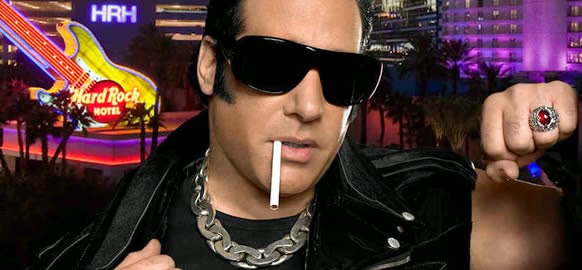
Andrew Dice Clay
If you don't believe me, here's a partial list of the entertainers who are appearing at the Hard Rock this month:  Tom Green, Cheech and Chong, Andrew Dice Clay, and Guns N' [sic] Roses.  (That would have been quite the lineup 20 years ago -- not so much now.)

Ben may no longer be welcome at the Hard Rock, but there's at least one casino in Las Vegas that would be happy if he played blackjack there:


By the way, Ben Affleck's directorial debut was a comedy titled I Killed My Lesbian Wife, Hung Her on a Meat Hook, and Now I Have a Three-Picture Deal at Disney.  Click here if you want to watch it.

That title might be viewed as evidence of a pretty serious case of misogyny, but Ben apparently gets a pass from feminists because he's raised a lot of money and actively campaigned for a number of Democratic candidates in the past.  He recently stated that the prospect of Hillary Clinton running for president in 2016 "does excite me."

Affleck thinks corporate CEOs make too much money.  It's a little hard to take that criticism from a guy who made $12.5 million for starring in Gigli.

Not one of his better efforts --
but $12.5 million ain't hay
Last year, Affleck famously tweeted that he was going to live on $1.50 a day to help bring attention to the fact that a billion people around the world survive on that amount of income. 

Of course, Ben only lived on $1.50 a day for one day.  And he didn't really live on $1.50 that day -- that number applied to what he spent on food, and not on his mortgage, cable TV, and gas for his vintage '66 Chevy Chevelle SS 396 (which probably contributes as much to global warming as a couple of hundred Priuses).

(If you want to see a video of Affleck's Chevelle refusing to start after he takes his daughter Violet out for Krispy Kreme donuts, click here.  Note where Affleck parks -- illegally close to a fire hydrant.  But he's a big Hollywood star, so the usual rules don't apply to him.)

Affleck's Pacific Palisades mansion
Affleck acknowledges that his beating his breast in public about eating rice and beans and drinking tap water for a day might be criticized as being as hypocritical as the Pharisee in Luke 18 who thanked God that he was not a sinner like everyone else.  Here's what he wrote in the Huffington Post:

There are valid criticisms of this effort.  Some accuse it of making the issue of extreme poverty into little more than celebrity Twister. It is also true that celebrities often promote (knowing or unknowingly) lifestyles that price out all but the richest Americans.  Why should they be lecturing Americans on poverty?  Fair enough -- and indeed there is a disgraceful inequity of wealth in this country. 
Affleck knows of what he speaks when he speaks of the richest Americans.  His net worth is estimated to be in the neighborhood of $65 million, a number which will jump considerably when he gets paid to star in the upcoming Batman movie.


If he's so worried about the "disgraceful inequity of wealth" in this country, maybe he should give away 90% or so of his money.
Back to Ben's HuffPo piece:
The issue is not that we should feel guilty about owning cars and Xboxes; taking vacations or buying fancy shoes. It's that we should understand that we have a responsibility as a country to be good global citizens. We have a responsibility to come to the aid of our neighbors, some of who are literally starving to death.
Once again, I must point out that Ben could be doing a whole lot more than he is to come to the aid of his neighbors.  By "neighbors," of course, Ben is referring to his fellow man in general -- not the people who live in his neighborhood, which is Pacific Palisades.  Affleck and Garner's posh digs there, which once belonged to Gregory Peck, cost a cool $17.5 million when they bought it five years ago.  


Blatant hypocrisy is not Ben's only personal failing.  But it's really nobody's business that he plays in illegal high-stakes poker games with his celebrity pals (and also with a hedge-fund manager who is in jail because he embezzled $25 million of his investors' money to pay his losses), or that he's had to go to rehab in an attempt to get control of his drinking problem, or that the tabloids are full of stories about him cheating on his current wife, actress Jennifer Garner.  (Let him who is without sin cast the first stone, etc.)

Garner and Affleck at Fenway
All that stuff is bad.  But the worst thing about Affleck BY FAR is that he's a Red Sox fan.  I've seen the big d-bag sitting in the expensive seats at many televised games at Fenway Park over the years, wearing a suitably beat-up Red Sox cap.  (No doubt he has his butler break in his caps so they don't look to new.  Wearing a too-new cap isn't cool.)

"The Card Cheat" is the last track on side three of the Clash's legendary double album, London Calling, which was released in 1979.  Rolling Stone ranked it as the 8th greatest album of all time.

Here's "The Card Cheat":


Click below to buy the song from Amazon:


Tuesday, June 18, 2013

Clash -- "The Guns of Brixton" (1979)


When they kick at your front door
How you gonna come?
With your hands on your head
Or on the trigger of your gun?

I mentioned the Second Amendment to the U.S. Constitution in passing in the previous 2 or 3 lines, and that got me to thinking about the above lines from "The Guns of Brixton."

You might think I would have no interest whatsoever in the Second Amendment.  No one in my family owns a gun, and none of us have ever been the victim of crime involving a gun -- or a crime that might have been prevented if the victim had a gun.  I've never even held a handgun or assault rifle, much less fired one.  My experience with firearms is limited to a couple of rounds of skeet shooting during long-ago family vacations.  


But when it comes to the right to bear arms, I do have some opinions.  For example, it's my belief that while it should remain legal to own guns for recreation or hunting or self-defense, the right of American citizens to bear arms really has little to do with target shooting or putting meat on the table or protecting oneself or one's home against criminals.  

The right to bear arms is really about we, the people, having the wherewithal to resist government tyranny.

Ice-T digs the Second Amendment
Historians and legal scholars have different opinions about what the Second Amendment was intended to mean.  But a couple of things seem clear.  

First, the Second Amendment did not create a new right -- it codified a right to bear arms that was widely acknowledged to exist prior to the ratification of the Constitution and, therefore, is not dependent upon the Constitution for its existence.

Second, the founding fathers believed that the citizenry had a natural right to engage in an armed insurrection against an oppressive government.  Initially, the colonists were concerned about the increasingly tyrannical British government.  Later, the fear was that the federal government would create a large standing army that would be used to oppress the states and individual citizens.

Some scholars argue that the Second Amendment's right to bear arms is limited to participation in a government-sponsored militia.  But think about the early days of the American Revolution.  

Minuteman statue in Lexington, MA
The Minutemen who fought at Lexington and Concord had been called out to prevent pro-British forces -- including not only regular British Army troops but also colonists who supported the Crown and joined Loyalist militia units -- from seizing their weapons and ammunition.  

Those Minutemen weren't a well-regulated militia.  They were not created as an arm of the government; rather, they organized themselves to resist the oppression committed by that government.  

Recruiting poster for Loyalist militia regiment
It may be naive to think that a 21st-century version of the Minutemen would be able to defend American citizens from foreign invaders or a tyrannical American government.  

After all, the original Minuteman were able to fight the British Army on relatively even terms.  It's hard to imagine that individual citizens armed with handguns, shotguns, hunting rifles, or even large-magazine, semi-automatic assault rifles could resist a foe equipped with armored vehicles, modern aircraft, spy satellites, and all the other high-tech weaponry that the United States and other world powers could bring to bear on their opponents.


But I still think it's important to remember these words from the Declaration of Independence:

[W]henever any Form of Government becomes destructive of [Life, Liberty, and the pursuit of Happiness] . . . it is their Right of the People . . . it is their duty, to throw off such Government . . .

That's what the right to bear arms is all about, boys and girls.  In today's world, it might be suicidal to respond to the tyrant's knock on your front door by coming out not "with your hands on your head," but "on the trigger of your gun."  But there comes a point where that just might the better alternative.  


One final point before we get to "The Guns of Brixton."  Have you ever tried to distinguish the successful attempt of the American colonists to dissolve their relationship with the powers-that-be (the British government) from the unsuccessful attempt of the Confederacy to dissolve its relationship with the federal government?  

Ignore for the time being the issue of slavery -- let's assume that it was not a bone of contention between the two sides.  How do you distinguish secession from the British Empire in 1776 from secession from the Union in 1861?  How can one be justified and the other unjustified?  

Until today, the Clash has been almost overlooked by 2 or 3 lines.  Sure, I featured the band's cover of "I Fought the Law" in February 2011, but I haven't featured any of their fabulous original songs.


"The Guns of Brixton" was released on the clash's third album, London Calling, which most agree is the greatest punk album of all time and one of the greatest rock albums.  (In 2003, Rolling Stone ranked it #8 on its list of the 500 greatest albums of all time, behind only albums by the Stones, Marvin Gaye, Dylan, the Beach Boys, and the Beatles -- who placed four albums in the top ten.)

Most of the Clash's songs were written by Mick Jones and the late Joe Strummer.  But "The Guns of Brixton" was written by the group's bass player, Paul Simonon.  Simonon grew up in Brixton, a multiethnic south London neighborhood.  

A scene from the 1981 Brixton riots

A couple of years after London Calling was released, rioting broke out in Brixton, which had become a high-crime, high-unemployment area.  The riots were a response to the police's attempts to reduce street crime by stopping and searching thousands of Brixton residents -- mostly young black men.  About 280 policemen were injured in the rioting, and 56 police vehicles were destroyed.

Since 2009, Brixton has had its own currency, the Brixton Pound.  That currency features pictures of celebrities with ties to Brixton, including David Bowie (who was born in Brixton in 1947) and NBA star Luol Deng, whose family migrated from the Sudan to Brixton to escape civil war.

Brixton ten-pound note
Here's "Guns of Brixton":


Click here to buy the song from Amazon: