Friday, September 11, 2015

Beach Boys – "Fun, Fun, Fun" (1964)


Well, she got her daddy's car
And she cruised through the hamburger stand now
Seems she forgot all about the library

In the last 2 or 3 lines, we learned about John Lothrop, a Cambridge graduate and Church of England clergyman who renounced holy orders in 1623 because he believed in the separation of church and state.

At that time, the only lawful church in England was the Church of England.  All other forms of worship were legally outlawed.

Rev. John Lothrop
In 1632, Lothrop and 42 others were discovered worshipping together in a private home.  They were accused by the Archbishop of Canterbury of being "desperately heretical" and were locked up in "The Clink," the notorious London prison.

Two years later, Lothrop was released on the condition that he leave England.  He and 30 loyal members of his congregation sailed for Massachusetts, and eventually settled in Barnstable, the second-oldest town on Cape Cod.


Click here to read a 1964 magazine article about Barnstable by Kurt Vonnegut.

Lothrop built a home in Barnstable in 1645, which was eventually willed to the town for use as a library by William Sturgis, a wealthy clipper ship owner who was one of Lothrop's descendants.  Many of the library's original 1300 volumes came from Sturgis's private library.


The Sturgis Library is the oldest library building in the United States.  Here's what it looks like today:


The Bible that Lothrop brought with him on the voyage from England to Massachusetts was almost destroyed, according to an account written by a family member:

During the voyage to this country Mr. Lothrop dropped on one of its pages a spark of fire while reading at his evening devotions.  Unaware of the accident he fell asleep with the book partially closed, his fingers between the leaves.  At length, awakened by the heat, he found a hole had burned through several pages of the sacred Book, the only copy on the ship.  Before the voyage was completed the space thus burned was carefully filled, and the missing words on most of the pages supplied from memory with pen and ink in the old English text in which they had been printed.

After his death in 1653, his Bible was passed down from generation to generation of the Lothrop family before being donated to the Sturgis Library in 1957, where it is on permanent display:


Lothrop and many of his congegrants are buried in the Lothrop Hill cemetery in Barnstable:


The Beach Boys' 1964 single, "Fun, Fun, Fun," was written by Brian Wilson and Mike Love.  It peaked at #5 on the Billboard "Hot 100."


The song's lyrics don't specify the model year of the Thunderbird in which the heroine of "Fun, Fun, Fun" cruised the hamburger stand.  I'm guessing it was done of the second-generation Thunderbirds built between 1958 and 1960:

1960 Ford Thunderbird
Here's an early version of "Fun, Fun, Fun":


Here's "Fun, Fun, Fun":


Click below to buy the song from Amazon:

Tuesday, September 8, 2015

Etta James – "All I Could Do Was Cry" (1960)


I heard church bells ringing 
I heard a choir singing

Earlier this year, the West Parish Meetinghouse's 607-pound Paul Revere bell was sent off to Cincinnati to be restored.  It was returned to the church's bell tower on June 30:


The West Parish Meetinghouse, which is the second-oldest public building in New England, is located less than a mile from the West Barnstable Conservation Area, my favorite mountain-biking destination on Cape Cod.

The story of the West Parish Meetinghouse begins in London in 1616, when the Rev. Henry Jacob and several of his friends founded England's first congregational church.  (Congregational churches are so named because they believed that each congregation should be self-governing, and rejected the authority of the state-sponsored Church of England.)

Jacob was succeeded by John Lothrop, a Cambridge graduate and Church of England clergyman who renounced holy orders in 1623 because he believed in the separation of church and state.

Rev. John Lothrop
In 1632, Lothrop and 42 others were discovered worshipping together and imprisoned because they refused to take an oath of loyalty to the Church of England.  Two years later, Lothrop was released on the condition that he leave England and never come back. 

Lothrop and 30 of his loyal followers promptly sailed for Massachusetts, and eventually settled in Barnstable, the second-oldest town on Cape Cod.

When the congregation eventually outgrew its original meetinghouse, and ground was broken for the West Parish Meetinghouse in 1717.

There are marble plaques in the church that list the congregation's pastors from 1616 to the current day:


One of the most prominent members of the West Parish congregation was Patriot leader James Otis, Jr., a Harvard-educated lawyer who challenged the authority of the British government in the colonial courts, and who said "Taxation without representation is tyranny."  Otis's family later gave the church a bell made in Paul Revere's foundry.

James Otis, Jr.
Another famous member of the church was Commodore "Mad Jack" Percival, who fought in the War of 1812 and who commanded the U.S.S. Constitution ("Old Ironsides") when it sailed around the world in 1844-46.

The West Parish Meetinghouse was remodeled in 1852.  In 1930, Miss Elizabeth Jenkins, a member of the church, proposed that it be restored to its colonial appearance.  But there was little money available for such a project during the Great Depression.  

Twenty years later, a foundation was formed to finance the restoration.  The rebuilding took several years to complete because the rebuilders did the work the way it would have been done in the 18th century.

The exterior of the church is austere yet beautiful:


Here's another view of the church:


The interior woodwork is made of entirely unfinished wood -- there is no paint, no stain.  It features "sheep-pen" pews – square enclosures entered through a gate:


Many of those pews were given as memorials.  Those so honored include James Otis, Lemuel Shaw (the son of a West Parish minister who served as the chief justice of the Massachusetts Supreme Judicial Court for 30 years), Harvard professor George Lyman Kittredge (a great Shakespeare scholar and folklorist), Gustavus Swift (a Cape Cod native who founded the Swift & Co. meatpacking company), and Evelyn Beatrice Longman.

Evelyn Beatrice Longman
Evelyn Longman was the first great female American sculptor.  Her most famous work, the 24-foot-high "Spirit of Communication," was commissioned to crown AT&T's headquarters building in lower Manhattan.

Today, that gilded bronze statue – nicknamed "Golden Boy" – dominates the lobby of AT&T's corporate headquarters in downtown Dallas:


When you enter the West Parish Meetinghouse, the first pew to the right is reserved for the ushers.  That pew is well-stocked with tissues and throat lozenges for parishioners who are afflicted with colds or coughs:


The raised pulpit has a sounding board, which amplifies the preacher's voice so that it can be heard throughout the church.


The church has a four-foot-long gilded weathercock, which was obtained from England in 1723:


"All I Could Do Was Cry" was recorded by the inimitable Etta James in 1960.  

The song is sung by a woman who is attending the wedding of her former lover to another woman.  (Who invites his ex-girlfriend to a wedding?  Not cool, boys and girls – not cool at all.)

"All I Could Do Was Cry" was co-written by Billy Davis, Berry Gordy (who would later found Motown Records), and Gordy's sister, Gwen, and was supposedly inspired by Etta's former boyfriend dating Gwen Gordy, who was Billy Davis's former girlfriend. 

Here's "All I Could Do Was Cry":


Click below to order the song from Amazon:

Sunday, September 6, 2015

Goatsnake – "Grandpa Jones" (2015)


You can't decide 
What to do
With your life

I like to look at the beach when I'm in Cape Cod, but I don't spend much time on it.  

This year, I was actually on the beach for less than five minutes – just long enough to take some pictures:


When I go to Cape Cod, I spend more time in the woods than on the beach.  Specifically, I spend more time in the West Barnstable Conservation Area, riding the less technical sections of the 21-mile "Trail of Tears" on my venerable Mongoose Rockadile SX mountain bike:


Here's a video that will give you a good feel for what it's like to ride the Trail of Tears:


When I say my mountain bike is "venerable," I really mean it's very, very old.  In fact, my Mongoose is older than my youngest child, who turns 21 next month.  But its shifters and brakes function flawlessly, and it fits me just right, so I'm in no hurry to replace it.

I feel all warm and fuzzy every time I ride my mountain bike.  You see, I bought that bike in Delaware, so I avoided paying sales tax on it.  (Feels good to stick it to the man, doesn't it?)

Delaware: home of tax-free shopping
There are dozens of intersections in the 21-mile-long network of West Barnstable Conservation Area trails, and I used to get lost there on a routine basis.  But a few years ago, those intersections were marked with letter-number signs (like "SW9" or "E14"), which are shown on the large maps at each of the Trail of Tears parking areas.

Here's a detail from one of those maps:


I simply pull out my Blackberry and take closeups of the parts of map that show where I am planning to ride before I saddle up.  When I come to an unfamiliar intersection, I look for the marker (which is attached to one of the trees in the vicinity), locate that marker on my map photo, and know exactly where I am.  

The new maps color-code the trail segments by degree of difficulty, although one man's "moderate" is another man's "moderate, my ass!"

A moderately difficult trail
Even when the trail isn't too rocky or steep for me to negotiate, it can be quite narrow, with dense shrubbery pressing in on you from both sides.


At times, I found myself riding through clouds of swarming insects.  Riding with only one hand on the handlebar so you can swat at the little bastards in your face is risky, and once I swerved into a large holly bush that was adjacent to the trail.  I'm still picking out the little pointy parts of the holly leaves that embedded themselves in my hide.

The other major hazard of riding the Trail of Tears is a thorny vine commonly known as catbriar or greenbriar.  Its thorns are more than sharp enough to puncture your tire if you ride over one:


Adjacent to the conservation area is the Cape Cod Airfield, a grass-field airport that is almost 100 years old.  It is home to 20-odd private planes, including an open-cockpit Waco YMF-5 biplane:


The original Waco biplanes were built in the 1930s.  The one based at Cape Cod Airfield is a replica that was built about 20 years ago.  For $175, two people can take a brief sightseeing ride in the Waco:


When I drove by the airport last month, someone was restoring a DC-3:


The DC-3 (which seated 21 passengers) first flew in 1935.  Over 16,000 were built, and some of them are still in use.    

Thirty-odd years ago, I used to fly to Cape Cod on Provincetown-Boston Airlines, which flew DC-3s like this one from Boston to Hyannis:


Goatsnake is a metal band from Los Angeles that released albums in 1999 and 2000, but broke up in 2001.  The band eventually reunited, and released the Black Age Blues album (which includes today's featured song) earlier this year:


I don't listen to a lot of metal, but you need harder music when you're mountain biking – metal, punk, etc.

I don't think today's featured song has anything to do with the late Hee Haw star Louis "Grandpa" Jones, but I'm not 100% sure of that.

Here's "Grandpa Jones":


Click below to buy the song from Amazon:

Friday, September 4, 2015

Dan Hicks and His Hot Licks – "Traffic Jam" (1971)


Traffic jam – I'm in a hurry
Why we're going so slow, I'll never know

Traffic jams are a way of life for those of us who live on the East Coast.

The I-95 corridor between Washington and Boston is 500 miles of potential road rage – you never know exactly where a traffic jam will bring your progress to a halt, but you know it will happen sooner or later.

I-95 traffic jam
During my recent Cape Cod vacation, I had occasion to drive from the Cape to central Maine.  ("I had occasion to" – ?  Who the hell do I think I am, Ford Madox Ford?  Evelyn Waugh?)

I barely got over the Sagamore Bridge before running into stop-and-go traffic on the highway to Boston.  The congestion continued off and on all the way through Beantown, finally easing once I was well north of the city.

So there I was, minding my own business, driving north on Route 1 through the nondescript blue-collar suburb of Saugus, and suddenly I see this enormous sign looming over the highway:

All that remains of the Hilltop Steak House
The Hilltop Steak House, which opened for business in 1961, closed for good in 2013.  The building was demolished recently to make way for a new development, but the 68-foot-high sign is going to be preserved.  

According to the New York Times, the Hilltop was the busiest restaurant in the United States 25 years ago.  It served 2.4 million customers a year and grossed $27 million.

In a typical week, the Hilltop served 3500 pounds of butter, 8000 pounds of fish, 14,500 pounds of salad, 17,500 pounds of baked potatoes, and 20,500 pounds of beef.

Frank Giuffrida founded the Hilltop in 1961
Click here to read a long magazine story about the Hilltop Steak House by a man whose father bought it from its original owner.

Not far away from the Hilltop was Weylu's, a 1500-seat Chinese restaurant that featured hand-painted Chinese vases, marble lions, and an indoor waterfall.  Chinese immigrants Rick and Wilma Chang spent $13 million to build it in 1989, but their bank foreclosed on it ten years later.  

New owners reopened the restaurant on three separate occasions since then, but all three of those owners eventually went belly up.  Today the building sits empty on a hilltop that looms over Route 1. 

The entrance to Weylu's
Saugus is also home to the Prince Pizzeria, which seats 700 and also houses Giggles Comedy Club. 

Prince's "Leaning Tower of Pizza" is another Route 1 landmark:

"The Leaning Tower of Pizza"
Freeport, Maine – my ultimate destination – turned out to be a match for Saugus when it came to roadside weirdness.

Freeport is the home of legendary retailer L. L. Bean, which started selling its distinctive "Maine Hunting Shoe" – also known as the "Bean Boot" – in 1912.  A large "Bean Boot" stands outside the main entrance to Bean's flagship store in Freeport:

Big-ass Bean Boot
When I was in Freeport, the L. L. Bean Bootmobile just happened to be parked in front of the Bean store.

The Bean "Bootmobile" in Chicago
Just south of Freeport is a 30-foot-high Indian statue known locally as the "Freeport Big Indian."  It was constructed in Pennsylvania from fiberglass and plywood in 1969, and driven to Maine on a flatbed trailer.

The "Freeport Big Indian"
I can only imagine the rubbernecking that must have resulted as that flatbed truck travelled up the New Jersey Turnpike and I-95.  Talk about your traffic jams!

In 1965, Dan Hicks became the drummer of the Charlatans, a legendary "San Francisco Sound" group.  A couple of years later, he switched from drums to guitar, and then left the band to form Dan Hicks and His Hot Licks.  


"Traffic Jam" was released in 1971 on the Where's the Money album, which has been one of my favorites since I was a college student.

Here's how Hicks later described his music:

It starts out with kind of a folk music sound, and we add a jazz beat and solos and singing.  We have the two girls that sing, and jazz violin, and all that, so it's kind of light in nature, it's not loud. . . .  Most of the songs are, I wouldn't say funny, but kinda maybe a little humorous.  We all like jazz, so we like to play in a jazzy way, with a swing sound you know, so I call it "folk swing."  

Here's "Traffic Jam":


Click below to buy the song from Amazon:

Tuesday, September 1, 2015

Sandra Bernhard – "Manic Superstar" (1991)


I know what I want

But I just don't know

How to get it


Sandra Bernhard's "Manic Superstar" is a mashup of "Everything's Alright" (from Jesus Christ Superstar) and the great Jimi Hendrix song, "Manic Depression."

The late Jimi Hendrix
Jimi Hendrix was left-handed.  I am also left-handed.  Other than that, we have about as much in common as the two very dissimilar halves of "Manic Superstar."

For example, Hendrix was black, while I am white.

Hendrix was a fabulous guitarist, while I am a fabulous pianist.

Another difference between us is that JIMI HENDRIX IS DEAD.  I am not dead.

And there's this: Jimi Hendrix knew what he wanted but didn't know how to get it, while I don't really know what I want.

*     *     *     *     *

The Board of Selectmen of Orleans, Massachusetts, knew what they wanted when it came to the hundreds of cormorants that were roosting on the power lines that spanned Cedar Pond – they wanted to get rid of them.

Roosting cormorants at Cedar Pond
And the selectmen thought they knew how to get what they wanted.  But it turns out that they couldn't have been wronger.

Why were the town officials trying to get rid of the cormorants?  Because they were pooping in the 15-acre pond.  That resulted in an increase in the pond's nitrogen and phosphorous content, which resulted in the pond becoming covered with algae.  (Yuck!)

The town wanted the local electric utility to put the power lines underground.  The estimated cost of doing that is $1.1 million, which would be passed on to the utility's customers.  (It's so easy to spend other people's money, isn't it?)

In the meantime, the geniuses on the Board of Selectman decided to pay the U.S. Department of Agriculture $6500 to scare the cormorants away by shooting fireworks at them.

A double-crested cormorant
I feel a little sheepish admitting that even though I've lived in Our Nation's Capital for my entire adult life, I didn't know that the U.S. Department of Agriculture is who you call when you need someone to go after pooping birds with pyrotechnics.

The USDA went after the fish-eating cormorants with "screamers" which they fired from kayaks.  ($6500 to shoot fancy bottle rockets at birds from kayaks?  I guarantee you that it wouldn't have taken more than ten minutes to find a dozen teenaged boys who would have been thrilled to do the job for free.)

Click here to see a short video featuring screamers.

*     *     *     *     *

Unfortunately, things quickly went awry the first night the fireworks were used.

The Cape Cod Times reported that a local resident who was driving nearby when the USDA began blasting the birds posted on Facebook that his truck was hit by the fireworks:

“[S]everal sky rockets struck the side of my truck, including the glass of the passenger's window,” the person wrote.  “If I'd had the windows down like I normally do the rockets would've gotten inside and I'm pretty sure I'd have totalled my truck.”

It's hard to believe that something went wrong with this well-thought-out plan, isn't it?  After all, according to the Times, "[t]hree USDA officials were on the scene, including one who was specifically there to make sure nothing went wrong."

The following evening, the USDA resumed the bombardment of the poor cormorants, which did appear to put a serious dent in the number of birds roosting on the power lines.

USDA headquarters in Washington, DC
But the effect of the screamers was short-lived.  According to a woman described by the Times as an "Orleans resident and bird-counter," there were some 150 birds back on the wire a week after the fireworks assault. 

USDA launched its kayaks and lit off another salvo of screamers the next night, which reduced the population of Cedar Pond cormorants significantly.  Unfortunately, observers said that the number of birds roosting on a power line over nearby Little Depot Pond had increased by a like amount.  (As my late grandmother used to say, "Six of one, a half-dozen of the other.")  

The Cape Cod Rail Trail goes right by Little Depot Pond.  When I rode my bike past the pond, there were a fair number of cormorants sitting on the power lines over that pond:  

Roosting cormorants at Little Depot Pond
One local resident complained to the Times that the fireworks were terrifying her pet dog.  "He just trembles and tries to hide," she told a reporter.  

The disgruntled pet owner was skeptical of the whole fireworks idea.  "The birds aren't really stupid.  They're just going to move to another pond," she said.  "It just seems crackers to me."

*     *     *     *     *

Sandra Bernhard (circa 1990)
Sandra Bernhard is kind of crackers herself.  She was brilliantly weird in the brilliantly weird Martin Scorsese movie, King of Comedy (which starred Robert DeNiro and Jerry Lewis), and I'll never forget her fabulous 1990 movie, Without You I'm Nothing (based on her one-woman off-Broadway show). 

Click here to buy Without You I'm Nothing from Amazon.

DeNiro and Bernhard in "King of Comedy"
Bernhard proved once and for all that a female comedian could be as dirty and funny as any male comedian.  One-trick-pony female comedians like Sarah Silverman, Chelsea Handler, and Amy Schumer may match Sandra Bernhard when it comes to talking dirty, but Bernhard was a much more interesting and multifaceted performer than her wannabes.

Click here to listen to "Manic Superstar," which was released on Bernhard's 1991 album, Excuses for Bad Behavior (Part One).  


Sunday, August 30, 2015

Sidney Bechet – "Hold Tight (Want Some Sea Food Mama)" (1938)


If you don't have oysters, clams will do
I want a seafood dish!

As we learned in the previous 2 or 3 lines, man does not live by fried clams alone.  Fried clams are delicious, but so are fried scallops and fried oysters.

Earlier this month, I visited Lena's, a humble clam shack in Salisbury Beach, the northernmost town in Massachusetts.  


Lena's opened for business in 1958.  It was originally located on Salisbury Beach's thriving boardwalk, which featured a Charles I. D. Looff carousel,  roller coasters, and bumper cars.

The entertainers who performed in Salisbury Beach in its heyday included Glenn Miller, Louis Armstrong, Liberace, and Frank Sinatra.

Salisbury Beach fell on hard times on the sixties, and Lena's moved to a new building located further inland in 1972:


From the looks of things, not much has changed at Lena's since then – which is a good thing as far as I'm concerned.

The prices at Lena's are certainly right – for just $12.75, I got 18 juicy and sweet fried scallops and a heaping helping of extraordinary onion rings: 


On weekends, Lena's offers fried lobster.  I've never seen fried lobster on a restaurant menu on Cape Cod or in Maine, but it seems to be a standard offering at seafood restaurants in northeastern Massachusetts.

Lena's also offers three types of chowder: clam chowder, fish chowder, and "clish" chowder (which I assume is a hybrid of the first two chowders).


A few days after supping at Lena's, I visited Captain Cass's, a venerable clam shack that overlooks Rock Harbor in Orleans, Massachusetts:


Captain Cass's is a tiny and somewhat ramshackle BYOB establishment with a diner-style counter and fewer than a dozen tables.  It's open six days a week from 11 until 2 and 5 until 8.

The service was a bit amateurish when I ate at Captain Cass's – the young waitress dropped a small condiment cup full of Tartar sauce in my lap – and the onion rings were frozen.

But my fried oysters came with a crispy exterior and a soft, juicy interior, and were full of flavor.  Even the most humble Cape Cod eateries can be pricey, but Captain Cass charged only $12.95 (cash and checks only, please) for a large plate of fried oysters, fries, and cole slaw:


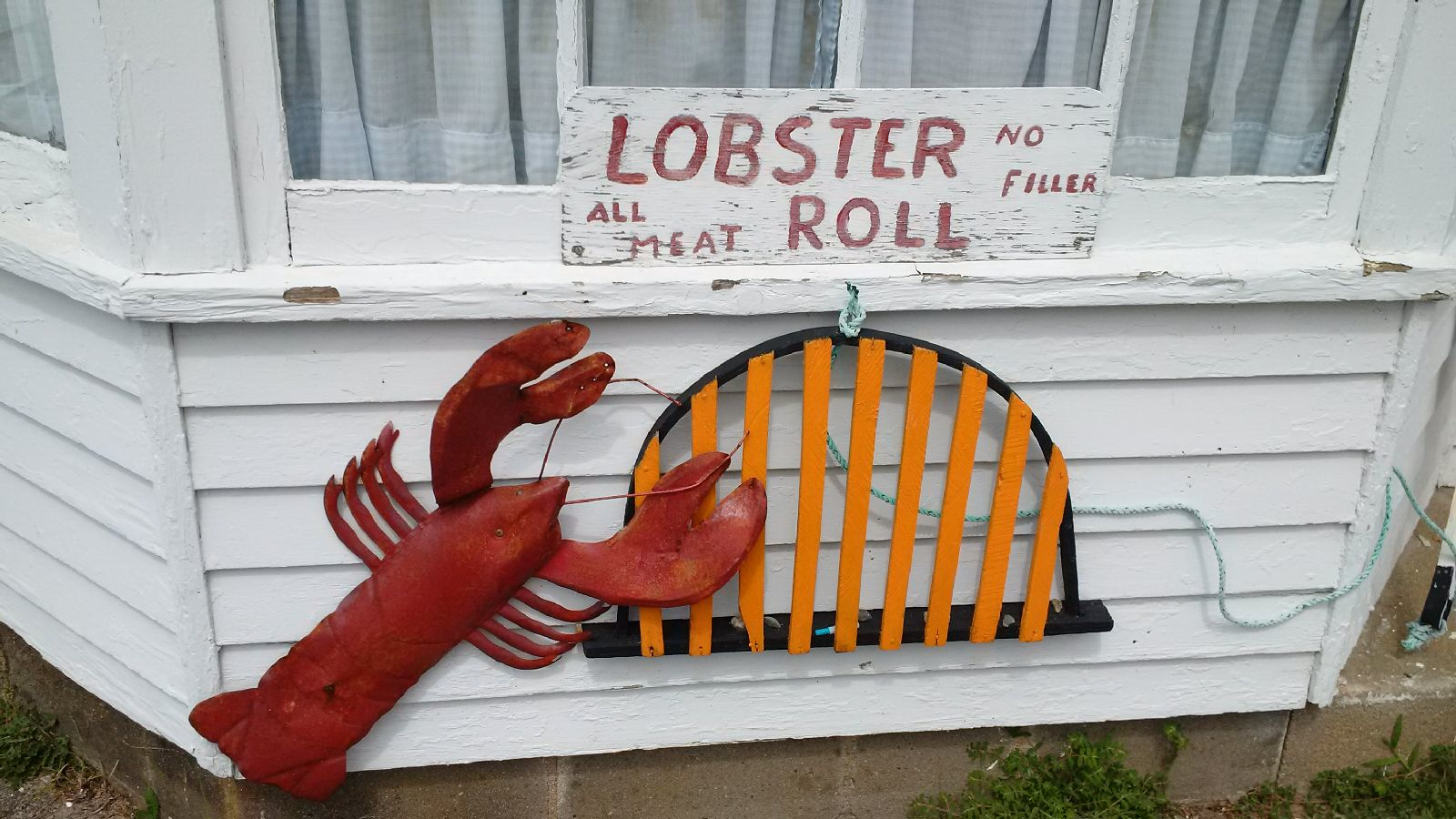
Lobster prices in New England are still reasonable, which makes lobster rolls a popular choice at restaurants like Lena's and Captain Cass's. 

"Lobster roll:  all meat, no filler"
But as tasty as lobster rolls can be, I think they are a little overrated compared to fried clams, fried scallops, and fried oysters.  Not as overrated as the Grateful Dead and Bruce Springsteen, perhaps, but overrated nonetheless.  

"Hold Tight" was a hit for the Andrews Sisters in 1938, but it was first recorded by Sidney Bechet and his Orchestra.

Bechet was a New Orleans jazz saxophonist and clarinetist who started performing publicly when he was still a teenager.  He moved to New York City shortly after turning 21, and toured extensively in Europe, eventually relocating to France.

Sidney Bechet
Woody Allen named one of his children after Bechet, and featured his music on the Midnight in Paris soundtrack.

Here's "Hold Tight":


Click below to buy the song from Amazon: