Sunday, August 12, 2012

Candy Strypers -- "Hymn the Girl" (2012)


In her wake I go
But I'm running slow
I won't win this race

I enjoy nothing more than discovering great new music.  By "new music," I mean music that is new to me -- whether it's an obscure single by a forgotten sixties garage band or a recent release by a young musician who is struggling to attract an audience in the increasingly crowded world of online music.

It's a lot easier to stick to the old familiar stuff than to go mining for new nuggets, and I'm a pretty lazy guy.  But occasionally an unfamiliar but talented musician makes it easy on me by knocking on my door and introducing himself.

Paul Hughes (a/k/a "The Candy Strypers")
That happened recently when Paul Hughes -- a self-described "bedroom musician" from Manchester, England -- e-mailed me recently.  He had stumbled across 2 or 3 lines, and discovered that I shared his appreciation for classic pop groups like the Beatles, the Beach Boys, the Byrds, and Big Star.

The difference between us is that I just write about that music, while Paul creates original songs inspired by the jangling guitars and gorgeous multi-part vocal harmonies that made the records released by those groups so wonderful.

Paul calls his one-man operation the Candy Strypers.  You can find his music on SoundCloud, which is an online music distribution platform that allows musicians to upload and distribute their music. 

Click here to go the SoundCloud page for the Candy Strypers.   As you'll see, Paul has uploaded 31 songs, which you can download to your computer or share on Facebook or Twitter.  (Note Paul's description of his music:  "Sunny power pop from a rainy city.")

The Candy Strypers logo
It's very easy to download the songs -- all of which are absolutely free.  All you have to do is click the "download" button that accompanies each song.  If you have iTunes or a similar program, it takes only a few seconds for Paul's song to show up in your music library, and then you can listen to it on your computer or transfer it to your iPod or other music player.  Easy peasy!

Now that we've gotten that out of the way, let's talk to Paul Hughes and learn a little more about him and his music:

2 or 3 lines:  Why the "Candy Strypers"?  Where did that name come from?

Paul Hughes:  I just liked the sound of the words together.  I put a "y" in "Strypers" in homage to the Byrds.  Plus if there was ever a Candy Strypers CD, it would be close to the Byrds alphabetically.

2 or 3 lines:  When I was a kid, "candy striper" was the name given to female hospitals volunteers because they wore a red-and-white striped uniform that distinguished them from the nurses and doctors.  I take it that had nothing to do with why you picked that name?

Paul:  No, not at all.  I've heard that, but only after I chose the name.  It's a funny coincidence because my career since graduating from university has been solely in the health-care industry.  Right now I work for the National Health Service.

2 or 3 lines:  So when and where were you born?

Paul:  I was born in Manchester on May 31, 1981 -- so I'm a Gemini like my heroes Paul McCartney, Brian Wilson, and Bob Dylan.


Manchester Town Hall
(Note:  Paul and I are almost astrotwins -- I was born on May 30.  Hey, now that I think about it, we might have both been born on the same date once you take time zones into account.  If Paul was born early in the morning of the 31st, it would have still been the night of the 30th in the U.S.  And if I had been born late enough on the 30th, it would have been the 31st in the UK.)

2 or 3 lines:  You parents were probably exactly the right age to be fans of classic sixties pop music.  Is that how you were exposed to it?

Paul:  Yes, my earliest memories are car journeys with my parents blasting sixties tunes -- the Beatles, Beach Boys, Searchers, Kinks, Rolling Stones, Hollies, Byrds, the Who, the Small Faces, etc.  I think that my entire musical life has been spent trying to find artists who get anywhere near the heights of that era.  Unfortunately, the quality of pop music has dwindled exponentially since then.  

2 or 3 lines:  Your songs are obviously inspired by that music -- especially the vocals.

Paul:  Basically, I'm in love with melody and harmony, and I think my creating music has sort of been a response to that dying off of great guitar pop.  I'm just trying to create music that I myself would get a kick out of.

2 or 3 lines:  So how did you get started playing music instead of just listening to it in the car?  Did your parents sign you up for music lessons?  Or are you self-taught?

Paul:  I played drums in a band at school -- we played a few gigs around Manchester -- after having a few lessons.  I bought a guitar when I was at university and have since acquired a digital piano and more guitars -- I have six-string and 12-string electrics, an acoustic guitar, and a bass -- and I have an electronic drum kit.  I'm self-taught on everything but the drums.


An electronic drum kit
2 or 3 lines:  You call yourself as a "bedroom musician" -- do you literally record your music in your bedroom?  

Paul:  Yes -- I record my music at home, using Logic Pro software on my Mac.  Today, most anyone can record their own stuff if they want to.

2 or 3 lines:  Easy for you to say, Paul.  Maybe most anyone can afford Logic Pro -- it's only $199 at the Apple Store.  But if I want to follow in your footsteps, I'll not only have to figure out Logic Pro --  I'll have to learn to sing and play guitar and drums and keyboards.  Paul, you are the only musician on your recordings, correct?

Paul:  It's just me on my recordings.  

2 or 3 lines:  So how do you put together a finished recording?

Paul:  I usually start with a guitar track, then add drums, bass, vocals, and then end up with up with an extra guitar line or some piano.  I play pretty rudimentary guitar, and I usually have to do take after take on the guitar solos.  So it takes me a while to get a song recorded. 

2 or 3 lines:  About how long on average?

Paul:  It usually takes me two or three evenings to record a song once it's written, or one full day if I have that luxury.

2 or 3 lines:  Some of your songs have horn and string parts.  I assume those are played on a synthesizer.

Paul:  Yes -- I haven't tried to master the trumpet or violin.  But pretty much everything else is real instruments plugged into the computer via a guitar effects box. 

I'll continue my conversation with Paul Hughes in the next 2 or 3 lines.  But now it's time to take a closer look at "Hymn the Girl."

If Paul had been born 40 years earlier and had written "Hymn the Girl" in 1965, I think it could easily have been a hit for a group like the Searchers or the Left Banke or the Hollies.  It may seem quite short at only 1:53, but that length was fairly typical of singles of that era.  

While Paul's affection for sixties pop comes through loud and clear when you listen to "Hymn the Girl," it's too distinctive a song to be anything other than an original.  The classic "British Invasion" bands certainly inspired Paul, but he did far more than just imitate them in this song.


The structure of a classic sixties pop song is often expressed schematically as ABABCAB, where A = a verse, B = the chorus, and C = the bridge (which usually contrasts with the verse/chorus).  

There are a lot of variations on this basic form.  Sometimes, the bridge is instrumental.  And sometimes there's no third verse -- the chorus is repeated once more after the bridge and you're done.  On occasion (e.g., "Can't Buy Me Love") the song begins with the chorus instead of a verse.

The structure of "Hymn the Girl" is interesting because there is no chorus.  It's a slightly more elaborate variation of AABA song structure -- sometimes called "32-bar form" -- which consists of four eight-measure sections (verse, verse, bridge, verse).  

Paul begins with a four-bar guitar introduction, which is reminiscent of the open of the Beatles' "Ticket to Ride."  (That's not surprising given that Paul plays that intro on a Rickenbacker 360 12-string guitar, which was made famous by George Harrison and also played by many other sixties pop guitarists.)

George Harrison with his
12-string Rickenbacker 360
Next, there's a verse -- eight bars long, with the same rhyme scheme as a limerick (AABBA) -- and then a second verse.  After that we have an eight-bar bridge, an eight-bar instrumental break, and a repeat of the bridge.

Finally, the first verse is repeated and we're finished.  In other words, instead of the basic AABA form, we have AABCBA.  

I spent some time trying to find an early Beatles song that matched this structure precisely, but finally gave up.  There are several that are quite similar.  For example, the Fab Four's "From Me to You" has an AABACBA form -- the Beatles stick in a third verse after the first bridge and before the instrumental break (which is only semi-instrumental in this song), but finish up by repeating the bridge and the first verse.  And "I Want to Hold Your Hand" comes pretty close as well.  

Here's "Hymn the Girl":


Click here to go to SoundCloud and download "Hymn the Girl."

If you prefer, you can click here to go to the EardrumsPop website, where you can not only download three Candy Strypers songs for free, but also see a virtual booklet with a photo interview of Paul Hughes.

Friday, August 10, 2012

DMX -- "Ruff Ryders Anthem" (1998)


Another unsolved mystery
It's goin' down in history  

Do you remember the original Unsolved Mysteries TV series?  It first aired on NBC in 1987, and was hoisted by good ol' Robert Stack.  Well, it's back on the air.  Dennis Farina now hosts the show on Lifetime.  

Dennis Farina is one of my favorite character actors.  He was a real-life Chicago police officer before director Michael Mann hired him as a consultant, and he ended up starring in Mann's Crime Story TV series.  He also appeared in Miami Vice and the original Hannibal Lecter movie, Manhunter (also directed by Mann).

Farina has a nice comic touch -- he was excellent in Get Shorty and Out of Sight (two movies based on Elmore Leonard novels) and perfect in Guy Ritchie's crazy caper movie, Snatch.  I understand he was stellar in the short-lived HBO horse racing series, Luck.

Here's Farina with Gene Hackman and Jon Gries in Get Shorty:


But I digress.  This is "Hip Hop 101," not a film studies class, so let's turn our attention to the rap song of the day: DMX's "Ruff Ryders' Anthem."

At the dawn of the new millennium, a new generation of rappers -- most notably, Eminem and a wave of hip-hop artists who hailed from the South -- began to dominate the rap charts.

But before "Hip Hop 101" says farewell to the rap stars of the nineties, let's listen to one last East Coast gangsta rap track from that decade before we head to Atlanta to meet a new wave of rappers with a very different style and sensibility.

DMX (who was born Earl Simmons) released his first major-label album, It's Dark and Hell Is Hot, in 1998.  It debuted at #1 on the Billboard album chart and eventually sold over five million copies.


"Ruff Ryders' Anthem," the fourth single from that album, is actually far from its most violent track -- but I think it is plenty violent for most peoples' tastes.  DMX has a major chip on his shoulder in this song, and heaven help you if you and your crew get crossways with the Ruff Ryders.  Even just looking at DMX the wrong way can lead to big trouble.

What was that look for?
When I walked in the door
Oh, you thought you was raw
BOOM! Not anymore!
You may think you are "raw" -- tough, hardcore -- but when DMX's .44 goes BOOM, you'll be sorry you ever messed with the man.  (DMX's spoken "BOOM" is accompanied by the recording of a gunshot -- 2 or 3 lines always appreciates a little dramatic verisimilitude.)
'Cause now you on the floor
Wishin' you never saw
Me walk through that door
With that four-four

It's days like these that make a gangsta wish he had studied a little harder in school, maybe gone to college. 

Now it's time for bed
Two more to the head
Got the floor red
Yeah, that n*gga's dead

A .44 Magnum revolver
After two shots to the head with a .44, not much doubt about that.

Look what you done started
Asked for it, you got it
Had it, should have shot it 
Now you're dearly departed

So what's the lesson to be learned from all this, boys and girls?  When you start something with DMX, you'd better not be hesitant to pull your gun and use it -- because he certainly won't be hesitant to use his.  And when that happens, you'll be one of the "dearly departed."

As you can see, "Ruff Ryders' Anthem" does not rely on a fancy rhyme scheme or tricky wordplay.  It uses simple end rhymes (i.e., the rhymes come at the end of the lines), and the rhyme scheme is AAAA BBBB CCCC, etc. -- each four consecutive lines rhyme.  

Ordinarily, this all might sound a little sing-songy, but I think a more complex or cutesy rhyme scheme would undercut the seriousness and menace that DMX's character is supposed to exude.  Complicated internal rhymes, clever homophones, tricky enjambment, and other such poetic devices would just distract you from the fact that DMX is a really scary dude.

DMX has probably put the children of several criminal lawyers through college.  His rap sheet is as long as your arm:  he's spent time in jail for various driving offenses, drug possession, assault, theft, and animal cruelty.

DMX on his way to the poke
DMX violates laws all over the world, not just in the United States.  In 2003, he was arrested during a performance in Saint Kitts and Nevis for using indecent language.  He was released on $376 bail and presumably got the hell out of Saint Kitts and Nevis for good.

The rapper was a one-man crime wave at New York's Kennedy Airport in 2004, where he was arrested for cocaine possession, weapons possession, driving under the influence of drugs and alcohol, and attempting to carjack a vehicle while barking and impersonating a federal agent.

He must have had the world's greatest lawyer, because he managed to plea bargain the whole shebang down to a 60-day sentence.

After that sentence, DMX's attorney said that the rapper was in good spirits.  "It's a somber situation.  He felt the reality of it and he's moving on.  The man's a class act."  (He took the words right out of my mouth.)

Here's the official music video for "Ruff Ryders' Anthem."  Kids, don't ride your motorcycles like the Ruff Ryders -- especially the guy at 2:45.  And, puh-LEEZE -- leave your four-four at home!


Use the link below to buy the song from Amazon:

Wednesday, August 8, 2012

Devo -- "Gut Feeling/(Slap Your Mammy)" (1978)


Something about the way you taste
Makes me want to clear my throat

Herewith begins a new series of 2 or 3 lines posts.  (The old series rarely if ever truly end -- they just fade away when I forget about them.)

This series will feature the music I liked in the time period that began when I left law school and ended when I had children -- mid-1977 through mid-1983.  I'm going to serve you up some new wave, some punk, some art rock, and who knows what else.  (I usually have no particular plan when I start a new series, and this one is no exception.)

(I read it in translation)
Here's a quote from Michel Houellebecq's novel, La carte et le territoire (The Map and the Territory):  

Jed would be asked numerous times what it meant, in his eyes, to be an artist.  He would find nothing very interesting or original to say, except one thing, which he would consequently repeat in each interview: to be an artist, in his view, was above all to be someone submissive.  Someone who submitted himself to mysterious, unpredictable messages . . . messages which nonetheless commanded you in an imperious and categorical manner . . . to set off in a radically new direction, or even occasionally no direction at all.

Exactly.  Which explains why I am writing about a group that I haven't thought about for three decades or more -- a group that I would have remembered as recently as last week as being the object of a short-lived and rather shallow enthusiasm of mine, which was based almost entirely on their novelty and eccentricity rather than any real musical merit or significance -- a group whose music I have suddenly realized is brilliant and absolutely original.

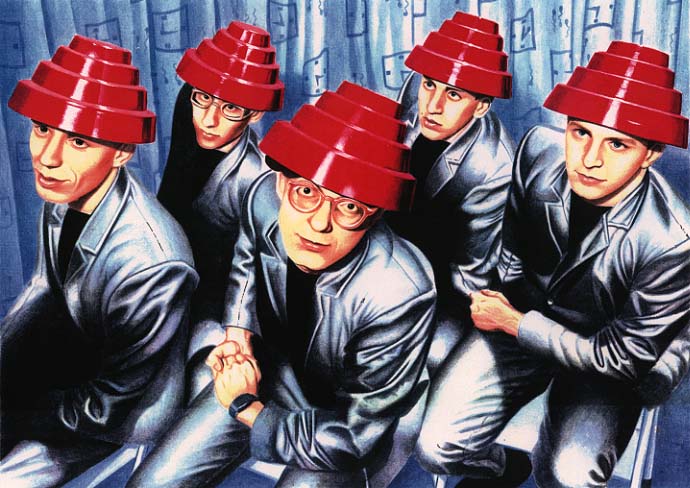
Devo (wearing energy domes)
Ladies and gentlemen, boys and girls, I speak of . . . Devo.  (Of course!)    

A funny thing happened to me recently while I was on the road to Damascus.  (Actually, I was taking a walk in my neighborhood with my dog and my iPod.)

The long instrumental introduction to "Gut Feeling/(Slap Your Mammy)" -- you'll find it on side two of Devo's debut album, Q: Are We Not Men?  A: We Are Devo! -- was playing, and suddenly a light from Akron, Ohio, flashed all around me, and I fell to the ground and was blind.


As I lay on the ground, I listened to the song three times, and something like scales fell from my eyes and I could see again.  A neighbor who closely resembled Brian Eno (the producer of We Are Devo!) placed his hands on me.  A mom driving her kids to the local pool stopped her minivan and asked if everything was alright, and the neighbor who looked like Brian Eno told her, "This man is my chosen instrument to proclaim Devo's name to the residents of Flower Valley, and the people of the Parkwood High School class of 1970, and those all around the world who randomly stumble upon the wildly popular 2 or 3 lines."

Hearing his words, the mom in the minivan rolled up the window, locked her doors, and got the hell out of there -- no doubt calling 911 as she drove away.  As for me, I got up and returned to my home, where I took some food (a slice of leftover pepperoni and mushroom pizza).

(I had a similar experience)
Now that I have regained my strength, I am ready to preach to the unbelievers that Devo's music is unexcelled.  I will talk to and debate with the followers of of Supertramp, and John Cougar Mellencamp, and Bon Jovi, and Bruce Springsteen, and they will try to kill me.

But I will speak boldly in the name of Devo, and 2 or 3 lines will enjoy a time of peace and be strengthened, and those who click on its ads will increase in numbers.  

(Apologies to Acts 9:1-31.  You don't think you-know-who is going to find this blasphemous, do you?  I'm just funnin' a little.)

"Gut Feeling" is worthy of comment in part because it has an unusual structure, consisting of phrases that are five measures long.  Each measure features a different chord -- E, G, C, A, and D (in that order).

This five-chord progression is repeated relentlessly throughout the lengthy instrumental introduction to the song, and the same pattern continues through the verses and chorus, which are sung by Mark Mothersbaugh.  It is as compelling as it is simple, and I wouldn't mind it a bit if the song kept going for an hour or so.

Devo lead singer Mark Mothersbaugh at age 60
The "(Slap Your Mammy)" part of the title comes from the last minute or so of the track, when the five-measure phrase are abandoned and Mark Mothersbaugh (who wrote the music for the Nickelodeon Rugrats series, among other things) sings "Slap your mammy down, slap your pappy down again" over and over.

Here's a clip featuring the instrumental introduction to "Gut Feeling" from the 2004 movie, The Life Aquatic with Steve Zissou.  The whole movie (like all Wes Anderson movies) is just as nonsensical as this clip is, so don't feel bad if you don't get it -- the only thing to get is that there's really nothing to get.  


Believe it or not, the Weather Channel has used "Gut Feeling" as background music for its local forecasts.


Here's a fascinating old video of Devo performing "Gut Feeling" live at the late, great Max's Kansas City club in New York City in 1977.


Here's Devo performing the song at an outdoor concert in California in 1996.


The drummer is fan-f*cking-tas-tic, n'est-ce pas?  And note Bob Mothersbaugh's LaBaye 2x4 guitar (so named because the body resembles a 2x4):


Here's "Gut Feeling/(Slap Your Mammy)":


Here's a link you can use to order the song from Amazon:

Monday, August 6, 2012

Kinks -- "Shangri-La" (1969)


The gas bills and the water rates
And payments on the car 
Too scared to think about 
How insecure you are 
Life ain't so happy in your little Shangri-La 

Only three months until election day.  (It'll be here before you know it!)

With the American economy in the toilet, President Obama's campaign is beginning to emphasize social issues -- abortion, gay marriage, immigration, etc. -- because the polls show that the President has an edge over his opponent on such issues.

The polls also show that 35% of voters say that jobs is the top issue, while 23% say the budget deficit is number one.  Only 5% say immigration is the most important issue to them, while only 4% rank gay marriage as their number one concern.


Many Americans are feeling like Arthur, the middle-aged and middle-class British man who is the title character of the album on which this song appears.

Arthur has purchased a modest house in the suburbs, not to mention a car and a TV set.  But to be able to buy his "Shangri-La," he had to go into more debt that he really feels comfortable with. 

The little man who gets the train 
Got a mortgage hanging over his head 
But he's too scared to complain 

A few years ago, many Americans were taking advantage of low interest rates to buy houses they really couldn't afford.  Lenders became more liberal in their lending policies because they assumed that the price of houses would continue to rise, providing them with sufficient security even if some borrowers were unable to pay their mortgages.

But when interest rates started to go up and housing prices started to drop in 2006-2007, defaults and foreclosures started to increase.  The bubble burst, the house of cards came tumbling down, the chickens came home to roost -- feel free to use the cliché of your choice.

Mr. Micawber
Remember what Mr. Micawber said in David Copperfield?

Annual income twenty pounds, annual expenditures nineteen [pounds], nineteen [shillings], and six [pence], result happiness.  Annual income twenty pounds, annual expenditures twenty [pounds], ought [shillings], and six [pence], result misery.

For those of you who never mastered old-style English currency, let me help you out.  There were 20 shillings to the pound, and 12 pence to the shilling.  So according to Micawber, the difference between happiness and misery is the difference between spending half a shilling (six pence) less than your 20-pound income, or spending half a shilling more than your 20-pound income.

Half a shilling is 1/800 as much as 20 pounds -- that's not much.  But what matters is whether you're running a surplus or running a deficit.  When you have money in the bank -- that is, the bank owes you -- all is well.  But when you owe the bank, watch out.

Micawber didn't have the advantage of advanced instruction in economics, so he didn't understand how debt allows you to leverage profits, how it's a good thing when governments operate at a deficit, and so on.  He was operating on the very old-fashioned principle that you should live within your means, and avoid becoming a debtor at all costs.  That's soooooo passé!

The biggest asset of Americans as a whole is home equity -- the value of their homes less mortgage debt.  At the beginning of 2006, total home equity was valued at $14.9 trillion.  By the end of 2010, it had fallen to $6.3 trillion.  Almost a quarter of American homeowners are underwater on their mortgages -- that is, they owe more to the bank than their houses are worth.


If I was one of those people, I would have only one issue on my mind when I went into the voting booth on November 6 -- and it wouldn't be immigration, or gay marriage, or the war in Afghanistan, or any of the other serious issues facing our country.

I was fortunate enough to make the final payment on my mortgage earlier this year.  We bought our first home in 1984 (I was 32 years old) with the help of a 30-year mortgage.  When we moved five years later, we signed up for another 30-year loan.  But when we moved to our current house in 1997, I was wise enough to switch to a 15-year fixed-rate mortgage.  Low interest rates made that decision feasible, and I didn't want to be paying off a mortgage when I was 75 years old -- which would have been the case if we had opted for a new 30-year loan at that time.

Those of you who own your home free and clear probably agree that not having a mortgage hanging over your head is very comforting.  Even if worse comes to worst, you'll always have a place to lay your head at night if you've paid off your mortgage.  (Assuming you can handle the taxes, of course.)

Given how low mortgage rates are right now, it's tempting to refinance a house and take out cash to spend or invest elsewhere.  That may be a very wise strategy.  

But I don't care.  I like having my house all paid off.  I can't imagine what would make me change my mind and go into debt every again.  

(Actually, I can think of one thing.  I have 25-year-old twin daughters.  Both seem to enjoy the company of men.  It's probably only a matter of time until I have two weddings to pay for.)

"Shangri-La" is one of those rare rock songs that was written for mature adults, not teenagers.  I know at least a thousand songs that are about how much it hurts to be in love (or in lust, as the case may be), but I know of no other song which has as its subject the angst of the middle-aged suburban homeowner.  (I personally think it's the best song the Kinks ever recorded, and that's saying something.)


Calling Arthur's modest suburban home "Shangri-La" -- the name given to the fictional Himalayan utopia in James Hilton's 1933 novel, Lost Horizon (which Frank Capra turned into a movie) -- is pouring the irony on pretty thick, of course, but this is a song that is essentially sympathetic with the concerns of what used to be called the silent majority.

It doesn't trash the middle class for worrying more about the next mortgage payment than about poverty in third-world countries, or global warming, or animal rights, or all the other causes that some so zealously advance.

Instead, "Shangri-La" says "There, there -- life's not so bad.  At least you've got indoor plumbing -- more than your ol' granddad could say, eh?"

A London suburb
Living on a street where "all the houses . . . look the same" and spending your time washing the car, watching the telly, or simply sitting by the fire in your slippers after dinner may not sound like heaven on earth.  But for many of us, that's the highest "reward for working so hard" that we will attain.  

So "sit back in your old rocking chair."  You've "reached your top and you just can't get any higher."  It may not seem like much, but it's "your paradise," "your kingdom to command." 

Feel better now?  No?

Me neither.

Here's "Shangri-La":


And here's Ray Davies of the Kinks singing the song with the Crouch End Festival Chorus:


Click here if you'd like to buy Arthur from Amazon.  It's a remarkable album:


Friday, August 3, 2012

Eminem -- "My Name Is" (1999)


Hi!  My name is -- what? 
My name is -- who?
My name is Slim Shady

Eminem is going to be a very hard sell for many of you.  But this isn't going to be the only "Hip Hop 101" lecture featuring an Eminem song.  

A class on rap music that ignored Eminem would be like a physics class that ignored Einstein -- or a modern history class that skipped over Hitler and Stalin.

Marshall Mathers
You don't have to like Eminem, but you can't ignore him.  So get over yourselves, all you haters.

I remember how a very smart baseball writer once described the difference between two outstanding hitters.  Player A had outstanding stats -- he got on base, hit for power, was quite consistent over a long career, and would probably be in the Hall of Fame if he hadn't been widely suspected of using steroids.  But when you looked more closely at player B's numbers -- also aided by steroids, it turned out -- you could see that he was a uniquely productive hitter.  

The first hitter was very, very good, the writer acknowledged.  But he described the second hitter as "a force of nature."

In terms of both artistic accomplishment and worldwide popularity, Eminem -- who was born Marshall Bruce Mathers III in 1972 -- is a hip-hop force of nature.  His first three major-studio albums each won the Grammy for Best Rap Album, and he has sold over 40 million albums in the United States and more than 90 million albums worldwide.  

It's no wonder that Eminem has been called the Elvis of hip-hop music.  He is by far the greatest white rapper ever and arguably the greatest MC period.  But he is also nutty as a fruitcake, and is the poster child for everything people hate about rap.

An artist once said that "happy people could not make great art."  Well, Eminem makes great art.  His verbal skills are unsurpassed by any other MC, although much of his writing is as distasteful as it is brilliant.  (A Toronto newspaper editorialist once wrote, "Being offensive is Eminem's job description."  Canadians have a real talent for understatement.)

Eminem with his mom, Debbie Nelson
Mathers' father abandoned his family when Marshall was a baby.  Eminem's music depicts his mother (who had married his father when she was 15, and who later married three other allegedly abusive men) as a drunken, pill-popping welfare mom, and says he had to raise himself and his little brother largely on his own.  (His mother sued him in 1999, alleging that his song lyrics slandered her.)

Because Eminem was small for his age, he was victimized by bullies.  When he was 9, he was beaten so badly that he suffered a cerebral hemorrhage.  Until he recovered from his brain injury -- which forced him to relearn how to tie his shoes, among other things -- he had to wear a football helmet to play outside.  

Mathers had to repeat 9th grade, and dropped out of high school when he was 17.  He kept showing up  at freestyle rap competitions in Detroit, but struggled to win the respect of the predominantly black audiences.  His debut album was a commercial failure.  Addled by drugs and alcohol, he attempted suicide.

Mr. and Mrs. Eminem in happier times
The most pathological aspect of Eminem's life was his relationship with Kim Scott.  She ran away from home and moved in with Mathers and his mother when he was 15 and she was 13.

Kim gave birth to their daughter, Hailie (who is the subject of a number of Eminem's songs), on Christmas Day, 1995.  The couple got married in 1999, divorced in 2001 (she had attempted suicide in 2000), remarried in 2006, and divorced again later that same year.

Eminem's daughter is now 16
Several of Eminem's songs -- most notably 2000's "Kim" -- reflect a level of hatred for Kim that is not only disturbing but seems to cross the sane-insane line.  Rolling Stone magazine described Kim as "the star of the world's most public ongoing murder fantasy."   

Eminem has had more legal problems than all the ex-Miami Hurricanes playing in the NFL combined.  In 2000, Mathers was arrested after he pulled out a loaded gun during an argument at a car audio store in Detroit.  The very next day, he assaulted a bouncer whom he saw Kim kissing in a parking lot.  Eminem's aunt and uncle sued him for allegedly breaking a promise to give them a house.  The bully who allegedly beat Eminem up when he was a child sued him when Eminem wrote a song about the incident.

Last but not least, in 2003, the Secret Service confirmed that it was investigating allegations that the lyrics of one of Eminem's unreleased songs threatened the life of President George W. Bush.


Eminem's first major-label album, The Slim Shady LP, is named for the rapper's crazy alter ego, Slim Shady.  (When you are as crazy as Eminem is, do you really need a crazy alter ego?)  "My Name Is," the first single from the album, is a typical Eminem song, characterized by what one reviewer described as "surreal, ultraviolent, trailer-trash/post-gangsta-rap extremism."  (That same reviewer went on to say that Eminem's music is "a breath of fresh air in a rap world that's despairingly low on new ideas.")

Let's stick our toe very gingerly into the very murky waters of the lyrics of "My Name Is":

My brain's dead weight
I'm tryin' to get my head straight
But I can't figure out 
Which Spice Girl I want to impregnate

(Remember the Spice Girls?  They used to be a big deal.)

Not an easy choice . . .
My English teacher wanted to flunk me in junior high
Thanks a lot -- next semester I'll be thirty-five
I smacked him in his face with an eraser 
Chased him with a stapler
And stapled his nuts to a stack of papers

(Oh behave, Marshall!)

Ninety-nine percent of my life I was lied to
I just found out my mom does more dope than I do

(Even the most obnoxious rappers usually say nice things about their moms.  By the way, this was the line that cause Eminem's mom to sue him for defamation.)

Am I coming or going? I can barely decide
I just drank a fifth of vodka, dare me to drive?
All my life I was very deprived
I ain't had a woman in years
And my palms are too hairy to hide

I could go on, but I think you get the picture.  Marshall Mathers' lyrics may be misogynistic, homophobic, deeply disturbing, and nothing that you'd want the kiddies to touch with a ten-foot pole, but they are also undeniably clever and funny.  

A lot of you won't even listen to this song, and many of you who do will be repelled by it.  But Eminem is a one-of-a-kind artist, and "Hip Hop 101" can't ignore him.  If you can't handle the truth, you need to transfer to a different class.

Here's the official music video for "My Name Is," which features a couple of  references to iconic sixties sitcoms and an appearance by 7-foot, 7-inch ex-NBA'er, Gheorge Muresan:


You can click on this to order the song from Amazon:


Tuesday, July 31, 2012

Tony Joe White -- "Polk Salad Annie" (1969)


Down in Louisiana
Where the alligators grow so mean
There lived a girl
That I swear to the world
Made the alligators look tame

I have a strict policy of staying away from any woman who makes alligators look tame.  

Maybe if I found myself in New Orleans on business and I could avoid giving this woman my real name, I might consider one teeny little "date" with such a femme fatale.  Especially if I had been drinking at this fine French Quarter establishment:


But it's probably a better idea to steer clear – especially if the woman's momma was working on a chain gang as the result of a rumpus involving a straight razor, which was the case with "Polk Salad Annie's" momma.

*     *     *     *     *

Polk salad – American pokeweed (Phytolacca americana) – is a large herbaceous perennial that is native to the eastern half of the United States.  ("Poke salad" seems to be the more common spelling, but I'm following White here.)

Parts of the plant are quite toxic, but the leaves are apparently safe to eat if you pick them before they mature.  (One source I found says leaves that are under seven inches in length are OK, but I think I'll take a pass on pokeweed altogether – there are plenty of varieties of lettuce, spinach, etc., at my local grocery store to satisfy my needs.)

Pokeweed (a/k/a/"Polk salad")
If you live out in the woods and have no money and decide to pick you a mess of polk salad and carry it home in a towsack, my understanding is that you need to rinse the leaves in cold water, cook them in boiling water, rinse them again, boil them again, and rinse them again.

Of course, you can just buy them in a can:


Polk salad is similar to collard, turnip, or mustard greens, and is at its best when cooked in bacon grease and served with bacon.  But you could say the same thing about almost any green vegetable (e.g., Brussels sprouts).

Click here for an article that tells you everything you need to know about cooking polk salad.

*     *     *     *     *

Tony Joe White was born and reared (not raised – as my high-school English teacher taught us, you raise animals but you rear children) in a small town in northeast Louisiana, near the Mississippi River.  

"Polk Salad Annie," White's only hit single, was recorded in 1968 in Muscle Shoals, Alabama, and released late that year.


Initially, the record went nowhere.  White was living in Corpus Christi, Texas, at the time, and the people who heard him play live bought enough copies to make it a local hit.  Eventually, it charted nationally in July – months after its initial release – and stayed in the top 10 throughout August of that year.  (We started school in August in those days, so "Polk Salad Annie" qualifies for inclusion in my ongoing series of one-hit wonders from my senior year of high school.)

White's other singles didn't do nearly as well, although his "Soul Francisco" single was something of a hit in France and Belgium.  ("Rainy Night in Georgia" – which he had written in 1962 – became a big hit for Brook Benton in 1970.)

*     *     *     *     *

Tony Joe appeared in the 1974 movie Catch My Soul.  That movie – think of it as "Othello" meets "Hair" – was directed by Patrick McGoohan, the star of two of my favorite television series of all time, Secret Agent and The Prisoner.  

The movie starred Richie Havens (of Woodstock fame) in the Othello role, Lance LeGault as Iago (you might remember him from The A-Team), Season Hubley as Desdemona, Susan Tyrrell as Emilia, and White (who wrote and performed several songs on the movie's soundtrack) as Cassio.  Delaney and Bonnie Bramlett and Billy Joe Royal also appeared.

Patrick McGoohan in The Prisoner
Catch My Soul was – in director McGoohan's words – "a disaster."  (He never directed a movie again.) 

Here's an excerpt from Vincent Canby's review in the New York Times:

The music, a lot of it written by Tony Joe White, who plays Cassio ("a wino from Baton Rouge, Louisiana") is not at all bad, especially when it's being sung by Mr. White or Richie Havens, who is as creditable an Othello as it's possible to be under the nervy circumstances.  It's the hybrid plot and dialogue that keep one in what is genteelly called stitches. . . .
Says Desdemona in plighting her troth: "Whither thou goest, I will go. Whither thou lodgeth, I will lodge."  . . . You wouldn't be at all surprised if she added: "In whatever car thou renteth, I will be beside thee, on the fronteth seat."
When Desdemona, asks Cassio why Othello no longer favors him, the sodden Cassio pulls himself together just long enough to say: "Ah don' know.  A mess a things.  Ah ain't much of a talker."
"I like not that," says Iago, as Desdemona goes off to whisper into Cassio's ear. Says the distracted Othello: "Wha's dat?" . . .
Susan Tyrrell, who was so good in Fat City, turns up as Emilia, a woman who talks like Mae West and who dresses as if she had access to the wardrobe of the Madwoman of Chaillot.
Forget the movie and get the soundtrack album.
*     *     *     *     *
"Polk Salad Annie" has been covered by a number of artists – unfortunately, Tina Turner was not one of them.  

Elvis Presley regularly performed "Polk Salad Annie" in concert.  Click here to view a video of one such performance, featuring Jerry Scheff's fuzzy bass solo.  (Scheff, whose first achieved success as the bass player on the Association's "Along Comes Mary," was a member of Presley's "Taking Care of Business" band from 1969 until 1977, and also played bass on L.A. Woman, the final Doors album.)

Click here if you'd like to watch a video of Tony Joe singing "Polk Salad Annie" with Johnny Hallyday, also known as "the French Elvis Presley."  (Why Tony Joe and Johnny were sharing the stage in Memphis in 1984 is a very good question.)

And click here if you'd like to hear Dan Aykroyd and Jim (not John) Belushi's version of "Polk Salad Annie."  It's OK, although Aykroyd's faux-Louisiana accent is a bit much.

Click here to listen to the original "Polk Salad Annie."

Click here to buy the recording from Amazon.