Wednesday, July 6, 2011

Kid Creole and the Coconuts -- "Annie, I'm Not Your Daddy" (1982)


Oh Annie, I'm not your daddy
See if I was in your blood
Then you wouldn't be so ugly

Serendipity is the defining quality of 2 or 3 lines.  As the hot (age-adjusted) French girlfriend might say (riffing on the Sun King's famous line, which is probably apocryphal), "La sérendipité, c'est deux ou trois lignes." 

To wit . . .

While working on my post about Eric B. and Rakim's "Eric B Is President," I learned that one of the records they sampled in that track was Fonda Rae's 1982 disco hit, "Over Like a Fat Rat."

It turns out that Fonda Rae was one of the original members of Kid Creole and the Coconuts, a tongue-in-cheek retro act that actually could sing, play and dance.  I had a cassette of one Kid Creole album back in the day, and the reference to the band immediately brought "Annie, I'm Not Your Daddy" back to me.

*     *     *     *     *

Kid Creole – who has been described as "the larger-than-life central figure in a multi-racial, multi-cultural music carnival" – was Thomas August Darnell Browder (he went by August Darnell), a multi-racial, multi-cultural singer and guitarist.  I can't think of another musician who looked snazzier in a zoot suit:


The term "creole" was originally used to distinguish New World residents of French or Spanish heritage (in particular, residents of Louisiana) who were born in the Western Hemisphere from colonists who had migrated from Europe.  Eventually, the term came to apply to mixed-race Louisianans – especially the offspring of white Creole fathers and black or mixed-race mothers.

Louisiana developed a three-tiered social structure, with whites on top, blacks on the bottom, and mixed-race Creoles somewhere in the middle.  But the Creoles didn't have it too bad – they were gens de couleur libres ("free people of color") and had most of the legal privileges of whites.  

The Coconuts were Kid Creole's female dancers and backup singers, who usually wore grass hula skirts and (of course) coconut-shell bras:


This article captures the essence of the group and the essence of the time (1980's) and place (New York City) when they were most popular.

Click here for an article from Slant magazine that discusses the sociological significance of Darnell's songs.

*     *     *     *     *

This song was the first track on the third Kid Creole and the Coconuts album, Wise Guy.  That album reached #3 on the UK charts (under the title Tropical Gangsters), and this song and two others from the album were top 10 singles across the pond.

The singer denies his paternity of the hapless Annie on two grounds.  First, Annie's mother got around – so the odds of the singer being her father are pretty slim.  Second, basic genetics precludes any possibility that the two are related – the singer is a very handsome man, but Annie is heinous-looking.  Quod erat demonstrandum!

Click here to view the music video for "Annie, I'm Not Your Daddy."

(Boy, does that video not make any sense or what?)

Click here to view a video of a 1982 "Top of the Pops" performance of the song.

(Have you ever seen a band that was working harder and having a better time while performing?)

You can use this link to buy the song from Amazon:


And you can use this link to buy a coconut-shell bra:


Monday, July 4, 2011

Eric B. and Rakim -- "Eric B. Is President" (1986)


I came in the door, I said it before
I never let the mike magnetize me no more
But it's biting me, fighting me, inviting me to rhyme
I can't hold it back, I'm looking for the line,
Taking off my coat, clearing my throat
My rhyme will be kicking it until I hit my last note

After our brief detour to Los Angeles to learn about early-day gangsta rap, we're returning to New York City for the next few "Hip-Hop 101" posts.

Eric B. and Rakim formed one of the great DJ/MC duos of old-school rap's so-called "Golden Age," which lasted from 1986 to 1992 (when gangsta rap became the dominant style).

Eric B. (Eric Barrier) was an up-and-coming 20-year-old DJ living on Long Island when he met 17-year-old MC William Michael Griffin, Jr., also a Long Island resident.  

Clarence 13X
Griffin had taken the name Rakim when he converted to The Nation of Gods and Earth, an offshoot of the Nation of Islam that was founded in Harlem in 1964 by Clarence Smith, who called himself Clarence 13X.

Followers of Clarence 13X are often called "Five Percenters."  That's because The Nation of Gods and Earth teaches that 85% of humanity is mentally dead, 10% know the truth but oppress the 85% by convincing them to believe in a "mystery God" who cannot be seen in this lifetime, while the remaining 5% constitute the "poor righteous teachers" who possess the truth.

(I don't about all this, but it's hard to argue with their theory that 85% of humanity is mentally dead and 10% are liars.)

A number of other hip-hop artists -- including Big Daddy Kane, Common, Brand Nubian, and Busta Rhymes -- are Five Percenters.  Click here to read more about The Nation of Gods and Earth.

The Paid In Full album cover
Eric B. and Rakim's debut album, Paid in Full -- which was ranked as the greatest hip-hop album of all time by MTV -- was released in July 1987, but "Eric B. Is President" came out as a single in 1986.  It's a hip-hop track about hip-hop -- Rakim's subject is MC'ing, not drugs, or guns, or sex, or expensive cars. 

Rakim took MC'ing to a whole new place.  Early-day rap lyrics were simple and sing-songy, heavy on end rhymes.  Rakim's style was jazz-influenced -- his rhythms were less predictable than the "flat-footed" rhythms used by older rappers, and his more complex raps were characterized by internal rhymes as much as by end rhymes.  (In the lines quoted above, "biting me, fighting me, inviting me" is an example of internal rhyming -- three rhymes within one line.) 

And Rakim's quiet, low-key delivery was the polar opposite of the high-energy, scream-into-the-microphone vocal technique that most rappers of the day utilized. 

James Brown
Eric B. was equally innovative as a DJ.  He was a master of live turntable mixing and scratching, and was the first DJ -- but far from the last -- to use James Brown samples.  (In fact, the "Godfather of Soul" sued to prevent the use of a sample of his music on this cut.)

"Eric B. Is President" also samples the bass line from Fonda Rae's 1982 disco hit, "Over Like a Fat Rat."  When Eric B. told Rakim that he planned to use that bass line, Rakim laughed so hard that he spit beer all over the wall.  "Just like you laughing now, you going to be laughing all the way to the bank and be a millionaire one day because of this record." Eric B. told him.  And he was right. 

Here's "Eric B. Is President":


Here's a link you can use to buy this record from Amazon:

Saturday, July 2, 2011

Sweet -- "Fox on the Run" (1975)


You . . . you talk about just every band 
But the names you drop are secondhand
I've heard it all before 
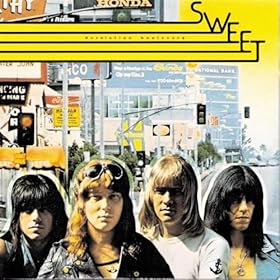
Sweet's Desolation Boulevard album was released in the fall of 1974, shortly after I started law school. 

Desolation Boulevard

"Fox on the Run" was released as a single in March 1975, while the band's other big hit -- "Ballroom Blitz" -- was released in May of that year.  Oddly, both singles were #1 hits in Australia, both hit #2 on the British charts, and both topped out at #5 in the US.  The band's biggest hit in the US was "Little Willy," which made it all the way to #3 in 1973.

I was tempted to feature "Ballroom Blitz" in this post, but I chose "Fox on the Run" for two reasons.  First, I think it is less familiar.  Second, it was featured in the Dazed and Confused soundtrack. 

"Fox on the Run" is about groupies.  Not the most original concept for a 1970's rock song, is it?  The first line of the song is "I . . . don't wanna know your name."  At least the band was honest.

Sweet (who were usually (but incorrectly) referred to as The Sweet) admired the Who -- they recorded "My Generation" and played a medley of  Who songs in their live sets for a number of years -- and Pete Townshend praised the band in 1974.  But Desolation Boulevard sounds more like T. Rex, Gary Glitter, and other British glam-rockers than the Who.

Desolation Boulevard was a top 25 album in the US, hit #13 in Australia, and reached the top 10 in Germany and Canada.  Sweet's next album did about as well, but the band's following LP sold poorly.  Sweet switched labels and switched musical styles as well.  Their final hit single -- "Love Is like Oxygen" (which made it into the top 10 in the US, UK, and a number of other countries) -- sounds more like ELO than ELO does.

The story of the band's subsequent downward spiral is a familiar one.  Lead singer Brian Connolly's drinking problem got out of hand, and the rest of the band weren't exactly poster children for sobriety. 

I don't know if the creators of This Is Spinal Tap had any particular band in mind, but it wouldn't surprise me if Sweet was one of the groups that inspired that great mockumentary.

It's a little embarrassing to admit that I bought Desolation Boulevard.  The music is unbelievably dated, although only about half as dated as the band's clothing and haircuts are.

The haircuts are really appalling.  Actually, that's not fair -- the haircuts would be beautiful if they were on girls.  If you had put Sweet's members in dresses and dropped them off at a singles bar, I guarantee you they would have gotten hit on by half the guys there.

Here's "Fox on the Run":


Here's a link you can use to order from Amazon:  

Monday, June 27, 2011

Apples in Stereo -- "Can You Feel It?" (2007)

Oh-oh-oh-oh, oh-oh-oh-oh,
Turn up your stereo!
Oh-oh-oh-oh, oh-oh-oh-oh
Drown out the bullshit on the FM radio!
Can you feel it?

The Rolling Stones' Let It Bleed LP -- probably their best -- had these words of advice printed on the record's sleeve: "THIS RECORD SHOULD BE PLAYED LOUD."  Amen to that.


The Apples in Stereo went the Stones one better.  The first line of this song -- which is the first track on the New Magnetic Wonder album -- is "Turn up your stereo!"

By the way, whatever happened to FM radio?

Back in the 1960s, there used to be top-40 stations, which were great -- because top-40 music was great then.  There were AOR ("album-oriented rock") stations, which played the songs from Beatles albums and Rolling Stones albums and Jimi Hendrix albums that hadn't been released as singles, and which you didn't hear on the top-40 stations.  And there were college stations, which played all this crazy stuff that only crazy, obsessive college-radio DJs knew about.

Now FM radio is about 99% crap.  I'm sure there are FM stations somewhere that play Apples in Stereo songs, but none of the ones where I live (Washington, DC) do.  

Earlier this month, I wrote six posts about the Joplin tornado, each of which featured a song from their 2007 New Magnetic Wonder album.  Unlike most 2 or 3 lines posts, those say almost nothing about those six songs or the group that recorded them.


The Apples in Stereo got their start about 20 years ago on a bus in Denver, Colorado.  Robert Schneider (the lead singer/songwriter on most of the group's songs) was a 20-year-old student who had recently moved to Denver from Ruston, Louisiana.  Jim McIntyre, the band's first bass player, took the same bus that Schneider took.  The two men talked about the Beach Boys -- they were both huge fans -- and discussed starting a band and even starting a record label.

Denver bus (1994)
Schneider and a group of his friends did form a recording collective called "The Elephant 6 Recording Company."  That collective spawned a number of legendary indie bands, including The Olivia Tremor Control, Of Montreal, Neutral Milk Hotel, and -- most significantly for purposes of my story -- the Apples in Stereo.  (No, I did not make any of these names up.)  McIntyre was the band's original bass player, although he left it a long time ago.

A number of these bands eventually signed with major labels, and The Elephant 6 Recording Company became more of a symbol of a certain type of indie music (which was variously called "psych folk," "psychedelic pop revival," and "lo-fi") but was revived by Schneider in 2007 when he issued the New Magnetic Wonder album on that label.

The Apples in Stereo have released seven studio albums -- this is only one I have -- and Schneider has a number of solo projects that sound interesting.  Plus there are all the other Elephant 6 musicians -- especially Neutral Milk Hotel (whose 1998 In the Aeroplane Over the Sea album was inspired by Anne Frank).  I feel an Elephant 6 series coming on . . .


The official music video for "Can You Feel It?" takes me back to my college days, when my friends and I took stereo equipment very seriously.  (I can't remember the last time I turned my 20-year-old-plus stereo on.  I now only listen to music on my Mac, or my iPod, or in my car.)

The version of the song that's used in the video is G-rated -- the "Drown out the bullshit" line that is on the CD is replaced by "Drown out the static."  But everyone knows that there's no such thing as FM static -- static is a phenomenon that's limited to AM radio. 

(My parents were surprised recently when I hooked up a pair of rabbit ears to one of their televisions -- they lost their cable service due to the tornado, and it still hasn't been restored -- and the picture was perfectly clear.  They expected "snow," which used to be a problem with analog television signals, but is not an issue with digital TV.  Try and explain that to your 85-year-old parents.) 

Here's the "Can You Feel It?" video:


Here's the version of the song that features the lyrics quoted above.  It accompanies a YouTube video (it's really a slide show) that appears to have been made by an Asian or Asian-American college student who spent 2007 studying abroad.  (The creator of this video is going to be AMAZED to suddenly be getting hundreds of views a day thanks to 2 or 3 lines.


Here's a link you can use to order this song from Amazon:

Friday, June 24, 2011

Toadies -- "Possum Kingdom" (1994) (part 2 of 2)


I'm not gonna lie
I'll not be a gentleman
Behind the boathouse
I'll show you my dark secret
We're back with part two of our two-part post on "Possum Kingdom," the 1994 hit single by the Toadies.  Click here to read part one if you haven't already.  

Even if you're not a musician, you've probably noticed that there is something very unusual about the rhythmic structure of "Possum Kingdom." 
A typical rock song is built around units of four measures with four beats per measure.  This is how you would count out such a song:

ONE-two-three-four
ONE-two-three-four
ONE-two-three-four
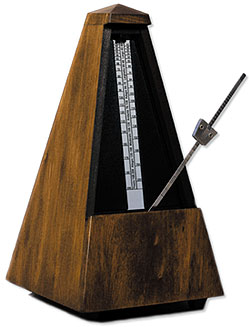
Mechanical metronome
ONE-two-three-four

(The "ONE" is capitalized because you usually accent the first beat.  There is sometimes a secondary accent on the third beat.)

But most of this song has a slightly different structure:

ONE-two-three-four
ONE-two-three
ONE-two-three-four
ONE-two-three-four

It's odd, because the impression this pattern left on me when I first heard "Possum Kingdom" was that they had added an extra beat at the end of the fourth line.  That's mostly because the third and fourth beat of that fourth line consist of repeated chords -- the repetition sounds odd, like the second one doesn't really belong.

But what the band really did was omit the fourth beat of the second measure.

The third beat of the second line is emphasized somewhat, which helps smooth over the transition to the next line -- the omitted fourth beat isn't quite so jarring as it otherwise would be.

I want you to start the video at the beginning and start counting.  Don't follow the words -- follow the guitar chords.

The chords are usually played in pairs -- the first is on the beat, and the second is off the beat.  (That is, between beat one and beat two.)  Another way to put that is to say that the chords are eighth-notes, not quarter notes.

Virtual metronome
So on beat one of the first measure, we get a quick pair of guitar chords -- on beat one and between beat one and beat two (beat 1.5, if you like).  Beat two is silent -- it's a rest.  There is another pair of eighth-note chords on beat three.  And beat four is silent.

The second measure has the two quick chords on beat one, a rest on beat two, and two most chords on beat three (although the chord changes) -- but there is no beat four.  Instead we go right into beat one of the next measure (which consists of the same two chords as all the first beats have).

But when we get to the fourth measure, you get the same quick pair of chords on beat three, which are repeated on beat four -- beat four is not silent.  

After that, we repeat the 4-3-4-4 pattern over and over again.  There are some normal 4-4-4-4 passages, but the song is characterized by four-measure units with the 4-3-4-4 pattern. 

And that, boys and girls, is what makes this song unique.  The skipped fourth beat in the second line propels you right into the third line, and the double pair of chords on beats three and four of the fourth line propels you to the next four-measure unit.  So the song has a lot of rhythmic momentum.

But skipping the beat is unnatural, disturbing, distracting -- try to dance to this song, and you'll see what I mean.  The Toadies get into a pretty good groove, but you never really stop noticing the rhythmic irregularity that makes "Possum Kingdom" so unique.  The song moves right along, but it's a little herky-jerky -- for those of you old enough to have owned LPs, the effect is just like the record skipping.

There's one other rhythmic oddity in this song.  Starting at 2:34 (when the binge-drinking, hot-tub-loving, cougar-pursuing Todd "Danger" Lewis sings "Give it up to me") the song shifts gears again.

The first two lines ("Give it up to me" is the first line, which is then repeated) are six beats each -- the singer rests on the first beat of each line, which makes it a little tricky to locate the first beat.  The next two lines ("Do you wanna/Be my angel") are four beats each.  So the pattern is 6-6-4-4 for a bit.

So what are the Toadies up to today?  According to Linda,

The Toadies are still hugely popular down here, revered really by their fans. They play a one-off show every once in awhile and those sell out immediately.

Oklahoma casino
Linda recently had an opportunity to see the Toadies play at some second-rate casino in Texas or perhaps Oklahoma.  (Can you believe that Oklahoma has 77 casinos?  What is the world coming to?)  For some reason, she didn't go.  You'd think someone who is constantly complaining about not having any 2 or 3 lines stock options might be trying just a little bit harder.

If she had attended that concert, her account would have no doubt been a great post for 2 or 3 lines.  We all could have read about her and Todd meeting backstage after the concert, perhaps sharing another bottle of vodka, etc. -- wouldn't you have loved to read about that?

Here's a live performance of "Possum Kingdom" featuring the band's original lineup, including hockey-jersey-clad bassist Lisa Umbarger (who looks like she would be a natural for that reality show that gives women fashion makeovers):


Click here to order the song from iTunes:

Possum Kingdom - Rubberneck


Click here to order from Amazon:

Wednesday, June 22, 2011

Toadies -- "Possum Kingdom" (1994) (part 1 of 2)


I can promise you
You'll stay as beautiful
With dark hair
And soft skin . . . forever

I think I'll turn this post into the pilot episode for a 2 or 3 lines television series and see if I get a cable network to put it on the air.  I'm pretty sure it would sell if I could get Keith Morrison to narrate it.

Keith Morrison
Keith Morrison is the creepy reporter who does the Dateline Saturday Night show on NBC.  (He's not the guy who does the "To Catch a Predator" shows -- that's Chris Hansen.)  Morrison specializes in lengthy, drawn-out pieces on obscure small-town murders.  He manages to take a story that could be told in 5 or 10 minutes and drag it out for an hour or so (not counting commercial breaks, of course). 

My wife watches Morrison's shows regularly.  I've never seen one from start to finish, but I've seen enough bits and pieces of them to have figured out that every one is pretty much the same.

Each episode begins with what appears to be an accidental death or a disease-related fatality or a suicide. 

There's usually a family member or friend who suspects foul play.  Eventually, that person is able to overcome the lethargy or incompetence of law enforcement officials -- sometimes with the help of a maverick police officer -- and the truth is revealed.

In about 90% of the shows, the victim is a wife, and the murderer is her husband.

Occasionally, the victim is a husband or a parent, and the killer is the wife or a child.  But most of the time the guilty party is a husband who killed his wife because he is having an affair with another woman, or a husband who killed his wife because her death would result in him coming into a large sum of money.

Not infrequently, the guilty party is a husband who wants a large sum of money to support his affair with another woman -- giving him not one, but two reasons to murder the wife.

Here's a typical Keith Morrison piece:


Click here to see Bill Hader's parody of Morrison on Saturday Night Live

There's certainly some kind of foul play going on in "Possum Kingdom."  What exactly is going on in this song is subject to interpretation.  How you interpret it will likely depend on whether you're a big vampire fan or not.  

Let's clear up a couple of preliminary matters before we turn to what "Possum Kingdom" means.  

First, this is going to be a two-part post.  All you regular readers of this blog know that two-part posts are kind of a big deal on 2 or 3 lines.  For example, we did a two-part post on "House of the Rising Sun" because it was the 100th song featured on 2 or 3 lines. This post is number 200.

(NUMBER 200???  As Ed McMahon used to say to Carnac the Magnificent, "You are correct, sir!"  The first 2 or 3 lines post appeared on November 1, 2009.  And here we are -- almost 20 months and 199 posts later.  What hath 2 or 3 lines wrought?) 

The Toadies
Second, you need to know a little bit about the Toadies, the band that recorded "Possum Kingdom."  The Toadies formed in 1989 in Keller, Texas, a suburb of Fort Worth.  They broke up in 2001 -- their bass player, Lisa Umbarger, quit the band for personal reasons, and the rest of the Toadies didn't want to continue without her -- but reformed with a couple of new members in 2006.  "Possum Kingdom" was released in 1994, and was by far the band's most successful single.  

Everyone knows  that 2 or 3 lines has a lot of showbiz connections, and it probably will come as no surprise to you to learn that our Chief Executive Senior Contributing Editor (we'll call her "Linda") is not only a resident of Keller but also a close personal friend of the band's lead singer.  I'll let her tell you more about him and how they got acquainted:

I don't know much personal stuff about Todd Lewis.  I think he goes by Vaden, his real first name, with his friends.  His full name is Vaden Danger Todd Lewis.  He has also gone by the name Danger Lewis.  
The closest I ever got to him was drinking the rest of the vodka he'd brought to my friends' ranch the weekend before we were there.  I know he's 45, divorced and has a young daughter, but that's pretty much it.
Vaden Danger Todd Lewis
Perhaps Linda really doesn't know much about Lewis, or perhaps all that binge drinking at her friends' ranch has left a few gaps in her memory.  Her account of how she came to be drinking Lewis's vodka doesn't include anything about peeing in a big-ass travel coffee mug, which makes me wonder if she is giving us the truth, the whole truth, and nothing but the truth.  

Note also how Linda's account leaves the impression that she and Lewis were at the friends' ranch on different weekends.  But if you read her words very closely, you will see that she does not actually deny that she and Lewis were there at the same time.  Nor does she actually deny that they drank that bottle of vodka while relaxing in a hot tub and gazing out at a beautiful Texas sunset.    

A hot tub, a sunset, and thou
I find that interesting.  Don't you find that interesting?  (I thought you would.)
Of course, my purpose in pointing this out is not to embarrass Linda by revealing facts that she has managed to keep secret until now.  I freely admit that I have no proof whatsoever that her relationship with hunky rock star Todd Lewis goes beyond their having gotten drunk from the same bottle of vodka at a secluded Texas ranch while sitting in a hot tub.  Anything else is just speculation.  

Let's hear a little more about that romantic getaway where Linda and "Danger" Lewis shared that bottle of vodka:
Our friends' ranch is about 60 miles northwest of Fort Worth. It's rustic but comfortable -- a log house (not a log cabin) on 75 acres with a small lake and lots of wildlife.  A huge raccoon joined us near the patio one night.  Even with an extended happy hour's worth of wine consumption, I got into the house in a split second.  [NOTE:  Linda's binge drinking is obviously not limited to vodka.]

A rattlesnake has been shot on that same patio.  A cougar has been sighted on the property a couple of times.  [NOTE: I'm sure that when Linda says "cougar" here that she is referring to the large cat species that is also known as the puma, mountain lion, and panther -- and not using the slang term for an older woman looking to "score" with younger men, especially hunky rock stars.]  
Our friends raise a few calves every year so that it's considered a working ranch for tax purposes.  [NOTE: What the IRS doesn't know won't hurt them!]  The "Supremes" (3 black Angus heifers) were there in late winter/early spring this year, but have since been sold.  [NOTE:  I'm not sure quite what to make of the previous sentence -- an example of Texas humor, mayhaps?]
The ranch is probably about 80 to 90 miles northeast of Possum Kingdom Lake. 
I'm sure you'll agree that "Possum Kingdom Lake" is a helluva odd name for a lake.  Let's let Linda explain the derivation of the lake's unusual sobriquet.

Possum Kingdom Lake is a man-made lake on the Brazos River about 90 miles west of Fort Worth.  Around the turn of the 20th century, a Russian Jewish emigrant named Ike Sablosky lived around there.  He was a fur and pelt trader, including possum pelts.  The canyons around the Brazos were prime hunting grounds for possums.  Whenever the possum hunters would bring pelts to him, he'd say "Here are the boys from Possum Kingdom."  That's what locals started calling the canyons, then when the dam and resulting lake were built by the WPA (completed in 1941), it became known as Possum Kingdom Lake.

Here's a good pic of a part of the lake called Hell's Gate:


If you go through Hell's Gate, there's a good-sized cove on the other side where I've heard a lot of boaters go to tie up or drop anchor and party.

Here's a picture from the Possum Kingdom party cove, which Linda has only "heard" about.


"Possum Kingdom" is one of those songs whose exact meaning is hotly debated.  

The most obvious interpretation of the lyrics is that the singer is trying to talk a young woman into accompanying him to a secluded spot behind a boathouse and have sex with him there.  (That's what professional journalists refer to as a "dog bites man" story -- no news there.)

But after the first couple of verses, things take an odd turn.  The singer promises the girl that she will stay beautiful forever if she "give[s] it up" to him.  "Do you want to die?" he asks, and then promises that he "will treat you well, my sweet angel -- so help me, Jesus."

Some people believe the singer is proposing a suicide pact -- by committing suicide together, the couple will never grow old but remain eternally young in the afterworld.  

Others believe it must be about vampires, which are tres chic these days.  They say that vampires don't age, so if the young woman agrees to become a vampire, she will remain young and beautiful.

The "Zodiac Killer"
In a comment posted on the Songfacts website, one fan of the song theorized that it has something to do with the "Zodiac Killer," a serial killer who murdered at least 5 people in northern California in 1968 and 1969.  This fan notes that the Zodiac Killer said in the letters he wrote to local newspapers that he was killing people in order to have slaves for his afterlife.

This is all very confusing, so let's go right to the source and ask Todd Lewis, who wrote the song, what it is all about.  From the Songfacts website:

In a 1995 interview with RIP magazine, Toadies lead singer Todd Lewis said: "It's just a story I heard long ago; it's just a really cool, eerie lake, and some stuff I heard and some stuff I just make up. I tend to do that. They dammed up this big river up there, and it's got all these spooky names like Hell's Gate. It's really cool."
Lewis went on to say that there was a real stalker in Tyler, Texas who became a folk hero: "I was down there for Thanksgiving, and after the family got through talking about who died and who's got cancer and all those things that families talk about, they started talking about this guy who was peeping in windows and started breaking into people's houses. He'd go out of his way to be seen, and everyone is like armed to the teeth, and he's like tapping on windows. The whole family was freaked out about it."
That doesn't make a whole helluva a lot of sense, does it?  Maybe ol' Todd was hitting the vodka when he gave that interview.  

What about the music video?  As Linda notes, 

The official video is mostly intercutting between footage of the band and scenes of something being dragged out of the water, the impression being that it's a body wrapped up in a tarp. The action in the music video doesn't seem to be consistent with the lyrics.

That's an understatement.  Perhaps Todd had also hit the vodka the day he met with the director of the music video to go over the draft shooting script.

There's no doubt that what the video wants you to think is that there is a body wrapped up in the tarp that is being towed through the water by a mysterious figure and eventually pulled up on to the lakeshore.

I just noticed that at 1:57 of the video there's a very quick close-up of a false eyelash and someone's finger reaching out to touch it.  Near the end of the video, there are several quick shots of a hand holding a knife and rising and falling in a stabbing motion.  But the final shot is of a woman's bust sculpted from a block of ice -- complete with that false eyelash.  

OK, that clears everything up.  The guy hasn't been towing a dead body in the tarp, he's been towing a big hunk of ice -- and he wasn't stabbing the girl, he was carving a statue out of a block of ice.  Now I understand perfectly!

Here's the music video.  You're the boss of you, but my advice is to ignore the guy towing the tarp-wrapped block of ice through the water and just listen to the music.


Click here to read part two of this post, which analyzes the unique rhythmic structure of "Possum Kingdom." 

Here's a link if you'd like to buy this song from iTunes:

Possum Kingdom - Rubberneck


Here's a link if you'd like to buy it from Amazon:


Sunday, June 19, 2011

Apples in Stereo -- "7 Stars" (2007)


Simple lives we once left behind
We're so distracted now


It's been two weeks since I came to Joplin to help out my parents and see what the tornado had done to my hometown, and it's time to move on.  This post will feature a few final pictures from my visit.

I didn't plan to post these pictures on Father's Day – it just happened that way.

There are a lot of Joplin fathers out there who lost their jobs as a result of the May 22 tornado, and a lot of Joplin fathers whose families' homes were destroyed.  None of that is the fault of those fathers, of course, but I'm guessing that their inability to shield their families is weighing very heavily on them this Father's Day.

After all, a father's job is to take care of his family – period.  (No excuses.)  

*     *     *     *     *

I went to Joplin shortly after the May 22 tornado to check up on my parents and provide them with some practical help and moral support, but also because I spent the first 18 years of my life there – a simpler life I left behind on the way to becoming "so distracted now" – and I wanted to see for myself exactly what had happened to the schools and neighborhoods that were the center of my universe.

Every day that I was there, I took long walks and used my Blackberry to take pictures – many of which I've already posted.  Looking back, it was almost as if I was a tourist on a trip to the site of an ancient civilization, where I snapped pictures of ruined temples to show the folks back home.  

After I left, I saw a picture of a homemade sign from Joplin that said "Put down your camera and help us," or words to that effect.

Mea culpa.  I worked to help clean up my parents' house and yard, but I didn't do anything to help anybody else.  Maybe I  should have done that instead of just being a voyeur.

On the other hand, I even saw local policemen stopping to take pictures with their cell-phone cameras.  It was hard not to stare, and not to want to have photos of what things looked like – without having pictures to show, I could never have described what I had seen to my kids and my friends. 

*     *     *     *     *

While I moved away from Joplin a long time ago, it was where I spent the first 18 years of my life.  I knew much of the area where the damage was the worst intimately.  I had walked and ridden my bike on those streets 40, even 50 years ago.  I wasn't just gawking at Irving Elementary School and Joplin High School and all the destroyed houses in between -- those were my schools, my neighborhoods.

I saw this house when I was walking from Irving School (which was destroyed by the tornado) to the house I grew up in (which was damaged but will survive).  The interior of this room is surprisingly intact, given that the wall that enclosed it was ripped off – it looks almost like a stage set:


This house is only two blocks from my parents' current house.  The clothes hanging in this closet appear to be undamaged – why are they still there two weeks after the tornado?  


Someone took the time to prop up this child's bicycle on its kick stand.  Who?  (Why?)


This sign was leaning against a half-destroyed house on Murphy Boulevard.  Before the tornado struck, had it been hanging in a young girl's bedroom?


I saw abandoned wheelchairs at several different locations.  This picture was taken near 24th and Iowa, just across from the high school – the houses in this area were completely flattened:


These wheelchairs are standing in the parking lot of a nursing home where several people were killed.


It was an odd coincidence that I saw three houses with ruined pianos on the same block.  Here's one of them:


The legendary Dude's Daylight Donuts on Main Street – New York Times story about local businesses that were destroyed by the tornado led with a mention of Dude's -- was just a pile of generic rubble:


But after poking around for a few minutes, I found definitive evidence that I was at the right spot:


*     *     *     *     *

Finally, while walking on West 26th towards Main Street, I saw some inexpensive metal flatware lying in the gutter.


There were actually nine spoons instead of eight, which is even more odd.  Where were the forks?  Where were the other knives?

God only knows.  And God only knows where about a million other missing things have ended up.

Of course, a lot of people in Joplin lost not only their forks and knives – but also their clothes, and cars, and pianos, and family photos, and kids' toys.

Some people lost even more.

*     *     *     *     *

Click here to listen to today's featured song, "7 Stars" by the Apples in Stereo.

Click on the link below to buy the song from Amazon: