Friday, August 10, 2018

Johnny Hallyday – "Hey Joe" (1966)


Je pensais avoir une fille
Mais il paraît, Joe
Qu'elle dort maintenant entre tes draps
Bravo!

What is wrong with this photo of the elevator control panel in a European hotel?


Everybody knows there’s no such thing as a “0” (zero) floor in a building.  The first floor is the first floor – not the zero floor!  That should be as plain as the nose on your face.

But to get to the ground floor of this hotel, you had to press the zero button – not the “1” button.  (Push the “1” button and you ended up on the second floor.)

New York City has a Third Avenue and a Second Avenue and a First Avenue.  But the last time I checked, it didn’t have a Zero Avenue.  The same should apply to hotel floors.

Calling the first floor the “0” floor is bad enough.  What’s even worse is calling the basement level the “-1” (minus-one) floor.  

*     *     *     *     *

This is the kind of thing that makes a right-thinking American like me tend to eschew European travel.

About a decade ago, I spent a few days in Paris.  Other than that, I managed to avoid Europe for the first three score and six years of my life.  (I’ve been to the UK three times, but I’m not counting that.  The UK is a lot more like the United States than it is like France, Germany, or the other countries of continental Europe.)

That all changed last month when I spent two weeks in France and Belgium with a small group of other Americans.

My fellow pilgrims and I spent most of our time marveling at medieval cathedrals and visiting World War One battlefields and cemeteries.  Truth be told, we also spent a fair amount of time bending our elbows at the bars in our hotels.

*     *     *     *     *

I knew I wasn’t in Kansas anymore – or any of the other fifty states – as soon as my airplane landed in Europe.  

For one thing, H2O is never free at restaurants – you have to buy a big-ass bottle of water if you want to wet your whistle with something other than beer or wine.  

European flush buttons
For another, the toilets always have dual flush controls.  You push one for number one, and push the other one for number two.  (I was never sure which was which, so I usually pushed both of them simultaneously.)  

Manual-transmission cars have pretty much disappeared in the good old U.S. of A., but automatic transmissions are the exception in Europe.  If you rent a car, expect it to come with a manual transmission – you’ll have to pay extra if you’re like my children and don’t have a clue how to use a clutch.

Also, you have to get used to kilometers and liters and other such metric units of measurements.  This is particularly important when you are ordering beer.  Draft beer is served in either 25-centiliter or 50-centiliter glasses – which are roughly equal to a half-pint and a pint, respectively.  Bottled beer usually comes in 33-centiliter bottles or cans, which are a bit smaller than standard 12-ounce American containers.  

*     *     *    *     *

I had one experience on my European trip that still mystifies me.

My tour group spent two nights at a fancy resort hotel in Chantilly, France – a rather posh town just 25 miles northeast of Paris.

Chantilly is the site of the Château de Chantilly, a sort of mini-Versailles built by a lesser branch of the French royal family (the House of Bourbon).  It is also the home of a prestigious thoroughbred turf racecourse, the Chantilly Polo Club, and the Living Museum of the Horse.  (That museum is housed in the château’s luxurious Great Stables, which have room for up to 240 horses.  The Great Stables were built in 1719 by Louis Henri, duke of Bourbon and prince of Condé, who believed that he would be reincarnated as a horse).

Horse-sized lamp in the
lobby of our Chantilly hotel
Our hotel was within spitting distance of the château and all that fancy horsey stuff, and came equipped with its own golf course.

What it did not come equipped with were any drawers or shelves where I could unpack my clothes.

In the United States, even the humblest Red Roof Inn or Motel 6 provides drawers or shelves where its customers can store their clothes during their stay.  My hotel room in Chantilly had five hangers in a closet, but no chest of drawers or other place to put my clothes.  I thought that I must be overlooking something, and called the front desk for assistance.

When a hotel employee finally answered, he claimed to not be able to hear me.  I tried calling back on the other telephone in my room and was told the same thing when I asked where the drawers or shelves were.

So I walked down to the lobby and put my question to a group of desk clerks.  Their expressions showed their utter lack of comprehension of what I was driving at, so I asked to speak to a manager, who assured me that my room was perfect just the way it was.

“Let me ask you something,” I said to the manager.  “Where am I to put my socks?  If you were me, and you wanted to take your socks out of your suitcase and put them somewhere, where would you put them?”

Fine for coats, but useless for socks
The manager had no answer to what seemed to me to be a most reasonable question.  Apparently, the custom at this hotel was for guests to place their socks on the floor, or perhaps on the desk.

Shortly after I returned to my room, there was a knock on the door.  When I opened it, one of the housekeeping staff handed me some wooden hangers, then turned and left without a word.  

Did this mean I was expected to put my socks on hangers?  Zut alors!

*     *     *     *     *

This is the first in a series of posts about my trip to France and Belgium, several of which will feature a song by a French or Belgian recording artist.

The late Johnny Halladay was the biggest of all French pop stars.  He released an astonishing 79 albums and sold well over 100 million records during his 57-year career.

Hallyday covered a number of American and British hits – including “Let’s Twist Again,” “(Let Me Be Your) Teddy Bear,” “House of the Rising Sun,” “Proud Mary,” and even “Itsy Bitsy Teenie Weenie Yellow Polkadot Bikini.”

Some called Hallyday “the French Elvis,” and it’s not a bad comparison.  Both were hugely popular, and both were hugely ridiculous.

Johnny Hallyday (1968)
The lyrics in Hallyday’s cover of “Hey Joe” are very different from the lyrics in the Jimi Hendrix version of the song.  For one thing, the singer didn’t shoot his old lady down.   

Here’s an approximate translation of the French lyrics quoted above:

I thought I had a girl who would be good to me, Joe 
But she’s sleeping between your sheets now
Bravo!

Click here to hear Johnny Hallyday’s cover of “Hey Joe.”

And click on the link below to buy the song from Amazon:

Tuesday, August 7, 2018

Britney Spears – "Gasoline" (2011)


My heart only runs on supreme
So hot! Give me your gasoline!

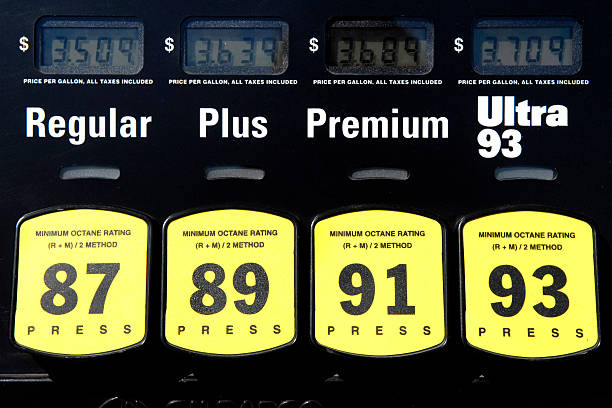
If your car gets by with “regular” 87-octane gasoline, you might as well stop reading today’s 2 or 3 lines right now.

But if your car’s manufacturer recommends 89 or 91 octane gasoline, I’m about to save you some  money.

Before reading any further, I’d recommend you drink a big cup of coffee – otherwise your eyes are going to glaze over quicker than you can say, “Jack Robinson!”

*     *     *     *     *

Whole milk is 4% fat.  Skim milk has zero fat.  

You could get 2% milk by mixing equal parts whole milk and skim milk.  But it’s easier just to buy 2% milk at the grocery store.

What if whole milk was $2.80 a gallon, and skim milk was $2.60 a gallon – but 2% milk was $2.75 a gallon?  If you mixed whole and skim milk yourself, you’d end up with 2% milk that cost only $2.70 a gallon – a nickel less than the store-bought 2% milk.


Would it be worth it to buy both whole and skim milk and mix it yourself just to save a nickel a gallon?  I can’t answer that question for you – I can only answer it for myself.

For me, the answer to that question is HELL, YES!

Not so much because saving a nickel is meaningful, but because I would be proving that I am one smart cookie who has seen through the bullsh*t propagated by the dairy industry and beaten them at their own game.

Get that weak sh*t outta here, dairy industry!

*     *     *     *     *

The same principle applies to gasoline.

My extensive research has revealed that most gas stations have two storage tanks – one that contains the lowest octane gasoline that is offered for sale (usually 87) and one that’s full of the highest octane fuel that’s for sale (usually 93).  If the the station sells an 89-octane midgrade gas – and most stations do – it simply mixes its two parts of 87-octane gas and one part of 93-octane gas.

You can do the same thing yourself.  Let’s say your car’s manufacturer recommends 89-octane fuel, and you need about 15 gallons of gas to fill the tank.  You pump ten gallons of the 87 and then pump five gallons of the 93 – which is essentially the same thing as pumping 15 gallons of the 89-octane midgrade, but a lot less convenient.

So why would you bother doing that instead of just buying the 89-octane juice?

*     *     *     *     *

Have you taken a good look at the prices for the various grades of gasoline sold at your local station?

There’s a Sunoco station near me that sells four grades of gas – 87, 89, 91, and 93.  


The 87-octane regular goes for $2.87 a gallon.  The three higher grades sell for $3.25, $3.35, and $3.45, respectively.

So if you mix your own 91-octane gas by buying equal parts of the 89 and 93, you don’t save a penny – $3.35 is smack dab in the middle of $3.25 and $3.45.

But let’s say that you decide to mix your own 89-octane midgrade by buying equal parts 87 and 91.  If you need 12 gallons to fill your tank, buying six gallons of 87 and six gallons of 91 would cost you $37.32.

Buying 12 gallons of the gas station’s premixed 89-octane gas would cost you $39.00.

So mixing the gas yourself would save you about 4.5% – or $1.68 per 12-gallon purchase.

*     *     *     *     *

The manufacturer of my car recommends 91-octane gas for best performance, but also says that I can safely use 89-octane fuel.  Occasionally, I’ll fill up with 91, but most of the time I stick to 89.

So I should mix 87 and 91 and save 14 cents a gallon rather than buying the premixed 89 – right?

Not so fast, bub!

The two biggest grocery store chains in my area – Safeway and Giant – offer discounts on gasoline to their customers.  For each $100 I spend at Safeway, I get ten cents off the price of each gallon of gas I buy at a Sunoco station.  Giant offers the same discount at Shell stations.


To maximize the value of that discount, you need to fill up only when your tank is almost empty.  That’s because if you spend $100 on groceries and then buy eight gallons of gas, you save 80 cents.  But if you spend $100 on groceries and buy 12 gallons of gas, you save $1.20.

So if you buy 12 gallons of 89-octane gas, you get the full benefit of the discount.  But if you buy six gallons of 87-octane gas and six gallons of 91-octane gas, you only get the ten-cent-per-gallon discount on one of those six-gallon purchases.

Even so, you still come out ahead – it would cost $36.72 for 12 gallons of the mix-it-yourself 89-octane gas vs. $37.80 for 12 gallons of the gas station’s 89-octane fuel.

Of course, if you waited until you had spent $200 at the grocery store before filling your tank, you’d save 20 cents a gallon.  That would lower the price of 12 gallons of out-of-the-pump 89-octane gas to $36.60.  

But 12 gallons of your do-it-yourself 87-octane and 91-octane blend would cost only $36.12.

In other words, you always save money by mixing your own 89-octane fuel.

*     *     *     *     *

But you save EVEN MORE if you make do-it-yourself 89-octane gas by mixing two parts of 87-octane regular with one part of 93-octane premium.


Twelve gallons of that mixture would cost $36.76 – a 6.1% savings over out-of-the-pump midgrade.  (That compares to a 4.5% savings from mixing equal parts 87 and 91.)

This strategy works even better when you can take advantage of the Safeway or Giant discount because you’re able to apply that discount to eight of your 12 gallons instead of only six gallons.  

According to my calculator, a ten-cent-per-gallon grocery store discount on my 87-octane and 93-octane formula would lower my cost to $35.96 for 12 gallons.  

The 20-cents-per-gallon discount would take the price of that twelve gallons down to $35.16.

*     *     *     *     *

Does all this strike you as a tad bit obsessive?

I would say so.  But I’m a bit obsessive when it comes to saving money on gasoline.

In fact, I’ve been known to go to the gas station with my son so I can fill up my car and then fill up his before closing out the transaction – essentially doubling the benefit of my grocery-store discounts.

Keep in mind that gasoline isn’t a big expense for me.  Let’s say I drive my car 12,000 miles a year and get 24 miles per gallon in combined city/highway driving – which means I buy 500 gallons of gas a year.  Saving 14 cents a gallon by blending my own 89-octane fuel means that I save $70 in the course of a year.  And if I qualify for the 20-cents-per-gallon grocery-store discount each and every time I fill up, that savings drops to 12 cents a gallon – or $60 annually.

I like saving $60 or $70 as much as the next guy.  But I can easily go through more than that in an hour or two at the local strip club.  So it’s not exactly a meaningful amount of dough.

*     *     *     *     *

I can’t believe that 2 or 3 lines has gone almost nine years without featuring a single song by Britney Spears.  I should be ashamed of myself!

“Gasoline” was released in 2011 on Femme Fatale, which was Britney’s seventh studio album.

Claude Kelly, who co-wrote “Gasoline,” told MTV that he came up with the tune for it while thinking of the hottest scenes in Britney’s previous music videos:

That kind of thing where it's sexy and it’s hot, sweaty and she’s in a club and she sees a guy.  That mysterious, exotic look, that whole imagery and that era where she’s a man-eater and all the girls want to be her and all the guys would kill to be with her. 

Sounds like Claude may have needed to take a cold shower or two before he finished writing “Gasoline”!

Click here to listen to “Gasoline.”

Click on the link below to buy the song from Amazon:

Sunday, August 5, 2018

Jack White – "Why Walk a Dog?" (2018)


Why does a dog
Need to be walked?

If you really don't know the answer to that question, here’s a hint: 


*     *     *     *     *

Jack White’s new solo album is titled Boarding House Reach:


Rolling Stone called it “his strangest record” – “a messy, sprawling, daffy, howling set that sounds spiritually hungry, collectively driven and, instructively, a little bit lost” – but also thought it was “thrilling and refreshing.”

Other reviewers were not so kind.  From Pitchfork:

Boarding House Reach is a long, bewildering slog. Deep in the eccentric-hermit stage of his career, with his own successful label and a devoted clutch of fans who will come to see his concerts until their children are in college, White is now free to record and release whatever he pleases. And judging by Boarding House Reach, he wants to noodle to himself in the studio, record spoken-word reminiscences about the first time he played piano . . . and make the kind of Cheeto-dusted funk instrumentals that the Beastie Boys would have left off of The In Sound From Way Out! What he doesn’t want to do: write any songs at all.

The worst part is that he doesn’t even sound like he’s having fun. The few rock songs here . . . are blowsy, water-logged things, devoid of wit or snap or fire.

I’m a diehard Jack White fan, so I’m going to give Boarding House Reach a chance.  Since it’s available at no cost from Freegal – thank you, Montgomery County Public Library! – I’ve got nothing to lose . . . except a few of the rapidly diminishing number of hours left in my life.  

But if I didn’t spend that time listening to this album, I’d just waste it some other way.

Click here to listen to “Why Walk a Dog?”

Click on the link below to buy the song from Amazon:

Friday, August 3, 2018

Richard Harris – "MacArthur Park" (1968)


MacArthur's [sic] Park is melting in the dark
All the sweet, green icing flowing down
Someone left the cake out in the rain

[NOTE: The 2 or 3 lines posts for July featured the first ten inductees into the brand-spanking-new 2 OR 3 LINES “GOLDEN DECADE” HIT SINGLES HALL OF FAME.   It's one hell of a group of great songs, if I do say so myself.  But after completing the last of those posts, something suddenly hit me: I had forgotten all about a song that absolutely, positively had to be included in the initial group of inductees.  So instead of our first 2 OR 3 LINES “GOLDEN DECADE” HIT SINGLES HALL OF FAME class containing ten songs, it's going to contain eleven.  Isn't that typical of the way 2 or 3 lines operates?  Underpromising and overdelivering – it's the 2 or 3 lines way!  Without further ado, here's an updated version of my original 2012 post about the hot mess that is the 1968 Richard Harris recording of "MacArthur Park."]

"MacArthur Park" (not "MacArthur's," as Richard Harris insisted on singing it) might not represent the greatest achievement of Western civilization since the Renaissance – but then again, it might.

You either love "MacArthur Park" or you hate it.  In the words of Paul Rees, the editor of Q magazine (which is the British equivalent of Rolling Stone):

["MacArthur Park"] polarizes opinion because it's mad.  It's as simple as that. 

Rees is correct: "MacArthur Park" is mad.  The music is mad, the lyrics are madder, and Richard Harris's performance is the maddest of all.  Put all that together and you have a song that is either seven minutes of incoherent insanity or a work of pop-culture genius that is the 1968 equivalent of the "Ode to Joy" movement of Beethoven's Ninth Symphony.

Personally, I vote for "work of genius."  I love everything about this song.  It is so over the top, so off the wall – it's hard to believe that a record company actually had the nerve to release it.  And it's unfathomable that a seven-minute single ever got played on AM radio stations, much less made it to #2 on the Billboard "Hot 100" the week of my 16th birthday.

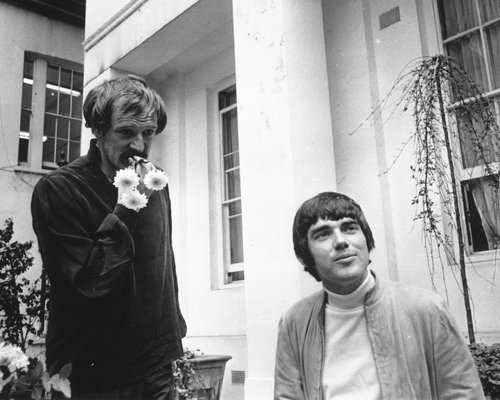
Richard Harris and Jimmy Webb
Nothing about this record makes any sense.  The man who wrote "MacArthur Park," Jimmy Webb, was a very gifted pop music songwriter who cranked out mainstream hit singles for Glen Campbell ("By the Time I Get to Phoenix," "Wichita Lineman"), the Fifth Dimension ("Up, Up and Away"), and many others.  By 1968, Webb was viewed as a bit old-fashioned and out of sync with the counterculture-influenced music that was  all the rage.

"MacArthur Park" is one of several Webb songs ("By the Time I Get to Phoenix" was another) that was inspired by his breakup with Linda Ronstadt's cousin, Susan Ronstadt.  Susan worked for an insurance company whose Los Angeles offices bordered the park.  She and Webb occasionally met in the park for lunch, and one of Webb's friends said later that Susan got married in the park after her relationship with Webb ended.

MacArthur Park, Los Angeles
According to that friend, the broken-hearted songwriter hid out in a gardener's shed and watched the ceremony.  When it started to rain, the water running down the shed's window made it look like the wedding cake was melting.       

That explains the song's chorus, but what about the song's opening verse?

Spring was never waiting for us, girl
It ran one step ahead 
As we followed in the dance
Between the parted pages that were pressed
In love's hot, fevered iron
Like a striped pair of pants

Check out those last three lines – well, doggies!  (That's "stripe-ed," by the way – two syllables.)

The next verse is also pretty wack:
I recall the yellow cotton dress 
Foaming like a wave 
On the ground around your knees
The birds like tender babies in your hands
And the old men playing checkers 
By the trees
"MacArthur Park" is really two different songs that have been rather crudely stitched together.  It's like nonidentical Siamese twins (which is an impossibility, of course).

The second song begins about two and a half minutes in – its lyrics are a little out there, but nothing like those that came before:

There will be another song for me
For I will sing it
There would be another dream for me
Someone will bring it
I will drink the wine while it is warm
And never let you catch me looking at the sun
But after all the loves of my life 
After all the loves of my life
You'll still be the one

After song-within-a-song #2 ends, there's about a minute and a half of feverish instrumental music, which leads us into the final chorus.  MacArthur Park melts in the dark one final time.  The song ends on a high note that is far too high for Richard Harris to sing, so he simply steps aside and lets his female backup singers finish up.

"MacArthur Park" was originally one movement of a 22-minute pop cantata that Webb wrote for the Association.  But the group balked at devoting an entire side of their upcoming album to Webb's music.

So how did Richard Harris – an actor, not a recording artist – end up recording "MacArthur Park"?  Jimmy Webb told Songfacts the whole story in a 2011 interview:

I met Richard on stage at the Coronet Theatre in Los Angeles.  We were doing like an anti-war pageant with Walter Pidgeon, Edward G. Robinson, Mia Farrow and some other people, and I was doing music. In our off-time we used to like to play the piano backstage and sing and have a few beers, and Richard and I got to be really good friends.  And we were just kind of tossing around that thing about, "Wow, one of these days we ought to make a record."  And I used to say that to everybody . . . 
So one day I got a telegram . . . that said, "Dear Jimmy Webb, come London, make record. Love, Richard."  And it was the first time I was ever out of the country.  I got on a 707 and flew to London and started doing this record with Richard. "MacArthur Park" was kind of in the pile, but we had a lot of songs that we were interested in doing.  And we ended up doing two albums. . . .

The first one was called A Tramp Shining.  And that takes us to the sort of hidden question in your question, which is why would you get an actor instead of a singer?  Well, he was a singer.  He had just done a very successful top-grossing motion picture, which was a musical version of Camelot.  
[Note: My high school English class read The Once and Future King and other Arthurian literature in 1968, and we took a bus trip to Kansas City to see the movie version of Camelot, which starred not only Richard Harris, but also Vanessa Redgrave (hot!) and Franco Nero (even hotter!).] 
And [Harris] had sung all the [Camelot] stuff.  I mean, it wasn't perfect, but he had sung it.  He had gotten through the score and it was considered successful.  And I thought he had done a good enough job singing [Camelot] that I thought I could make a record with him.  I didn't think it was that weird – I still don't know why people are so taken aback by it.  It's not like some strange thing. He had just done a musical. You know what I'm saying?
[N]ow that Richard's gone [Note: Harris died in 2002, aged 72] he's a little easier to appreciate.  He brought a great kind of theatrical dignity to "MacArthur Park" . . . .  And if he missed a note or he didn't carry it off particularly well as a singer, he had the actor's ability to step his way through the lyric and to speak some of the lines and basically to carry it off. . . . [H]e eventually bought the rights to the [Camelot] score, so he owned the publishing. And he played Camelot on the road for eight years. He told me one day at a bar that he made $65 million playing Camelot on the road. . . . So it's a little insulting to say that he couldn't perform, or that he couldn't sing.
Click here to read the entire Songfacts interview.

"MacArthur Park" is one of the most-covered songs of all time.  Webb got his start working for Motown, and the Four Tops were one of the first groups to cover "MacArthur Park."  Click here to listen to their version of the song.

Waylon Jennings won a Grammy for his 1970 version of the song.  Click here to listen to it.

Click here to listen to Donna Summer's disco version, which was a #1 hit in 1978.

There are a lot of jazz covers of "MacArthur Park."  Click here for Stan Kenton's version.

Click here for Woody Herman's version.

Click here to watch a brilliant SCTV bit based on "MacArthur Park."

Last and almost certainly least, click here for Weird Al Yankovic's "Jurassic Park" parody.

*     *     *     *     *

And now . . . the moment you've all been waiting for.  

Click here for Richard Harris's one-of-a-kind performance of Jimmy Webb's one-of-a-kind song, "MacArthur Park."

Click here to buy that recording from Amazon.