Tuesday, February 14, 2017

Bobby Vinton – "Coming Home Soldier" (1966)


I am a soldier
A coming home soldier
No purple heart
Do I wear on my chest

Canonsburg, Pennsylvania – a town of 9000 or should located about half an hour’s drive southwest of Pittsburgh – is the birthplace of both Perry Como and Bobby “The Polish Prince” Vinton, two of the most successful male recording artists of their era.

Vinton’s father was a bandleader who pushed him to learn the clarinet by withholding his allowance until he had completed his daily practice.  

Bobby formed a band when he was 16 and earned enough money to help pay for his tuition at Duquesne University, where he majored in music composition.  By the time he graduated from Duquesne, Vinton could play not only the clarinet, but also the piano, saxophone, trumpet, drums, and oboe.  (At one time he hoped to play the oboe for a symphony orchestra.)

Vinton had four #1 hit singles in the early sixties – “Roses Are Red (My Love),” “Blue Velvet,” “There! I’ve Said It Again,” and “Mr. Lonely.”  

Vinson owned the Blue Velvet
Theatre in Branson until 2002
“Roses Are Red (My Love)” was the featured song on 2 or 3 lines last Valentine’s Day.  

I have a soft spot for “Blue Velvet” because it was the song my 6th-grade ballroom dance teacher played each week when we practiced the foxtrot.  

“There! I’ve Said It Again” was displaced from the #1 spot on the Billboard “Hot 100” by the Beatles first #1 single, “I Want to Hold Your Hand.”

The singer of “Mr. Lonely” is a lonely soldier who never gets letters from home.  The singer of “Coming Home Soldier,” which peaked at #11 on the “Hot 100,” is a soldier on his way home to see the girl he left behind.  Both songs were co-written by Vinton and Gene Allan.  

Later, Allan helped write Ron Dante write a number of songs for the Archies.  He and Dante also wrote the music for “Billy,” an unsuccessful Broadway musical that was based on the famous Herman Melville novella, “Billy Budd.”

Here’s “Coming Home Soldier”:


Click here to buy the song from Amazon:

Monday, February 13, 2017

The Mamas & the Papas – "Words of Love" (1966)


Wornout phrases and longing gazes
Won't get you where you want to go
No!

(Especially not on Valentine's Day, fellas.)

“Words of Love” is essentially a Cass Elliott solo record, except for the Betty Boop-ish “No!” that’s interjected at the end of the sixth line of the first verse.

That “No!” might have been spoken by Michelle Phillips.  But Mama Michelle, who was married to Papa John Phillips, was kicked out of the group in June 1966, after she was caught kanoodling with Papa Denny Doherty.  So the “No!” might have been uttered by her replacement, Jill Gibson, a singer/songwriter who was the girlfriend of Lou Adler, the group’s producer.

Cass Elliott with Jill Gibson
“Words of Love” and several of the other songs on the group’s eponymous second album had been recorded before Michelle was given the boot, but some or all of those songs were re-recorded with Jill Gibson.

Michelle was admitted back into the Mamas and Papas in August, and no one seems to know for sure whether she or Jill Gibson is singing on some of the tracks on the album (which was released shortly after Michelle’s return).  Some people believe that recording engineer Bones Howe may have used both Michelle’s and Jill’s vocals on the record.  (You can click here to read more about the Michelle-Jill story.)


John Phillips, who wrote “Words of Love,” was certainly parsimonious with the lyrics to the song.  The words of its two verses are virtually identical, and the chorus consists of one phrase – “You oughta know by now” – repeated a whole bunch of times.

“Words of Love” made it to #5 on the Billboard “Hot 100.”  If you’re as old as I am, you probably remember hearing it on AM radio fifty years ago this month.

Cass Elliott (who was born Ellen Naomi Cohen in Baltimore) died in a London apartment in 1974, just a few weeks before what would have been her 33rd birthday.  The cause of death was “heart failure due to fatty myocardial degeneration due to obesity.”  


Four years later, Keith Moon of the Who died in the same apartment, which was owned by singer/songwriter Harry Nilsson.  He was also 32 when he died.

Here’s the mono mix of “Words of Love” that was used for the single.  It's quite different from the stereo version that was used for the album:


Click below to buy the song from Amazon:   

Sunday, February 12, 2017

Don Ho and the Ali'is – "Tiny Bubbles" (1966)


Tiny bubbles
In the wine
Make me happy
Make me feel fine

Don Ho, a Hawaiian high-school football star who became a fighter pilot, got his start as an entertainer at his parents’ Honolulu cocktail lounge after leaving the Air Force in 1959.

“Son, why don’t you go make music?” Ho’s father asked him one day, hoping that some live entertainment might attract customers to his down-at-the-heels nightspot.  

Ho turned out to be a very personable performer – sort of a Hawaiian Dean Martin.  Eventually, he moved to Duke’s, a large Waikiki nightclub, where he routinely sold out three shows a night.

Don Ho with Elvis
Ho’s signature song was “Tiny Bubbles,” which was listed on the Billboard “Hot 100” for 17 weeks, peaking at #57.  No other record has ever remained in the "Hot 100" for longer without cracking the top 50.

I wish I had a dollar for every “Tiny Bubbles” parody or Don Ho impersonation I saw on television when I was a teenager.

Ho fathered ten children – six by his first wife (they were named Donald Jr., Donalai, Dayna, Dondi, Dori and Dwight), and four by two other women.  His daughter Hoku had a top-forty single titled “Another Dumb Blonde” in 2000, and his daughter Kea has appeared in a number of movies.

Don Ho with his daughter Hoku in 2001
He was diagnosed with cardiomyopathy (deterioration of the heart muscle unrelated to coronary artery disease) and had a pacemaker implanted in 2005, when he was 75 years old.  In 2006, Ho married his longtime producer but went into cardiac arrest just a few days later.  (It must have been some honeymoon.)  

Ho’s doctors gave him a new pacemaker, but he collapsed and died of heart failure about six months later.  You can click here to read his Los Angeles Times obituary.

Here’s a live performance of “Tiny Bubbles”:


Click here to buy the song from Amazon:

Saturday, February 11, 2017

Four Tops – "Standing in the Shadows of Love" (1967)


Didn't I treat you right, now baby, didn't I?
Didn't I do the best I could now, didn't I?

Lamont Dozier and brothers Brian and Eddie Holland wrote and produced more great Motown records than you can shake a stick at, including “Standing in the Shadows of Love.”  (Altogether, Holland-Dozier-Holland wrote thirteen #1 hits – most of them for the Supremes – and an amazing 35 top ten singles.)

“Standing in the Shadows of Love,” which reached #6 on the Billboard “Hot 100” in February 1967, is my favorite of the Four Tops’ many hits.

Unlike most Motown songs, there’s no instrumental introduction – ready or not, here come the song’s bleak lyrics:

Standing in the shadows of love
I'm getting ready for the heartaches to come

Levi Stubbs
Other male vocal groups (like the Temptations) usually gave the lead vocal to a tenor or falsetto singer.  The Four Tops’ lead singer, Levi Stubbs, was a baritone.  His voice wasn’t as pretty as David Ruffin’s or Smokey Robinson’s, but it had an urgency and strength that made songs like “Standing in the Shadows of Love” very compelling.

Here’s “Standing in the Shadows of Love”:


Click below to buy the song from Amazon:

Friday, February 10, 2017

Sonny & Cher – "The Beat Goes On" (1967)


Grandmas sit in chairs and reminisce
Boys keep chasing girls to get a kiss
The cars keep going faster all the time
Bums still cry, “Hey, buddy, have you got a dime?”

(Plus ça change, plus c'est la même chose.  Except cars don’t keep going faster all the time because today most of them have poopy little four-cylinder engines that were designed to minimize emissions rather than to maximize  horsepower.)

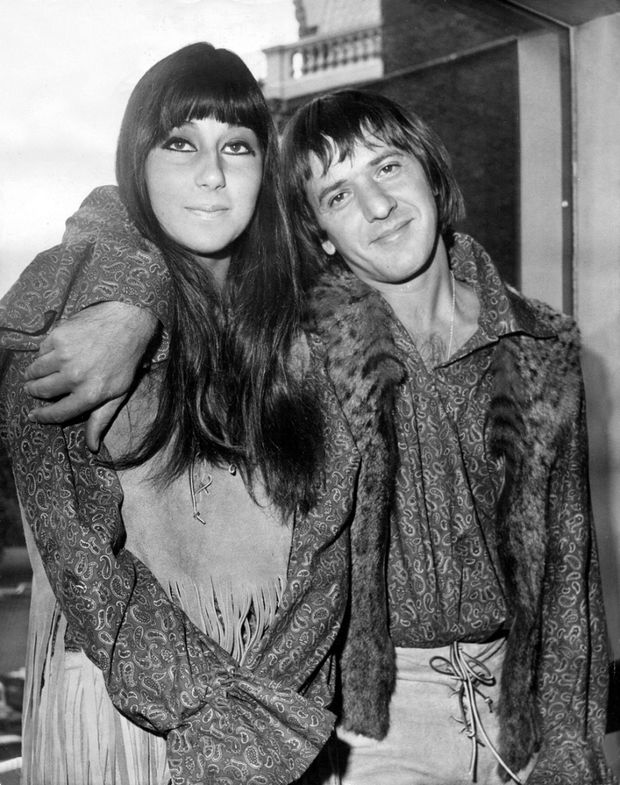
Salvatore “Sonny” Bono was a 27-year-old songwriter and jack-of-all-trades for record producer Phil Spector when he met the 16-year-old Cherilyn Sarkisian – you know her as “Cher” – at a Hollywood coffee shop in 1962.  

Cher and Sonny in 1964
The two sang backup on classic Spector records like “Be My Baby” and “You’ve Lost That Loving Feeling,” and released a few singles as “Caesar and Cleo,” which went nowhere.  But as “Sonny & Cher,” they became one of the most successful pop recording acts of the mid-1960s.

The couple’s fame peaked when their variety show, The Sonny and Cher Comedy Hour, became a big hit for CBS when it debuted in 1971.  The Comedy Hour Sonny and Cher were a latter-day George Burns and Gracie Allen, but with the roles reversed – the diminutive Sonny was perfect as the hapless and not-too-bright second banana who was on the receiving end of his wife’s put-downs.

The Sonny and Cher Comedy Hour
In real life, Sonny was the brains behind the operation.  He wrote and produced most of the duo’s hit singles (like “I Got You Babe” and today’s featured song), as well as some of Cher’s biggest solo hits, including “Bang Bang (My Baby Shot Me Down).”

In 1988, long after he and Cher had divorced, Sonny tried to open a restaurant in Palm Springs.  Frustrated by a never-ending series of hassles with the local government bureaucracy, he decided to run for mayor and won.  

In 1992, he ran for the Republican nomination for U.S. Senate, but lost in the primary.  Two years later, he was elected to Congress, where he served until he died after hitting a tree while skiing in January 1998.  His fourth wife, Mary Bono, was elected to fill the remainder of his term and then re-elected seven times.  

At Mary’s request, Cher gave the eulogy at Sonny’s funeral.  The epitaph on his headstone is “And the Beat Goes On.”  

Sonny Bono Memorial Park (Washington, DC)
Shortly after Sonny’s death, a family friend funded the creation of the Sonny Bono Memorial Park, which is sited on a tiny, triangular patch of ground created by the intersection of New Hampshire Avenue and 20th and O Streets in northwest Washington, DC.  

I walked right by this park recently, but had no idea it was a memorial to Sonny.  It features a small vault filled with Sonny Bono memorabilia, including his Congressional cufflinks and the sheet music to today’s featured song, which reached the #6 spot on the Billboard “Hot 100” fifty years this month.

Here’s “The Beat Goes On”:


Click below to buy the song from Amazon:

Thursday, February 9, 2017

Mitch Ryder & the Detroit Wheels – "Sock It To Me – Baby!" (1967)


Sock it . . . to me baby
Sock it . . . to me, baby
Sock it!

After losing the 1960 presidential election and the 1962 California governor’s race, Richard Nixon spent the next few years licking his electoral wounds.

Nixon, who wasn’t exactly “Mr. Personality,” knew he’d have to do things differently if he hoped to make a political comeback.  As part of his efforts to become more personable and appealing to voters, Nixon hired a former NBC comedy writer named Paul Keyes.  

Paul Keyes and Richard Nixon
Keyes persuaded Nixon to appear on the series premiere of Rowan & Martin’s Laugh-In, which aired on September 16, 1968 – less than two months before the 1968 presidential election.  (That contest pitted Nixon against Democrat Hubert Humphrey and third-party candidate George Wallace.)

The Laugh-In crew asked Nixon to say “What’s a bippy?” when it was time to film his cameo for the show.  Nixon wasn’t sure what a bippy was, so he declined.  He also didn’t want to say “Good night, Dick.”  (Dan Rowan always closed the show by telling his co-host, Dick Martin, “Say good night, Dick,” which Martin answered by saying, “Good night, Dick.”)

Nixon eventually agreed to say “Sock it to me” – which he delivered more as a question than as a statement:


It’s incredible to me that Richard Nixon agreed to appear on Laugh-In, much less did so when the election was only a few weeks away.  Of course, both Hillary Clinton and Donald Trump appeared on Saturday Night Live, but they appeared a full year before the election.  

“Sock it to me” wasn’t new with Richard Nixon appeared on Laugh-In.  To the contrary, it had been in use for over 100 years, as this excerpt from an 1866 book about the American Civil War shows:

Now then, tell General Emory if they attack him again to go after them, and to follow them up, and to sock it to them, and to give them the devil.

Some people believe that Nixon’s Laugh-In appearance contributed to his winning the very close 1968 election.  Lena Horne – who was no fan of Nixon – reportedly was so angry that she kicked Dick Martin in the shin when she saw him after the election.

Martin defended himself by pointing out that Humphrey was invited to appear on Laugh-In as well, but passed on the invitation.  (Laugh-In’s creator, George Schlatter, later said that he planned to have Humphrey say, “I’ll sock it to you, Dick!”)

*     *     *     *     *

Mitch Ryder & the Detroit Wheels’ “Sock It To Me – Baby!” was released over a year before Nixon’s Laugh-In cameo.    


A few months later, Aretha Franklin released “Respect.”  Aretha’s backup singers chant “Sock it to me” repeatedly during the chorus of “Respect.”

By the way, Mitch Ryder's real name was William S. Levise, Jr.

Click here to listen to “Sock It To Me – Baby!”  I can’t think of another record that used a slide whistle to such good advantage.

Click below to buy the song from Amazon:

Wednesday, February 8, 2017

Rolling Stones – "Ruby Tuesday" (1966)


She would never say where she came from
Yesterday don't matter if it's gone

“Ruby Tuesday” was the B-side of “Let’s Spend the Night Together,” which we featured in yesterday’s 2 or 3 lines.  

But because “Let’s Spend the Night Together” was such a naughty song, “Ruby Tuesday” ended up getting a lot more radio airplay.  It spent most of February 1967 in the top ten, taking over the #1 spot in the Billboard “Hot 100” the first week of March.

Mick Jagger didn’t write the words or the music to “Ruby Tuesday.”  Marianne Faithful said that Brian Jones came up with the melody, but others say that Keith Richards deserves most of the credit.

Linda Keith
Everyone agrees that Richards wrote the lyrics.  According to his autobiography, the song was about Linda Keith, a London model who was his girlfriend in 1966 when she heard an unknown Jimi Hendrix  perform in New York City.

Linda was blown away by Jimi’s talent.  She loaned him one of Keith’s guitars (his own had been pawned) and started hanging out with him. 

Keith told Linda’s parents that she was abusing drugs – a textbook case of the pot calling the kettle black – and her father came to New York City and dragged her back to London.  Linda eventually got married and moved to New Orleans.


Wouldn’t you love it if your mother had been a model for British Vogue and became Keith Richards’ girlfriend and took drugs with Jimi Hendrix and inspired a #1 song by the Rolling Stones?  (I bet your mother was BORING by comparison with Linda Keith!  God knows mine was.)

Linda’s and Jimi’s relationship is the subject of a 2013 movie called Jimi: All Is By My Side, which starred Outkast’s André 3000 as Hendrix.  Here’s the trailer for that movie:


The first Ruby Tuesday restaurant was opened in 1972, several years after “Ruby Tuesday” was released.  Some sources say that one of the owner’s fraternity brothers suggested that he name his restaurant after the Stones’ song – another source says Bob Hope gave him the idea.  (Bob Hope?  Really?)

By the way, it took two Stones to play the bass violin part of "Ruby Tuesday" – Bill Wyman handled the fingering, while Keith Richards did the bowing.

Here’s “Ruby Tuesday”:


Click below to buy the song from Amazon: