You learned from the previous 2 or 3 lines that I root for a small number of sports teams and root against a much larger number of teams.
If you think that’s irrational, you just don’t understand what it means to be a sports fan.
I’ve noticed over the years that the teams I root against tend to be remarkably lucky – they win many more games than they really should. Mathematics tells us that while any single contest can be and often is decided by luck, no sports team can be consistently lucky. But are you going to believe mathematics or are you going to believe me, especially when I’ve seen teams like the Red Sox and Redskins get lucky all the time with my own eyes?
* * * * *
Two psychologists proved that being a sports fan does funny things to your brain way back in 1954.
“They Saw a Game: A Case Study,” which published in the Journal of Abnormal and Social Psychology, presents the findings of an experiment that was inspired by the 1951 football game between Dartmouth and the undefeated Princeton Tigers, whose star player was Dick Kazmeier, the last Ivy League football player to win the Heisman Trophy.
Dick Kazmaier, all-American
Before I tell you about that game and the psychological experiment it inspired, I want to tell you a little bit about the amazing Mr. Kazmaier.
Dick Kazmaier was born in 1930 in Toledo, Ohio. The 5-11, 155-pound Kazmaier lettered in football, basketball, baseball, track, and golf. Devoting all that time and energy to sports hurt his classroom performance – he ranked only second in his graduating class.
Kazmaier was recruited by 23 colleges, eventually choosing Princeton. He quarterbacked the Tigers to an undefeated season in 1951, leading the nation in rushing yards. In addition to winning the Heisman Trophy, he was voted “Athlete of the Year” by the Associated Press.
Kazmaier was drafted by the Chicago Bears, but declined to play professionally. Instead, he earned an M.B.A. from Harvard Business School, spent three years in the Navy, and then founded an investment and financial consulting firm. He chaired the President’s Council on Physical Fitness during the Reagan and George H. W. Bush presidencies, and later became the president of the National Football Foundation and Hall of Fame.
Kazmaier’s last college football game – the 1951 matchup with Dartmouth – was a very rough one. He had to leave the game after he suffered a broken nose and a mild concussion in the second quarter. (You know what a “mild” concussion is, don’t you? It’s a concussion that someone else suffers.) In the next quarter, the Dartmouth quarterback’s leg broken when he was tackled by Princeton.
Kazmaier on the move
Each school’s student newspaper editorialized about dirty play by the other team, which inspired the psychologists to show a game film to groups of both Dartmouth and Princeton students.
Are you surprised that the Princeton students who watched the film saw twice as many rules infractions by the Dartmouth team than the Princeton players? By contrast, the Dartmouth students though both teams were guilty of about the same number of penalties. (For what it’s worth, the referees called more penalties on Dartmouth than Princeton.)
Here’s how the psychologists interpreted their data:
Like any other complex social occurrence, a “football game” consists of a whole host of happenings. Many different events are occurring simultaneously. Furthermore, each happening is a link in a chain of happenings, so that one follows another in sequence. The “football game,” as well as other complex social situations, consists of a whole matrix of events. . . .
In brief, the data here indicate that there is no such “thing” as a “game” existing “out there” in its own right which people merely “observe.” The “game” “exists” for a person and is experienced by him only in so far as certain happenings have significances in terms of his purpose. Out of all the occurrences going on in the environment, a person selects those that have some significance for him from his own egocentric position in the total matrix.
In other words, a football game is actually many different games, each one of which is just as real to a particular observer as other versions are to other observers.
Kazmaier with his Heisman Trophy
That’s all well and good, but it still doesn’t explain why the Red Sox and Redskins and other teams I hate are so lucky.
Speaking of being lucky, Kazmaier – who died in 2013 – had six daughters.
Dave Mason, who was one of the founders of Traffic, has recorded with Jimi Hendrix, the Rolling Stones, George Harrison, Eric Clapton, Delaney & Bonnie, Graham Nash, and many others.
Mason, who is 70, is still touring. He and his band (including my pal Tony Patler, Mason's fabulous keyboard player) are in Florida this week, and will be performing in France and the UK in February and March.
Here’s Mason’s solo hit “We Just Disagree,” which was released on the Let It Flow album in 1977. It made it to #12 on the Billboard “Hot 100”
When it comes to my fellow man – and to my fellow woman – I am definitely not a hater.
But it’s a different story when it comes to sports teams.
* * * * *
When I was a child, I spoke as a child, I understood as a child, I thought as a child – which meant that I rooted for the local sports teams.
I vividly remember listening to radio broadcasts the local high school’s football and basketball games when I was a kid – including the 1959 Missouri state high school basketball championship game between the team from my hometown (Joplin) and an all-boys Catholic high school from St. Louis. (Joplin lost.)
I also rooted for the University of Missouri football team, which had eleven straight winning seasons between 1959 and 1969. (I’ve written about the one and only Mizzou football game I’ve ever seen live — a 44-10 shellacking of Oklahoma in 1969, when the Sooners had three #1 NFL draft picks and Heisman Trophy winner Steve Owens on its team.)
Terry McMillan was Mizzou's QB in '69
When it came to the pros, I was loyal to the three St. Louis teams – the baseball Cardinals, the football Cardinals, and the NBA Hawks. (Kansas City was much closer to Joplin than St. Louis, but the Kansas City A’s were too pitiful and the Chiefs were not as near and dear to my heart as the chronically underachieving football Cardinals were.)
There was one non-Missouri team I became a fan of quite early, and that team – the New York Yankees – is the only one that I’ve been consistently loyal to ever since.
Why the Yankees? Perhaps because Mickey Mantle – every red-blooded American’s beau idéal when it came to baseball heroes – grew up a stone’s throw away from Joplin, and played his only full season of minor-league baseball for the Class C Joplin Miners.
Mantle as a Joplin Miner
Or perhaps because the Yankees were featured much more regularly on the CBS Game of the Week broadcasts, which were the only televised games I was able to view as a kid.
Or perhaps because I spent most of my childhood at the local public library, and the Bronx Bombers’ dominance was so overwhelming that the library’s books about baseball history were really Yankee histories.
I think I was equally loyal to the Yankees and the baseball Cardinals until 1968., when I dropped the Cardinals like a hot potato after they gagged up the World Series. (The thought that Bob Gibson would lose game seven after posting the most dominant pitching stats of my lifetime – a 1.12 ERA, 13 shutouts, and 0.85 WHIP – simply never entered my mind.)
Bob Gibson threw hard . . . very hard
* * * * *
Once I moved away from Joplin, my team loyalties were more fluid, depending to some degree on where I was living. I remained a diehard Yankees fan (although the retirement of Jeter, Rivera, Jorge Posada, Bernie Williams, and rest of the Joe Torre-era greats took its toll on me), and my marriage to the boys in pinstripes is one of those till-death-do-us-part deals.
The list of the teams I root against is much longer than the list of teams I like. It’s funny – I’ve had short-term affairs with a number of teams based on geographic proximity or other factors. (For example, I moved to San Francisco and became a fan of the great Bill Walsh-Joe Montana 49ers, but my interest in the team faded once I left the Bay Area.) But once I hate a team, I hate it for life.
There’s often a reason for my ill-will towards a team. For example, I root against the University of Michigan mostly because one of first bosses was an obnoxious Michigan Law School grad. I haven’t worked for that guy in almost 40 years, but I still root for Ohio State when they play the Wolverines. (What’s with those stupid helmets, Michigan?)
Bill Clinton in his Razorback hat
And I’m always happy when the University of Arkansas football and basketball teams suck. That’s because my mother was born into a large Arkansas clan, all of whom were vocal Razorbacks backers. My branch of the family was the only one to move out of Arkansas – albeit just barely – and I just had to be the turd in the punchbowl when it came to all that wooo pig sooie crap.
But I can’t really explain my dislike of a number of college or professional teams. (Why have I never liked Notre Dame? I don’t really know.)
I rooted against the Red Auerbach-era Celtics when I was a kid, supporting whichever team had the best chance of toppling them off their NBA pedestal at the time – first the St. Louis Hawks, then Wilt Chamberlain’s Philadelphia teams, then the Walt Frazier-led Knicks.
The same was true of the Green Bay Packers – I cheered for whatever team had a chance to prevent them from winning a championship. That was the Giants for a couple of years, then the Cowboys, then the Chiefs (who lost to Green Bay in Super Bowl I).
I learned to dislike a number of teams when I was a student at Rice University in Houston. There were a lot of obnoxious Cowboys fans at Rice, and I was still loyal to the NFL Cardinals, who rewarded my loyalty by spanking Dallas 38-0 in a Monday Night Football game my freshman year – a game that I viewed on a large TV in a basement common room in my dormitory while giving the Cowboy fans in the audience hell.
Texas A&M – a school I knew very little about before going to Rice – came very close to beating out Arkansas for the #1 spot on my college football “Most Loathed” list.
The Texas A&M marching band
Why? Keep in mind that this was the early seventies. Rice was liberal by Texas standards, with lots of long-haired guys and braless chicks, while A&M was almost all-male and all-ROTC. Our football players probably weren’t very different from the A&M players, but the cultures of the two schools were polar opposites.
In 1973 – my senior year – the Rice-Texas A&M gridiron matchup was dominated by the Aggies but won in rather fluky fashion by my Owls. Even worse, the irreverent and ragtag Rice marching band had the temerity to poke fun at various sacred Aggie traditions — especially the jackbooted, saber-equipped Texas A&M military marching band – during its halftime performance.
The result was a postgame riot by the A&M ROTC cadet corps. Rice’s administration had to call on the Houston Police Department to escort band members out of the stadium.
Most Rice students had a major problem with the University of Texas, but my rather mild dislike of the Longhorns paled in comparison to the rancor I felt for Arkansas, Texas A&M, and Oklahoma. (I still remember the Texas students doing a hilarious cheer at one Rice-UT gridiron clash: “What comes out of a Chinaman’s ass? Rice, Rice, RICE!” How can you hate a school with such a well-developed sense of humor?)
The Rice marching band
I could go on and on. I root against Stanford (my college girlfriend went to B-school there), Yale (I went to Harvard’s law school), Duke (I liked the ’78 basketball team, but have pulled against them since the Christian Laettner era), and the University of Miami (too many thugs and criminals on their teams):
As far as professional teams go, I loathe the Mets, the Orioles (who somehow had the Yankees’ number in the early eighties – I sat through far too many Orioles victories over Yankees teams chock full of better-known and higher-paid players), the Celtics (they play in Boston, my least favorite city – although I do like the Patriots), and the local NFL team, the Redskins.
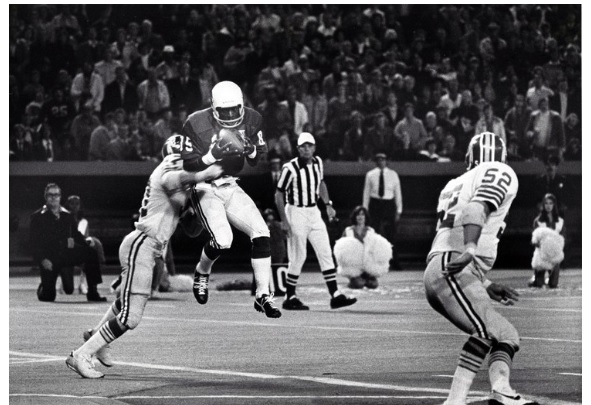
My dislike of the Redskins goes back 40 years, when Washington and the Cardinals were major rivals. The first NFL game I ever saw was a 1975 Redskins-Cardinals game that was won by St. Louis thanks to a controversial touchdown catch by Mel Gray that Redskins fans still bitch and moan about:
The disputed Mel Gray catch
I root against the 'Skins today despite the fact that most of my family — especially my youngest son – and most of my friends are Redskins fans. You can chalk it up to me being kind of a dick, I guess.
* * * * *
Which brings us to the ne plus ultra of loathsome sports teams . . . the Boston f*cking Red Sox.
For the first 50 years of my life, I didn’t worry much the Red Sox. If there was one thing in life that you could count on, it was that any Yankees-Red Sox confrontation would end up going the Yankees’ way.
There was the 1978 season, for example. The Red Sox led New York by 14 1/2 games at one point, but the Yankees ran them to ground and won a one-game playoff on the strength of a home run on an 0-2 count by their 9th-place hitter (Bucky Dent).
Yankees celebrate '78 playoff win over Red Sox
When the Yankees won the first three contests of the 2004 ALCS, it seemed certain that the Red Sox were going to be the Yankees’ bitches once more – after all, no team in the history of baseball had ever come back from a 3-0 deficit to win a seven-game series.
But the unthinkable happened. Boston staved off defeat with a couple of fluky extra-inning victories, and suddenly the tide had turned. My son took a bus to see game seven in New York City, and witnessed the worst moment in the Yankees’ long history. (I tried to talk him out of going to the game, but did he listen? No.) New York gave up six runs in the first two innings – which was about what I expected – and went down to defeat with nary a whimper. The Bostonians went on to sweep the Cardinals in the World Series, and the “Curse of the Bambino” was broken at last.
Indeed
My dislike of the Red Sox has been off the charts ever since. On occasion, I’ve given voice to the wish that the Red Sox team plane would crash. Realizing that such a sentiment is hardly Christian, I’ve amended my wish to one that the team bus has a mishap that results in not a single fatality but plenty of career-ending arm and leg injuries.
Truth be told, I get much more pleasure when the Red Sox fail – as they did in spectacular fashion in 2012, when their final record was an embarrassing 69-93 – than when the Yankees win. (I knew 2012 was going to be a good year when the Sox blew a 9-0 lead and ended up losing 15-9 in a nationally televised game against New York in April.)
Would I sell the Yankees’ soul to the devil if he promised me that the Red Sox would never win another World Series? ABSOLUTELY.
Does that make sense? OF COURSE it does. (Does watching the Yankees bat and leaving the room when it’s Boston’s turn to hit – because only bad things can happen when the Red Sox are batting – make any sense? OF COURSE it does.)
* * * * *
Years ago, when the Yankees were having a good year and the Red Sox had fallen out of contention, my wife – a Red Sox loyalist – announced that she was going to root for the Yankees for the rest of the season because she wanted my son and me to be happy.
“Wouldn’t you pull for the Red Sox if the situation was reversed because you wanted me to be happy?” she asked me.
“You don’t have the slightest idea what it means to be a sports fan,” I replied.
* * * * *
Prince Paul – who was born Paul Edward Huston – got his start in the rap world as a DJ for Stetasonic, one of the first alternative hip-hop groups.
In 1989, he produced De La Soul’s brilliant 3 Feet High and Rising album.
Prince Paul has worked with legendary rappers (Chuck D, Ice-T, RZA, Big Daddy Kane, Coolio) and legendary comedians (Chris Rock, Dave Chappelle, and Don Novello – a/k/a Father Guido Sarducci). His Handsome Boy Modeling School album – a collaboration with producer Dan the Automator – is a combination of hip-hop and comedy such as the world has never seen.
“Not Tryin’ to Hear That/Words (Album Leak)” was released in 2003 on Politics of the Business, a concept album that was a follow-up to his 1999 concept album, A Prince Among Thieves.
The concept of Politics of the Business is the concept of following up a concept album that didn’t sell very well (A Prince Among Thieves). This is so meta that it’s meta squared.
Here’s “Not Tryin’ to Hear That/Words (Album Leak)”:
The movie Lion tells the story of a poor five-year-old Indian boy named Saroo who boarded a train to look for his older brother after the two became separated at the local railway station. Saroo ended up in Calcutta, almost a thousand miles from his town where his family lived.
For several days, he survived on the streets. Eventually, a concerned man took him to a police station. But the way the Hindi-speaking Saroo pronounced the name of his hometown was impossible for Bengali-speaking officials in Calcutta to understand, so there was no way to reunite him with his family.
Lion is based on this book
Saroo was taken to a sort of orphanage, and was eventually adopted by the Brierlys, an Australian couple.
After he became an adult, Saroo began to use Google Earth to look for his hometown. After years of needle-in-a-haystack searching, Saroo located satellite photos of one particular train station that matched up with his childhood memories of the station where he became separated from his brother.
I won’t tell you what happened next, but it’s an amazing story . . . and a true story to boot.
Lion stars Nicole Kidman as Saroo’s adoptive mother, Rooney Mara as his girlfriend, and Dev Patel as the adult Saroo. (Patel was only 17 when he was cast in the starring role in Slumdog Millionaire.)
Sunny Pawar as the young Saroo
But the real star of the movie is eight-year-old Sunny Pawar, who plays the young Saroo.
Here’s the movie trailer:
And here’s a video explaining how Saroo used Google Earth. (Spoiler alert!)
Lion is based on Saroo’s book, A Long Way Home. You can click here to buy that book from Amazon.
* * * * *
The song that plays during the closing credit sequence of Lion is “Never Give Up” by Sia, a 41-year-old Australian singer, songwriter and record producer.
Sia usually performs while wearing a half-blonde, half-black wig that covers much of her face because she doesn’t want to be famous, or recognizable.
Sia
She explained why she feels that way in a piece she wrote for Billboard magazine in 2013:
If anyone besides famous people knew what it was like to be a famous person, they would never want to be famous. Imagine the stereotypical highly opinionated, completely uninformed mother-in-law character and apply it to every teenager with a computer in the entire world. Then add in all bored people, as well as people whose job it is to report on celebrities. Then, picture that creature, that force, criticizing you for an hour straight once a day, every day, day after day.
In 2014, Howard Stern asked Sia if she was religious during an interview. “I believe in a higher power and it's called ‘Whatever Dude’ and he's a queer, surfing Santa that's a bit like my grandpa, so yes.” She went on to say that “Whatever Dude” inspired the lyrics she wrote for Rihanna's #1 hit single, “Diamonds.”
My first birthday party was covered by the local newspaper, the Paragould (Arkansas) Daily Press. (That's me in the crib – I've drawn a red circle around my head.)
Happy birthday to me!
In case the print in that photo is too small for you to read, here’s what it says:
Gary Hailey celebrated his first birthday Saturday afternoon with a party at the home of his parents, Mr. and Mrs. H. D. Hailey, 617 North 6th Street. Gary is the grandson of Mrs. Cecil Hailey of Neosho, MO, and Mr. and Mrs. B. H. Cooper of Joplin, MO.
[NOTE: Yes, my paternal grandmother apparently spelled her first name “Cecil,” not “Cecile.”]
Pictured above at the gala event are Barbara Bishop, Steve Branch, Mickey Branch, Steve Bishop, Rita Spillman, and Sherry Tucker. In the playpen are Eva Schreit and the little honoree.
Refreshments of birthday cake and cold drinks were served, and Gary received many nice gifts.
(Damn, that dude could write! The article is not bylined, but I’m betting that its author ended up as a star reporter in Memphis or St. Louis – the two big cities nearest to Paragould – or maybe even Chicago.)
* * * * *
I usually tell people that I spent the first 18 years of my life living in Joplin, Missouri.
You should take that statement seriously, but not literally. I was born in Joplin, but my parents and I moved to Paragould when I was a baby because the company my father worked for transferred him there. (I moved back to Joplin about a year later, and stayed there until after I graduated from high school.)
I’m glad the newspaper article I quoted above included our Paragould street address, which enabled me to go to Google Earth and see what our old house looks like today — over 60 years later:
What our Paragould home looks like today
Paragould, which is the 19th-largest city in Arkansas, grew up around the intersection of two competing railroads – the Texas and St. Louis Railway, and the St. Louis, Iron Mountain and Southern Railway.
The city’s name is a portmanteau word that combines the names of the presidents of those two railroads: James W. Paramore and Jay Gould.
Gould – the famous (or infamous) “robber baron” who controlled 15% of the trackage in the whole country at the time – objected to his name being second rather than first. For a time he refused to use the name Paragould on his railroad’s timetables.
Jay Gould
When I recently asked my mother about why we didn’t stay in Paragould longer, she said that my father’s employer would have likely asked my father to move to California next, but they decided to return to Joplin instead, where he went back to a non-management job.
My mother, who was an only child, was very close to her parents and her large extended family – my grandmother was one of seven kids, so my mother had plenty of aunts and uncles and cousins close by. I’m sure she would have wanted no part of packing up the “little honoree” and moving to California, where she wouldn’t have known a soul.
When you hear a story like that, it makes you realize how your life could have been totally different. I don’t know where in California my father might have been asked to transfer to, but being a teenager in the sixties in either the San Francisco or Los Angeles areas would have been very different than growing up in Joplin.
Of course, it’s not certain that I would have been a world-famous rock musician or movie star if I had grown up in California instead of Missouri. Likely, yes – but not certain.
Anyway, no use crying over spilled milk . . . and no use blaming my mother, who probably did me a favor by keeping me in Joplin. After all, California in the sixties was full of dangerous temptations that might have proved irresistible to me – like LSD and braless hippie chicks, to name just a couple.
So thanks, Mom . . . thanks a lot!
* * * * *
The previous 2 or 3 lines featured a bluegrass song from a 2013 Edie Brickell-Steve Martin album.
Today’s featured song, “What I Am,” was the lead single on the first Edie Brickell & New Bohemians album, Shooting Rubberbands at the Stars, which was released in 1988.
“What I Am,” one of the most iconic songs of its era, made it all the way to #4 on the Billboard “Modern Rock Tracks” chart, and the album reached the same spot on the Billboard album chart.
The problem with having a big hit single and a big hit album right out of the box is that there’s nowhere to go but down . . . which is exactly where Edie and her band went.
Don’t cry for Edie Brickell, 2 or 3 lines readers. In 1992, Edie (who was 26 at the time) married the 50-year-old Paul Simon. She was his third wife. (The late Carrie Fisher was wife number two.)
In 2014, Edie and Paul were arrested for disorderly conduct at their home in fancy-schmancy New Canaan, Connecticut, when an argument between the couple got out of hand. The two were all smiles when they appeared in court a couple of days later, and held hands during their hearing.
Here’s “What I Am," which thinks it's a cool song pretending to be an uncool song . . . but which is really an uncool song pretending to be a cool song:
On August 14, 1902, a 67-year-old Missouri farmer named William Helms hitched two horses to a wagon and headed off to the local sawmill to get some lumber.
Helms had stopped near the St. Louis, Iron Mountain and Southern Railway bridge over the Big River to let his horses take a drink when the number 4 train crossed the bridge, heading north towards St. Louis.
After the train had passed him by, Helms heard an odd noise. When he went to investigate it, he found a small suitcase at the base of the trestle that carried the train tracks to the Big River bridge. It had apparently been thrown from the train.
The Big River trestle
The suitcase and its contents – a baby boy who was only a few days old – had landed about 50 feet below the elevated train track. Not surprisingly, the baby was pretty banged up. (One account says that he had a pronounced dent in his head when Helms found him.)
The "Iron Mountain Baby" and the valise he was found in
Helms carried the infant to his nearby farm, and he and his wife nursed the baby back to health.
The couple adopted the little boy, who they named William Moses Gould Helms – the “Gould” was for Jay Gould, the wealthy “robber baron” who owned the railroad.
The Helms family
Flattery will get you somewhere, it seems, because the railroad paid for the boy’s education.
Young William eventually got married and fathered one son. He was living in Texas when he died in 1953.
His body was shipped by rail back to Missouri for burial. It was only the second time Helms had ridden a train.
William Moses Gould Helms's tombstone
It remains a mystery who tossed the “Iron Mountain Baby” off train number 4, why he or she did so . . . and whether he or she intended that the poor little babe land in the Big River and drown.
In the next 2 or 3 lines, we’ll learn more about the St. Louis, Iron Mountain and Southern Railway's president, Jay Gould, and the small Arkansas railroad town that was named for him and for a rival railroad’s president.
* * * * *
Shortly after William Helms discovered the baby in the valise, the Rev. John T. Barton wrote a song titled “Iron Mountain Baby” about the incident.
Barton’s song assumes that the baby’s mother threw it from the train – perhaps because the father had forsaken her:
I have a song, I would like to sing
It's awful, but it's true
About a babe, thrown from a train
By a mother, I know not who
The train was running at full speed
’Twas the northbound number four
And as it crossed the Big River bridge
She cast it from the door
A mother unkind, a father untrue
And yet, I'm bound to say
It must have grieved that mother’s heart
To cast her babe away
Over a century later, Edie Brickell and Steve Martin wrote and recorded a song titled “Sarah Jane and the Iron Mountain Baby.” (Sarah Jane was the name of the wife of William Helms.)
The lyrics to that song have a very different take on who threw the baby off the train and why:
His mama must have died
Giving birth to the child
And the daddy went crazy
Got on the train
With a heart full of pain
And took it out on the baby
“Sarah Jane and the Iron Mountain Baby” was released on Love Has Come for You, a #1 bluegrass album Brickell and Martin released in 2013.
Brickell (who married Paul Simon on my 40th birthday) wrote the lyrics for all the songs on that album, while Martin (who is not only a comedian but also a novelist, playwright, and Grammy-winning banjo player) wrote the music.
Here’s a live performance of “Sarah Jane and the Iron Mountain Baby” that is prefaced with Edie Brickell explaining what inspired the song’s lyrics:
Are you feeling lonely and depressed? Do you suffer from low self-esteem?
Sounds like you’re in need of some pop psychology. If so, you’ve come to the right place.
Have you made your New Year's resolutions yet?
Sure . . . there are plenty of other sources of simplistic self-help guidance on TV and the internet. But why turn to someone like Dr. Phil when 2 or 3 lines is just as qualified AND serves up its glib advice with a really good Rolling Stones song.
Today, we’re going to talk about expectations.
You may be familiar with the saying, “Happiness equals reality divided by expectations.” I’ve seen everyone from novelist Jodi Picoult to billionaire Warren Buffett given credit for that formula.
For those of you who always struggled with algebra, let me explain something very important about “Happiness equals reality divided by expectations.”
It's simple mathematics
If you want to be happier, there are two ways to go – make the numerator larger or make the denominator smaller.
In other words, one road to happiness is to improve your reality – make your life better. Of course, if you knew how to do that, you wouldn’t be looking for advice on a pop music blog.
So I’d suggest that you choose the prize behind door number two and try making the denominator smaller – that is, lower your expectations.
After all, it works for the Danes . . . assuming you can believe the New York Times, which is a big-ass assumption.
From the Times:
Denmark is the happiest nation in the world. More than two-thirds of Danes report being “very satisfied with their lives” . . . . But why, researchers wondered, are Danes happier than Finns and Swedes, who share . . . a similar culture and climate?
The answer is, in a word, expectations. Danes have low expectations . . . .
Good Santa, bad Santa
About once a year, some new study confirms Denmark’s status as a happiness superpower. Danes receive this news warily, with newspaper headlines that invariably read: “We’re the happiest lige nu.” Lige nu is a Danish phrase that means literally “just now” but strongly connotes a sense of “for the time being but probably not for long.” Danes, in other words, harbor low expectations about everything, including their own happiness.
As marriage therapist Winifred Reilly has written, expectations are particularly dangerous when it comes to relationships:
Expectations are based on a fantasy about how life (and our partner) is supposed to be, and, like it or not, fantasy and reality rarely match up. . . .
(“Rarely”? How about “never”?)
😢😢😢😢😢
Most of us are inclined to think that our expectations are perfectly reasonable. Some of us even think they’re our due. The truth is, most of the expectations people have are unrealistic. When they’re not met, many think there’s something wrong with the relationship when the trouble lies with the expectations they brought.
Many people think expectations set standards when, most often, they’re a set-up for disappointment or frustration.
I don’t think Reilly is telling you to compromise your values just for the sake of getting a relationship off the ground or keeping it going.
What I think she is saying is that you need to see the other person as he or she really is and make your decision about whether to enter into a relationship accordingly. You’re going to be disappointed if you evaluate someone on the basis of how well he or she conforms to your fantasy.
Many times, the initial infatuation is powerful enough so that you are blinded to the gap between reality and fantasy. But over time, you may begin to see your significant other more clearly and become increasingly dissatisfied with his or her failure to live up to your fantasy.
This usually leads to the expectation that causes more problems than any other: the expectation that your significant other will change to satisfy you.
Expecting change is a set-up for disappointment. Requesting change is another thing entirely, though even the most reasonable and respectful requests are not guaranteed to be met.
We all know what happens when we insist on change: our partner resentfully complies or defiantly digs in. Now and again we may get an “I’ll think about it” which is, quite often, a “no” in sheep’s clothing.
While I would never suggest people live in situations where they’re treated badly, figuring out how to live in a less-than-ideal world . . . is a fruitful endeavor.
It's January 1, and you're probably trying to decide what your New Year's resolutions for 2017 should be. 2 or 3 lines recommends that you resolve to lower your expectations and try to be satisfied even when you don't get everything you want.
(Think about it.)
After all, as the 16th-century English author John Heywood said, “Half a loaf is better than no bread.”
(By the way, this guy Heywood really had a way with words. He also came up with “Rome was not built in one day,” “Beggars should not be choosers,” “Rob Peter and pay Paul,” “Better late than never,” “Make hay when the sun shines,” “A penny for your thoughts,” and – my personal favorite – “All cats are gray in the dark.”)
* * * * *
“No Expectations” was recorded in May 1968 and released in December of that year on the Beggars Banquet album.
It’s bluesy-sounding, but it’s not a traditional blues song. For one thing, each verse has eleven bars, not twelve. (I would have never guessed that until I counted them out.)
“No Expectations” is notable for Nicky Hopkins’s subdued piano and Brian Jones’s acoustic slide guitar. “That was the last time I remember Brian really being totally involved in something that was really worth doing,” Mick Jagger said years later.
Jones (who had five children by five different women) drowned in July 1969, less than a month after he parted ways from the band he had founded.
Brian Jones and Mick Jagger
“He formed the band. He chose the members. He named the band. He chose the music we played. He got us gigs,” Bill Wyman told the Los Angeles Times in 2002. “He was very influential, very important, and then slowly lost it . . . and just kind of wasted it and blew it all away.”
Jones was not a songwriter. “To be honest, Brian had no talent for writing songs,” Jagger told Rolling Stone magazine. “I've never known a guy with less talent for songwriting.”
But he was an exceptionally versatile instrumentalist. He played guitar, slide guitar, sitar, organ, marimba, Mellotron, saxophone, autoharp, dulcimer, recorder, and harmonica on Rolling Stones recordings.







 Posts
Posts

